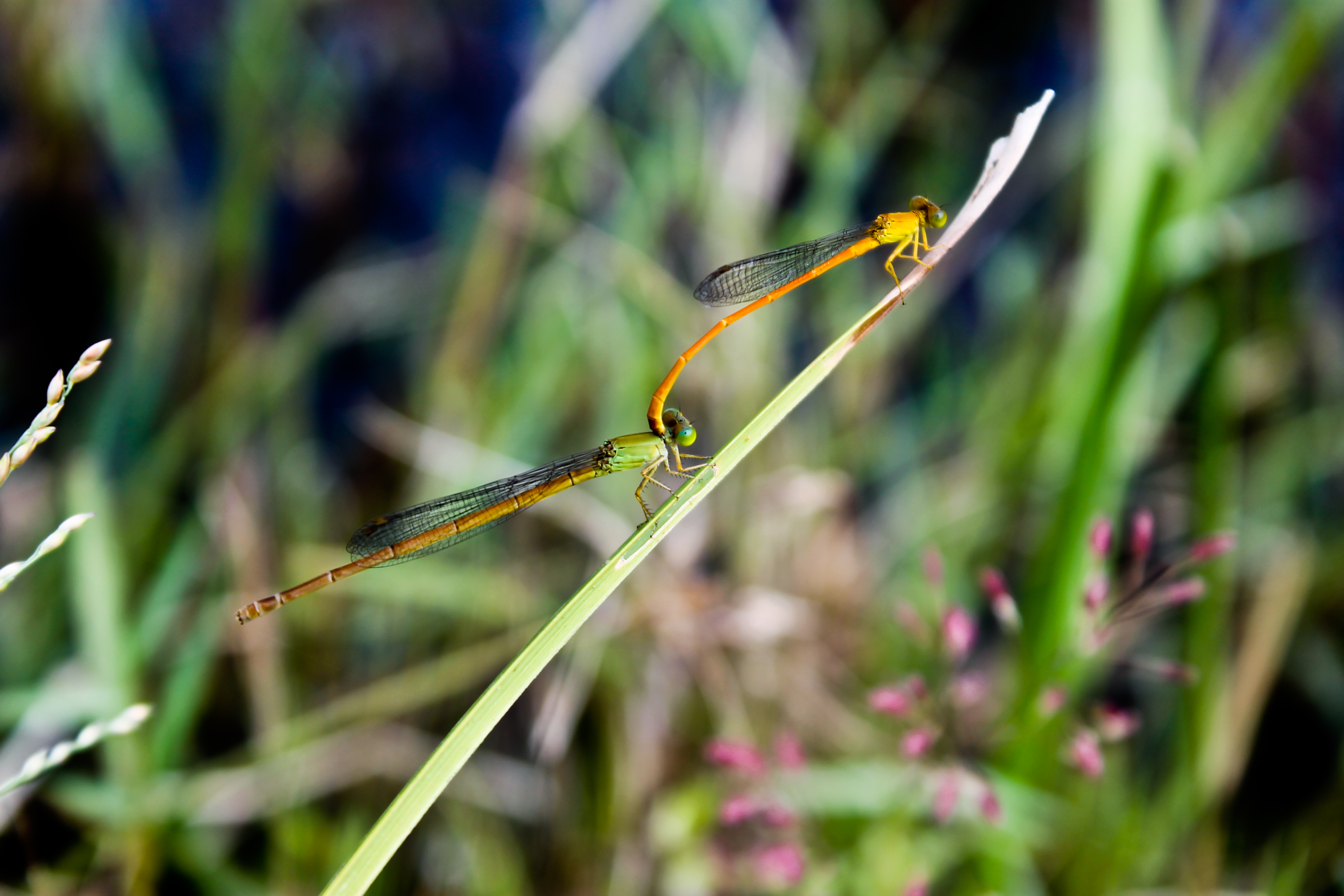
 Orange Marsh Darts, Ceriagrion rubiae in copula, photographed in the Periyar Tiger Reserve. The male is mostly golden, while the female is more olivaceous. I’m unsure whether this is exclusive to this species or in all damselflies Continue reading
Author: Milo Inman
Blue-Tailed Yellow Skimmer
 A mature male Blue-Tailed Yellow Skimmer, also known as Asian Widow (Palpopleura sexmaculata) shot in the Periyar Tiger Reserve. This is undoubtedly the smallest species of dragonfly I’ve photographed, scaling it at close to under an inch long. The dragonfly’s abdomen is unique – not only in length, but in breadth and shape. The Trumpet-Tail is another uniquely-abdomened dragonfly I’ve spotted in Periyar – pictures of her next time.
For some reference to size, here’s a short anecdote Continue reading
A Well-Rounded Adventure
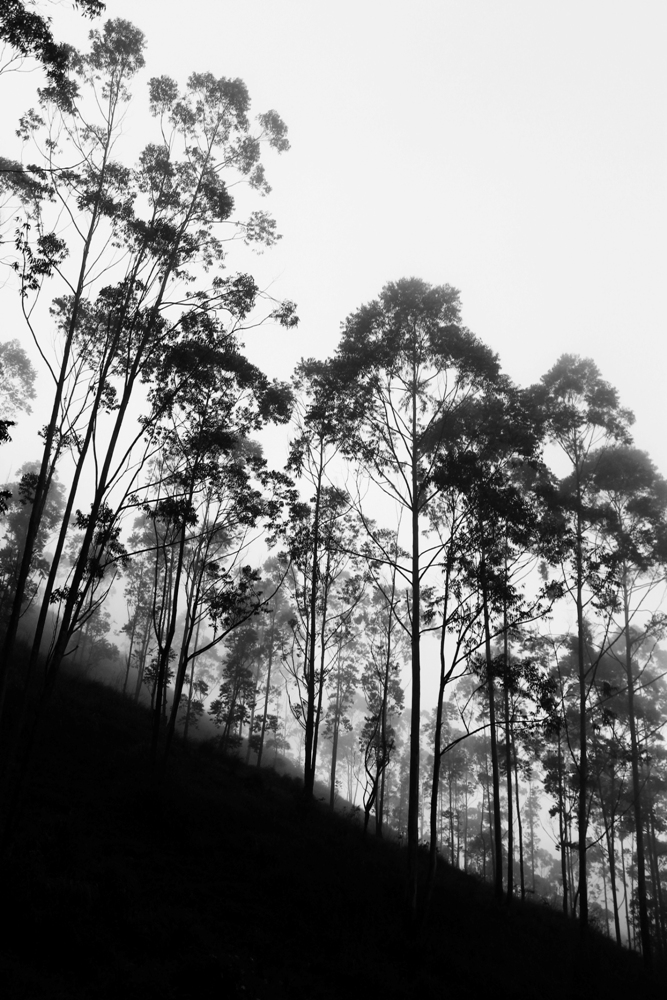 “Mists, ah, very problem!”
I glanced sideways at the boisterous Mallu man driving the jeep along the winding mountain road. Like his passengers, he was peering out of the vehicle at the steep slopes around us, scanning them for wildlife, abetted by the pre-dawn lighting and the heavy mists.
If any elephants or bison were grazing upon the high hills we drove through, they were impossible to see thanks to the cotton-thick mists blanketing the tall grass and trees that covered the terrain. As the vehicle banged and clunked over potholes at high speeds, I held determinedly onto the railing for dear life, occasionally risking freeing my hands for a photograph of the scenery speeding past.
Some ways down the road, once the sun had risen above the horizon, the jeep rolled to a stop under a densely canopied corridor. My eyes began to search the trees for the reason of our stop to no avail – the driver pointed to what I had previously taken for a pile of rocks, proclaiming it to be a tribal temple. Upon a second look, I realized that the blocks of granite were hewn into rough rectangles, and while in no particular order, they were indeed surrounding a small garlanded icon. Continue reading
Scarlet Basker
 Teneral (young) female Urothemis signata spotted in the Periyar Tiger Reserve. Her male counterpart is a rich scarlet color throughout, with some black coloration and partially amber-tinted wings.
Protecting Penguins
Penguins – one of the most charismatic and charming birds on the planet, and yet very few people ever get the chance to see them. They are not enigmatic, nor are they rare, for the most part. And yet, the majority of people are under the impression that the only penguins living today are the Emperor Penguins, and that they live in the Arctic region. However, not only are the emperors one in over twenty extant species, but no penguins whatsoever live in the Arctic region. In fact, no penguins at all even live in the northern hemisphere – all are native to the southern hemisphere, but not exclusively in icy-cold climates such as Antarctica. They are spread over the entire hemisphere, with significant populations on the east coast of South America, the entire Sub-Antarctic, Oceania, and various islands on the Indian and Pacific oceans.
Cochin Sunsets
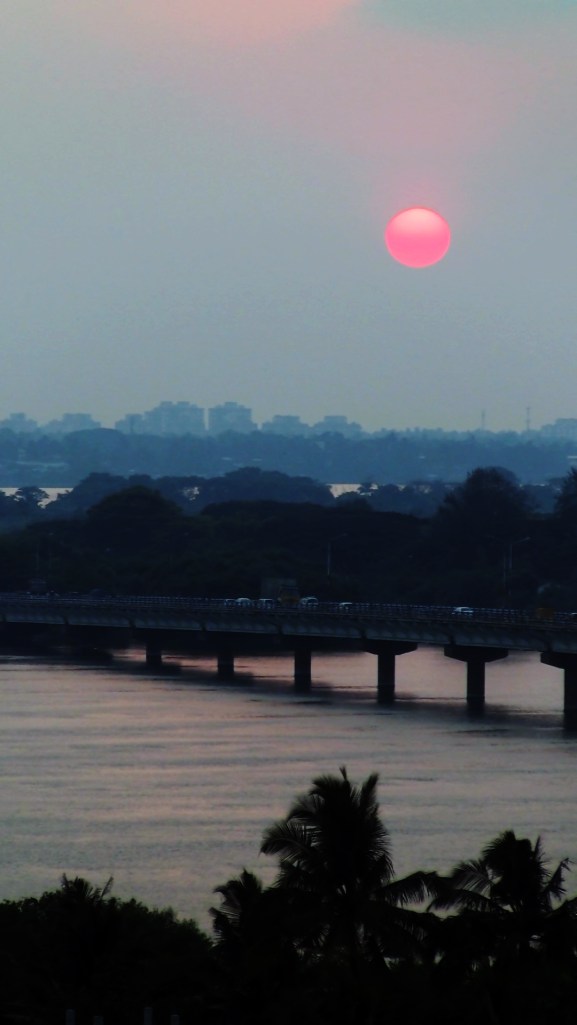
From two of the windows in our flat in Cochin, the sunset at around 6 is visible, albeit with some structural interference. Nonetheless, the colors and hues, scientifically explained only two days ago, are visible from almost the entire city, or at least all the windows facing west Continue reading
Periyar Panorama
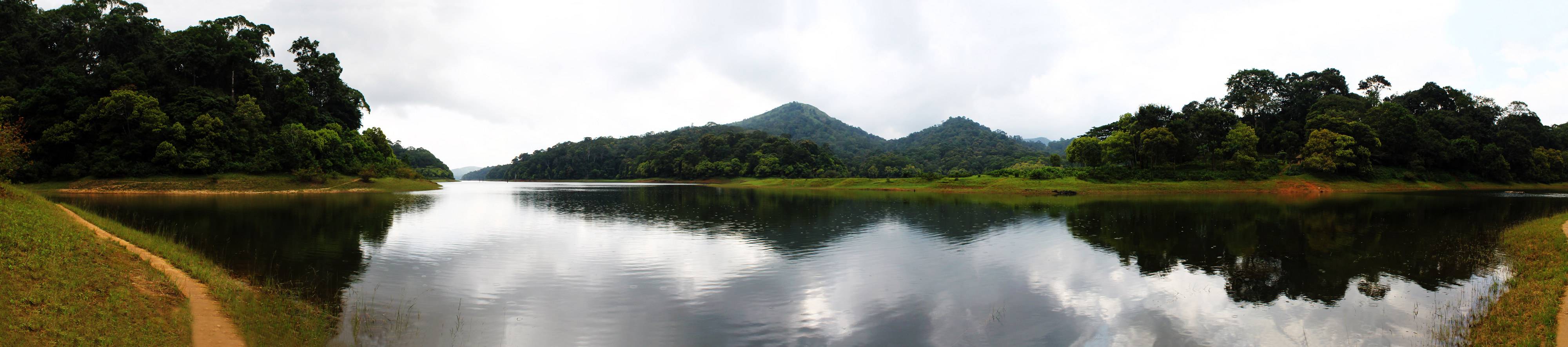 Thekkady’s boat-landing area on Periyar Lake. The full panoramic weighs in at 18mb and a print-size of 190 inches wide, so I have done your computer the courtesy of downsizing it to a still whopping 2mb – viewable by clicking the above image.
Burning Skies
Many people associate fiery skies over cities with pollution and smog. While these are indeed causes for a red-orange color during sunset and sunrise, they are not exclusively so – any particles in the air, including dust and vapor, can cause Rayleigh scattering. This optical phenomenon is not as complicated as some other forms of light scattering, and is more easily explained.

Primitive Garage
While driving through Tamil Nadu a few weeks ago, there were more than enough of those moments one experiences when travelling through a culture not your own, during which your eyes glaze over as you try to determine either what someone was doing, what you saw, or what in the world is going on. Tamil Nadu, of all the places I have traveled in the world, very likely has the highest concentration of these moments I have personally experienced, and in addition to a truck garage that looks more like an elephant parking space, one is liable to see extravagantly mustachioed motorcycles, patchwork oxcarts, and large angry red men.
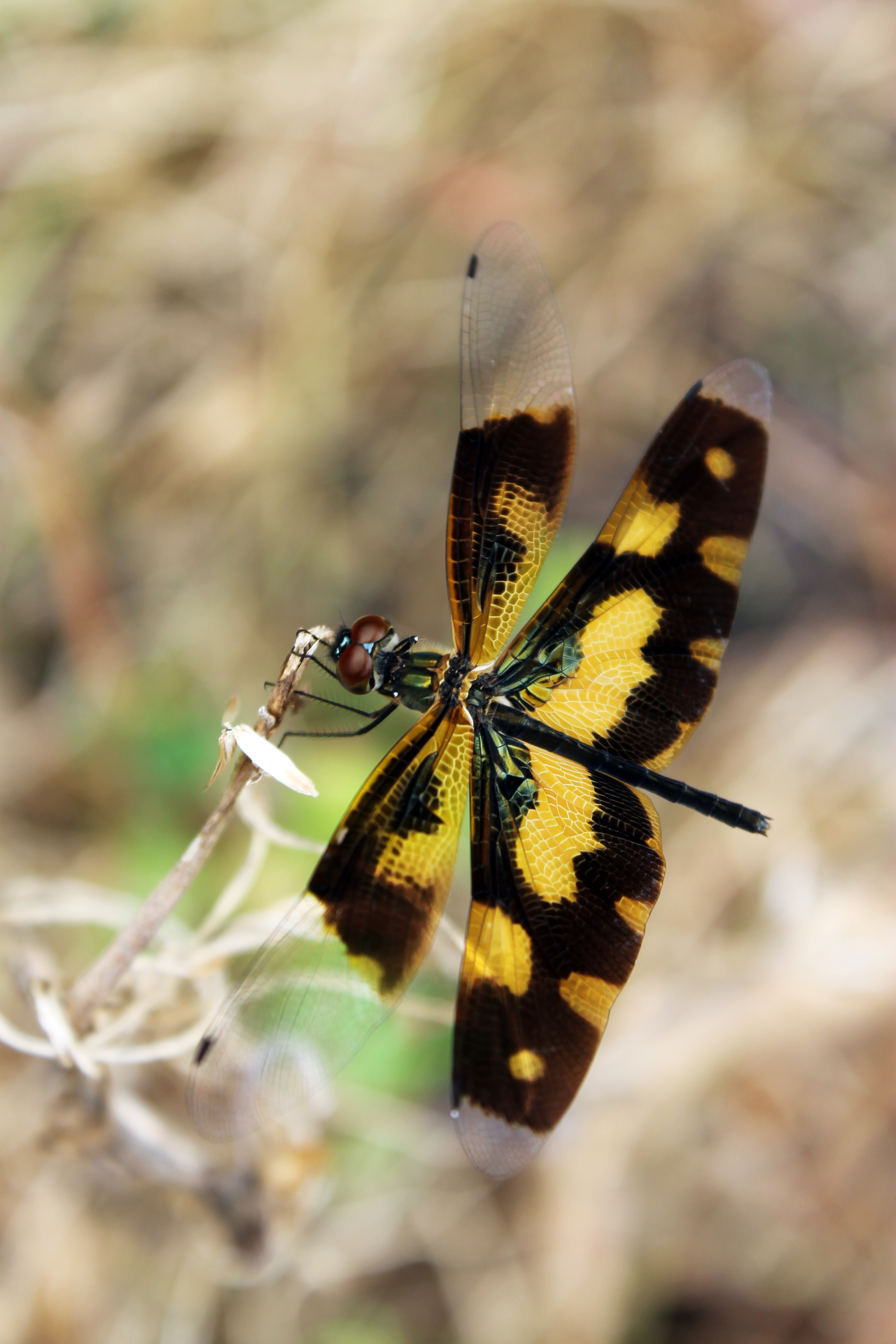
Rhyothemis variegata
Field guides and online descriptions of this dragonfly dub her the ‘Common Picture Wing’. I ask you to take a good look at her delicate wings – the architecture of the joints on the back of her thorax, and the colored patterns of the papery wings that carry her so gracefully through the air. I ask you to ask yourself – why is it called the Common Picture Wing?
The Wind Lens
After the earthquake in Japan earlier this year, critics of nuclear energy are clamoring for the retreat to the ‘safe’ and ‘reliable’ fossil fuels so commonplace of this age – the fossil fuels which are rapidly depleting due to the glut and the delusion of surplus of today’s culture. Not enough critics of the world’s energy policies are on what we at Raxa Collective consider to be the ‘right side’ of the argument – the one keeping the environment clean and safe. Nuclear energy is perhaps cleaner than burning fossil fuels for electricity, but even the slim chances of a catastrophe like Japan’s are enough to sell the public back to the gas-guzzling camp. But who is fighting for the third choice? The safe, the clean, the green – wind and solar power, the still-in-development responsible option

for civic-minded citizens wanting to lower their carbon footprint.
As explained in the link above, Japan’s Kyushu University is currently researching the most efficient form of harnessing wind power, and is developing a simple and cost-effective solution to the problems posed by the widely used ‘tri-blade” wind turbines of today. The main issue at hand is that the common turbine’s blades are too heavy (which is the case because lightweight materials are too weak), and more wind energy is necessary to spin the turbine, producing less energy than the potential. Kyushu University’s solution? The Wind Lens – a simple but ingenious addition to either existing or modified turbine designs which can double (or even triple) the energy output of the devices. The mechanism, in essence a ring around the turbine’s blades, acts in respect to wind much the same way a magnifying glass does to light – it takes the existing wind power, and thanks to the physics of pressure, concentrates the energy in such a way that the wind is forced through the tunnel at a significantly increased speed, resulting in a great increase in energy output. Environmentalists, intellectuals, and a few key organizations. Also, the Japanese. Continue reading
Dawn and Dusk
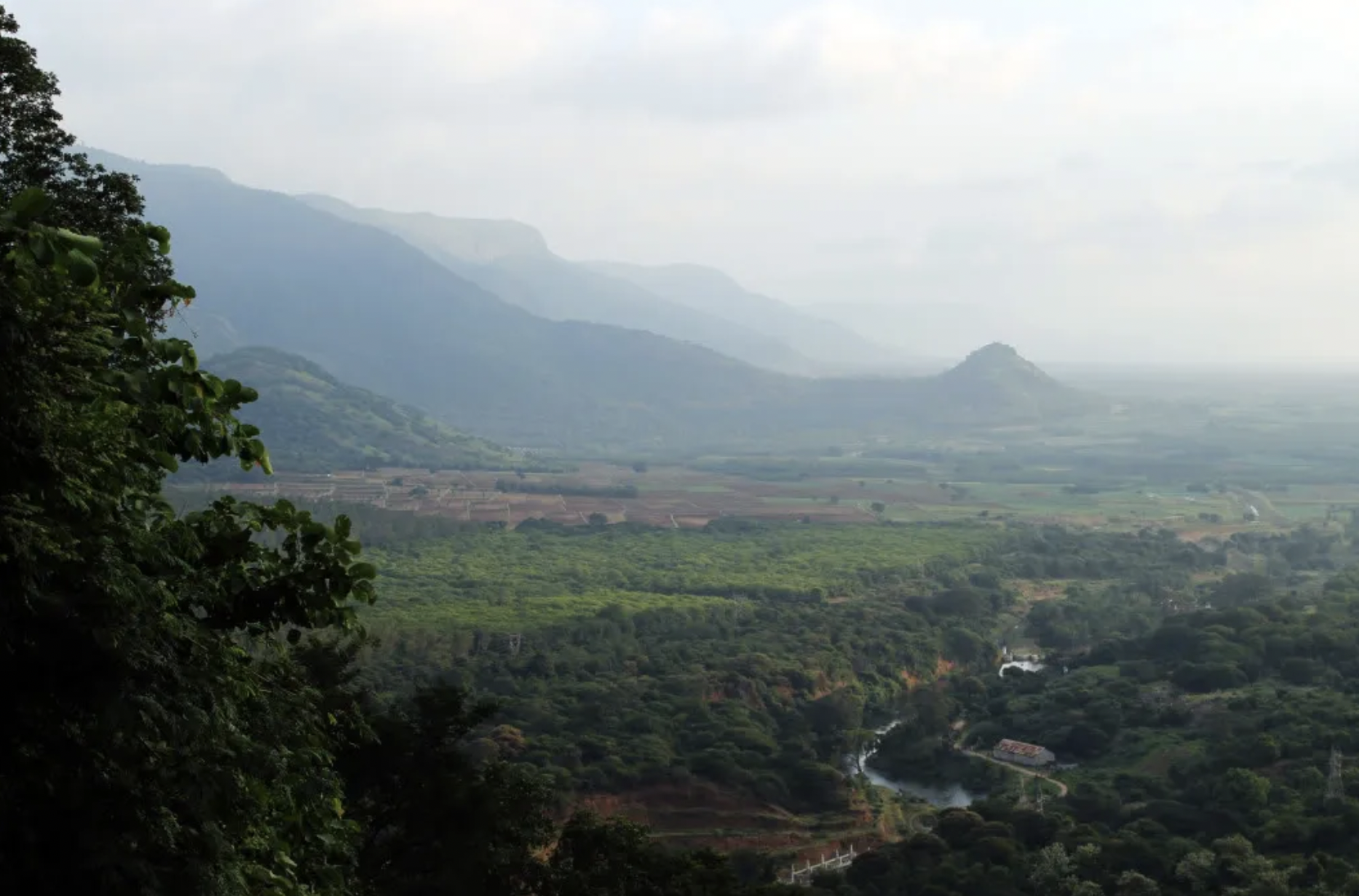
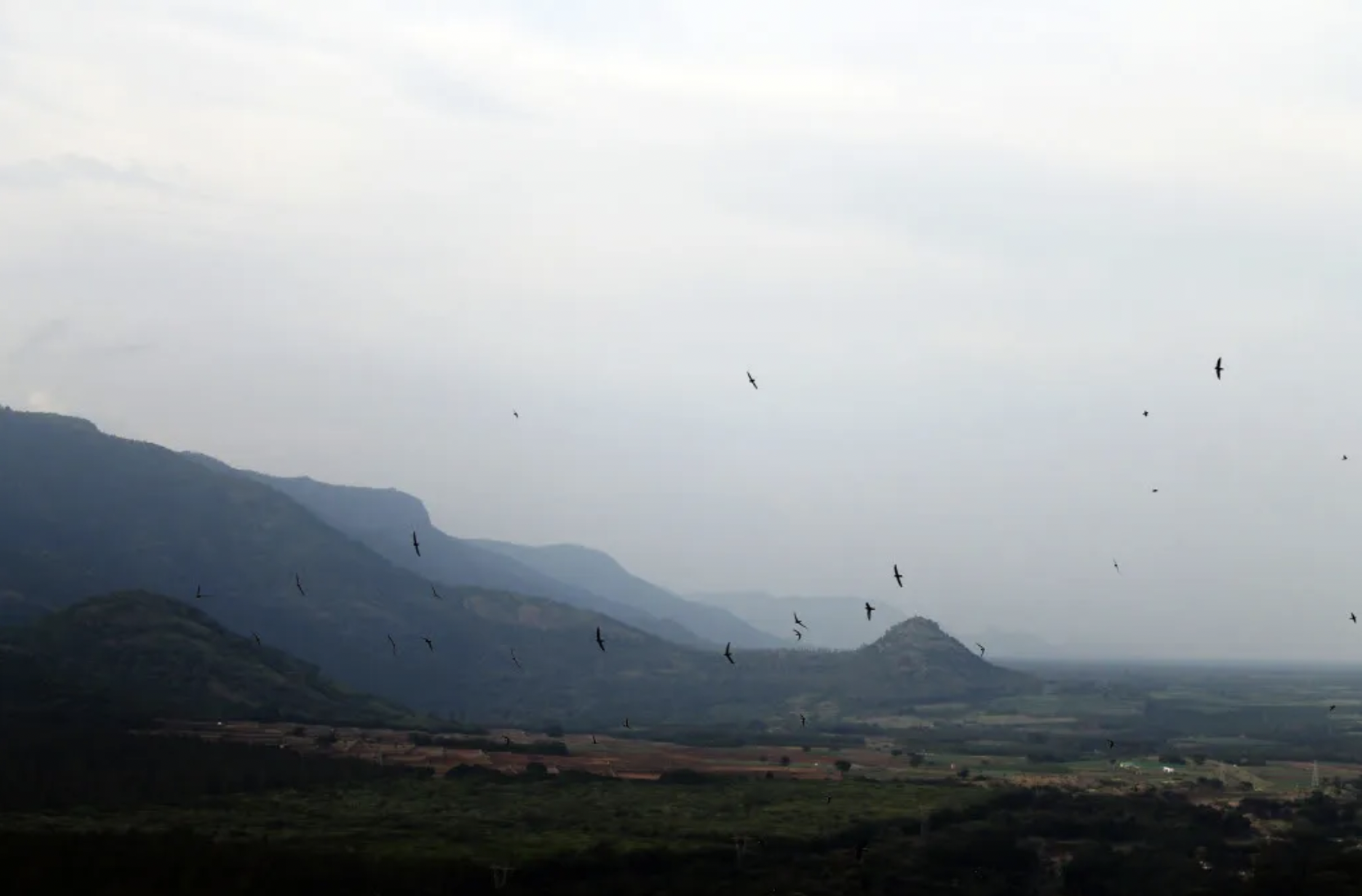
The clear skies and fair weather last Saturday allowed for breathtaking views across the expansive scenery on the drive down from Kerala’s Idukki District into Tamil Nadu. The following pictures were taken respectively at 7AM and 5PM (not quite dawn or dusk, but close enough) from different points along the drive down from and back up to Kumily.
Oxygen & Odonata
300 million years ago, the world was a very different place. Besides the severe geological changes and the sudden appearance of invertebrates, the Paleozoic Era was host to a severe change in atmospheric composition – namely the extreme increase of oxygen levels, and a drastic drop of carbon dioxide. The atmosphere, changing so radically, caused one or two ice ages, a few extinctions, and a natural development of what we today would consider very strange creatures indeed.

Scientists today, curious about (or perhaps inspired by) the fossils of dragonflies with 2-foot wingspans that zipped and zoomed (or whooshed, rather) through the Paleozoic skies, have been conducting experiments on the effects of atmospheric oxygen levels on short-term adaptation in a variety of insects. In late 2010, results were produced – on a large scale.
Fauna of Periyar

Sambar Deer (Rusa unicolor) grazing in an open field near the Periyar Lake.
Pachyderm Premonitions
At the risk of being tagged a superstitious bumpkin, I bring up the topic of auguries for the second time. My first omen of good fortune in Kumily was the appearance of an owl – the portent was indeed accurate, as shown by the success of Diwia’s paper bag workshop. Today, while in the Periyar Tiger Reserve, I sat on a bamboo raft and allowed my gaze to amble into the skies. It was a bright, sunny day (my toasted face solid evidence), with a clear sky save for a few small outcroppings of water vapor drifting in the soothing breeze. One particular puff of cloud caught my eye for a single reason – it looked like an elephant.

Amused but not particularly touched, I returned to my casual waterline eye-scanning. Not 10 minutes later, the significance of the elephant cloud hit me, albeit from about a football field’s distance.

Still In Motion
There is something fascinating to me about images that depict stationary objects while also imparting a sense of rapid motion. Night-shots of city streets with cars trailing lights are tricky, difficult to stage, and unnatural, yet still beautiful. Finding natural scenes depicting motion while the environment stands still is difficult, but a reliable source of endless photographs is the waterfall. Whether a mega-million gallon monolith or a trickling stream tickling down the side of a wall, the endless motion of a waterfall starkly contrasts against the backdrop, and the patterns which are the result of the water’s movement over a period of time can often be breathtaking.

Shop on the Water
Kerala’s Backwaters may be the only home to certain cultural items such as the snakeboat races and the traditional Kettuvalam houseboats, but they are also host to universal waterway phenomena. There is the mandatory bounty that nature provides in the form of distinct and delicious fish and crustaceans, not to mention the huge swathes of coconut palms that grow naturally. Acres and acres of rice paddies are cultivated at below sea level – a feat not unique of Kerala. But in today’s universal culture of rapid globalization, few areas are content with being entirely self-sufficient. So what do the residents of the Kerala Backwaters do if they can’t grow or forage a supply they want? The strips of land are too remote and inaccessible for a run-of-the-mill supermarket to be profitable, let alone practical. As usual, Kerala folks have come up with a creative yet simple solution to the problem of accessibility and functionality – a floating supermarket.

Moving Through Space, Time, and Culture
Hundreds of years of studying physics has told us that the journey through time is linear, and only goes one way. Laws of gravity aside, travelling through space need not be linear – any course can be taken as we move through our lives. These videos were created on a journey through 1056 hours of time and 38,000 miles of space – but the cultures witnessed and experienced by the travelers are innumerate.
[vimeo 27246366]
Jellyfish Preserves
Ever heard of Jellyfish Lake? Located on the Eil Malik island of Palau, Ongeim’l Tketau (as the natives call it) is a lake which was formed about 12,000 years ago by the Pacific Ocean. Along with the clean blue waters of the Pacific, the tides brought in immigrants – jellyfish of the genus Mastigias . Today, after 12,000 years of isolation and removal from the predator-rich environment of the Pacific Ocean from which they originated, the jellyfish have evolved into a significantly different organism. Due to the fact that the only predators the scyphozoans have is a species of anemone which is significantly removed from their swimming depth, they reduced their defensive mechanisms to virtual non-existence, meaning that unlike most beach-faring jellyfish, they don’t sting.
Due to this remarkably friendly gesture, Jellyfish Lake has become a popular snorkelling destination, and those fortunate enough to swim those waters are graced with an ethereal sensation of a world different and far removed from our own.
[vimeo 23079092]
Windowfarms: More on Urban Gardening
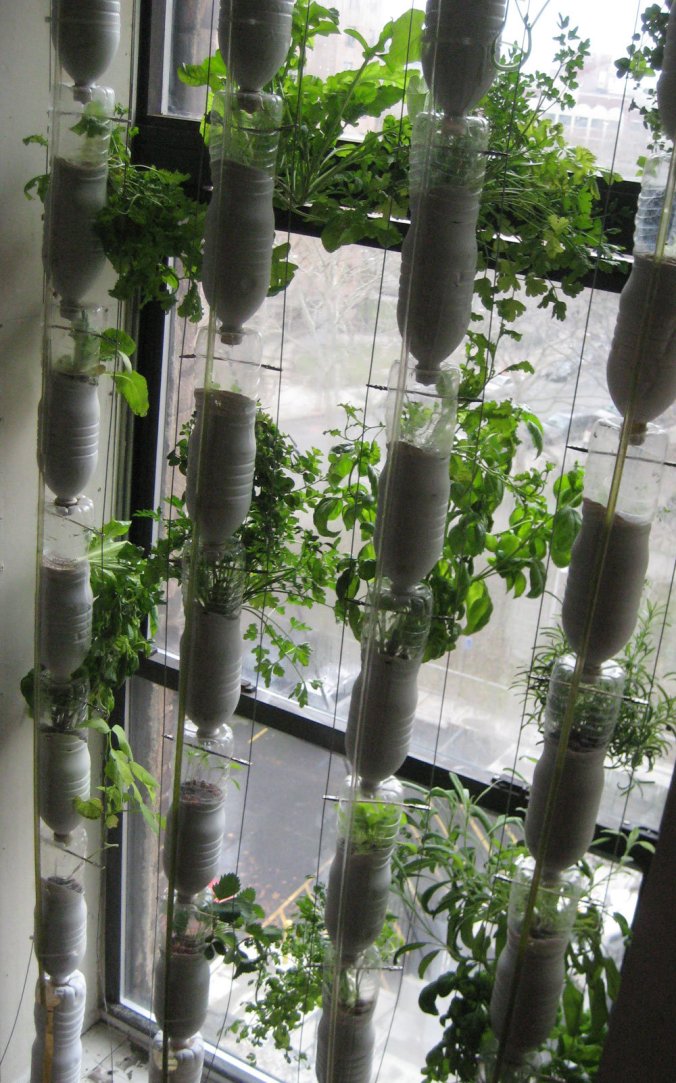
In one of my earlier posts, I discussed some of the basics of hydroponics, one of the less popular but more efficient forms of urban gardening. Today I won’t discuss the technical aspects of hydroponic gardening, but display an example of an entrepreneurial venture taking advantage of the underdeveloped market. Most people with hydroponic gardens are either aficionados or professionals – very few grow soil-less produce casually.
Windowfarms, an American open-source project concerning itself with urban agriculture, not only offers the blueprints for solar window-contained hydroponic gardens, but also the option of purchasing a kit of varying dimensions (for those less comfortable with the technical specifications). In addition to its mission of reducing urbanites’ carboon footprints by enabling them to grow their own produce, Windowfarms are being used to educate schoolchildren on the benefits and ease of urban farming.
 Organikos