Panthera onca

video taken by author on August 5th

Chan Chich is known for being pretty much the best place in Belize to spot a jaguar (scientific name, Panthera onca) in the wild, given the Lodge’s huge amount of protected land (30,000 acres) adjacent to hundreds of thousands of acres similarly preserved, or under government conservation that together form the international Jaguar Corridor Initiative.

The word Panthera comes from the ancient Greek pánthēr (πάνθηρ), which essentially means “predator of everything,” and is a scientific genus comprised of the five big cat species in the world: snow leopards, tigers, lions, jaguars, and leopards. The latter four of these are the only cats that can roar, given morphological differences in their bones and throat.


Continue reading

Tropical Kingbirds Make Good Parents, Part Two

Yesterday I wrote and shared a video about this particular flycatcher’s protective nature, but it’s important to note that this behavior isn’t limited solely to the Tropical Kingbird. Neither is the rigorous feeding displayed in the video below. Most birds take good care of their young, whether by bringing meals every couple minutes or by picking up their poop and depositing it away from the nest – which you can see the parent kingbird do at 00:30 and 2:31. I apologize for publishing this in low resolution and pixelating the cuteness, but it’s the best one can do when off-grid in the middle of the Belizean jungle!

Continue reading

Tropical Kingbirds Make Good Parents, Part One

Just a few days ago, I was working from my laptop in one of the Chan Chich Lodge common areas when I saw an Ocellated Turkey on the road – not a peculiar sight at all – that walked a few steps before suddenly doing a swift yet panicked pirouette  – a slightly less usual occurrence, in my brief experience with the scintillant species. I grabbed my camera, which doesn’t leave my side here at the Lodge, and recorded the following video, in which the turkey gave a new meaning to the chicken-dance, albeit as an unwilling partner:

Continue reading

Big Numbers for eBird this Summer

Starting in May, eBird hit a big milestone: 11.8 million bird sightings in that month alone – the same amount of sightings the citizen science database collected in the first five years it existed. Participation in recent years had shot up enough to make that sort of number, and these sorts of maps, possible. Then, on June 17th, the 333,333,333th checklist was submitted to eBird from a participant in Illinois. A third of a billion records submitted by just over three-hundred thousand different people around the world since the Cornell Lab of Ornithology and Audubon partnered to make it possible for people to easily digitize their bird sighting checklists – that amounts to an average of a thousand-and-fifty checklists per eBirder!

At the end of last month, eBird saw another big number, with a million bird photos archived in the Cornell Lab’s Macaulay Library through the new tool allowing users to attach images to their checklists. And this week, the app Merlin got downloaded by its millionth user since it was launched for iPhones in January 2014 (and a bit later on Android phones). But eBird, Merlin, and the Macaulay Library aren’t the only ones reaching milestones this summer. Continue reading

Jumping Mobula Rays at Villa del Faro

A few weeks ago I wrote about the dawn rays at Villa del Faro, when I saw the jumping fish coming out of the water and slap down in almost-graceful belly flops. I finally got a little footage of the interesting behavior in the video above, and I found an article from BBC Earth that covers the topic – in the Gulf of California, no less – while still not providing an explanation for why the rays jump like they do:

Soaring high above the waves as easily as a bird, mobula rays appear perfectly designed for this astonishing aerobatic display.

Continue reading

Good Bag News from England

Image via Pinterest

Last year in October, a five pence charge (around seven US cents) for plastic bags at supermarkets was introduced to discourage shoppers from using the wasteful and unnecessary receptacles – and prevent pollution at the same time. With this extra cost, use of the bags dropped by over 85%, according to the Department for Environment, Food and Rural Affairs. But England hasn’t led the charge (pun intended) in this effort: Scotland, Wales and Northern Ireland all successfully employed the 5p cost prior. Rebecca Smithers reports for The Guardian:

Retailers with 250 or more full-time equivalent employees have to charge a minimum of 5p for the bags they provide for shopping in stores and for deliveries, but smaller shops and paper bags are not included. There are also exemptions for some goods, such as raw meat and fish, prescription medicines, seeds and flowers and live fish.

Continue reading

American Coots

The title may be reminiscent of recent movies like “American Sniper,” or “American Hustle,” or slightly older ones such as “American Psycho” and “American Beauty.” But as the video suggests, the American Coot is a type of bird, a wading species in a family called Rallidae, which most non-birders probably haven’t heard of because the birds are typically either near water or hiding in dense vegetation. Coots, along with rails, gallinules, and crakes, make up the Rallidae family, and all these types of birds like to stay on the ground, very rarely flying or venturing into trees unless it helps escape a predator. They’re more closely related to cranes than to ducks.

Continue reading

New Zealand Plans to Eliminate Invasive Mammals

Illustration of a Brown Kiwi chick. A History of the Birds of New Zealand. 2nd ed. by W.L. Buller (London, 1888). page 326 via WikiMedia Commons

It is not surprising that one of the nations that stands to lose the most from invasive mammals is also the first country in the world to announce its ambitious plan to remove them all by 2050, but the islands of New Zealand have a lot of work ahead of them to eradicate animals like rats, stoats, and possums – around nineteen and a half million US dollars worth of work, which will be the government investment in a new public-private joint venture called Predator Free New Zealand Limited . And now that deforestation has been controlled better, it’s time to protect the country’s wildlife another way. The kiwi illustrated above, for example, is one of five species in New Zealand, all of which are threatened or endangered, or critically endangered, thanks to predation by invasive mammals that the flightless birds can’t avoid.

Continue reading

Honeyguide Relationship can Include Talking

Greater Honeyguide specimen used in Cornell’s Ornithology course (photo and handling by a teaching assistant)

When I took Cornell’s course in ornithology, we learned about all the bird families in the world to varying extent, often based on the number of species within each family or how interesting they were to our professor. One family that we did not cover with great depth, but which was considered a “cool” example of evolution that could either make for a fascinating science experiment or just good cocktail-party chatting––we were gently reminded that the latter shouldn’t always revolve around weird bird things––was Indicatoridae, or the honeyguides.

While not all members of this family are literally guides to honey, one species in particular, the Greater Honeyguide, is well known for actually showing (or indicating) the way to beehives, where humans can harvest honey and the birds can eat larvae and wax. In this week’s edition of Science, researchers from Cambridge University and University of Cape Town published a paper revealing that the wild birds can actually be better guides when they receive a certain signal from the human honey-hunters. Nicola Davis reports:  Continue reading

Boca del Tule, Kayak & Surf

img_9395_zpsmfqybqon

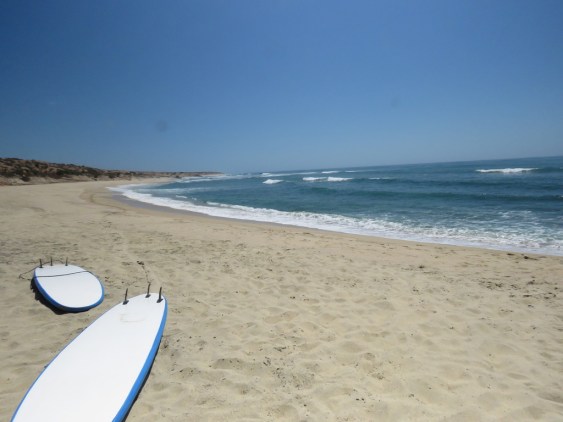
The shore down below Villa del Faro is known as Boca del Tule, since the Tule arroyo –– a seasonal river in the desert –– runs into the ocean at that point (boca means mouth in Spanish). The beach is public but very few people are ever on it, partly because we’re an hour away from the closest city, San José del Cabo, via dirt road. Now and then you’ll see a couple fishermen, or if the waves are good, some surfers. Last week, Jocelyn and I tried surfing both here at Boca del Tule and also at a better-known surfing beach just twenty minutes south called Nine Palms.

Both spots offered fair surfing for either experienced or newbie surfers, since Continue reading

Video Tour of a Recycling Plant in Brooklyn

My junior year, I founded and sat as president of my high school’s recycling club, which was a fairly simple operation of setting up cardboard boxes in classrooms and asking people to put their plastic or glass bottles and aluminum cans inside – paper recycling was already managed by the school district, but the rest wasn’t. Every Monday I’d go around collecting all that material into the big blue plastic bags sold by the county for residential recycling, normally filling one to two of them a week, and then take them to some neighbor of the school’s gracious enough to loan us their curb space for recycling pickup the next morning. From those big trucks that would load up the blue bags for the county, all the glass, plastic, metal (and garbage people thought was recyclable or didn’t care enough to remove) probably went to a recycling plant a bit like the one in the video below:

Continue reading

A Dawn Excursion Continued

The main building in dawn light

My last post on this topic involved the ocean, but the bulk of that morning earlier this week was actually spent out in the chaparral: scrubby, thorny, and sparse vegetation in the desert just outside of Villa del Faro. Right before I exited the property I spotted a black-tailed jackrabbit warily watching me as I descended the hill–these hares are a common sight on the side of the dirt coastal road out here.

Continue reading

What Can Be Done with eBird Data?

Brighter colors indicate higher relative abundance. © Cornell University

The Western Tanager is a species I have yet to see, but which will be unmistakeable once I do, with the male’s red-and-orange head and bright yellow body contrasting with black wings striped with white bars. Based on the animated map above, I expect to spot some of them down in Baja California Sur by September or October, and I look forward to it. As I’ve written here before in the case of another moving map, citizen science makes this sort of illustrative prediction of a species’ moving presence possible, and it’s one of the reasons why I contribute to eBird as often as I can.

A paper titled “Using open access observational data for conservation action: A case study for birds” was published in the scientific journal Biological Conservation by a team of researchers at the Cornell Lab of Ornithology, several of whom I was just down the hallway from when I worked there. Although I haven’t gotten through their findings yet myself, Victoria Campbell chose nine interesting examples of how eBird data created tangible conservation in several countries.  Continue reading