Kerala is heralded as one of the leading states in India with a good collection of Murals. Dating back to the 8th century, the paintings are highly valued for their aesthetic composition and techniques. The temples and palaces of Kerala are custodians of many notable Mural works depicting Hindu Gods and Goddesses.
Continue reading
Art
If You Happen To Be In New York City
An artist seemingly after our own heart, thinking as we do about the impact of light pollution. Through May 4, you can see for yourself. From the Danziger Gallery’s website:
Thierry Cohen was born in Paris in 1963. He began his professional career in 1985 and is seen as one of the pioneers of digital photography. His work has been shown at the Palais de Tokyo, and the Musee de l”Homme in Paris, and in 2008 was an official selection of the Mois de la Photo. Since 2010 he has devoted himself to a single project – “Villes Eteintes” (Darkened Cities) – which depicts the major cities of the world as they would appear at night without light pollution, or in more poetic terms: how they would look if we could see the stars. Continue reading
Napier Museum – Thiruvananthapuram, Kerala
The Napier Museum is also known as the Trivandrum Art Museum of Art. It was completed in 1880, making it the oldest museum in Kerala and one of the oldest in India.The museum houses an extensive collection of bronze and stone sculptures and wooden carvings dating from the 11th to the 18th centuries. There are some very interesting musical instruments and a 400-year old clock. The traditional ornaments used by Kerala women, elaborate lamps and life -lized Kathakali figures complete with resplendent costumes add to the museum’s eclectic collection. Continue reading
Nick Cave And Grand Central Station’s 100th Birthday
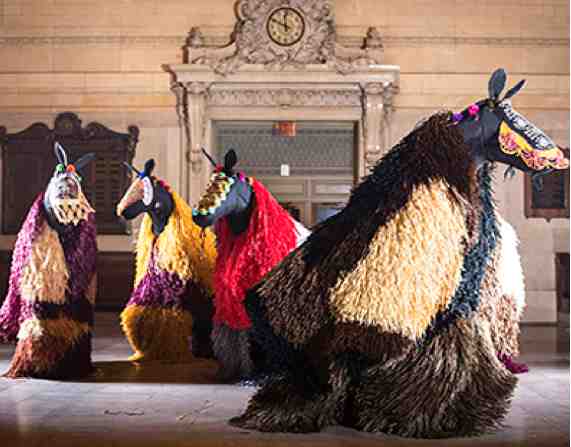
This has captured our attention, and will not let go. Why? Maybe it is because the artist’s name (but definitely not his work) is identical to that of another non-mainstream artist who, according to the most widely used search engines, is alot more well-known. But that cannot be all there is to it. For some it could be the strong memory of Grand Central Station and the seeming incongruity of its use as a stage, even on the occasion of a birthday party. For others it may be as simple as a question. What are those costumes? A post in on the New Yorker‘s website explains:
…Cave, who was born in Missouri, in 1959, and is based in Chicago, where he serves as director of the Art Institute’s graduate fashion program, has been producing Soundsuits—which can be displayed as inert sculptures, or can be worn, often by their creator, “activated” to produce a variety of noises—for nearly twenty years. He has made Soundsuits from an array of found materials including dryer lint, sequins, sweaters, socks, buttons, feathers, human hair, and vintage toys. His first Soundsuit was made of twigs, in reaction to the beating of Rodney King. Continue reading
Painter’s Progress
There does not seem to be a weak link in this chain: From Scratch consistently delivers. Earlier samplings were, with few exceptions, mostly interviewees who we know about and admire at the intersection of conservation and commerce. Chuck Close, pictured to the right in a self-portrait from 1994, is another exception in terms of theme. But like his paintings, his role as entrepreneur is a matter of perspective: seen from one distance, then like any great entrepreneur he combines determination with creativity to do what he must do, even in the face of adversity most of us cannot even imagine. From another distance, his distaste from the commercial dimension of his chosen calling appears anti-entrepreneurial (but of course this is why he is among the most celebrated living artists). He is a mirror opposite of all the things we find distasteful and dreadful about the so-called “art world.” Click the artist’s image to go to the interview:
When we see a painting hanging on the hallowed walls of a museum, we get a sense of an artist’s technique and imagination, but we don’t get a sense of the process and hurdles that artist faced on the way to critical acclaim. Continue reading
Richard Ouzounian, Come To Kerala!
He is the Theatre Critic for The Toronto Star, and let this fellow make a statement that is probably unparalleled in this sort of venue or any other venue for that matter. Artists are often reticent to share their views on meaning or interpretation, their craft, their purpose. This one puts it all out there, and Richard is wise to let him go at it. Continue reading
If You Happen To Be In New York City
Many people happen to be in New York City. It happens all the time. People just show up. But this time is different (as they all are, and so on). In discussion recently, several of us at Raxa Collective agreed that the first time they heard of someone named Nick Cave, a rather offbeat artist to say the least, was through the music in a film that may have had the best soundtrack of any film ever. Now, continuing that offbeat approach, he shows up in a train station of all places. Only thing is, it is not the same Nick Cave. That soundtrack Nick Cave was the real deal. So is this one. How many Nick Caves are there?
Nick Cave/ HEARD • NY
Presented by MTA Arts for Transit and CREATIVE TIME
Vanderbilt Hall, Grand Central Terminal
March 25 – 31, 2013 Continue reading
If You Happen to be in New York City
For the next several months, The Metropolitan Museum of Art (aka The Met) has quite a few great special exhibits open that I would recommend seeing. My two favorites from a visit to The Met last week are titled “Cambodian Rattan: The Sculptures of Sopheap Pich” and “Birds in the Art of Japan,” both on the second floor in the Asian Art section.
In the first exhibit, Pich uses wire, bamboo, rattan, and a couple other materials to craft beautiful abstract or representational sculptures, which are presented, as you can see in the picture on the left, with great lighting to create superb shadows around the piece. Pich and his assistants had to boil the rattan and bamboo cane in diesel oil to remove insect eggs, prevent fungal damage, and preserve the cane from discoloration.
Community, Theater & Transformation
We have mentioned this fellow more than once, and we have an ongoing thing for libraries (thank you Toronto Public Library for making this possible, and may you do the right things in order to live forever!). Now we must mention the journalist who conducts this “interview” by asking few questions, brilliantly, and then brilliantly getting out of the way and letting his interviewee speak. And speak he does. If you have a better definition of art, operatic or otherwise, please let us know. This is worth every minute, so wait until you have time to watch it from beginning to end.
Metal, Craftily Crafted
Brazilian artist Vik Muniz has been on our radar for quite some time. Partially because his work redefines the concepts of waste and the proper “mediums” in art, but mostly because his work is just plain fun. While some previous series have used medium as bizarre as dust, granulated sugar or melted chocolate, the prints exhibited at the 2013 New York Armory Show were created with the metal waste of the modern world.
Muniz is not only a master at recycling but at keeping his viewer completely off balance with his sense of scale. His 3 dimensional collages, whether made of scrap metal like the ones in the slideshow above, or with more “generalized garbage” as in the pieces depicted in the documentary The Waste Land, are orchestrated piece by piece from a 20 meter vantage point. For example, at first glance the hummingbird image looks as shimmeringly delicate as a Hupert Duprat/caddisworm collaboration, but wait! Are those paint cans, bed springs and automobile tire hubs I see? Continue reading
Tidy Up

© Die Post Swiss Post has asked Ursus Wehrli to create a tidied up stamp – the stamp is NOW available at every Swiss post office
There is an entertaining video from five years ago of this comic artist presenting his “work” and a book review from 18 months ago on Trendland that is worth a look because it presents an excellent sampling of Ursus Weherli’s images, and you can decide relatively quickly whether you want more or not (one purpose of a book review, well fulfilled in this case:
Organizational skills aren’t usually something you look for in an artist, but in Ursus Wehrli‘s case, they’re definitely something of value…
His most famous image is likely this one below, but the stamp above commissioned by Swiss Post shows an evolution of sorts, which you can see after reviewing the images in that book review. It also shows an idea, a concept, on a roll. Where did it come from? Where is it going?
Palm Leaf Decorations
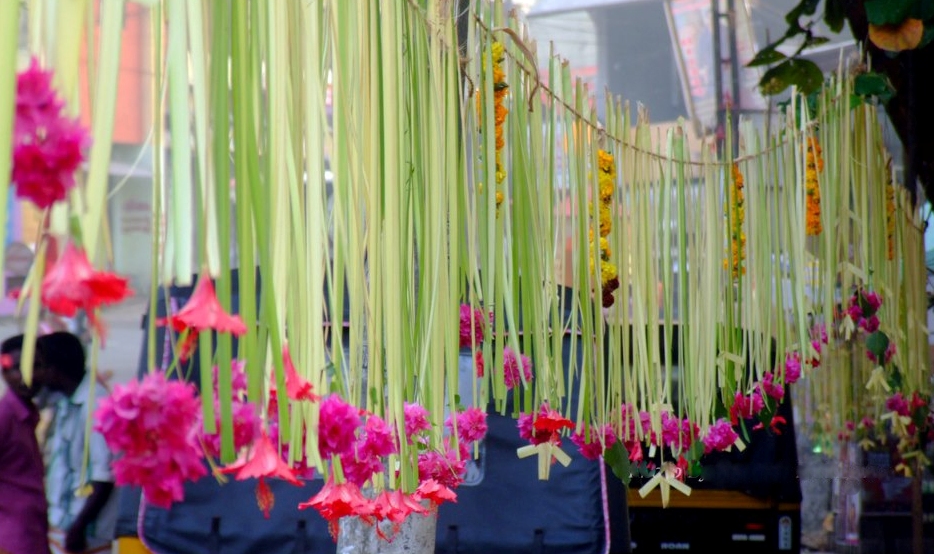
The coconut tree plays an integral part of the lifestyle and the economy of the Kerala. (In fact, the name of the state itself has coconut in its etymological roots.) There are numerous products and byproducts derived from the tree. In addition to its use for food, beverage and coir, its tender leaves are used for decorating houses, Temples and churches. Continue reading
Exoskeletal Bling
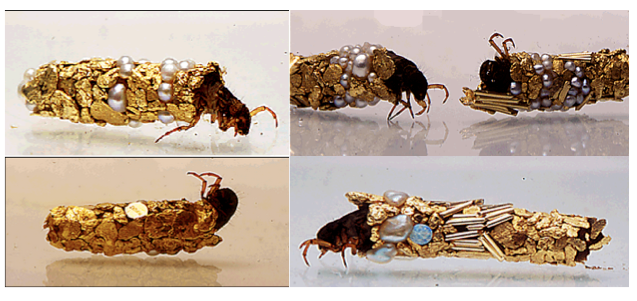
The caddis worm (order Trichoptera) may not be as popular as its famous shiny cousin, the scarab beetle, but it carries the extra charisma of an intrinsic aesthetic behavior.
French artist and science enthusiast Hubert Duprat took his natural curiosity to an elaborate level when he began providing these case building larva with gold spangles and semi-precious materials in lieu of the bits of sand and gravel they would normally use.
An amazing observation is that the worms seem to approach their work with an artistic eye, choosing the color and quality of the materials they use. In the 1930s an American entomologist observed in a Nevada river that “among all the little particles of sand and minerals swept along by the water, the Trichoptera make meaningful selections of bright blue opals—in other words, the most conspicuous or garish materials.” Continue reading
Thanjavur Memorial Shrines And Nandi Mandapa
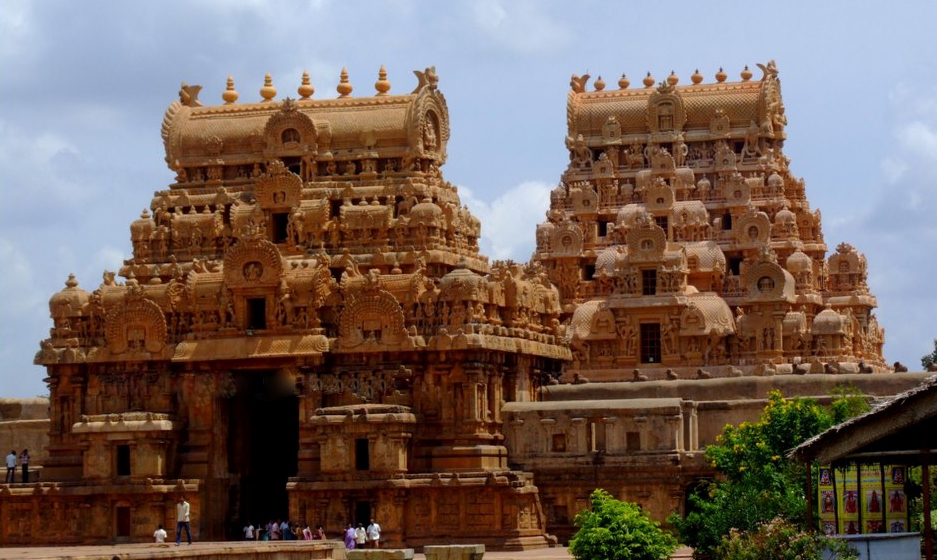
The temples and shrines at Thanjavur are amoung the finest examples of South Indian architecture of the late Chola period. Dedicated to Lord Shiva, the Breehadishwara Temple is considered the greatest single undertaking of its time, taking almost 15 years to complete the full structure. Continue reading
Interesting Intersections
We have pointed him out before, and will likely continue to do so; here, with a link to a catalogue archiving some of his earliest work as an adult artist. And there is a podcast of the radio show about entrepreneurs, From Scratch, featuring an interview with this artist that allows him to sit remarkably well with pioneers at the intersection of conservation and other pursuits:
Andy Goldsworthy
Sculptor
Some sculptors work with materials like bronze or marble, which last forever; but others build sculptures made of ice or snow, which last only a few moments. Continue reading
If You Happen To Be in New York City
From today until May 19 the New-York Historical Society will begin hosting a multi-phased exhibition of Audubon‘s early, exuberant period as an illustrator-naturalist:
Audubon’s Aviary: Part I of the Complete Flock
To celebrate the sesquicentennial of the New-York Historical Society’s purchase of the Audubon avian watercolors and the the release of the lavishly illustrated book Audubon’s Aviary: The Original Watercolors for “The Birds of America”―published by the New-York Historical Society and Skira/Rizzoli and winner of a 2013 New York Book Show Award Continue reading
James Prosek, Come To Kerala!
When we invite an artist to visit us, it is mostly but not always because we think their work would fit well with the natural environments where we work. And, of course, because we love what we have seen of their art. The slideshow above includes current and boyhood illustrations by an artist who would hopefully appreciate our daily attention to his beloved creatures in various places:
…The artist and author James Prosek uses vivid and highly detailed watercolors to capture the natural world. He’s compared often to Audubon, though unlike the 19th-century artist’s focus on birds, Prosek’s work most often focuses on animals with fins instead of feathers. Continue reading
If You Happen To Be In Washington, DC
From our friends in the north comes our favorite kind of cultural festival–all mixed up. It is reviewed in this podcast and explained on the Kennedy Center’s website:
About the festival
February 19-March 17, 2013, the Kennedy Center presents Nordic Cool 2013, a month-long international festival of theater, dance, music, visual arts, literature, design, cuisine, and film to highlight the diverse cultures of Denmark, Finland, Iceland, Norway, and Sweden as well as the territories of Greenland, the Faroe Islands, and Áland Islands. Continue reading
Temple Gopurams
The word Gopuram refers to the monumental tower built at the entrance of South Indian Dravidian temples. These Gopurams are multistoried structures decorated with painted sculpture and carvings depicting Hindu mythology.
Continue reading
Happy Birthday Ansel!
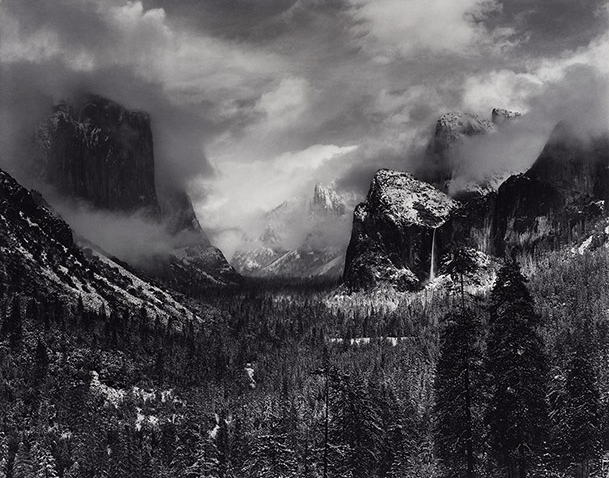
Ansel Adams has become almost synonymous with the environmental movement in general and Yosemite National Park in particular. He first visited the park when he was 14 and the impression he had at that age would last a lifetime. His photographs played a seminal role in convincing Congress to place that amazing landscape under federal protection.
Yosemite Valley, to me, is always a sunrise, a glitter of green and golden wonder in a vast edifice of stone and space. I know of no sculpture, painting or music that exceeds the compelling spiritual command of the soaring shape of granite cliff and dome, of patina of light on rock and forest, and of the thunder and whispering of the falling, flowing waters…
— Ansel Adams, The Portfolios Of Ansel Adams Continue reading