If You Happen To Be In London

Much as we love birds, and Mr Audubon’s illustrations, little did we know their value in book form, or that we might have this opportunity to see them on display under one roof (click the museum’s banner to the left or any of the bird images to go to the source):

John James Audubon’s hand-engraved The Birds of America (1827-1838), is the world’s most valuable book. But which page illustration from the book should be shown first in our new Treasures gallery?

Vote for your favourite page from the 4 below and see it in the Treasures gallery when it opens on 30 November 2012.

Anti-gambling though we are, we encourage you to cast a vote on the Natural History Museum’s website for your favorite Audubon illustration, with the chance to win a complete edition of Audubon’s The Birds of America. Continue reading
Franzen On Birds

On this site we have a commitment to, bordering on an obsession with, birds.  Every day you can find at least one post featuring a bird that a member of our team (employee, internstaff photographer, or staff photographer’s brother) or a member of our extended network of birders.  Recently, we have run several posts featuring the bird-loving writer featured in this video.  We will continue this thread until we run out of material.  Promise.

Grumpy, Bird-loving Awesomeness

What if every artist made a love pact with something, anything, in the natural world?  Mr. Goldsworthy, we noted after a recent post, had already made (to our eyes, a similar cairn included) such a pact a long time before his Australia work.  Mr. Franzen, as we shall highlight as often as we can here, has made such a pact with birds.  Walton Ford, in phantasmagorical manner, check. And this fellow, on the sands down under, too.  More!

Birds, Book, Bother

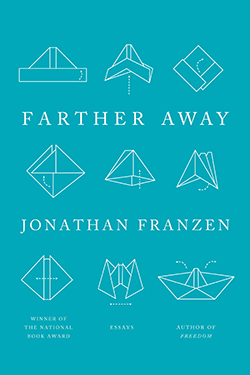
From the review in Smart Set (click to book image to go to the source) it is clear that we will enjoy this collection, whose title we had already seen in another context, from a writer we already had reason to admire for his attention to birds:

A novel is a bird. I learned this from Jonathan Franzen. It is the underlying message of his newest collection of essays, Farther Away.

Franzen became a bird watcher many years ago. He is almost apologetic about that fact, realizing that — in the opinion of most normal human beings — the birdwatcher is a slightly pathetic if otherwise harmless individual. In his commencement address at Kenyon College, “Pain Won’t Kill You,” Franzen writes: Continue reading

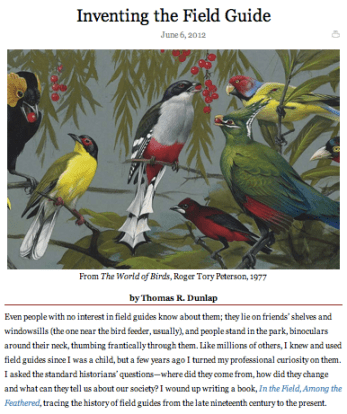
Field Guides?

Click the image at left to go to the source.

We have a strong connection on this site to the world of birds, birding, birders and the guides who intersect on each of those.  Salim took the lead in helping us decide to put more attention on birds.  We were convinced it was a good idea with the following Vijaykumar established among serious birders visiting this site.

Our efforts picked up steam when Martin joined in the fun and Seth started reporting from Ecuador; after Ben saw his thousandth bird while in Kerala we were hooked.

Now that we are, we seem to notice more and more interesting resources related to the world of birding.  Interpretive guiding has been important to several of us for our entire adult careers and this article tells a great story about the books that help one subset of all that field guiding.

From Feather to Frame

Painting by: Jane Pompilio George

It was with pleasure that I recently discovered a Cornell “neighbor” who happens to be both an artist and bird lover, who takes inspiration from the Cornell Lab of Ornithology’s round-the-clock “bird cam” nest images.  (Click on the painting above to go directly to her blog.)

People all over the world have been able to experience (and be inspired by) the nesting of great blue herons and red-tailed hawks near the Cornell campus, as well as Osprey nests in other parts of the United States.

Continue reading

The Final Bird Club Meeting

Screen Shot 2020-08-14 at 11.03.31 AM

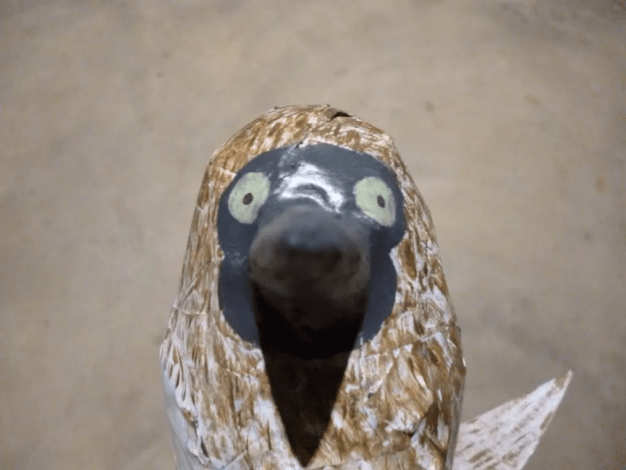
Last Wednesday was the final day the Union Educativa Modelo Tomás de Berlanga Bird Club would be gathering under my supervision. In the end, I was never able to get the papier-mâché project off the ground for most of the kids – two students did end up making penguins, but forgot to bring them to this last day to attach body parts and spray the final product with a protective varnish, and my hosts’ son painted a bird I made (looks like a male frigatebird). The photo above is of the Blue-footed Booby I made for my host family.

Continue reading

Are Cormorants Evil?

Funny to see this headline at the same time as Martin’s photo just published; not to mention previous posts of Cormorants from time to time.

With a nickname like Black Death (click the headline for the full story), it seems some think of these amazing birds in quite strong, negative terms; they sound evil.  Are they? Of course not.  Just providing a little friendly competition to those with rod and reel:

Known to anglers as the Black Death, the cormorant is a killing machine that can swim two minutes underwater and diving 80ft. In China, fishermen hunt with trained cormorants, but in Europe the protected species is a hated rival, blamed for emptying rivers of fish.

Anglers have been petitioning the government to do something about the birds for more than a decade. But a perception that cormorant numbers are now out of control has resulted in a clamour for unprecedented action.

Cornell’s New Little Red Bird

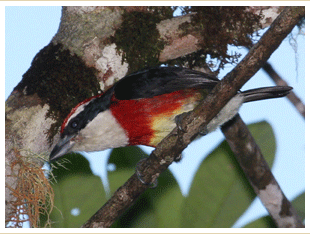
Sira Barbet by Michael G. Harvey

What happens when a group of “newly minted” Cornell ornithologists go on a birding expedition in the high Peruvian Andes and the team discovers a new species of bird?

They name it after the Cornell Lab of Ornithology executive director Dr. John W. Fitzpatrick whose fieldwork in Peru during the 1970s and 1980s led to numerous discoveries of course!

Continue reading

A Perfect Sendoff and a Nostalgic Farewell

It is amazing how fast ten weeks can go by.  I remember sitting in the library at Cardamom County writing about my first day of birding here; I remember how excited I was to see barbets, minivets, and leafbirds from the parking lot.  Now, ten weeks later with about a dozen activities completed and many birding expeditions into the Periyar Tiger Reserve under my belt, I’m suddenly looking back on fond memories.  My first excursion into Periyar was a Bamboo Rafting trip along Periyar Lake.  To be honest, I was a little overwhelmed in this strange new place with its checklist of over 300 unfamiliar birds.  As is always the case with Periyar, the excursion was a blast, and that trend continued with the Border Hike, the Nature Walk, the Tiger Trail, the Green Walk, and indeed with every trip into the Reserve.

Continue reading

Kumarakom Bird Sanctuary

Kumarakom Bird Sanctuary is located in Lake Vembanad, the largest fresh water lake in India and second largest in south Asia. Set against the backdrop of rich green paddy fields and still grey waters, the 14 acre sanctuary is the home for many species of birds.

Continue reading

Gathering to the Bird Club

Last week’s Bird Club sessions saw eight, nine, and one participant(s) in the Wednesday 2th-4th grade group, Thursday 5-6th grade group, and Friday 7th-12th grade group, respectively. My goal had been to start a papier-mâché project, but after forty-five minutes the youngest group was eager to walk through town, so we left the balloons to dry and reviewed the usual crowd at the Fisherman’s Wharf with the addition of a Great Blue Heron and an Elliot’s Storm Petrel. Since some of the eight kids hadn’t come to the first week, it was still a pretty good day, except that most of the students didn’t take their balloons home with them. This week, only three students arrived on Wednesday (it is final examination week), so we made papier-mâché again and this time everyone took their birds home to dry for next week’s wing and beak addition, and perhaps even painting.

Given the younger students’ response to the papier-mâché, I came to the Thursday group last week prepared to put the issue to a vote. Quite a few kids came half an hour late, so we ended up walking to Tortuga Bay, a 45-minute trip through the Park on a path surrounded by cacti and trees that always yields Galápagos Flycatchers, Galápagos Mockingbirds, and a couple species of finch. When we reached the shore a small group of Ruddy Turnstones flew away, and after a couple minutes we had to turn back towards Puerto Ayora. This Thursday, almost the same group of nine students made their balloons and drew their wing-plans on cereal boxes.

Continue reading

Birdman Of Skomer

For our bird-loving contributors and followers, an interesting story told in a brief video, thanks to The Guardian. (Click on video image to go to the source.)
Tim Birkhead, professor of zoology at the University of Sheffield, talks to Steven Morris about his study of Amos guillemots on the tiny, uninhabited island of Skomer, south-west Wales. Birkhead first visted Skomer in 1972 as a 22-year-old PhD student interested in the sex life of the guillemot. His 40-year investigation into the birds is one of the longest-running field studies of its kind.

The Younger Grades at Tomás de Berlanga


This past week, apart from being the second session of the Bird Club, I was teaching 1st and 2nd graders English, Science, and Art (e.g. bird names, bird biology, bird crafts). I wasn’t quite prepared for the radical change in behavior between 7th-12th graders and 1st-2nd graders in the classroom, though obviously I expected there would be significant differences.

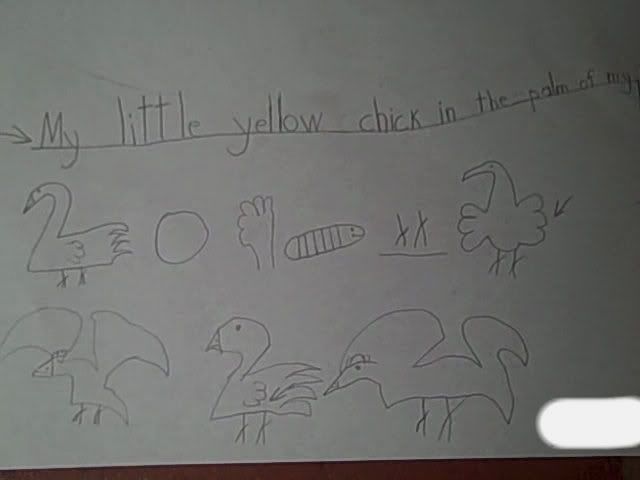
But when on your first day a group of nineteen 6-year-olds spontaneously and simultaneously burst into a song about a little yellow chick in the palm of their hand while you’re trying to teach the basic body parts of a duck you’ve drawn on the whiteboard, you have a good sign that things might get tough. If this song includes mention of a hawk, which scares the chicks into hiding under their desks while the chosen bird of prey stalks the room to catch any straying chick-children, then things are already tough and you have to act accordingly.

Continue reading

Bird Club

For the past two weeks I’ve been planning my bird-related extracurricular activity at Tomás de Berlanga, the school where I’m on my fourth full week of volunteering English substitute teaching for grades 1, 2, and 7-12 (1st and 2nd graders are taught English as a class, and the older students are classified based on skill level—I taught Intermediate for a week and Advanced for two weeks).

I decided on a weekly 2-hour (4-6PM) meeting of what we’d call the “Club de Aves,” the Bird Club, and I sent a small paper invitation and permission sheet home with students of 2nd grade and up. About 50 students brought back responses allowing them to participate, and a dozen or so slips denying permission because the student was otherwise engaged after school (Santa Cruz has a great cycling team that is quite competitive on a national level). Given this unexpectedly high number, I had to supplement my planned Thursday and Friday groups with a Wednesday one: about twenty 2nd, 3rd and 4th graders for Wednesday; thirteen 5th and 6th graders for Thursday; and eighteen 7th-12th graders for Friday.


Continue reading

Target Birds


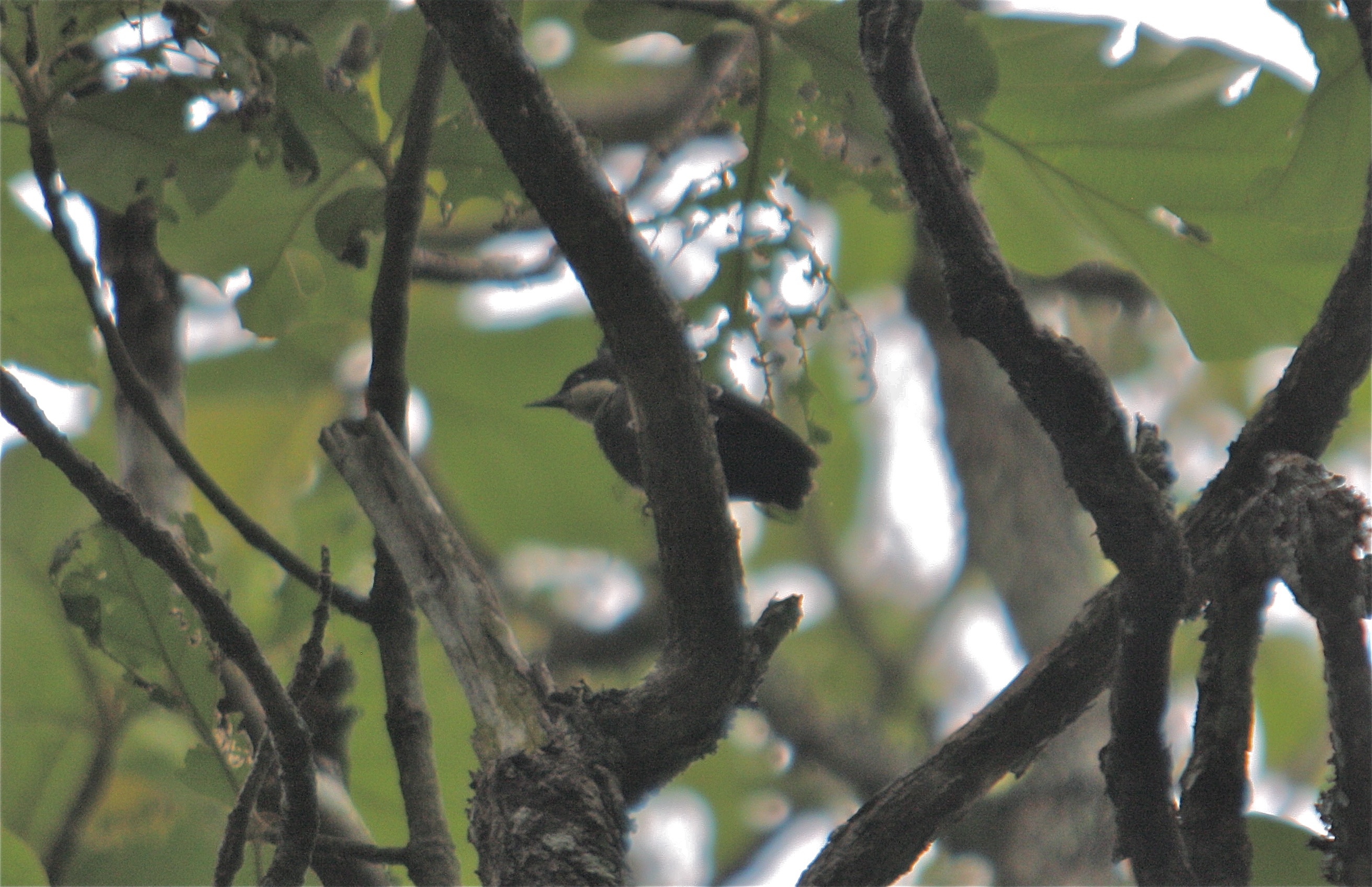
After trying for about half an hour to photograph this little Heart-spotted Woodpecker all I could manage was this photo! I’ll take it!!

Before embarking on a birding trip, I always attend to a few traditions.  First, I get a bird book for the location to which I am traveling, a necessary step in order to familiarize myself with the birds of that region.  When I am birding in the eastern United States, my guide of choice is Sibley’s Guide to Eastern Birds; likewise, when birding in the western United States, I choose its contemporary, Sibley’s Guide to Western Birds.  However, when birding internationally, I have found that Princeton makes unbelievably good field guides for a tremendous variety of places.  I purchased the Princeton Field Guide to the Birds of East Africa for my trip to Kenya, and for this most recent trip, the choice was easy – the Princeton Field Guide to the Birds of India (including Pakistan, Nepal, Bangladesh, Bhutan, Sri Lanka, and the Maldives).

Continue reading

Bird-watching Trips with Tomás de Berlanga Students

Friday morning, at 9:30, my 10th-12th graders and I took two taxis down to Puerto Ayora to look for birds. We started at the intersection between the two main streets of the town: Baltra Rd, which is the same road all the way from the other side of the island at the canal separating Santa Cruz and Baltra, and Charles Darwin Ave, which is the southernmost street in the area and is lined with tourist shops and the ocean.

We walked down Charles Darwin Ave and easily pished some Yellow Warblers from bushes and overhanging trees on the sidewalks. A little space that cut towards the water and was surrounded by artisans’ booths (closed until the afternoon and evening) had a couple cacti with nests in them, and indeed we saw a pair of Cactus Finches fly away as we approached. Looking out over the water, we could see some frigatebirds circling around the Muelle de Pescadores—Fishermen’s Pier—and Brown Pelicans flapping towards it. We returned to the sidewalk and reached a zigzagging plank pathway that wound between red mangroves and led to stairs descending towards small boats moored next to the pier, and from there we could watch the action at the pier and the surrounding water from a good vantage point. Brown Pelicans, both adults in breeding plumage and the greyer juveniles, sat in the water and trees nearby, and waddled among the feet of the fishermen cleaning their fish. A couple of Lava Gulls were also underfoot, as well as a young sea lion!

The same scene awaited us on Monday afternoon, at 12:30PM, when I went back to the Puerto with nineteen 7th-9th graders and a fellow teacher, Andrew. Continue reading

The Road to 1,000 World Birds

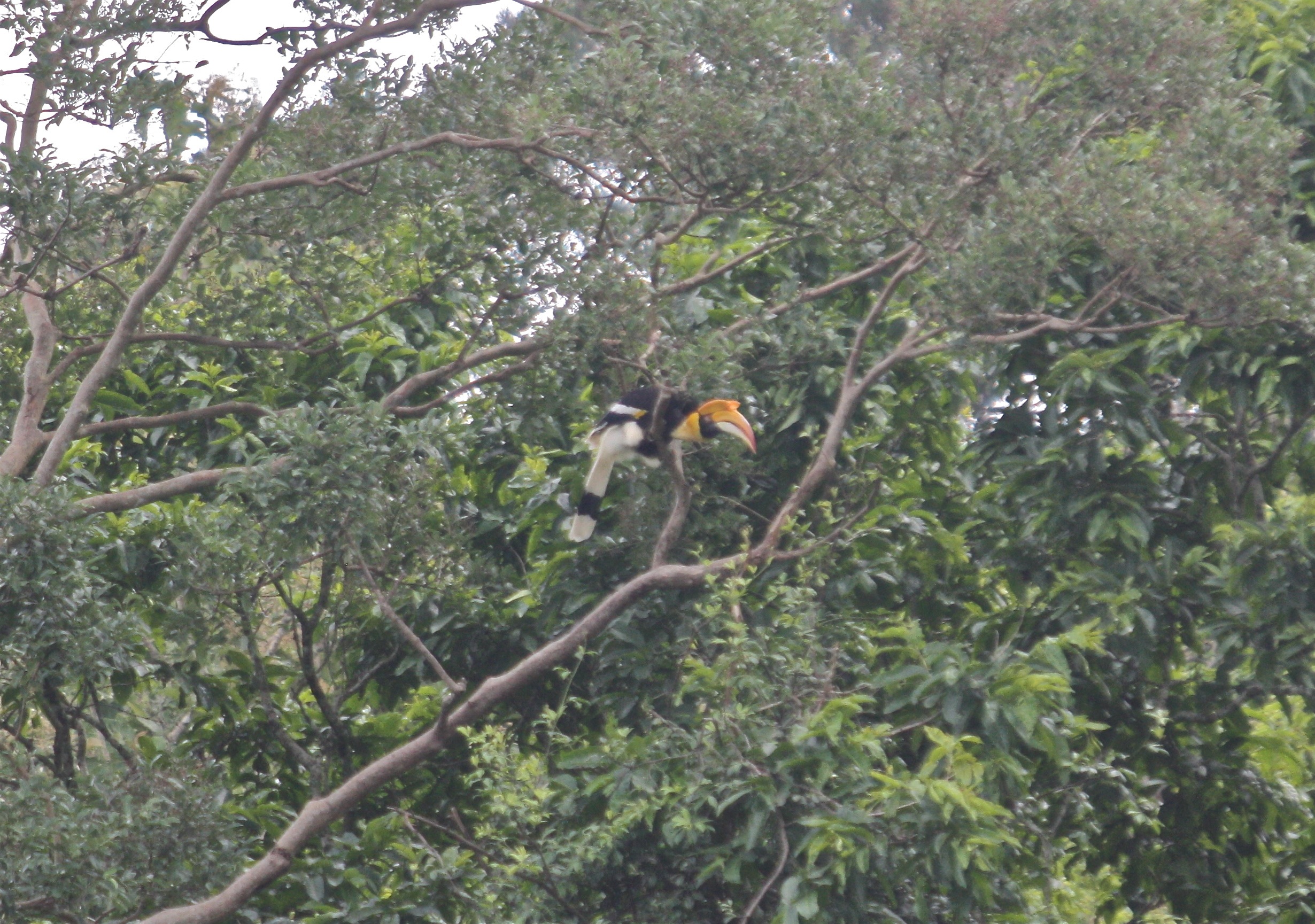
A photo I had to take and post. Although you probably cannot even make out the bird this is #1000,                                      a Grey-headed Fish Eagle

Five years ago, my dad and I walked out of our front door and embarked on my first serious bird walk.  As soon as we stepped outside, a House Sparrow flew from the roof of my neighbor’s house and landed in a nearby bush – #1.  Throughout the next year, the two of us birded New Jersey extensively, adding to my North American life list.  Luckily, New Jersey is one of the best birding states in the country.  It is small enough to travel from one location to another in less than four hours to see any bird that winds up in a place like Cape May or even Stokes Forest in High Point, and located right by the coast, it has become famous for both spring and fall migrants and for seabirds on Sandy Hook and at Cape May Point.  Furthermore, the hawk migration, during the fall months in the mountainous western part of the state, is certainly something to behold and has captivated my interest over the past few years.  Within a year of birding in New Jersey alone, I was able to see 200 birds, my 200th being a Clapper Rail in the marshes at Edwin B. Forsythe NWR.

Continue reading

First Few Days at Tomás de Berlanga: Part 2/3

This post continues the description of my first week working at Unidad Educativa Tomás de Berlanga.

On Wednesday, I started playing soccer with the students during recess. School for these grades goes from 7:10AM to 2PM with a 25-minute break at 9:10AM and 12:15PM, and many of the boys play on the cement basketball court, which is fitted with soccer goals as well. There is actually a bigger court just a half-minute away, but it is essentially made of crushed lava-gravel (the red variety) and when I asked why they didn’t play there I was told the surface is too slippery to run on without falling relatively often. The guys normally play with teams of three or four and play to between one and three goals, rotating the losing team until recess is over.

As the youngest of the teachers here (and probably the least concerned about getting back to class all sweaty), I’m the only one to play soccer, and so far I’ve been on teams with mostly my own students. I think this helps them remember that I’m not just someone teaching them about birds in English, asking them to quiet down, or tell me what I just said, but a person they can have fun with both in and out of class.

Continue reading

Mindo Manakins Video

Here is the video I put together of the manakins in Mindo! I added it to my original post as well.

The video is all of the same branch, but there were at least four or five males in the same 10m radius calling from their own branches, often on the same tree.