Hatched Hats

For several decades after the 1880s, seeing birds on women’s hats in the United States was very common. It was fashionable to have everything from a couple flowing plumes to a whole pheasant on a hat; the ornithologist Frank Chapman found forty species in the millinery district of Manhattan.

Less than a decade earlier, wild passenger pigeons had gone extinct in North America, due to unfettered hunting and deforestation. It looked like the same was happening to several other species, but instead of being hunted for food like the pigeons, these other birds were killed solely for their bodies or feathers.

Snowy egrets and great white egrets were nearly decimated … The millinery trade in the 1880s and 1890s cleaned out tern, heron, gull and egret rookeries up and down the Atlantic coast, from Maine to the Florida Keys. Continue reading

Protecting Penguins

Penguins – one of the most charismatic and charming birds on the planet, and yet very few people ever get the chance to see them. They are not enigmatic, nor are they rare, for the most part. And yet, the majority of people are under the impression that the only penguins living today are the Emperor Penguins, and that they live in the Arctic region. However, not only are the emperors one in over twenty extant species, but no penguins whatsoever live in the Arctic region. In fact, no penguins at all even live in the northern hemisphere – all are native to the southern hemisphere, but not exclusively in icy-cold climates such as Antarctica. They are spread over the entire hemisphere, with significant populations on the east coast of South America, the entire Sub-Antarctic, Oceania, and various islands on the Indian and Pacific oceans.

This slideshow requires JavaScript.

Continue reading

Lights Out!

The Celebration of Urban Birds isn’t just about “Bird Counts” and helping to create welcome habitats for your ornithological neighbors.  Protecting migratory birds is an urgent part of this process.  Just as we work to create and support buffer zones around nature reserves in various parts of the world, we need to think about ways that human lifestyles impact animal health and habitat.

New York City Audubon’s Director of Conservation Susan Elbin states that

Night-time migrants navigate using cues which include moon-light and star position, and may become confused by the glare of tall building lights.

Continue reading

Citizen Science

Bird watchers are everywhere. Countless households around the world sport bird-feeders in back yards, and thousands of photographers like Vijaykumar Thondaman dedicate much of their lives to capturing stunning images. It is practically impossible to believe that anyone could fail to see the beauty in a toucan or quetzal, Latin American species that tourists travel whole hemispheres to see for themselves in the wild.

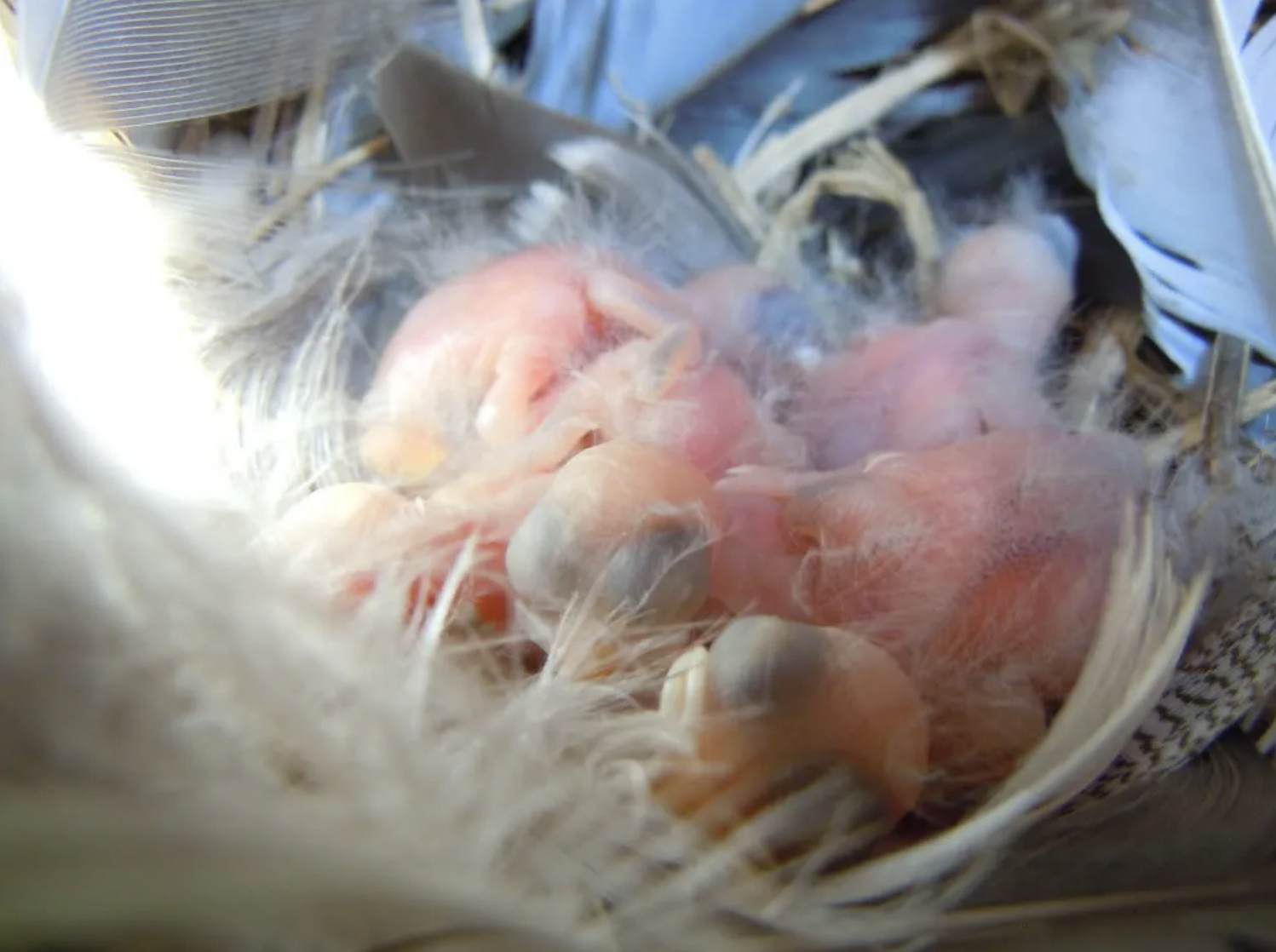
Swallow nestlings studied by Cornell students

Collecting data on birds is a difficult process because there aren’t enough ornithologists to be in the field all the time. But what about the casual bird watchers carrying around their binoculars, the families gathering on their porches to watch hummingbirds flit around flowers, or the schoolchildren staring out the classroom window at the distant and free shadows of birds of prey in the sky? Citizen science involves using these millions of bird lovers as a resource. As one of the world leaders in the study of birds, the Cornell Lab of Ornithology has been using citizen science since 1966, and is involved in many projects that bring bird watchers together while building an impressive database that is used for important research.

Here’s an article on Cornell Lab of Ornithology and the National Audubon Society’s citizen science project eBird.org.

Starting next week I will be working at one of these projects, called Celebrate Urban Birds, managing/deciphering this data and helping people around the country get involved in the surprisingly simple and rewarding experience of watching and identifying birds, whether they have a background in ornithology or not.

Flattering Mother Nature

The Art and Design worlds are constantly giving us examples of our interpretive abilities when it comes to nature.  In fact, the very roots of Art go back to those expressions. But if “Imitation is the Sincerest Form of Flattery” then scientists and engineers are also following the adage that “form follows function” in ways that have the potential to direct us out of some of our environmental problems.

Lindsey Doermann writes about how an elephant’s trunk, water strider’s legs, woodpecker’s beak, peacock’s feathers or a beetle’s back (to name a few) are inspirations toward conservation focused engineering.

Continue reading

Nature’s Art

Our relationship with the natural world has shifted considerably along with our technological advances.

The drawings in Lascaux morphed into Egypt’s hieroglyphs; into Greece’s elaborately painted frescos and urns; into the Renaissance’s Nature morte. 

Photo by Milo Inman

But the more precise the depiction became, the more likely it was that the animal in question had to meet its demise in order to be immortalized. Continue reading

Snowy Charisma

There just seems to be something about Owls.  Wisdom personified.  Avatar of the Greek Goddess Athena and also of the Hindu Goddess Lakshmi.  Which came first?  To complicate matters, in other ancient traditions they represent less desirable qualities (bad omens in Arabian mythology, and death in some African and Mesoamerican cultures).

I can almost picture a Zack Snyder battle on the big screen covering all this territory.

Meanwhile they remain charismatic members of the ornithological world.

According to veteran Owl researcher Denver Holt:

 “People pay attention to owls more than other birds because they look like us,” he said. “They have a symmetrical face, eyes facing forward, a round, flat face and a round head with feathers that look like hair.”

In his New York Times article Jim Robbins writes that owls are not only harbingers but barometers, helping us understand the status of fragile ecosystems.  Daniel J. Cox’s photographs give readers a stunning view of both the owl’s majesty and scientific importance in these studies.

Bird of the Day? Let’s call these Strigiforme ambassadors the Bird of the Hour!

Kingfisher – Messenger of Hope

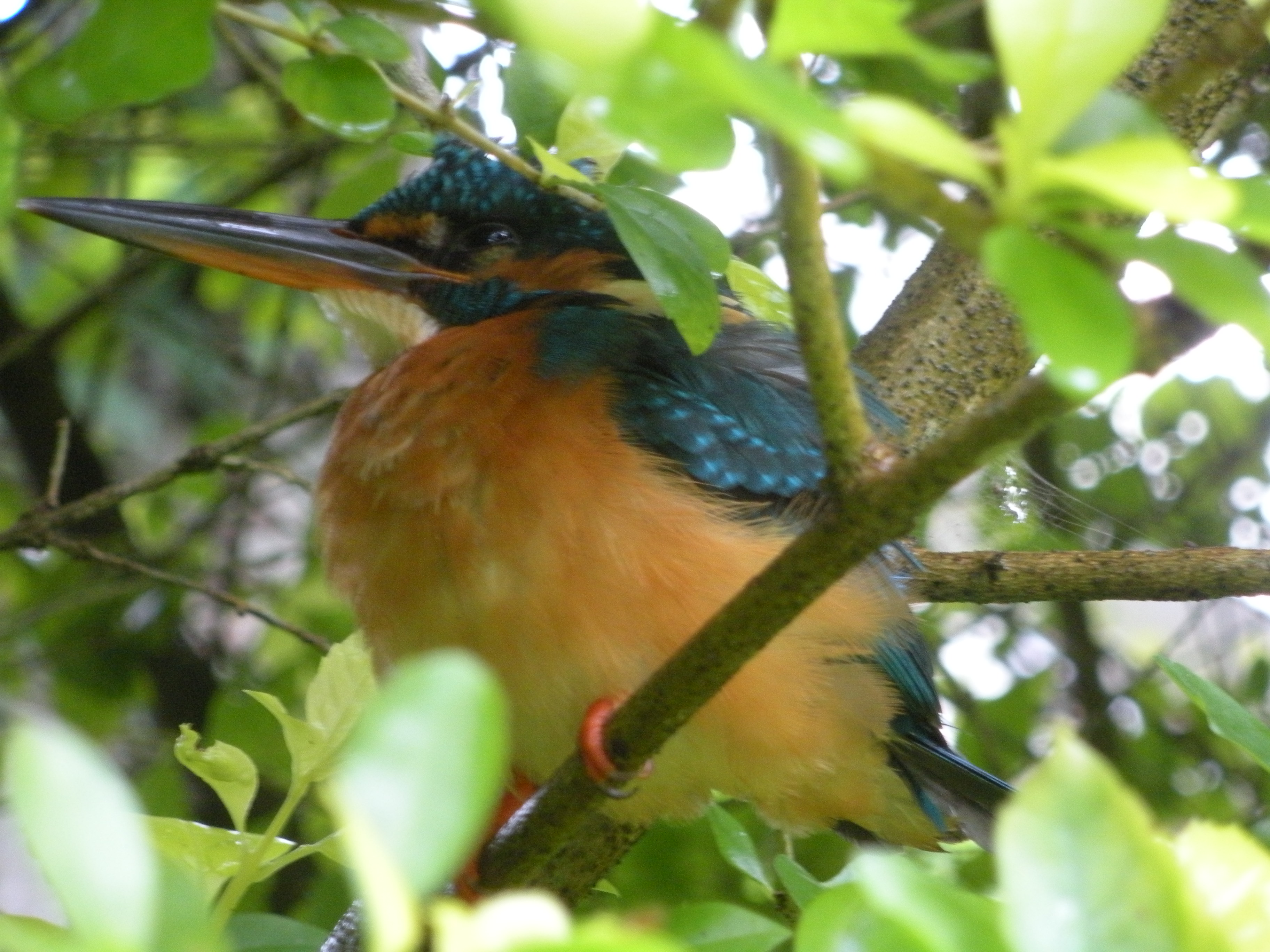
BAM! The usual silence of the internet café at Cardamom County is suddenly and startlingly broken as one of its large windows deflects a wayward bird. The bird, a kingfisher with feathers as vibrantly colorful as nature allows, lay still in the bush, ostensibly lifeless.

This is how my morning started, but thankfully, not how it ended. I quickly ran next door to the gift shop seeking help from Manoj, guest relations executive, thinking that he might know what to do. We approached the bush to find the bird still breathing. Manoj tugged at it gently, expecting to extract a paralyzed, fading animal. Then, with the same unexpected abruptness that it collided with the windowpane, it fluttered and flew away, as if all it needed was to be untangled from the branches it landed in. The kingfisher, disoriented, had another less than graceful clash, this time with the bushes that line the pool. Fearing again the worst, I approached, and it took flight again, finally landing as intended, perched on the branch of another of the poolside shrubs. It was stunned. As it took its time recollecting itself, I ran and got my camera to snap these photos.

Continue reading

Visit with Vijaykumar Thondaman, “Bird of the Day” Photographer

Today we had a visit from a very important contributor, Mr. Vijaykumar Thondaman, the generous gentleman whose remarkable photography skills and passion for wildlife have furnished us with the ever-popular “Bird of the Day” series.

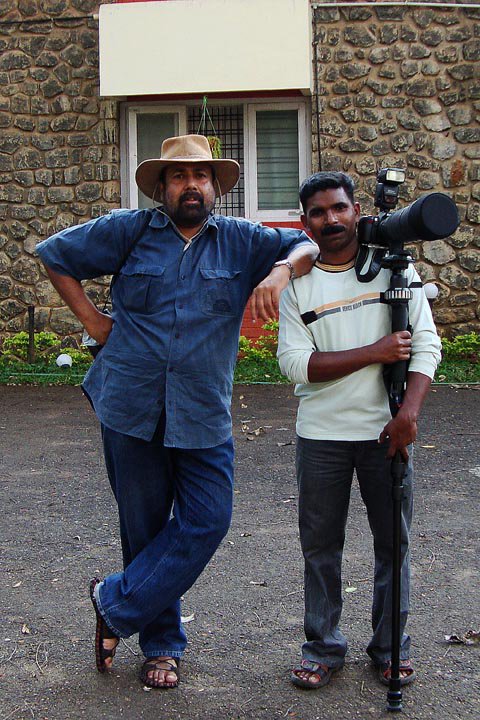
We forgot to snap a photo so we stole this one of Mr. Thondaman (left) with assistant Jayan

Sipping tea and chatting with Vijaykumar was not only an honor (in addition to being an accomplished wildlife photographer and naturalist, he is the nephew of the Late His Highness Raja Rajagopala Thondaman, the ninth and last ruler of the erstwhile Pudukottai State), but it was also an educational exploration of the feathered fauna of southern India. With a palpable passion for the subject, his ornithological knowledge is the consequence of a unique upbringing, as his father, Maharajkumar Radhakrishna Thondaman, maintained a mini zoo with blackbuck, sambar, chital, barking deer, four-horned antelope, foxes, crocodiles, pythons and wild and imported birds. More specific than his father’s captive collection was his small ornithological museum where Vijaykumar learned taxidermy at a young age. Vijaykumar grew up in the 100-acre campus of the New-Palace (the present Collectorate), which had a collection of rare trees and shrubs and wildly roaming peacocks, rabbits, partridges, quails, blackbucks and chitals, none of which exist there anymore. His love affair with wild-life, however, has been an indelible part of his life ever since. Continue reading

Brown Hawk-Owl

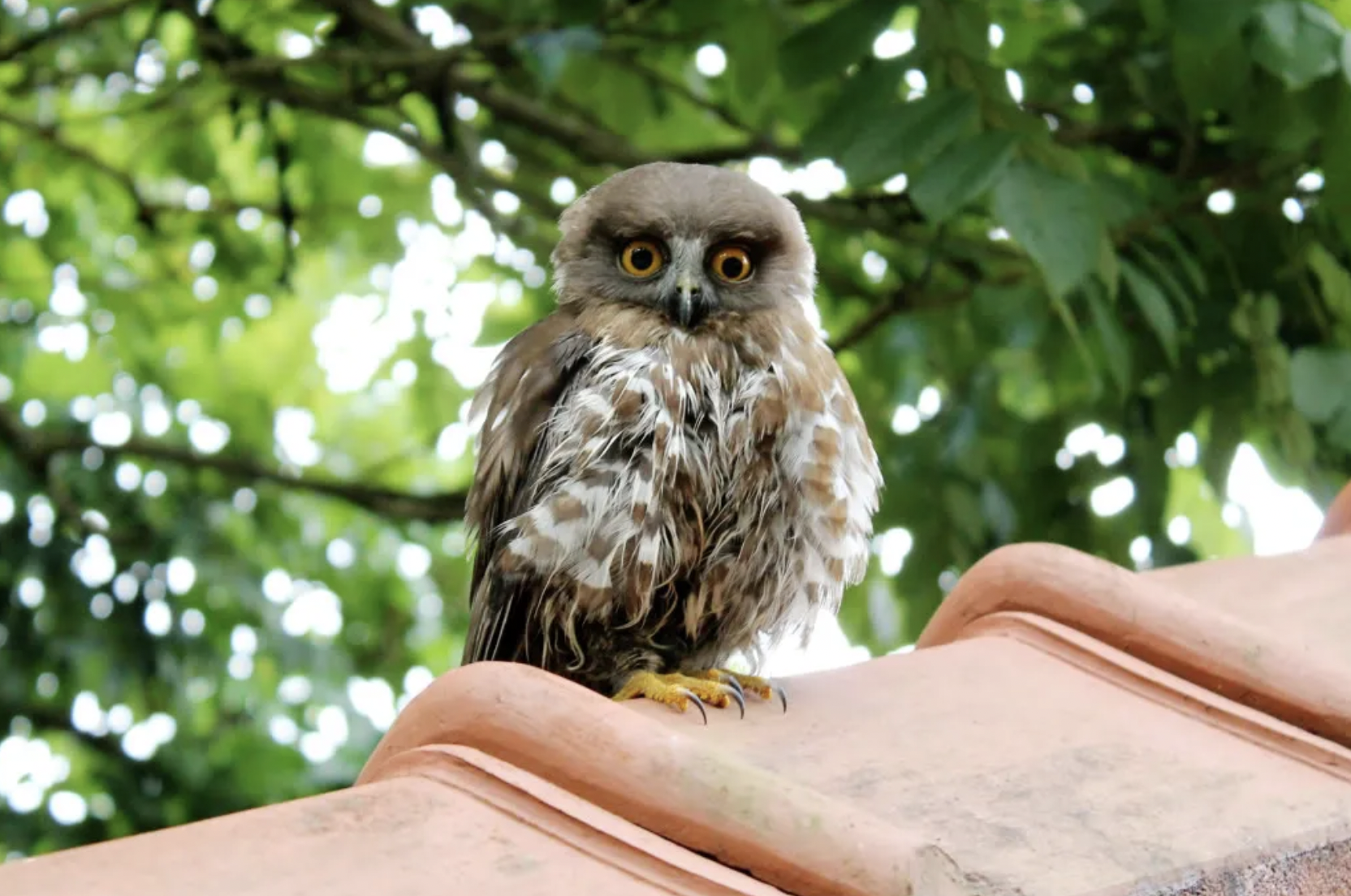
On the morning of Diwia’s paper-bag workshop, the team was pleasantly surprised by what could only be considered a portent of success and good luck – a small owl was perched on the roof of reception, in plain sight during the daylight hours. I was summoned forth with my camera, and was fortunate that the owl still hadn’t alighted by the time I arrived, rubbing the sleep out of my eyes.

Continue reading

Sri Lankan Frogmouth

Early yesterday morning, Gourvjit and I met Saleem and Deepthi, a graphic designer who was collecting information about wildlife in the Periyar, for a trek into the forest. Because Gourvjit and I had recently been with Amie and Milo on a path typically followed from the boat landing–which was where we were meeting our guide this morning–to avoid touring the same land we asked the guide to lead us on a different route. He told us there was one which might yield some interesting wildlife sightings, but that the terrain would be a bit more difficult. We took the challenge, of course.

What our guide had neglected to tell us then, but which we soon realized, was that the route he had planned for us to take wasn’t really a ‘route’ at all. That is to say, to make our way we had to cut through 7 ft tall elephant grass and other underbrush, and we followed no well-worn groove in the dirt, or footpath. But in this manner we carved our way up a hillside, conquering some slippery rocks under foot, to a clearing, from which we could see a broad landscape of savannah hills and waterways.

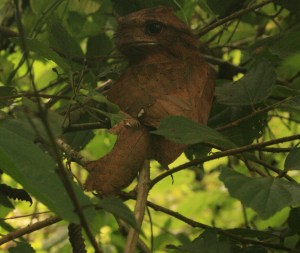
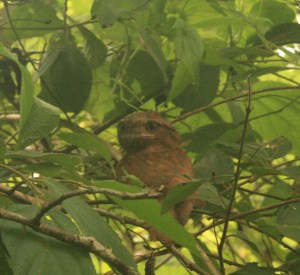
Yet on the way down from the clearing these minor travails were justified as, after tramping through another patch of thick grass, our guide told us to be still while he pointed to what looked like a lump of tree–but with eyes. Deepthi whispered to me that we were seeing a Sri Lankan (or Ceylon) Frogmouth, a nocturnal bird native to the Western Ghats, whose skill at camouflage makes you about as likely to spot it as one of the Periyar’s 50 tigers. I can say very honestly that I have never seen a bird I was so taken with, with its wide-set and perfectly round eyes, and its blocky, brown, and perfectly rigid form. Because the Frogmouth hides in the daytime by keeping still, we were able to get unusually close to it for a good while before it was threatened and flew off to a tree with thicker foliage.

It was a really unique experience to see this bird, and one I’ll not soon forget. Luckily, Deepthi was able to capture some great shots of the bird. Check them out!