If You Happen To Be In New York City

Richard Serra, left, and Philip Glass in the 1970s. Credit Richard Landry

Richard Serra, left, and Philip Glass in the 1970s. Credit Richard Landry.

Two Raxa Collective contributors remember reading and discussing a profile of Richard Serra a dozen years ago (linked in the announcement below) in advance of a visit to the architectural wonder in Bilbao, Spain created by Frank Gehry. Serra’s persona, his strong views on the boundaries between art and architecture, enrich the viewing experience of his sculpture, especially if that sculpture is viewed within a Frank Gehry building. Now there is an opportunity to experience Serra’s sculpture in the context of one of the most revered living composers.

If you are a fan of cross-arts collaboration, this upcoming performance should be on your radar.  If you have been looking for a way to make a contribution to solve a specific problem related to the recent earthquake in Nepal, then the only question is whether you will be in New York City on June 27 when these two luminaries in their respective field offer a remarkable such opportunity:

The composer Philip Glass once worked as an assistant for the sculptor Richard Serra, after the two befriended each other in Paris in the early 1960s and swapped cultural touchstones.

Continue reading

Who Baked the Brownie and Made Tea?

The open-hiring policy at Greyston Bakery in Yonkers, N.Y., invites local residents to apply for jobs — regardless of their immigration status, whether they have criminal or drug records, or even prior work experience PHOTO: GREYSTON

The open-hiring policy at Greyston Bakery in Yonkers, N.Y., invites local residents to apply for jobs — regardless of their immigration status, criminal or drug records, or even prior work experience PHOTO: GREYSTON

We know a ‘community’ story when we read one. More so when we share its ethos. The one about people making and being the difference. Whether you stay with us at our waterfront property, Xandari Harbour, in Kochi or by the virgin beach at Mararikulam or even sail with us on the backwaters, you are bound to notice ‘our’ people. Their cheery smiles, readiness to help and the spirit of being perfect hosts make for the memories that guests so often write back about. And when we came across the wonderful community at Greyston, we knew we’d found our kin across the seas.

Continue reading

The Two People of a Land

First Nations peoples are also excessively marginalized in the public health system, and at least 1,200 aboriginal women have been reported missing or murdered over the past 30 years PHOTO: Daniella Zalcman

First Nations peoples are also excessively marginalized in the public health system, and at least 1,200 aboriginal women have been reported missing or murdered over the past 30 years PHOTO: Daniella Zalcman

Indigeneity comes at a premium today. From the hyper-local experience of taking local buses or tuk-tuks to food that is loudly ‘branded’ as authentic and traditional, the focus is on the native narrative. Today is also about the stories and people of the land – often oppressed and relegated to numbers of casualties until acknowledged, rehabilitated, and apologized to. Like the indigenous population of Canada.

Our languages are coming back. Our songs are coming back. But not everything is returning — some things have been lost forever. That’s the price of our ancestors being forced to assimilate – GRAHAM PARADIS, OJIBWE AND MÉTIS

Continue reading

How do you Say “Butterfly” in Malayalam?

Photo by James Zainaldin

We have a history of sharing butterfly photos here, primarily from Kerala (ചിതശലഭം, by the way, is Malayalam script for “citaśalabhaṁ,” or butterfly) and Costa Rica (“mariposa” being the Spanish name for the insects) but also in miscellaneous nature posts by our contributors. We also have a bit of a connection to the Smithsonian Institution, and are always happy to hear about friendly, creative polyglots, in this case from the New York Times:

Amid Butterflies, a Bit of a Lingua Franca at the Natural History Museum

 20, 2015

On a recent Sunday, Holly Tooker stood by the transparent wall inside the Butterfly Conservatory, at the American Museum of Natural History. It was, as always, 81 degrees with 78 percent humidity, and it had been a busy morning. Nearby, a giant Danainae butterfly perched on a

Continue reading

Check This Out

anarc71

We watch the comments and forwarding links on each of our posts, and there have been many fellow travelers over the years coming and going from our community. Here is one fellow we would like to point your attention to, first to thank him for his shoutout of our site; second because we like the name Milo, which got us to click his link; third we find his message kindred to our own; and last but not least because of the graphic above, which is worth more than a thousand words.

Leopards And Humans Peacefully Cohabitating In India

An elderly priest descending to Perwa village from a temple devoted to Lord Shiva on Perwa Hill where he lives, one of the many holy slopes in the region that is also home to leopards. Credit Richard Mosse

An elderly priest descending to Perwa village from a temple devoted to Lord Shiva on Perwa Hill where he lives, one of the many holy slopes in the region that is also home to leopards. Credit Richard Mosse

If you are coming to visit one of Raxa Collective’s properties in south India, and want a recommendation for a visit to another part of India, this may be on our to do list (we need to go check it out first, and will let you know):

Life Among the Leopards

Continue reading

If You Happen To Be In New York City

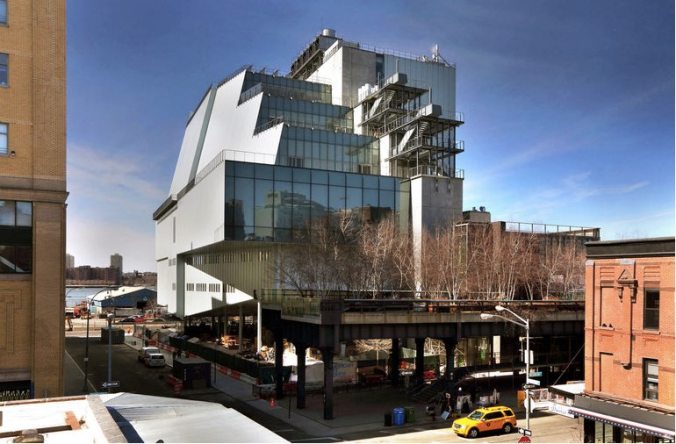
Whitney Museum of American Art. Photograph by Ed Lederman

Whitney Museum of American Art. Photograph by Ed Lederman

We have a thing for public spaces, especially when they combine with community activism. We try to get firsthand experience, and when we have learned enough about such places, we share what we can here. Ditto for museum exhibits, special library exhibitions, and unusual library thingys. It is not every day we get to announce the opening, or re-opening, of one of the greatest museums in the world, right in the midst of such a public space:

THE NEW WHITNEY OPENS MAY 1, 2015 BUY ADVANCE TICKETS NOW

The reviews convince us that this will be worth the visit, and this particular wording puts it in perspective:

The Whitney Museum of American Art, long the odd duck among the Big Four of Manhattan art museums—a cohort that includes the mighty Metropolitan, the starry Modern, and the raffish Guggenheim—takes wing on May 1st, when it reopens in a new, vastly expanded headquarters downtown. The fledging owes a lot to the Italian architect Renzo Piano’s ingenious building, on Gansevoort Street, which features six floors of shapely galleries, four open-air terraces, spaces for performance and screening, a library and reading rooms, a restaurant, a café, and an over-all feeling of seductive amenity—a bar on the piazza-like ground floor bodes to be one of the toniest trysting spots in town. It is likely to win far more fans than the Whitney’s old home, Marcel Breuer’s brutalist “inverted ziggurat,” which opened in 1966, on Madison Avenue, and which it vacated six months ago and leased to the Met. Piano’s museum stands at the southern end of the High Line and hard by the Hudson River, in what remains of the tatterdemalion meatpacking district. It looms like a mother ship for both gallery-jammed Chelsea, to the north, and the puttering West Village, to the south. It is instantly a landmark on the cultural and social maps of the city—and on its poetic map, as a site to germinate memories. Continue reading

Ethiopia, Diaspora, Community, Success

21MARATHONweb3-sfSpan-v3

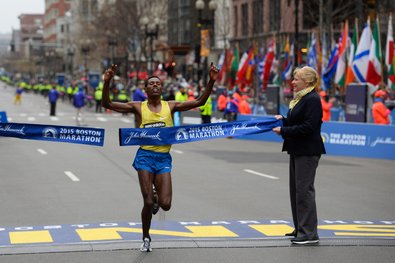
C.J. Gunther/European Pressphoto Agency. Lelisa Desisa crossing the finish line. As he rounded Hereford Street for a well-honed sprint to the finish, he cast off his hat in pre-emptive triumph and waved to the crowd.

Today’s news about an Ethiopian man winning the Boston Marathon gives me the hook to write a post that has been on my mind since Friday. Back before I knew much about Ethiopia from actual experience, I heard an interview with a man from Ethiopia, an emigre in New York City. Adopted man. Adopted city. And a worldview, a lifeview, that I could relate to with a powerful intensity that I did not fully understand at the time:

This Time, Lelisa Desisa Wins Boston Marathon for Himself

Something in that interview began changing the structure of my thoughts about Ethiopia. And then within months of that one of our colleagues from the Zaina Lodge project started telling me that the next place I “must, must, must” explore is Ethiopia. The dial moved even further because that colleague told me stories I could hardly believe about the beauty of Ethiopia. And when I finally made my first visit, I was nonetheless awed beyond what the colleague had led me to expect. So, Ethiopia has been on my mind every day for a couple months now.

And then a couple of days ago, another Ethiopian emigre to New York City checked in to Marari Pearl. Continue reading

Danish Can-Do Greenery

Screen Shot 2015-04-10 at 5.53.12 AM

Read a bit about their work, mission and invitation, and contagion takes on a new meaning:

Sustainia is a think tank and consultancy headquartered in Copenhagen, Denmark. We identify readily available sustainability solutions across the world and demonstrate their potential impacts and benefits in our work with cities, companies, and communities.

By focusing on innovative breakthroughs, inspiring alternatives and new opportunities, Sustainia is shaping a new narrative of optimism and hope for a sustainable future that seeks to motivate instead of scaring people with gloom and doomsday scenarios. Continue reading

From The Department Of Save It For Later

Screen Shot 2015-04-09 at 4.58.56 AM

Anyone, anywhere, who believes that something is worth saving (preserving, conserving, protecting, etc.) enough to dedicate time and effort, among other resources, we are likely to support it however we can. Our Bird of the Day feature is an example that goes back to one man’s collection of photographs he took personally containing all the birds, endemic and otherwise, that inhabit and/or migrate through south India. This collection is part of his passionate commitment to wilderness conservation in Kerala and other neighboring states.

We asked, in 2011, if Vijaykumar would allow us to publish his photographs in the interest of promoting conservation. He said yes. By now we have probably published all of the collection as it was in 2011, but he is still photographing and contributing. And four years later we have talented birders, many of whom are also exceptional wildlife photographers, contributing their photographs from all over the world. Seth became an employee of the Cornell Lab of Ornithology that same year, and that has led to a whole bunch of other interesting bird-related posts that we host.

Meanwhile New York City has rarely been a subject we cover from a conservation perspective, though its Public Library is of special interest to us. We have not linked to Jeremiah’s blog previously, but it is the type we favor, as you might have noticed, so here goes. Maybe there is more NYC in store for us.

Continue reading

Ecological Intelligence, Desperately Needed, Requires Social Intelligence, The Foundation Of Which Is Individual Emotional Intelligence

Screen Shot 2015-04-08 at 11.41.53 AM

To do what we do, at Raxa Collective, and to do it well, and to succeed, requires alchemy. We are neither sure we are doing it, nor how to do it, nor whether it can be explained; thus, alchemy. No formula. For those of us with management education, of a certain age, there was a certain author who brought alchemy closer to theory, and so closer to the grasp. A conceptual grasp more often than an actual grasp. Mastery? Not even close. But try? Yes. In the beginning it was all about emotional intelligence, but expanded in interesting directions to now include even ecological. Important ideas. Powerful tools. In the current Education section of the New York Times, a small dose that helps understand why:

How to Be Emotionally Intelligent

What makes a leader? Knowledge, smarts and vision, but also the ability to identify and monitor emotions and manage relationships.

Northern California’s Public Media Shares Art History With Communities Local And Global

Sonya Noskowiak, Calla Lily, 1932. (Courtesy Center for Creative Photography)

Sonya Noskowiak, Calla Lily, 1932. (Courtesy Center for Creative Photography)

Thanks to KQED (Public Media for Northern California, including National Public Radio and Public Broadcasting System, both of which would have the Raxa Collective seal of approval, if such a thing existed, for their excellent service to their communities) for this story of a not well enough known photographer:

Sonya Noskowiak: A Groundbreaking but Forgotten Photographer

By Matthew Harrison Tedford

…Another photograph, Calla Lily(1932), also possibly shown at the de Young, demonstrates Noskowiak’s thoughtful treatment of light. The flower’s milky white spathe is set against a vacuous black background. The flower appears as if floating, but the light falls on the veins of the leaves, grounding the luminous spathe.

A work titled Sand Pattern (1932) looks like aerial photographs of the Sahara or a satellite image of some uncharted Martian desert. Tentacles of sand stretch out in all directions as if they’re grasping for a nearby oasis. The sand resembles the aluminum powder found in an Etch A Sketch, almost shimmering. In actuality, the patterns might cover an area no larger than a footprint, possibly on a Carmel beach. Continue reading

Disrupting The Odds

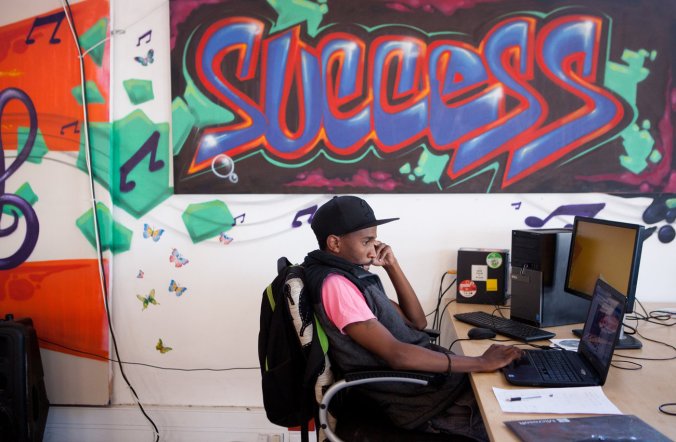
An entrepreneur uses his laptop near graffiti-decorated walls at Hubspace in the Khayelitsha township. Emily Jan/NPR

An entrepreneur uses his laptop near graffiti-decorated walls at Hubspace in the Khayelitsha township. Emily Jan/NPR

Entrepreneurship always catches our attention, especially when the odds appear long from the standard perspective:

Far From Silicon Valley, A Disruptive Startup Hub

EMILY JAN & ADAM SEGE

Starting a business is tough anywhere.

But when you live in a place where many people lack basic services, such as electricity and toilets, it’s even harder.

These are the obstacles facing new business owners in South Africa’s townships — sprawling communities designated for nonwhites during apartheid. Apartheid may be history, but two decades into democracy, townships remain overwhelmingly disadvantaged.

Internet service and office space are difficult to come by. There are few sources of investment from within the community, and if you manage to interest a potential funder who is an outsider, you have to hope you can manage to travel to a meeting.

Continue reading

Green, Greener, Greenest–Which City? Says Who? And How?

260cd679-e63d-417f-84b1-be816cf7f658-2060x1236

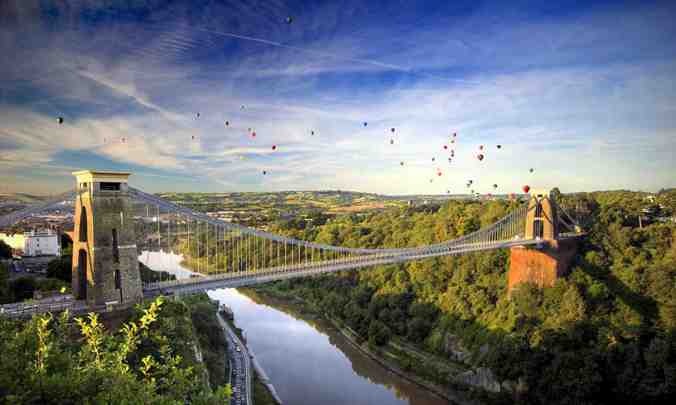
The Clifton Suspension Bridge in Bristol, 2015 Green Capital of Europe. Photograph: Destination Bristol.com/EPA

This is one of the environmentally-oriented rankings that many of us think about, from time to time, and then throw our hands in the air in frustration at the criteria used for judging green-ness, or what is often green-ish-ness. Thanks to the Guardian for asking the questions we want answered when it comes to rankings like this:

Where is the world’s greenest city?

Bristol is the ‘green capital’ of Europe, but its predecessor Copenhagen comes top in a Europe-wide index. Curitiba, San Francisco and Singapore all have strong eco-friendly claims too – so what’s the best way to compare cities’ greenness?

It’s easy to say we’d like our cities to be cleaner and greener. But what does that even mean? “Greenness” is a concept that’s hard to pin down – there’s no official list of the top 50 most eco-friendly cities, nor any widely agreed set of measurements for working out how green a city actually is.

Continue reading

Citizen Farmers

Photo credit: Pattie Baker

Photo credit: Pattie Baker

As we “plant to the menu” at Marari Pearl we’re constantly looking at the inspiring stories of people who make the choice to stay connected with the land and the food we eat.

We met “Farmer D” when we participated in a newly created community garden while living near Atlanta. He and his family are now sowing seeds in California, and we know that he continues to spread the fruitful good word.

ABOUT THE BOOK
Biodynamic farming, with its focus on ecological sustainability, has emerged as the gold standard in the organic gardening movement. Daron Joffe (known as Farmer D) has made it his mission to empower, educate, and inspire people to become conscientious consumers, citizens, and stewards of the land. In this engaging call to action, Farmer D teaches us to not only create sustainable gardens but also to develop a more holistic, community-minded approach to how our food is grown and how we live our lives in balance with nature. Continue reading

Place, Memory And Experience At Present

Screen Shot 2015-03-20 at 7.02.51 AM

Our kind of project, and we look forward to the experience:

MADE WITH KICKSTARTER

In Japan, a Farmhouse Becomes a Journalist’s Elegy

Memory Restoration

Normally we avoid posting on what can be viewed as corporate advertisement, but we have to applaud the use of technology to assist in the healing process after the devasting Tōhoku earthquake and subsequent tsumani in 2011. Thousands of lives were lost, and survivers suffered the additional trauma of losing their homes, including the photographic mementoes of their loved ones.

Ricoh used their expertise in office imaging equipment to coordinate an amazing effort of 518 employee volunteers to find, clean and digitize  418,721 photos, returning 90,128 pictures to the people who lost them.

Ricoh is now offering a glimpse of how this monumental effort was conducted for future reference. The company would be delighted “if this record is useful for improving awareness towards disaster prevention or reconstruction support activities after the event of a disaster,” it says. Continue reading

Redefining Recycling

In the early years of this site we highlighted a concept of “the fourth r” – focusing on the restaurants and events planners who support a form of social entreprenuership by donating excess food to local shelters. On an annual basis huge amounts of prepared foods go to waste in all forms of venues, but the classic buffet-style cafeteria is a long-term culprit. But luckily creative solutions have gone hand-in-hand with awareness of the problem. At the time we used the term “recycled” when taking about the food programs. Kudos to the new voices who redefined at as “repurposed.”

Back in 2011 when I was a student at the University of Maryland in College Park I once noticed a massive pile of trash in front of a dining hall. A closer look revealed that it was mostly food — a half-eaten sandwich, a browning apple and what appeared to be the remains of the day’s lunch special.

The heap was gross, but intriguing. Turned out it was a stunt to get students thinking about how much food they throw out each day.

Nowadays, students are coming face to face with their food waste, and its environmental and social impact, a lot more often. They also have more opportunities do something about it. Continue reading

Hackers, Lentils & Love In A Flower Bed

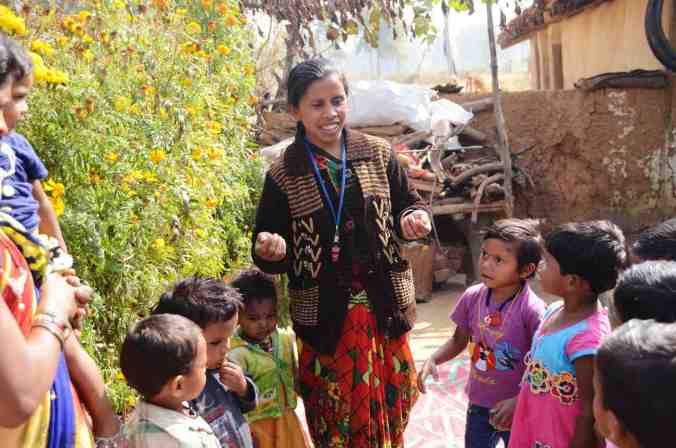
Nursery worker Shivkumari Pate leads children in a learning song. Pate works with the nonprofit Jan Swasthya Sahyog, which developed the first network of community nurseries. Ankita Rao for NPR

Nursery worker Shivkumari Pate leads children in a learning song. Pate works with the nonprofit Jan Swasthya Sahyog, which developed the first network of community nurseries. Ankita Rao for NPR

It would be remarkably easy to fill these pages with stories from India, from various places in Africa and Latin America where we also have projects, that give a strong sense that no matter how quickly solutions get hacked, there are more problems than can possibly be resolved; we spare you those most of the time. Instead, we point to stories like this one (thanks National Public Radio, USA):

…For decades, aid organizations tried to improve the health of moms and babies in Chhattisgarh. Little made a dent. But then a garden of flowers rose up in the state. Continue reading

Neighbors Unite

Photo credit: Davebloggs007/Flickr

Photo credit: Davebloggs007/Flickr

Many of the RAXA Collective contributors could could easily get behind  the motto: “Book Lovers Unite!”; many could be found with their noses in a book from early childhood to the present day. So when we read about these “pop up libraries” in various parts of the country the only response possible was excitement.

Books are an essential part of culture and the LFL concept of sharing creates an even greater community bond worth conserving.

Three years ago, The Los Angeles Times published a feel-good story on the Little Free Library movement. The idea is simple: A book lover puts a box or shelf or crate of books in their front yard. Neighbors browse, take one, and return later with a replacement. A 76-year-old in Sherman Oaks, California, felt that his little library, roughly the size of a dollhouse, “turned strangers into friends and a sometimes-impersonal neighborhood into a community,” the reporter observed. The man knew he was onto something “when a 9-year-old boy knocked on his door one morning to say how much he liked the little library.” He went on to explain, “I met more neighbors in the first three weeks than in the previous 30 years.” Continue reading