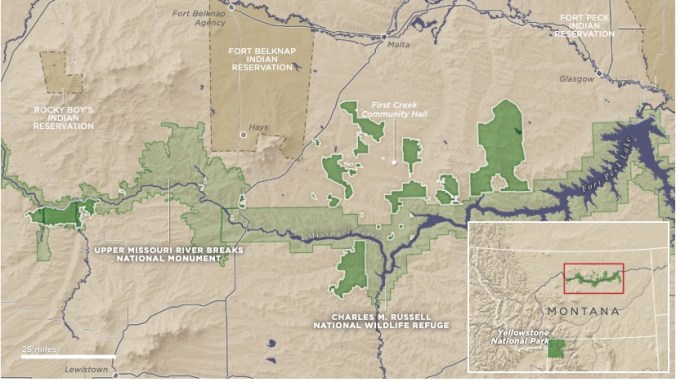
American Prairie Reserve’s Patchwork Of Properties
American Prairie Reserve’s purchased and leased land is shown in green with white borders adjacent to Upper Missouri Breaks National Monument and Charles M. Russell National Wildlife Refuge. Together, these parcels complete a network of land larger than Yellowstone National Park, the second-largest national park in the Lower 48 states. Source: American Prairie Reserve, Montana State Library, U.S. Geological Survey 1 Arc-Second SRTM, Natural Earth, Montana Department of Transportation, U.S. Census Bureau, National Park Service
Credit: Daniel Wood/NPR
Hats off to Sean Gerrity, as well as to the farmers and ranchers who have kept the native prairie grasses intact in recent generation, and to the native communities who stewarded these lands long before all this became a story. Our thanks to National Public Radio (USA) for sharing the story:
Big Money Is Building A New Kind Of National Park In The Great Plains
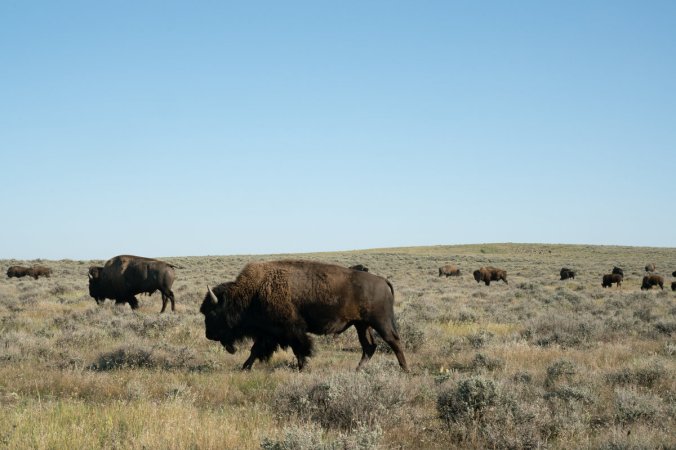
Bison walk on American Prairie Reserve land. The organization is slowly purchasing ranches from willing sellers, phasing out the cows and replacing them with wild bison. Claire Harbage/NPR
This story was supported by the Pulitzer Center on Crisis Reporting.
A privately funded, nonprofit organization is creating a 3.2 million-acre wildlife sanctuary — American Prairie Reserve — in northeastern Montana, an area long known as cattle country.
Sean Gerrity founded the American Prairie Reserve more than 18 years ago after he moved back home to Montana from Silicon Valley, where he ran a firm that consulted for companies such as AT&T and Apple.
Claire Harbage/NPRBut the reserve is facing fierce opposition from many locals because to build it, the organization is slowly purchasing ranches from willing sellers, phasing out the cows and replacing them with wild bison. Those private properties are then stitched together with vast tracts of neighboring public lands to create one giant, rewilded prairie. The organization has purchased close to 30 properties so far, but it needs at least 50 more.
“I see them coming in with big money, buying up ranches and walking over the top of the people who are already here,” says ranch owner Conni French. “For them to be successful in their goals, we can’t be here, and that’s not OK with us.”
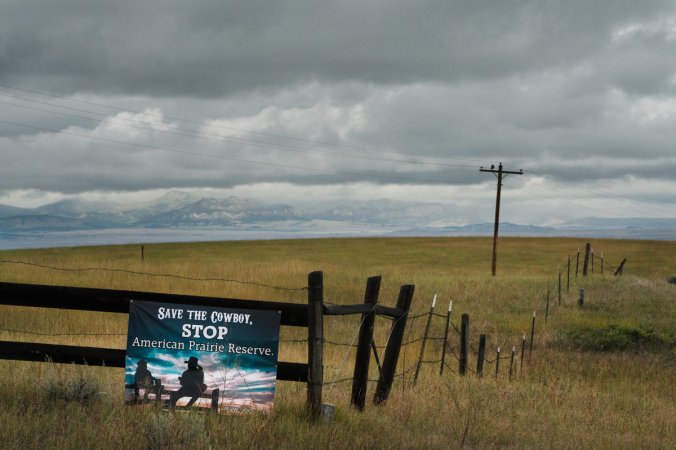
She isn’t alone. Driving around, you see signs everywhere that say, “Save The Cowboy, Stop The American Prairie Reserve.”
A “Save the Cowboy” sign is posted along a fence. The “Little Rockies” on the Fort Belknap Indian Reservation are seen in the distance. Claire Harbage/NPR
But the project’s efforts have garnered a lot of positive attention from those living outside northeastern Montana because, once it’s complete, it will be the largest wildlife sanctuary in the Lower 48 states — about 5,000 square miles, nearly the size of the Serengeti National Park in Tanzania. Continue reading







 I mentioned his coffee
  venture


 Cupping notes on all these later. For now, a puzzle. The name of the coffee company, Organikos, harkens to an older and broader set of meanings related to the word organic. Not strictly the certification for all-natural food production, but a wider selection of good outcomes. We chose only one certified-organic coffee among our twelve coffee offerings. It happens to be from one of the less well known regions, Brunca, in the south bordering Panama. To our surprise, this has been our top-selling coffee so far. We promoted it only as organic, but it is also a single estate (
 It is not surprising that organic coffee sells well, but it is puzzling to me that it outsells by such a large margin a certified fair trade coffee from Costa Rica’s most recognizable region of origin. Not to mention that this fair trade coffee is produced by one of the country’s most respected cooperatives.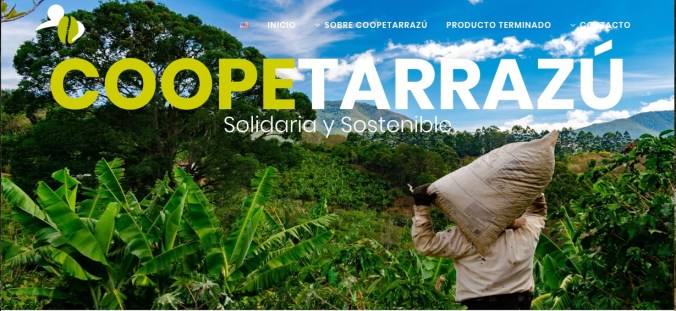
 Organikos