A Man, A Plan, A Grain of Sand

Newspaper editor Brendon Grimshaw bought an “abandoned” Seychelle island in the 1960s and spent the rest of his life lovingly creating the habitat that is now Moyenne Island National Park, part of the Ste. Anne Marine National Park.

Together with a Seychellois named Rene Lafortune Grimshaw transformed the island, planting 16,000 trees by hand, including native hard woods such as mahogany.  The trees attracted birds (some 2,000 make the island their home), and Grimshaw himself reintroduced over 100 giant tortoises, native to the Seychelles but almost hunted to extinction in the early 1900s. The labor of love resulted in Moyenne island now holding more than two thirds of all endemic plants to the Seychelles as well as the Seychelles government standing firm against the multiple advances offering millions of dollars to”develop” the island after Grimshaw’s death. Continue reading

Save Our Species (SOS) Needs Your Help

This slideshow requires JavaScript.

The IUCN released the most recent list of 100 Most Threatened Species last week.  Read it and weep.  Or get activated.  Look at what SOS is doing and see what you can do to make a difference.

Droning On About Conservation

In a world where funding for national parks and rangers isn’t always in the budget, conservationists have to look to technologies to help protect the millions of acres that some of the world’s most threatened species make their home.  The World Wildlife Fund has developed remote controlled planes that use simple enough technology to be launched by hand and be powered by rechargeable electric batteries.  Click the image above to go to the story in the BBC:

Conservationists in Nepal will soon start using special drones…developed by the global wildlife organisation, WWF. Continue reading

Conservation Crossroads, Asia

Click the headline above to go to the story:

On Sept. 1, 1914, the last passenger pigeon on earth died in captivity at the Cincinnati Zoo. The species, once numbering in the billions, had been hunted to extinction.

Around the same time, another iconic North American species, the bison, was also being hunted past the point of no return. But the bison didn’t die off steadily until the last one perished in an enclosure. Continue reading

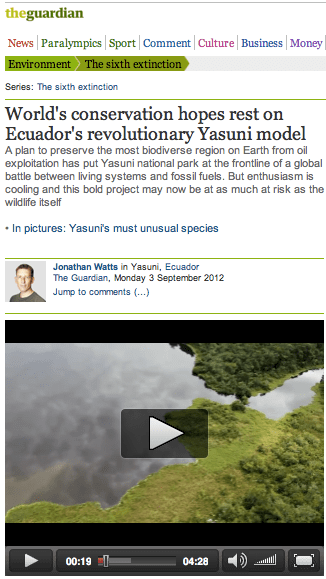
Yasuni Model Of Conservation

Click the headline to go to the story:

In their first hour in Yasuni’s Amazonian forest, many people will see more creatures than they have seen in their entire lives, including some that have yet to be documented by science. To paddle up the Ayango creek that leads from the traffic and pollution of the Napo river into the most biodiverse region on Earth is to encounter a wall of noise, frequent bursts of colour and unimaginable combinations of life.

A tiger heron flaps lazily past our canoe, electric blue Morpho butterflies jolt the eye, spiders the size of an adult’s hand sit on branches, and kingfishers flash past. On a mud bank, a lizard suns itself, while high up in the tree canopy, we catch glimpses of flying monkeys and grunting Hoatzin “stinky turkeys” – prehistoric survivors with claws that grow into wings…

Paul Watson, Sea Shepherd & The Rogue’s Gallery Of Nations After Him

A woman with a Sea Shepherd tattoo, the organisation of marine conservationist Paul Watson (not pictured). Photograph: Thomas Peter/Reuters

Quite a few of us contributing to this site have called Costa Rica home at one point or another and it is probably fair to say all of us admire and respect that country’s pioneering role in modern conservation schemes.  For some of us, it was literally the country that inspired us to do what we do.  But no country is perfect, and at least in one current affair Costa Rica seems to be playing the stooge.  Shame on Germany and especially Japan for their leading roles in this farce. Costa Rica’s official abandonment of its core values should not be winked at, even by those of us who otherwise love the country and its people.  Paul Watson deserves our attention and support (click the image above for his editorial in today’s Guardian, which has played its fourth estate role well in this affair):

I must serve my clients, the whales

I can do that far better commanding the Sea Shepherd fleet than I can defending myself from bogus charges by Japan

Chinnar Wildlife Sanctuary

This slideshow requires JavaScript.

Chinnar Wildlife Sanctuary is located in the eastern part of the high ranges of Kerala’s Western Ghats. It is regarded as one of the unique protected areas in the whole of the mountainous region due to its ecological, floral, geomorphological and cultural significance. The habitat types range from high altitude shola-grassland to dry thorny scrub. Chinnar Wildlife Sanctuary is near to Munnar situated in the rain shadow region of the Western Ghats, getting rains mostly during the North-East monsoons of October-December. This important watershed area feeds two perennial rivers; the Pambar and the Chinnar, from which the sanctuary takes its name.  Continue reading

Questions About Conservation At 100

First, congratulations are in order for the birthday of such conservation efforts in Britain.  And thanks to The Guardian for the provocative question and discussion that follows:

This pristine four-mile spit of shingle and sand in Norfolk is, of course, far older, but its purchase by the National Trust 100 years ago marked the beginning of a radical movement in Britain: instead of protecting specific species, the new environmentalists recognised that entire “reserves” must be created to save our wildlife. As the country’s first coastal nature reserve, Blakeney was also the British birthplace of the science of ecology, the urge to understand how species relate to each other.

Rethinking Good & Evil

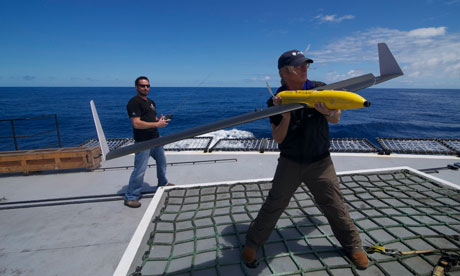
Activists launch a long-range drone from the deck of the Steve Irwin to locate a Japanese whaling ship. Photograph: Observer

If cormorants can possibly be defined as evil, can drones be re-redefined in the opposite sense in which we commonly think of them–namely related to death and destruction, including innocent “collateral damage.”  Click the image above to see what these environmental activists are doing with drones:

They are better known as stealthy killing machines to take out suspected terrorists with pinpoint accuracy. But drones are also being put to more benign use in skies across several continents to track endangered wildlife, spot poachers, and chart forest loss. Continue reading

Ganges River Dolphin Conservation

Click the image for the story on BBC’s website:

The Ganges River Dolphin is one of the world’s most endangered freshwater mammals.

Its numbers in South Asia have plummeted in recent decades. But Indian conservationists working on the Brahmaputra River hope to reverse the dolphin’s decline by mobilising riverside communities to protect these amazing cetaceans.

Mind Your Food’s Aquifer

Click the map for the brief review of what looks to be an important paper published in the current issue of Nature (which requires subscription for the entire article so this review in the Science section of the New York Times is important for non-subscribers).  For some, the constant reminders are tedious.  We appreciate them nonetheless because it is so much easier to forget, ignore, pretend otherwise that water is an infinite resource.  Not only is it finite, but solving this puzzle may be the next most important thing for mankind to get right:

The study underlines a problem that scientists have already pinpointed: that the demand for groundwater in several major agricultural regions of the world is unsustainable. Continue reading

Calling All Collective Activists

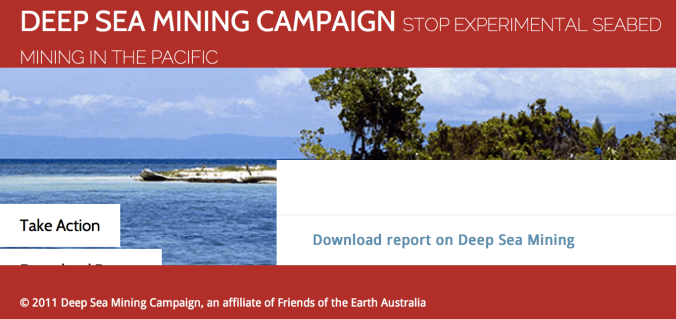
A deeply disturbing story, one among seemingly countless opportunities for any of us to jump in and build an opposition, brought the above organization to our attention.  Gold and copper, not to mention jobs, and concession revenues in a developing nation, are all important.  Up to a point.  But so is the marine ecosystem that will suffer the consequences.  The mining company and its shareholders gain if the operation is profitable; plus the livelihoods of all those working on the technology and the mining jobs to carry out these operations; plus what the PNG government earns; and then some.  It sure looked valuable enough to whomever was involved in granting the concession.

But who did the calculation on the other end of this equation?  The ecosystem valuation side.  Click the image above to see in detail (download the report) what is at stake and what might be done about it, as also reported here in The Guardian:

Nautilus alone has around 524,000 sq km under licence, or pending licence, in PNG, Tonga, New Zealand and Fiji. Continue reading

A Summer in Muir Woods

Guest Author: Robert Frisch

In the summer between the first and second years of nearly every MBA program, students are tasked with finding themselves a three-month internship.  Some advise trying to round out your resume by focusing on your weaknesses.  Others say to shoot for a well-known company that will lend you credibility.  For me, I knew that I wanted to spend my time doing something that I love and feel passionate about.   A position in the realm of sustainable hospitality, land conservation, or eco-tourism was what I was looking for.  I had a few interviews for a sustainability position in a hotel real estate investment trust (REIT), talked to a conservation focused management firm based in India, and a for-profit land conservation company based in Chile.  I would have never guessed it, but I ended up accepting a position as a summer consultant to the National Parks Service in San Francisco. Continue reading

Live And Let Live

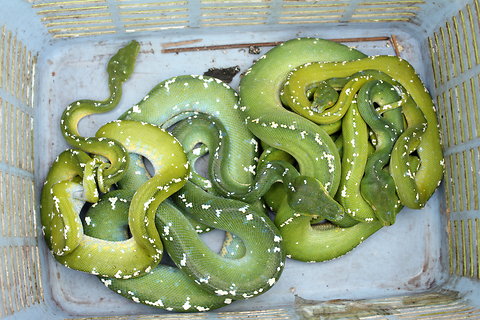
The images after the jump are from here and first came to our attention in the Guardian story (click the headline image to the left), which follows a recent interest we have taken in these mercilessly misunderstood and under appreciated wild creatures. Seth’s recent post begins a new vein in our conversation about marine conservation (for
that wait for 2/2 in that series).

Continue reading

Thank You, North Carolina

Of course, thanks to the individuals who made the direct effort to make this project possible.  Click the image above to see the visuals they produced, and click here to see those individuals.  But North Carolina’s citizens, whose taxes make the University’s operations possible, deserve our thanks too:

Our 2012 Fellows present a Powering a Nation special report, “100 Gallons.”

“100 Gallons” explores how our most critical resource goes far beyond traditional power. More than fossil fuels, commerce or industry, water powers life. Continue reading