Wadi Feynan was one of the first 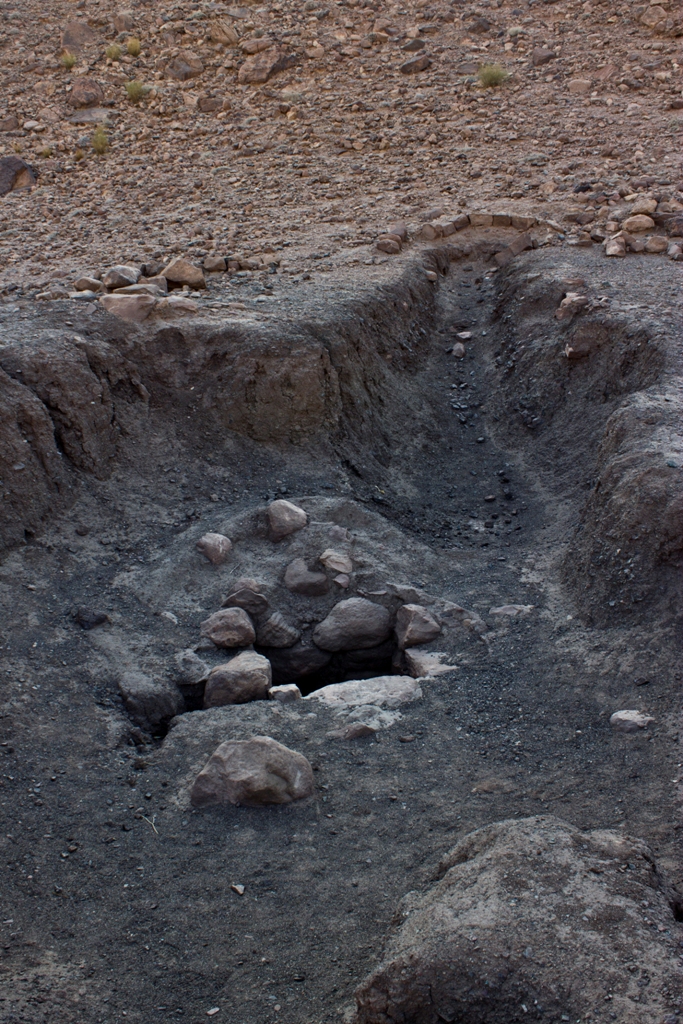 places in the world where copper was mined and smelted by humans, which when
paired with one of the first Neolithic settlements in the world, makes Feynan an extremely important area in terms of prehistoric human development. Few places in the world can boast this sort of historical wealth – and visitors to Feynan can journey into the past with or without a guide. From the first bit of ore extracted to the collapse of the Roman Empire to the 20th century, copper mining has been a major aspect of human settlement in these valleys. Innumerable shafts have been opened, collapsed, reopened, and abandoned using a wide range of methods and technologies. Today, guests at Feynan Ecolodge have the chance to venture into the past by walking or biking to these historic sites nestled in the rocky foothills of the Dana Biosphere Reserve – and learn about their historical significance. Continue reading
Conservation
Gotta Love It

Whale Shark Freed From Fishing Net
 Another day, another story of net-freed. Click the image below, which looks like the one in the story here, for the story told briefly by video; yet another hero story we thank The Guardian for:
Scientists free a whale shark caught in a fishing net in Indonesia’s Cenderawasih Bay. Conservation International have completed the first expedition to tag whale sharks with radio-frequency identification making them easier to track and film. Whale sharks swimming into fishing nets has become a problem in the area.

Eine Kleine Bankmusik
Not many people would mistake us for a bank advertising medium. But today, full disclosure, we feel willing to play that role. Just because the music is nice, the scene is well thought out in a family-friendly, music-as-inspiration kind of spirit. As banks go in today’s world, this one has the right idea: it is the community that really matters; and we love the collaboration. That town square seems well conserved, doesn’t it?
Participatory Monitoring Workshop: Part 2/3
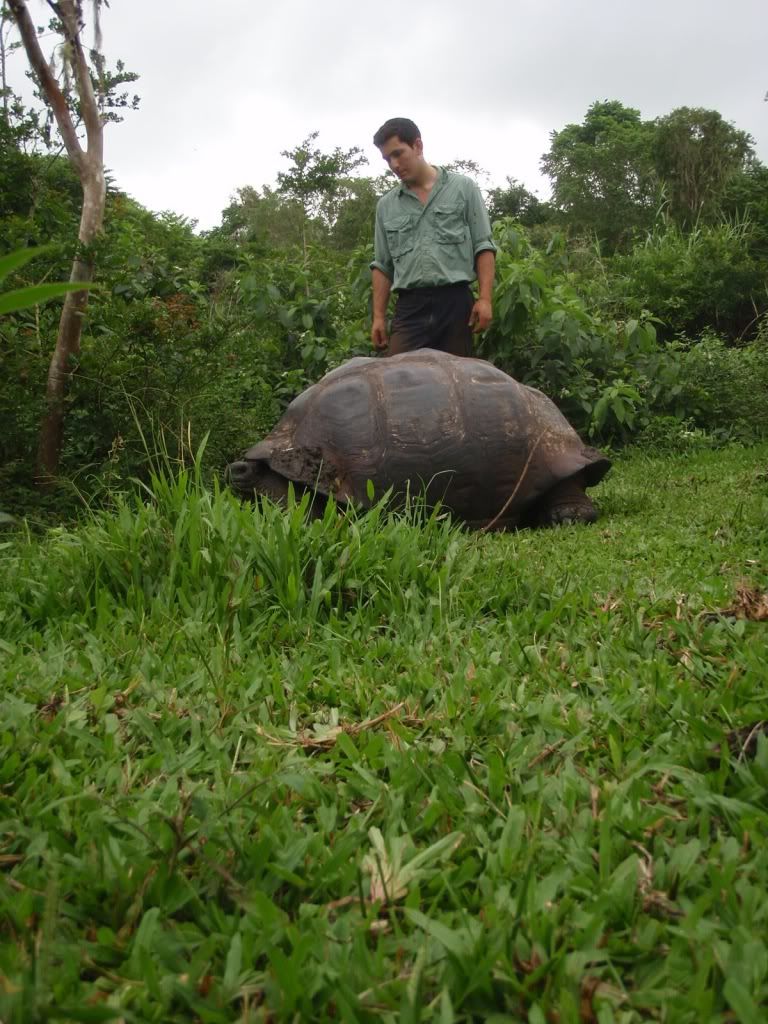 My penultimate post covered the participatory monitoring workshop I attended the last week of June. Here I will describe our results in the last two days of the meetings.
When dividing the attendees into different groups with assigned topics of discussion, the workshop organizers assigned me as discussion leader of the Resident (Urban and Rural) group, where six or seven of us talked about varied approaches and types of programs.
We started with the rural residents, focusing on farmers since the majority of landowners in the agricultural region of Santa Cruz fit that category, either with coffee, sugarcane, cattle, or other crops. There are countless farms in the area, and only about a dozen of them practice any tourism, but we considered this smaller group the perfect audience for a pilot project, since they should be more interested in completing periodic checklists of focal species that serve as tourist attractions. Guides from cruises or local operators often take groups of tourists up into the highlands to see wild giant tortoises and less common landbird species like the Vermilion Flycatcher, and these few farms offer not only passage in their land (as safe havens for the attractive species) but also their coffee or homebrewed sugarcane rum to the tourists. Some properties even have lava tunnels, one of which I’ve been told by a Hawaiian visitor is even more impressive than the famous Thurston lava tunnel on the other well-known volcanic archipelago of the Pacific Ocean.
The Mestizo-Indigeno Divide

Should we connect everyone, everywhere? Another of globalization’s thorny debates, but this time argued very locally. As always there are global implications (in this case having to do with the loss of unique cultural heritage). Click the headline image above to go to the story in The Guardian:
The 125-mile (200km) road would pass through the Alto Purús national park in Peru, connecting a remote area to the outside world but opening up the most biologically and culturally important area of the upper Amazon to logging, mining and drug trafficking. Opponents of the plan fear it will threaten the existence of uncontacted tribes such as the Mashco-Piro. Continue reading
Participatory Workshop Introduction
 Last week, thanks to the effort of very helpful contacts on the islands, I was able to attend a Participatory Monitoring workshop in Puerto Ayora. For those of you unfamiliar with the term in the workshop title, you are not alone. Participatory monitoring, community science, public participation in scientific research, volunteer data collection–these all mean practically the same thing as citizen science, which I have briefly written about before. Here is another good, and possibly the most definitive, source of information on the subject, and although the site is a part of the Cornell Lab of Ornithology, I’ve pointed out (even more briefly) that projects are by no means limited to birds.
 The workshop consisted of an impressive list of international expert invitees—representing Cedar Crest College/Earth Watch, SUNY (College of Environmental Science and Forestry and at Stony Brook), Stanford University, Pepperdine University/ Scripps Institution of Oceanography, the Center for Biodiversity and Conservation/American Museum of Natural History, Colorado State University/University of Wisconsin-Madison, the United States National Park Service (Joshua Tree National Park and Acadia National Park), and the Galápagos Conservancy. Additionally, the Galápagos National Park, Charles Darwin Foundation, WWF Galápagos, Conservation International, Universidad Central Sede Galápagos, and Grupo FARO were present. A very skilled interpreter, with portable headsets, helped those who didn’t speak English or Spanish. Being in the minority of non-PhD.-holders, and practically the only person with just an undergraduate education, made walking into the room slightly unnerving, but I knew that since the Cornell Lab of Ornithology didn’t have a representative in attendance there were still constructive inputs that I could contribute, seeing as the workshop was about citizen science. Another comfort was that people commonly mistake me for being older than I am. While a freshman at Cornell two years ago, many of my TAs thought I was a senior or junior for most of the semester, and when traveling, people who I tell I’m studying at Cornell tend to assume I’m in graduate studies until I correct them.
A Quick Thought on George
I was at the beach with Reyna, Roberto, and their kids at Tortuga Bay on Sunday when we heard from an acquaintance that El Solitario Jorge had passed away (the news passed at a speed throughout the Galapagos Islands similar to that reserved for elder dignitaries elsewhere in the world). My first feeling was surprise, because I had always heard how old giant tortoises could live and I knew how much veterinary care the animals at the Charles Darwin Research Station received. My second and third feelings were sadness, followed by some unexplained relief (was it a queasy feeling of my good fortune for just having seen George for a second time on Friday afternoon, while walking through the tortoise breeding area? Relief provided by the mystical thought that maybe he will find his soul mate in the next dimension? Something else? I do not know).
We were all a bit stunned by the news, wondering what the implications were for the dozens of organizations and companies that used George as “celebrity” endorser for the Galápagos and biodiversity conservation: almost every t-shirt you see on Charles Darwin Road in Puerto Ayora has Lonesome George imprinted on it, either in artwork or the logos for the National Park, the Galapagos Conservancy, and many other groups. This single tortoise was placed alone on billions of pieces of merchandise supporting (or purporting to) conservation, and his loss brings to mind what the WWF would face should the last panda pass: the extinction of the species might serve as an even more compelling, albeit less directly or personally moving, icon for protection of endangered species.
In lighter news: this week, from morning till evening, I’ll be attending and learning from a workshop titled “Development of a Participatory Environmental Monitoring Program for Galapagos,” which I think will be incredibly useful and educational for my plans with citizen science at Tomás de Berlanga!
Many Stripes. Many Tales. Few Tigers.
When I decided to come to Kerala this summer for my internship, I got most excited not entirely about my work, but really about seeing a tiger. I can’t even remember the last time I went to a zoo, but I know deep in my closet I have a dusty photo of me and a tamed tiger from Thailand. At this time, seeing a wild tiger was actually more of a WILD idea. Since I’m working next to the Periyar Tiger Reserve, a home to approximately 40 tigers and many other animals, I’m practically neighbors with them and awaiting a miraculous moment to see a tiger before my trip to Delhi.
As a Korean descendent, I must introduce you all to some Korean culture and explain why I’m writing a blog post that is dedicated just to tigers. I’m sure a lot of my Korean folks will agree that tigers and Koreans go way back. My relationship with tigers started when I was 3 years old when my grandmother told me a story about a tiger that smoked using bamboo pipes. My reaction was: “Really? Tigers smoke, too?”

Source & Credit: Picture of a Tiger at SamChunSa (삼천사) at BookHanSan (북한산)
When Privilege Speaks
We have said on an earlier occasion that when someone as recognized and wealthy as this speaks out on behalf of the environment, it is worth taking note. Not because his voice is more valid than all the scientists, activists etc. dedicated to the cause. But because every voice has a role and if more voices connected to immense privilege took the time to send messages like this, we might get where we are going a bit faster…
Golf Course Wildlife
From Scotland and South Africa to Scottsdale and South America, certain destinations draw countless visitors whose singular recreational motivation is golf. Few other sports or activities require the amount of terrain that golf does, so its environmental implications go further than most sports. But when considering golf’s land use, it is refreshing to recognize how many courses end up being preservations of rich natural areas and contribute to conservation as places of refuge for wildlife and plant life.
Story’s It
I can trace it back to the beginning for you, trace my Moth addiction to its start. For the uninitiated, the Moth is an organization devoted to the craft of storytelling. It’s real people telling true stories, “live and without notes.”
So can I. Click the image above to read Nathan Englander’s engaging account of telling stories in front of a live audience. Reading it I am reminded of my recently untended year-old efforts to further articulate Why La Paz Group?
Thank You Australia!
Click the image to go to the coverage:
Australia has created the world’s largest network of marine reserves and will restrict fishing and oil and gas exploration in a major step to safeguard the environment and access to food.
The area will cover 3.1 million square kilometres (1.2 million square miles) of ocean including the entire Coral Sea, and encompass a third of the island continent’s territorial waters.’

The Great Barrier Reef is one of the areas that will be protected through the marine reserve network. Photograph: Doug Steley B / Alamy/Alamy
Merged Publications & Happy Museums
Neither had been on our radar before, but with a bit of investigation, we congratulate Satish Kumar on his decision to merge them (click the image below to go to the new site hosting both publications):

A quick sampling of articles led here and to the conclusion that our site will be following this publication for news of a non-conformist nature: Continue reading
Brazilian Beef & Cornellians In Kerala
Click the image below to go to the story. Brazil, host to the 1992 summit that put the concept of sustainable development into global consciousness, host to its follow up this year, and an erstwhile hotbed of environmentalism, is in recent years also the home of cattle-ranchers and soy farmers who slash and burn the Amazon rainforest in vast swathes to feed a growing global population. What shall we do?
We have already noted our support of beefs with major corporations over irresponsible forestry practices; and we have a beef with US tax code that warps market forces, reduces the incentive for ecologically sound grazing practices and leads to poorer human health outcomes… but here our beef should be with beef itself, since Brazilian political leaders seem ill-equipped to contain the destruction of Amazon rainforest by enforcing that country’s already strong environmental law. May we suggest a simple change in diet?
Raxa Collective sees travelers increasingly mentioning their love of vegetarian options on the menu (e.g. here and here) so we are doubling our bet on vegetarian cuisine. A group of seven amazing Cornellians will be working on this with us, among other green initiatives, for the next few months so the next post(s) will introduce them. Meanwhile, send your favorite veg recipes…
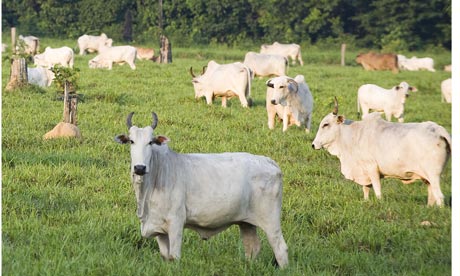 Cattle at an illegal settlement in northern Brazil: such ranches are the leading source of rainforest destruction in the Amazon. Photograph: Antonio Scorza/AFP/Getty Images
Greenpeace’s latest investigations follow a groundbreaking study in 2009 that for the first time established a clear chain of responsibility stretching from Amazonian ranches on land cleared illegally to western companies including luxury brands, supermarkets and a variety of “household name” firms using everything from leather, beef and other cattle byproducts to paper packaging. Continue reading
Yay, OK!
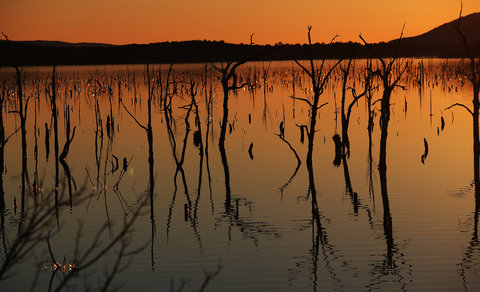
Sardis Lake, a reservoir near Tuskahoma in southeastern Oklahoma, is one of the water supply centers that could be protected by the state’s new long-term voluntary water conservation goals. Photo: Jim Wilson/The New York Times
…You see, California is the state crusading against human-caused global warming while Oklahoma’s senior senator, James Inhofe, has just written a new book excoriating that kind of focus. Continue reading
Back To The Commons
Cattle graze on public lands under federal permits, and the fee is heavily subsidized — $1.35 per head of cattle, in contrast with the $22 per head that ranchers pay for their cattle to graze on private land.
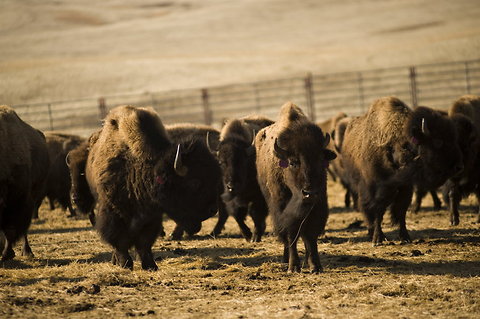
Most days we find stories that bring us back to one of the common themes affecting, and affected by, the one or more of the three “c” words in our site’s banner. Just this last week, in two very different contexts–the Mediterranean fisheries and the great plains of the western USA–we see the potential for the tragedy so commonly affecting unrestricted and accessible open spaces.
Click the image above to go to the second of these stories. While we do not believe markets solve all problems, and certainly do not solve the most complex problems easily, this one seems to be the definition of a no-brainer. Or at least, the questions seem obvious: why do citizens in the USA, who contribute to ranchers abundantly at the supermarket each week, also contribute so generously on April 15 each year? If they reduced the latter would they reduce the former? And would that not be a good thing, in terms of health and environmental considerations?
Gotta Love a Good Reserve
The Periyar Tiger Reserve is one of those places that gets your adrenaline flowing just a little more than usual, because you’re always on the verge or the high of an interesting sighting or sensation. A good reserve does that. It fosters enough of a preserved environment that exploring it brings you back to a pre-industrial state of awareness.
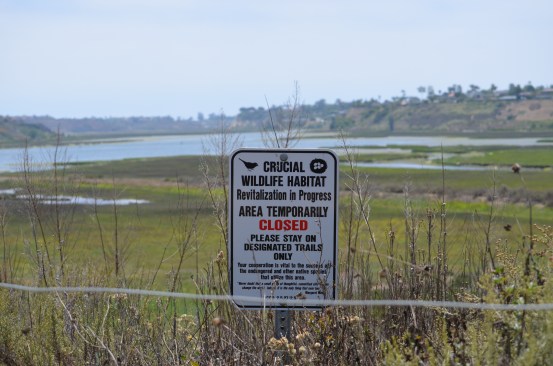
Today I visited the Newport Bay Conservancy in Newport Beach, California. It’s not quite as wildly invigorating as Wild Periyar, but it was a beautiful day and the birds were hungry.
Fish-Eater’s Dilemma
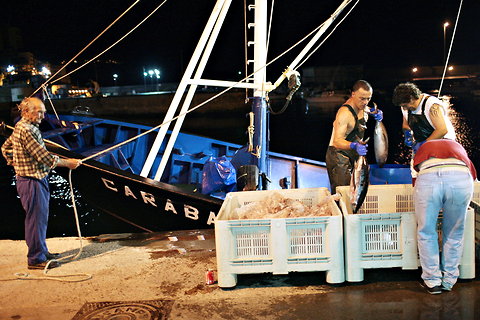
Click the image above to go to the story in Dot Earth:
Talk about timing. As American and European fisheries officials met this week in Brussels to talk about, among other things, the problem of illegal and unregulated fishing, Chinese boats were illegally in the Mediterranean, making a mockery of efforts to manage the bluefin tuna fishing season.
The 2012 Iscol Environmental Lecture
 The David R. Atkinson Center for a Sustainable Future at Cornell University hosts (click to the left):
Peter Matthiessen takes us on a journey to Arctic Alaska, where climate change is the new reality. In this fragile ecosystem, potentially severe negative effects of large-scale fossil fuel development—especially offshore prospecting and drilling—are already taking their toll on the Arctic sea ice and permafrost, on Arctic wildlife, and on indigenous peoples such as the coastal Inupiat and the Gwich’in Dene (“caribou people”).
 Organikos