Can Your Horoscope Do This?

Living in India has really highlighted the cultural differences of things that I have often taken for granted.  How we meet our future spouses is most definitely a case in point.

My culture certainly has its fair share of well meaning friends, relatives and co-workers who have the “perfect person” in mind for someone to spend their lives with.  Even if one doesn’t wish to avail themselves of this advice, it is often persistently given.  Barring that, people meet frequently at school, parties, conferences, libraries, sporting events, airports…the list is endless, and one has to wonder at the statistics of how frequently those serendipitous meetings lead to long term relationships.

In Kerala (and I believe the rest of India as well) there is still a tradition of family involvement in the choice of life partner. Historically there was always an “auntie” (the catch-all name for an older, married woman) who has just the right match for young men and women of their acquaintance.  But times are changing and computers and the internet have taken a role in this process, whether it be “on line dating” in the Western world, or “matrimonial sites” here.

I was recently shown a “print out” from an on line matrimonial site based in Kerala.   Continue reading
Pico Iyer: Global Soul

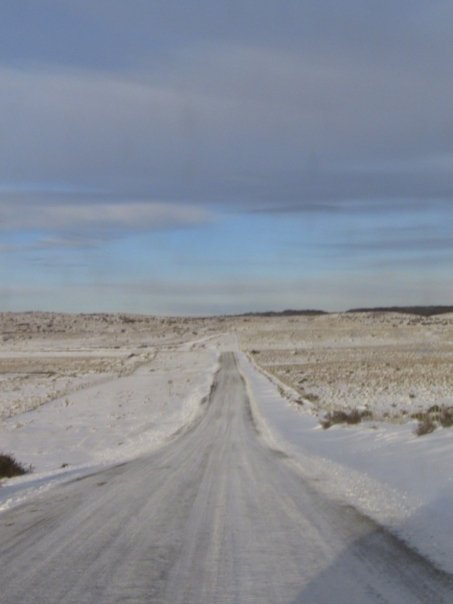
Deserted road on Tierra del Fuego

For me the whole point of travel is to leave yourself behind, to leave your assumptions behind, to become cleared out and to step into another person.

–Pico Iyer

Sometimes I have to wonder what kind of rock I live under.  I mean, really!  Despite my peripatetic lifestyle I seem to be strangely illiterate in “travel writer” terms.  Busy “doing” perhaps?  Perhaps.

So when I received an email from Diwia with a video link and the short note: “Great listening Amie, watch the first 15 mins – you’ll be hooked to the very end”.  I clicked with the clear mind of the uninitiated. Continue reading

Crunch

Hans Gigginger photo from The New Yorker

I consider myself a pretty adventurous eater.  In fact, I will easily go so far as to call myself a “foodie”.  I’ve spent my adult life living on various continents, trying to understand the history and culture of the cuisine wherever I was living.  I’ve patiently explained my dinner party plans to vendors at Parisian fromageries (in hopes they will approve and allow me to complete my purchase).  I’ve “mastered” what I like to call Kitchen Croatian, or a knowledge of food nouns in that language, to be able to market and somewhat communicate recipes to kitchen staff while living there.  Malayalam still totally eludes me, but it is one of the world’s most difficult languages after all, so please don’t hold that against me.

But to the best of my knowledge, I’ve never eaten a bug Continue reading

Wind, Water, Light

Janet Echelman, Her Secret is Patience, Phoenix, AZ, U.S.A. 2009

American artist Janet Echelman has worked in numerous mediums throughout her career and has a long history of working collaboratively with communities outside of her own culture, whether it be Balinese textile artisans or Indian bronze castors.

A Fulbright lectureship about painting brought her to Mahabalipuram, India, a fishing village in Tamil Nadu famous for sculpture. But it was watching the millennia-old craft of weaving and working with nets that ultimately inspired the work that now defines her art. When she watched the men making piles of nets on the shore she began wondering if the material was “a way to create volumetric form without heavy, solid materials.”   Continue reading

Bambouzle

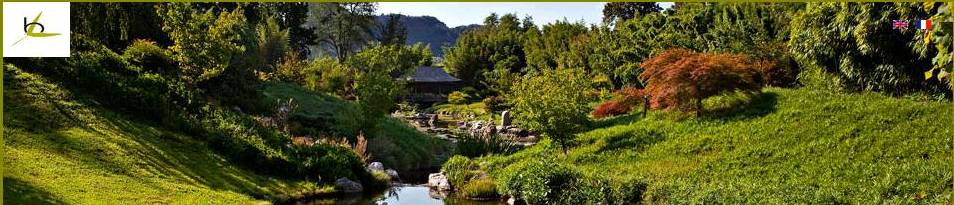
France has a horticultural history that goes back centuries, from the forested hunting grounds to the formal gardens of kings.  But “Liberté, égalité, fraternité” leads to parks for the people, offering countless opportunities for visitors to fulfill their desires to commune with nature.

Continue reading

October Air

National Geographic Magazine, Vol. 1

There must be something in the air.  Some Universal Energy of Inspiration that touches down in October, if not annually, then biannually for a brief moment in time. Or is it just coincidence that two events of such simple, yet great significance should have happened on the same date?

What had begun as an elite club for academics and wealthy travel enthusiasts was reorganized in January 1888 into  “a society for the increase and diffusion of geographical knowledge.”  The National Geographic Society was incorporated a few weeks later and the first issue of the magazine was published as its official journal on October 1st.

William Morris Davis, often called the “father of American Geography” was an early member and contributor who wrote the introduction to Vol.1 of the newly minted magazine.

History became a science when it outgrew mere narration and searched for the causes of the facts narrated; when it ceased to accept old narratives as absolute records and judged them by criteria derived from our knowledge of human nature as we see it at present, but modified to accord with past conditions.

The society’s historic mission has continued for well over a hundred years, extending beyond the specifics of geography to increase and diffuse geographic knowledge while promoting the conservation of the world’s cultural, historical, and natural resources.”

And so we come to conservation.  Continue reading

Primitive Garage

While driving through Tamil Nadu a few weeks ago, there were more  than enough of those moments one experiences when travelling through a culture not your own, during which your eyes glaze over as you try to determine either what someone was doing, what you saw, or what in the world is going on. Tamil Nadu, of all the places I have traveled in the world, very likely has the highest concentration of these moments I have personally experienced, and in addition to a truck garage that looks more like an elephant parking space, one is liable to see extravagantly mustachioed motorcycles, patchwork oxcarts, and large angry red men.

This slideshow requires JavaScript.

A Worldly Point of View

Emory’s Language Lab

Diversity in American universities is on the rise: just a little under a quarter (23%) of Harvard’s undergraduate enrollment consists of international students. At Columbia University, over a quarter (26%) of the university’s enrollment are international students. The story is the same at other top schools around the nation. UCLA, Boston University, Cornell and NYU all boast international student levels at around 15%. Here at Emory, the picture is roughly the same. Most of these international students in American universities hail from Asian countries, but there is plenty of exchange from Europe, Africa, the Middle East, and other parts of the world as well.

At Emory, many international students specifically come from China, India, South Korea, and Japan. Having spoken to these foreign exchange students, it is clear that international admissions to a top-20 American university are incredibly competitive, even more so than they are here. One friend told me that he was the only student from his entire town (a suburb of Calcutta, so quite a lot of competition) to attend a top-30 American school; even with his extremely impressive credentials Continue reading

Mystical India, In Practical Terms

There have already been plenty of posts on this site that give the perspective of non-Indians living in or visiting India.  Here is another good example of an Indian describing a local feature of life that, to the non-Indian, is more of a phenomenon.  And so the style of delivery, while quite different from that of this man, is equally intriguing (fair warning: the accent is stronger here, but you can train your ear to understand)–both men talking about old stuff, rather genially and humbly, but clearly aware that they are sharing with the world something of value that might have been overlooked because it has been hiding in plain sight for so long.

The style of delivery, in fact, is as interesting as the content itself, if you are a non-Indian trying to figure out what makes the place called India so worthy of attention.  It is not what Robert Hughes called the Shock of the New, translated from art to service or organization; it is another example of the Shock of the Old.  And the style of delivery reinforces just that.

The joking self-effacement–no Silicon Valley-type innovation or technology, but we get by in our own way–belies an organizational philosophy made tangible that would be the envy of many organizations around the world.

Captivating Vision

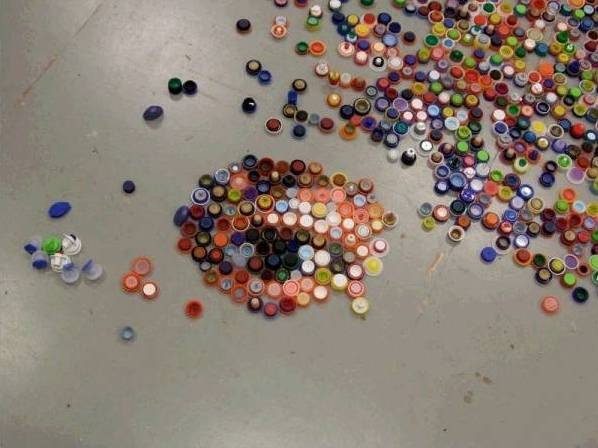
Mary Ellen Croteau’s “Nested Caps/eye”

Even the most enthusiastic recycler gets bogged down by bottle caps.  Their chemical make up is different from the bottles they top, so often they don’t fit into the categories of those ubiquitous numbers that are ascribed to other plastic items.

Artist (and self proclaimed Agitator) Mary Ellen Croteau has a history with statement art and commenting on the quantity of plastic waste has been part of her work for some time.  She’s used both bags and the caps to create work that is both captivating and provocative. Continue reading

“Vella-kkaran!”

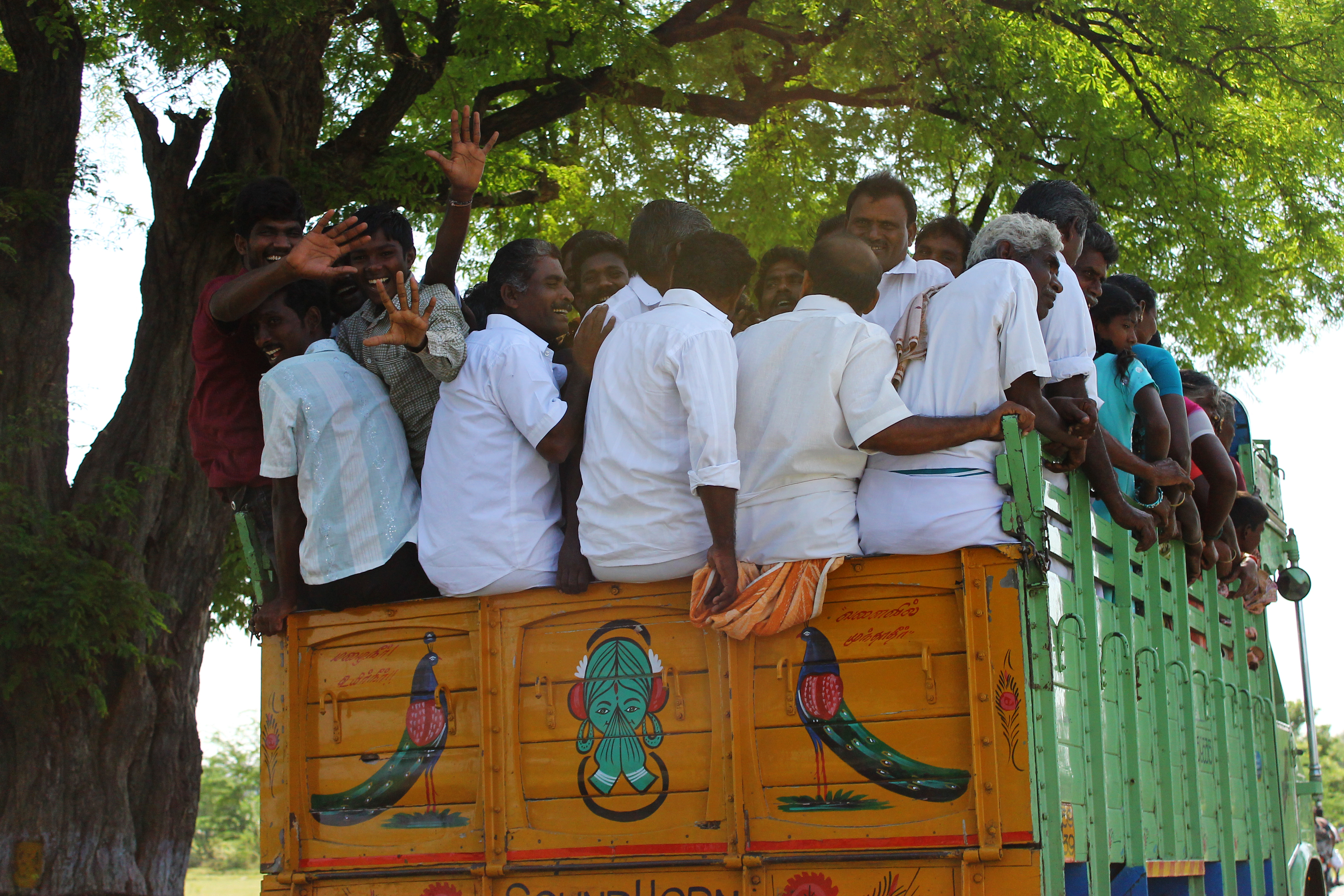
A group of celebratory Tamils on route to a festival

On a recent road trip into Tamil Nadu I was really struck by the ways it differed from Kerala. Although the states are direct neighbors, and many Tamil live and work in Kerala, the contrasts were striking.

They were small differences, subtle even, but enough to give the states a different flavor, if you will. Maybe its that Keralites seem a bit more serious, a bit more focused on their modernity and business acumen. There was something more colorful about the way life was portrayed next door. Although there is the old adage that the “grass is always greener on the other side”, an irony in this case to be sure, as Kerala is a far greener state in almost every meaning of that word.  (I highlight the word almost because, as Sung wrote in a previous post, much of the produce eaten in Kerala is grown in Tamil Nadu, despite their far lower rainfall.)

The short time I spent in the state left me with an impression of a less mechanized world.  A land of brick works and goat herds, of Bullock carts as lorries, of fields and fields of crop cultivation. Continue reading

…And Back Again

This small book has followed a long and lively trail since its publication seventy-four years ago today. Tolkien himself recollected that the book began with a mere doodle –“In a hole in the ground, there lived a hobbit”–in the late 1920s, yet the tale itself didn’t actually get written until about 10 years later. But Tolkien was a master scribbler, so those doodles included maps and genealogies that essentially outline the geography of the adventure. He used his keen knowledge as a professor of Anglo-Saxon to populate “Middle Earth” with creatures and languages, making an alphabet of “runes” and painting cover and plate art for the book’s first edition.

J.R.R. Tolkien painted Dust cover from 1937 first edition

“Good morning!” said Bilbo, and he meant it. The sun was shining, and the grass was very green. But Gandalf looked at him from under long bushy eyebrows that stuck out farther than the brim of his shady hat.

“What do you mean?” he said. “Do you wish me a good morning, or mean that it is a good morning whether I want it or not; or that you feel good this morning; or that it is a morning to be good on?”

“All of them at once,” said Bilbo…then Bilbo sat down on a seat by his door, crossed his legs, and blew out a beautiful grey ring of smoke that sailed up into the air without breaking and floated away over The Hill.

“Very pretty!” said Gandalf.  “But I have no time to blow smoke-rings this morning.  I am looking for someone to share in an adventure that I am arranging, and it’s very difficult to find anyone.”

“I should think so–in these parts!”

And even before the adventure truly began my then small sons would sit enthralled as we read chapter after chapter.

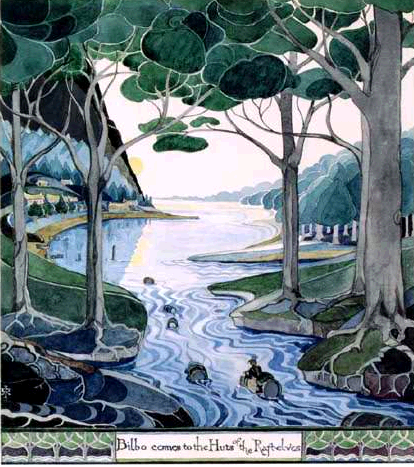
J.R.R. Tolkien painted picture plate from 1937 edition

Before The Hobbit there was Homer, before Homer there was Doyle and Swift and Aesop… Our peripatetic lifestyle always included books, no matter what continent we lived on.

The Hobbit has played an important role in the lives of generations, mine and my sons’ counted among them. Before there were computers and video games there were books, and before books there were stories. I can only pray that the latter two will outlive the former.

Watch It On National Geographic Channel

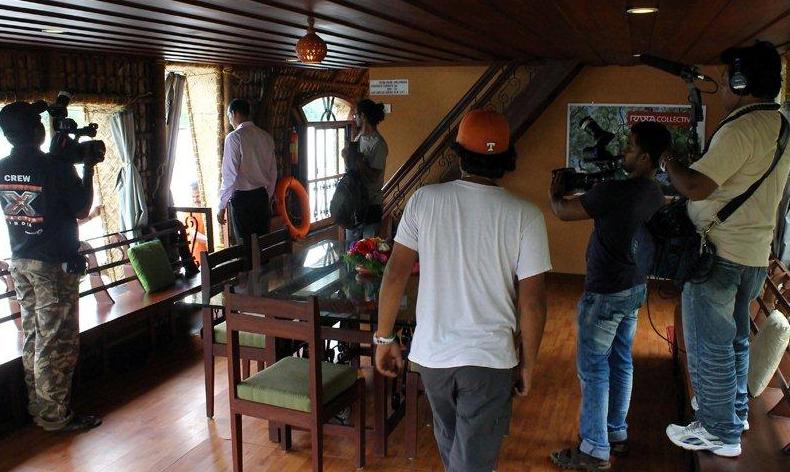
Our colleagues offer amazing experiences on the backwaters of Kerala, in the houseboats described here, with some visual support here and here; and once more here (really, look at it to get a sense of grocery shopping in our neighborhood); so no surprise that a film crew and remarkable cast of characters asked to spend time with them.  The crew of 15 or so (I lost count) was from all over India; so was the cast.  The four featured men in this film are part of a “bucket list” adventure that is being filmed in the locations ranked most highly in a national competition as “must go.” Kerala’s backwaters made that list. Raxa Collective’s houseboats were chosen as the venue for best experiencing those backwaters.

The four men–a student, an IT marketing executive, an Indian Capoeira master-in-training, and a famous Bollywood actor–met for the first time not long ago, and by the time we met them they seemed like old friends.  By the time it airs on the National Geographic Channel, that will stand out as much as the fabulous locations (I like the picture hanging on the wall past the camera man).  We will share more on the broadcast times when we have them.  The photo below is Milo’s, and we have some additional photos by Sung from this particular day (they were on the houseboats for many more days), more on which as we have those photos, and hopefully some film outtakes.

Cool-Schooling

If you are a parent, and ever had a challenge related to your child(ren)’s school (what is the opposite of an oxymoron? this must be an example of it, but where is George Carlin when you need him?), you will likely want to read Clifford Levy’s moving description (alert: if you are not a subscriber to The New York Times this link will count as one of your free sample views) of enrolling his three kids from Brooklyn in a Moscow school a few years back.

If you are anyone who ever had your own momentary thoughts about being too cool for school (again the opposite of an oxymoron: who hasn’t?  is it called a tautology?  or just plain old redundant?), you will definitely want to read at least one snippet about the founder of the school in Moscow that Levy is describing:

…Bogin added courses like antimanipulation, which was intended to give children tools to decipher commercial or political messages. He taught a required class called myshleniye, which means “thinking,” as in critical thinking.

That is the school everyone could use a bit of: the one that enlightens, that empowers its students to become too cool to be fooled.

Color Wheels

Whether by coincidence or just being on a roll (sorry), I just came across an inspiring urban art project that is part Civil Disobedience, part Public Art Initiative, part plain old recycling and completely FUN! Continue reading

Takeaways

The video clip above is what comes to mind after a bit of reflection. Thanks to Alan, Bill and 30+ others, I have not only fonder thoughts for Brown University, but food for thought.  The course ENGN 1930, aka Social Entrepreneurship, asks students to provide brief, written reflections on class sessions, readings, etc.  In my session with them, I started by sharing my experience completing a PhD and moving to Costa Rica in the mid-1990s.  I then described the process of learning from both public sector leaders and entrepreneurs there, and eventually forming a company that practices entrepreneurial conservation.

The gist of several of the “takeaways” from students is the reasonable question that I am chewing over now: are the Raxa Collective initiatives examples of social entrepreneurship?  Is La Paz Group practicing social entrepreneurship?  The snarky, if partially true reply would have been that I do not care all that much what it is called.  Continue reading

What Wheels Can Do

This slideshow requires JavaScript.

From Bike Share programs to recycled wheels, Tour de France to backwater byways, bicycles are universal, or at least global.

More than just a method of transportation, they are often a form of expression, of the person riding it or the job they do. Continue reading

Shop on the Water

Kerala’s Backwaters may be the only home to certain cultural items such as the snakeboat races and the traditional Kettuvalam houseboats, but they are also host to universal waterway phenomena. There is the mandatory bounty that nature provides in the form of distinct and delicious fish and crustaceans, not to mention the huge swathes of coconut palms that grow naturally. Acres and acres of rice paddies are cultivated at below sea level – a feat not unique of Kerala. But in today’s universal culture of rapid globalization, few areas are content with being entirely self-sufficient. So what do the residents of the Kerala Backwaters do if they can’t grow or forage a supply they want? The strips of land are too remote and inaccessible for a  run-of-the-mill supermarket to be profitable, let alone practical. As usual, Kerala folks have come up with a creative yet simple solution to the problem of accessibility and functionality – a floating supermarket.