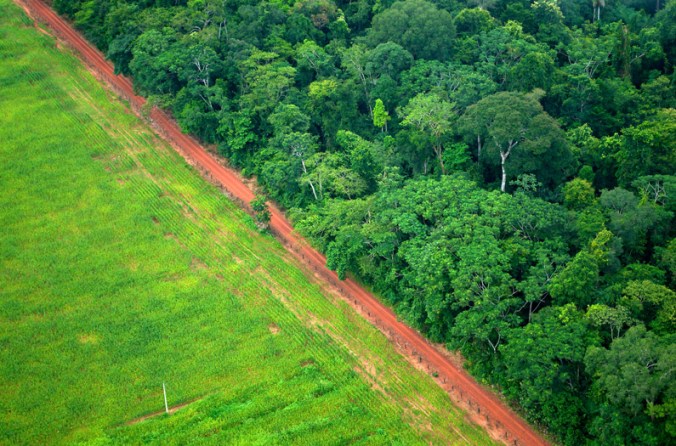
Image: CIFOR/Flickr
Thanks to Anthropocene for a moment of relief:
In Brazil, signs that a soy moratorium is slowing down deforestation
Image: CIFOR/Flickr
Thanks to Anthropocene for a moment of relief:
In Brazil, signs that a soy moratorium is slowing down deforestation
Thanks to contributor Phil Karp for sharing this great example of how peer-peer knowledge exchange can help to replicate and scale up innovative solutions.
For communities, by communities
Experience from around the world shows that managing fisheries and marine resources works best when responsibility is placed in the hands of local communities. This is particularly true in low-income countries, where there is often limited capacity and infrastructure for fisheries management and conservation.
Locally Managed Marine Areas (LMMAs) are areas of ocean managed by coastal communities to help protect fisheries and safeguard marine biodiversity. Found throughout the world’s tropical and subtropical seas, and encompassing diverse approaches to management and governance, their sizes and contexts vary widely, but all share the common theme of placing local communities at the heart of management.

Photo: NASA
Thanks to Anthropocene’s Brandon Keim for the summary and insights from Mangroves optimized: How to make coastal habitats sequester even more carbon:
Of all the carbon buried in the floors of Earth’s oceans, most of it is found in the narrow strip of tidal marshes, seagrass beds, and mangroves along their edge. Known as blue carbon ecosystems, these vegetated coastal habitats “occupy only 0.2% of the ocean surface, yet contribute 50% of the total amount of carbon buried in marine sediments,” write researchers, led by Deakin University ecologist Peter Macreadie, in the journal Frontiers in Ecology in the Environment. Meter for meter, they’re some of the most effective carbon storage systems we have. But could people make them even more effective? Continue reading

If you missed this post, it is worth a read for perspective either before or after the story below, and even if you do not read the story below that one should not be missed. Thanks to Cool Green Science:
Ridding the West of cattle remains a priority for some organizations and individuals. “Ranching,” the director of one prominent group told High Country News, is among “the most nihilistic lifestyles this planet has ever seen. Ranching should end. Good riddance.” Another group charges that ranching causes “desertification.” Another proclaims that “grazing spreads weeds.” Still another cites as a “myth” that “profitable livestock production and ecological preservation can coexist.” Continue reading
We have an event coming up that is our main focus now with regard to citizen science. After a few years of linking out to plenty of initiatives in this realm, 2017 is our big year, so to speak. And not only for us, nor only for 2017. We see the trend building momentum. Thanks to the Nature Conservancy and Cool Green Science for this story reminding us of the variety of citizen science projects are out there waiting to be discovered:
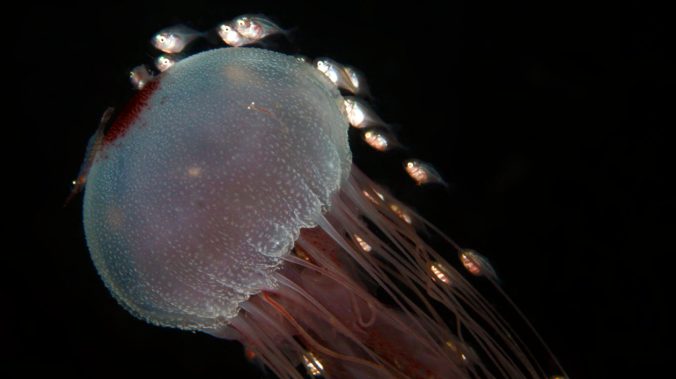
As a remotely operated vehicle (ROV) descends into the ocean depths, inky blackness slowly consumes all sunlight. Jellyfish and unidentified floating objects drift by, marine snow shimmers in the vehicle’s headlights. Suddenly, mountains and canyons taller and deeper than any on land materialize out of the darkness. Then, a voice breaks over the intercom, “Bridge, this is Nav, can we move five-meters South and hold position? Okay, let’s get underway again. Bearing 180°, 20 meters.” Continue reading
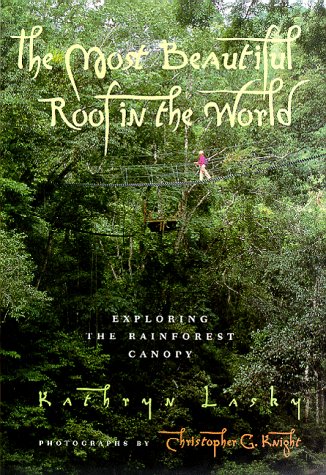 After posting this quick thought about foraging, I sent a link to Meg, and she reminded me that she had not only been to Belize but that there is a book about her time here.
As I explored the book I realized that it was first published 20 years ago, incidentally the year when I first visited Belize. I also discovered that the book is in wide circulation among educators in the USA, for hopefully obvious good reasons:
Journey along with Dr. Meg Lowman, a scientist who, with the help of slings, suspended walkways, and mountain-climbing equipment, has managed to ascend into one of our planet’s least accessible and most fascinating ecosystems–the rain-forest canopy. “Fresh in outlook and intriguing in details, this book will strengthen any library collection on the rainforest.”–Booklist Continue reading
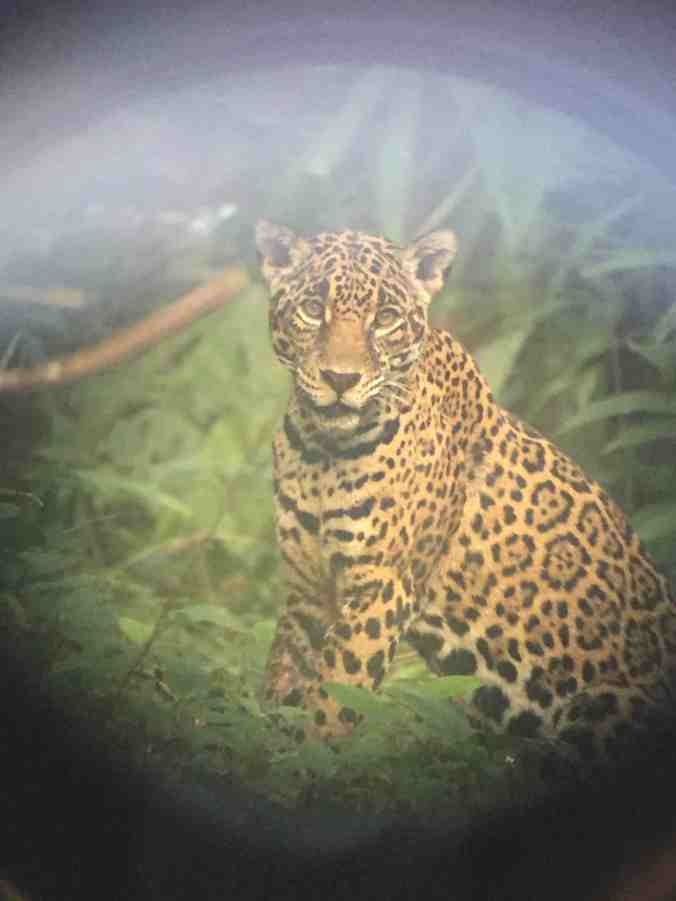
I was just starting to think how surprisingly awesome broccoli is, when a guest at Chan Chich Lodge showed me the photo he took about an hour ago. It was taken using his phone, through the scope that our guide Luis had while they were on the morning Gallon Jug tour. That complements well, to say the least, the photo the guest took with just his phone last night. Continue reading

Thanks to Anthropocene for providing a summary of recent science on a topic of concern in these pages from time to time in the last few years:
Invading pythons and the weird, uncertain future of the Florida Everglades
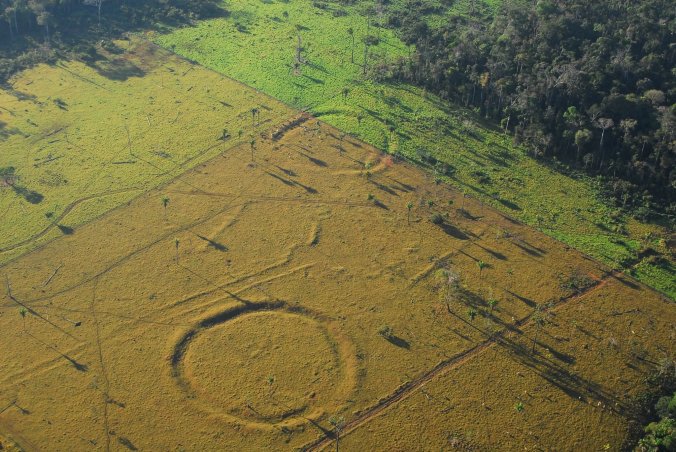
New research suggests people were sustainably managing the Amazon rain forest much earlier than was previously thought. Credit Jenny Watling
Anything with the word Amazon in it, when it refers to the rainforest ecosystem in South America, is worthy of marvel. Joanna Klein offers this story, in the Trilobites feature at the New York Times, that is one of the more surprising finds we have seen in a long time:
Deep in the Amazon, the rain forest once covered ancient secrets. Spread across hundreds of thousands of acres are massive, geometric earthworks. The carvings stretch out in circles and squares that can be as big as a city block, with trenches up to 12 yards wide and 13 feet deep. They appear to have been built up to 2,000 years ago.
Were the broken ceramics found near the entrances used for ritual sacrifices? Why were they here? The answer remains a mystery. Continue reading
Leigh Guldig
Please take a few minutes to read what follows to the end, and share it as far and wide as you can. Our thanks to Chris Wood–president and chief executive of Trout Unlimited, which needs and deserves our support for exactly the reason stated below–for writing, and the New York Times for publishing this clear statement:
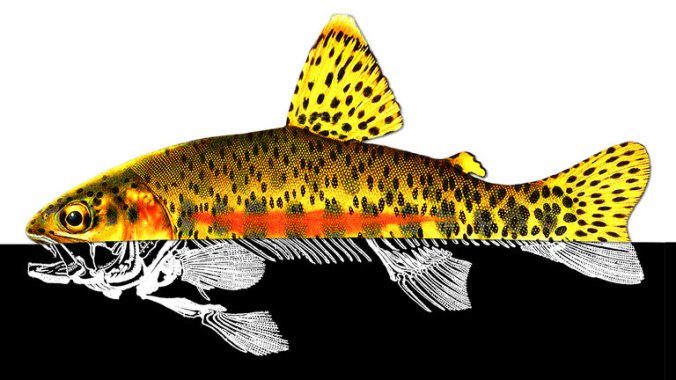
THE eastern brook trout, whose native haunts in the Appalachians are a short drive from my home in Washington, is a fragile species. It requires the coldest and cleanest water to survive, and over the past two centuries, its ranks have been decimated by all that modern society could throw at it. Today it lives in a fraction of its historic range.
One reason? Thousands of miles of prime brook trout streams have been polluted by poorly regulated historic coal mining, and what has been lost is difficult to bring back. Groups like Trout Unlimited have worked with partners to restore more than 60 miles of wild trout streams damaged by acid mine drainage in Appalachia. But it is hard, painstaking work — it has taken the better part of two decades and millions of dollars, and the fact is that it would take many lifetimes to revive all the streams in need of resuscitation. Continue reading
Thanks to the Nature Conservancy’s Cool Green Science, and specifically Lisa Feldcamp, for this note and video on adaptive coastal folks:
“It hurt my heart to see how [the beach] had been deteriorated,” says Norris Henry of St. Andrew’s Development Organization. “I know in the past there was a nice beachfront, where you can play cricket, you can play football, you can run. But it’s so sad to see it is no longer there.” Continue reading
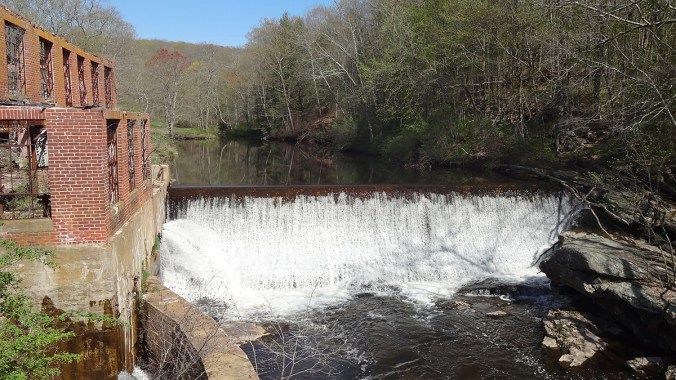
Norton Mill Dam view from the bridge. Photo © Lia McLaughlin / USFWS through a Creative Commons license
Outtakes: Exploring America’s Most Dammed Waterways
by JENNY ROGERS
Sally Harold has one eye on the river and one on the cars whizzing by as we stand on a road near the freeway. A river restoration specialist for The Nature Conservancy’s Connecticut River program, she’s showing me a map of the state, obscured with dots representing dams. To our left, a burned-out mill building looms over a small river. To our right, the road that leads northeast to Hartford. Continue reading
Alexander V. Badyaev
We had not known of bioGraphic until just now, and want to shout out to the source before anything else. Our thanks to the California Academy of Sciences, who we look forward to hearing from more in the next few years, for the service that bioGraphic provides to all of us. Vigilance, informed by science, will be more important than ever. You know what we mean.

bioGraphic is powered by the California Academy of Sciences, a renowned scientific and educational institution dedicated to exploring, explaining, and sustaining life on Earth.
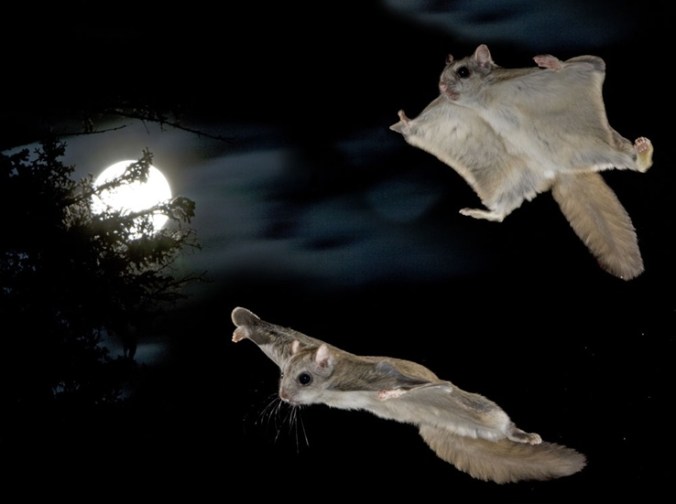
This recent story in bioGraphic seems like as good an option as any to link you to. We realize now that we have not posted any stories on the flying squirrels of the Malabar coastal region where we have been based since mid-2010, so glancing at this creature in the western USA habitat first seems a fine reminder of a pending task. Thanks for this story and photographs by Alexander V. Badyaev:
After listening all day to relentless warnings of “severe winter weather” and poring over equipment manuals to determine the lowest operating temperature for various pieces of photographic gear, I decided to stick with the plan. A few hours and several miles of snowshoeing later, I was hard at work in the diminishing February twilight, setting up lines of strobes and high-speed cameras along gaps in the tree canopy that framed a forest lake at the edge of Montana’s Bob Marshall Wilderness. I knew this lakeshore to be a primary movement corridor for a resident female northern flying squirrel (Glaucomys sabrinus), and based on observations from previous nights, I expected my nocturnal subject to launch herself across the lake sometime between 2:20 and 2:50 a.m. Continue reading
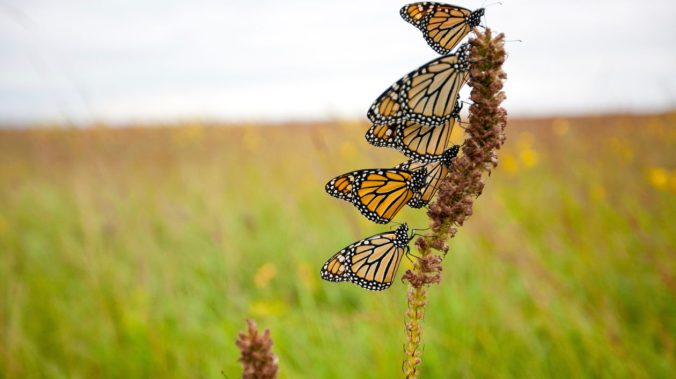
Butterflies congregating on the Nature Conservancy’s Bluestem Prairie, considered one of the largest and best northern tallgrass prairies in the United States, designated by Minnesota as a state natural area. Photo © Richard Hamilton Smith
We agree with the sentiment, never underestimate the underdog; more often than not, we root for the underdog. Thanks to the Nature Conservancy’s Cool Green Science for the reminder, in an ecological context:
Can Grasslands, The Ecosystem Underdog, Play an Underground Role in Climate Solutions?
By Marissa Ahlering
Never underestimate the underdog — in sports or in ecosystems. My favorite baseball teams, the Royals and the Cubs, reminded us of this over the last two years, and prairies (the underdog in the world series of ecosystems) proved this again recently in an analysis demonstrating that grasslands have a role to play in our climate change solutions (Ahlering et al. 2016).
Globally, grasslands are one of the most converted and least protected ecosystems (Hoekstra et al. 2005). The rich soil of Earth’s grasslands plays an important role in feeding the world and because of this much of our grassland has been converted to row-crop agriculture. Loss of grasslands is a big problem for two reasons: Continue reading

Wild and wet … Lake Skadar national park, Montenegro. Photograph: Alamy
It is now ancient history, but it may as well be yesterday, since I can look at the photo above and it has no less of an impact on me. When Montenegro was still part of what remained of ex-Yugoslavia, La Paz Group worked in partnership with UNDP on a project for the Prime Minister of this soon-to-be independent nation. He was visionary, and wanted to replicate what Costa Rica had accomplished as a small ecologically diverse country–harnessing sustainable development to ensure his country would not become the victim of the forces of mass tourism.
Skadar Lake was the crown jewel in the country’s potential attraction of ecologically-oriented travelers, and the perfect complement to the wild beauty of the coast line and the spectacular mountains. Montenegro has done a very good job in the decades since my first visit to Skadar Lake (standing exactly where the photographer above stood, looking at my own photos from that visit), communicating its commitment to those principles. Nonetheless, the challenges never go away, so we wish them continued success in fighting the dark forces:
Montenegro’s pristine Lake Skadar threatened by new resort
Tourism in Montenegro is booming, but the approval of plans for a new ‘eco-resort’ has led to protests from conservationists who fear it will threaten a stunning national park Continue reading
Thanks to The Nature Conservancy’s Cool Green Science team for helping us realize we almost missed this story:
Flight Over the Bas-Ogooué: Using Drones to Map Gabon’s Wetlands
BY JUSTINE E. HAUSHEER
How do you map a nearly inaccessible 9,000-square-kilometer African wetland that is home to hippos, forest elephants, crocodiles, and the notorious Gaboon viper?
Enter the drones.
Nature Conservancy scientists are using unmanned aerial vehicles to create the first-ever detailed wetlands habitat map of coastal Gabon, in collaboration with scientists from NASA, and other conservation groups working in Gabon. Continue reading
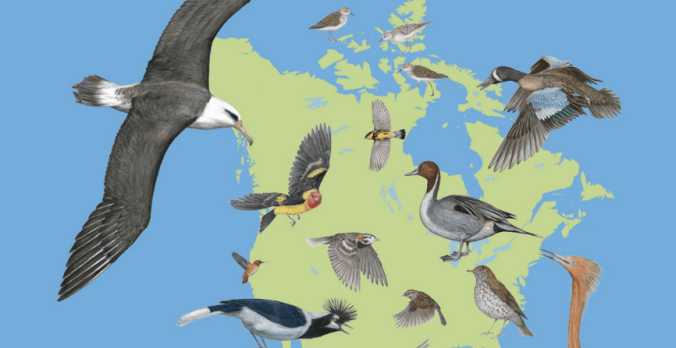
The State of North America’s Birds 2016
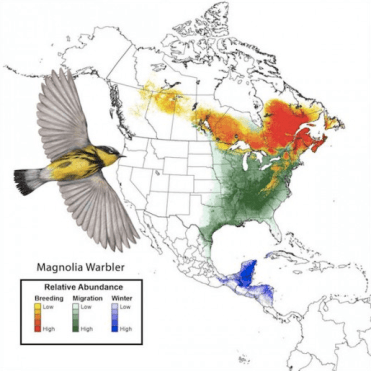
We continue to laud the importance of eBird on this site, gaining special importance as it becomes more and more clear that wildlife doesn’t acknowledge political borders. The data gleaned from tens of thousands of Canadian, Mexican and U.S. citizen scientists who contribute to eBird indicate that more than 350 species in North America migrate up and down Canada, the U.S.A, and Mexico over the course of a calendar year.
And according to the recently released State of North America’s Birds 2016 report, those three countries—their governments, and their societies—need to step up and do more to preserve our continent’s spectacular and shared natural heritage of birdlife. This report is the first-ever scientific conservation assessment of all 1,154 bird species in North America, and it was only possible because of the tremendous scale and big-data capabilities of citizen-science….
Among the many takeaways from eBird maps and models includes one of relevance to our property, Chan Chich Lodge, located on 30,000 acres of Belizean forest in the Yucatan peninsula.
The Yucatan Peninsula is one of North America’s most vital bird habitat regions
Not only is the Yucatan rich with endemic birdlife, it’s a critical wintering area for more than 120 birds species that migrate from Canada and the U.S.A. In winter, the entire population of Magnolia Warblers relies on an area of tropical forest in Mexico only 1/10 the size of its boreal forest breeding range, with the Yucatan as the bull’s-eye of their wintering range.
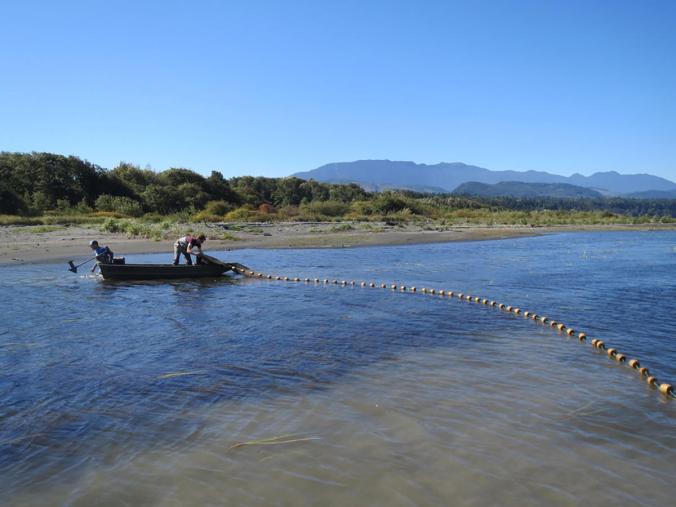
It’s been only two years since the removal of the last of the dams that obstructed the Elwha River, in Washington State, but already species are returning. Photograph Courtesy E. Tammy Kim
Among our favorite story types, the story of ecological recovery, which is to say of redemption, the following is a welcome addition to the files of 2016:
NEW LIFE ALONG WASHINGTON STATE’S ELWHA RIVER
By E. Tammy Kim
…Shaffer and her colleagues have sampled the Elwha’s nearshore region, where the river meets the ocean, once or twice a month since 2006. August, of course, is an ideal time; when you go in January, McBride said, “your fingers freeze, so you just put ’em under your armpits.” The work of the C.W.I. now seems particularly vital, because, for the first time in several generations, the forty-five-mile-long Elwha is a living river, end to end. Between 2011 and 2014, two large, century-old hydroelectric dams were demolished as part of a federal recovery effort. Continue reading
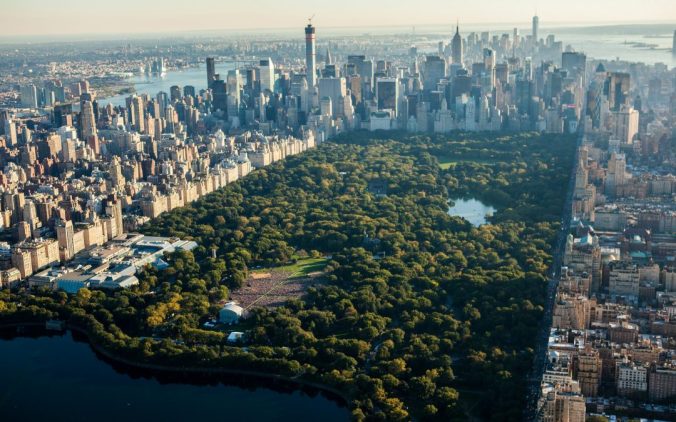
Central Park, New York City. Credit: Anthony Quintano via Flickr.
Thanks to Anthropocene:
Looking for the next miracle drug? Try searching city soils
Many drugs are based on molecules produced by bacteria. Previously, the search for such drugs has mostly focused on “pristine” environments in far-flung locales. But a new study shows that many useful molecules could already be, quite literally, at our feet. Continue reading

Thank you Maine and thank you federal government of the USA:
Touring Maine’s Newest — and Largest — Parcel of Federal Land
By
On an early fall day, with just a hint of red tinting the maples, the view from the summit of Deasey Mountain is spectacular.
To the west stand the rugged, treeless basins and knife-edge spine of Mount Katahdin. Off to the south, you see Wassataquoik Valley in the near distance, the peaks of the 100 Mile Wilderness beyond. To the east and north, more wild Maine woods and hills rolling for miles, to the Canadian border. Continue reading
 Organikos