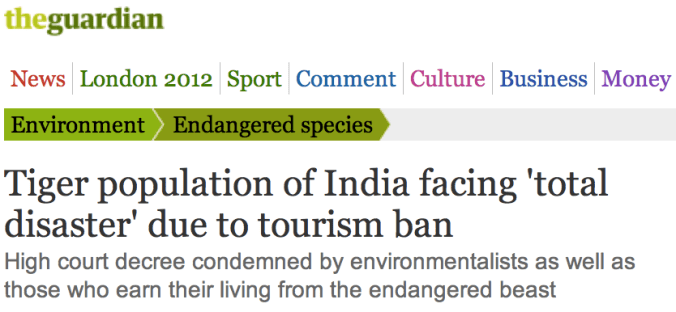
August 22, A Big Day For Tigers

Click the headline above to go to the story, in advance of tomorrow’s ruling in India about a controversial ban.  These issues are at the core of the entrepreneurial conservation concept:

“If the ban on tourism continues, it will be the end of the tiger in India,” he said. “We’re the ones who put energy into tracking them. We deter poachers. Tourists are only allowed in the park for six hours every day, but we guides take it in turns to patrol the park from sunrise to sunset. Voluntarily.” Continue reading
Thoughtful Rejoinder

Not surprisingly, The Guardian provides a second opinion on a critically important topic:

The new discourse about “natural capital” is seen by some as another step towards the degradation of the biosphere. George Monbiot wrote in such terms this week.

He argued:  “Rarely will the money to be made by protecting nature match the money to be made by destroying it. Nature offers low rates of return by comparison to other investments. If we allow the discussion to shift from values to value – from love to greed – we cede the natural world to the forces wrecking it.”But to paint such a one-sided picture is a dangerous game.

What Would Jean Jacques Rousseau Do?

Our rivers and natural resources are to be valued and commodified, a move that will benefit only the rich, argues George Monbiot. Photograph: Alamy

Click the image to the left to go to the editorial opinion of one of The Guardian‘s environmentally-oriented writers.  It starts with a quotation from Jean Jacques Rousseau; not shabby:

‘The first man who, having enclosed a piece of ground, bethought himself of saying ‘This is mine’, and found people simple enough to believe him, was the real founder of civil society. Continue reading

Defining Moments

This slideshow requires JavaScript.

“At the end of the world,” the photographer Brigitte Grignet writes, “lies one of the most remote and undisturbed areas of Patagonia.” This sparsely populated region in southern Chile, called Aysén, is also one of the most endangered, threatened by plans to dam two of the region’s rivers in order to send hydro power north along thousands of miles of power lines.

Reading about and seeing the images of Aysen above brings back fresh memories of the two years prior to our move to India.  In October 2009 I was invited by the local community of Aysen to represent their commercial interest in wilderness conservation at a forum sponsored by Hydro Aysen.  I had been working in Patagonia since early 2008 and established relationships that led to their entrusting this task to me.  I did not let them down. Continue reading

Infusion Of Meaning

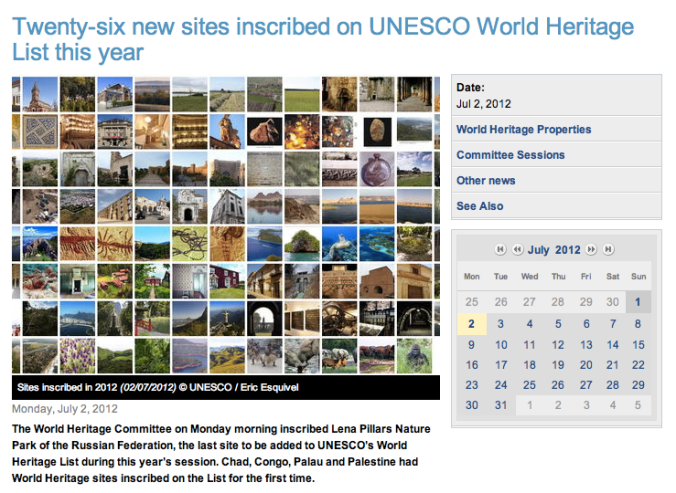
Today it was announced to the world that the Western Ghats have been designated as a World Heritage Site.  How does that happen?  How does a place, a practice, or a thing, get inscribed?  What infuses meaning in a place?  We spend a lot of time thinking about that, especially with regard to lodging properties that are devoted to the conservation of patrimony.  And especially in the Western Ghats, where Cardamom County is our learning laboratory for entrepreneurial conservation. Continue reading

Worth Half A Minute

Thanks to the Environment section of the New York Times, its website, the “Green” and the “Science” initiatives on that site, the above quick video of an invention that may change clean up procedures for one of the scariest new energy trends (read the story here, and then scroll down that site for earlier stories on fracking itself):

In fracking, a mix of water, sand and chemical additives is injected into a drilling well under heavy pressure to release natural gas from shale deposits. At the end of the process, some of the chemical-laden water returns to the surface along with salts, radioactive elements and other contaminants absorbed from the shale. Safely disposing of the waste from fracking without contaminating drinking water and waterways has been a major environmental and health concern.

Language & Conservation

Click the image above to go to National Geographic‘s valuable contribution to address one of the least discussed conservation crises facing the world today:

Every 14 days a language dies. By 2100, more than half of the more than 7,000 languages spoken on Earth—many of them not yet recorded—may disappear, taking with them a wealth of knowledge about history, culture, the natural environment, and the human brain.

National Geographic’s Enduring Voices Project (conducted in collaboration with the Living Tongues Institute for Endangered Languages) strives to preserve endangered languages by identifying language hotspots—the places on our planet with the most unique, poorly understood, or threatened indigenous languages—and documenting the languages and cultures within them.

Hampi Conservation

This slideshow requires JavaScript.

In advance of Amie’s visit to Hampi in a few weeks, at which time we hope to hear more on this story, for now a few images and words from The Guardian:

Half a million pilgrims and tourists come to Hampi’s 2,000 temples and ancient stones each year. Conservationists want the site in Karnataka state restored to its medieval glory – but the price is the eviction of those who live in its old bazaar

Forests Need People

The premise underlying entrepreneurial conservation is that there are good economic reasons to preserve natural and cultural heritage.  And when such good reasons present themselves, opportunity dances with need. With natural heritage in particular, in the interest of introducing the dance partners with neither too much fanfare nor scowling, we have taken a light approach to the concept of biophilia, making reference from time to time.

Click the photograph above, by Raul Touzon, to go to National Geographic‘s online coverage of forests under threat, which we link to with entrepreneurial intent.  A bit of fanfare (just look at that creature!) and a hint of scowl are inevitable when you read the sampling in this series: Continue reading

I Belize I Can Fly

Guest Author: Robert Frisch

The tiny islands or “cayes” off the coast of Belize sit in the middle of beautifully serene coral atolls and are surrounded by the world’s second largest barrier reef.  Like shallow lakes in the middle of the ocean, the atolls host several UNESCO world heritage sites and some of the best snorkeling and scuba diving in the world.  My team, consisting of three Johnson  students and an MPA student from the Cornell Institute of Public Affairs, found itself tasked with providing consulting services and business advice for the owners of one of these cayes in what turned out to be the most unique spring break of my life. Continue reading

Yoga & Evolution

A few months ago there was an article in The New York Times that apparently caused a ruckus (click the image to the left to read The Guardian‘s coverage of that aftermath) in the Western yoga community.  Maybe it is because I am not a member of the Western yoga community that, when I read the article originally I thought:   Brilliant.  Eastern tradition meets Western science.  Evolution.  Improvement.

Today I had a reminder about that article, and my response to it, while listening to this podcast.  The journalist (a Pulitzer-toting science writer who also has practiced yoga for more than 40 years and recently published The Science Of Yoga) writing that article says something about half way through that rings true: Continue reading

Happy Birthday, Douglas

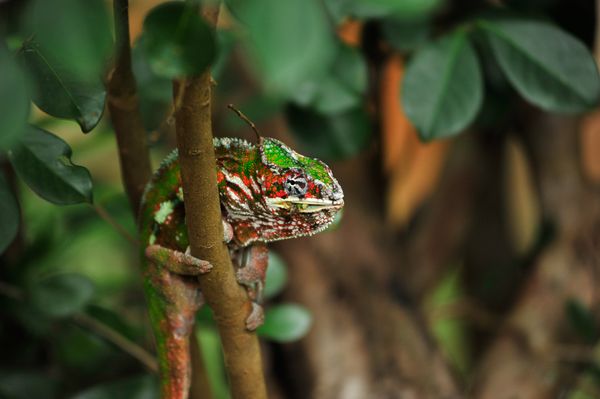
Amie, she-er than she, was a bit late on noting the birthday of one favored writer, and I, me-er than me, will be a bit early noting another.  Click on the image to the left and you will find a fun opportunity to celebrate this birthday and at the same time support conservation for these creatures, which I still have not seen in the wild but hope to one day do so, or at least participate in something like this; anyway, take a look:

11 March 2012 would have been Douglas Adams’ 60th Birthday. To celebrate this event, Douglas’ family and friends, in association with ‘Save The Rhino’ (one of Douglas’ favourite charities) are holding a very special birthday celebration in his honour at the Hammersmith Apollo in London. An evening’s entertainment from some of the finest names in the world of science, comedy, entertainment and music, with a very special premiere performance of Douglas’ material, this is one event that is definitely not to be missed. Continue reading

Connecting The Madeleines

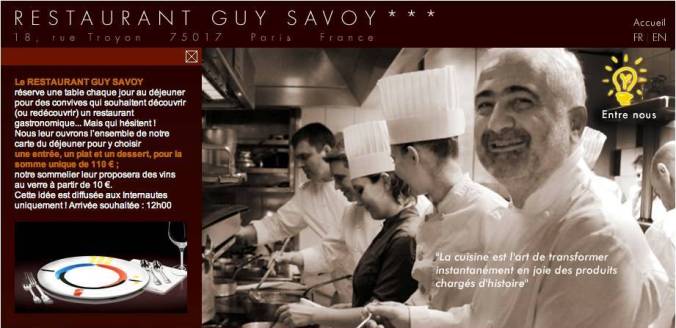
The young man working his way through the kitchen brought to mind a young man of about the same age, three decades earlier. I had the good fortune, in my early adulthood, to work in a restaurant owned and operated by a man who is one of the great chefs of his generation.  I did not work in the kitchen, but in the dining room, from 1983-1985. It provided the most important education of my life, which is saying a lot because I eventually earned a Ph.D. and even that did not top the learning earned in Guy Savoy’s restaurant.

Continue reading

Needing Mr. Miyagi

Anyone who has ever been to ski slopes may have experienced small, pint-sized, infant skiers buzzing down the hills.  As a veteran skier of 18-years, I proudly proclaim that I was once one of these daring children.  However, I learned this past weekend that through the years I have lost this fearlessness when I was challenged to try snowboarding.  I would love to boast that my first run was very similar to this video, but the aching of my entire body keeps me truthful as if to say, “Ha!  You wish, Meg!”

Several times I met the side of the mountain and regardless of the many parts of my body that hit, the solid surface was resilient to my attacks; in fact, the bruises that continue to surface would argue that it fought back with increasing firmness.  The absence of soft, powdery snow brought my awareness to this season’s lack of typical winter weather, and it drew my attention to the resort’s snow-making cannons.  Continue reading

Travel, Writing & Games

This series has always been worth reading, whether you are an American looking through the eyes of a fellow American, or otherwise intrigued by a niche of American perspective that is not quite representative of that culture as a whole.

First things first: sometimes a book, a music recording or other item is only available from the mainstream online retailers such as Amazon or iTunes, but whenever possible we promote the purchase from independent sellers.  So click the image to the right if you want a link to independent booksellers in the USA, provided by the ever-entrepreneurial American Booksellers Association.

Now, the side show: the series editor Jason Wilson is also a contributor to a site we refer to on occasion, and he wrote an interesting item a couple of years ago that began:

Continue reading

Wild Things Lurk In Tranquil Places

Two of Milo’s recent posts–one about appetites and the other about maternal instincts–provide reminders that as beautiful as nature is, there are situational downsides. In an earlier post we mentioned Walton Ford, and it is interesting to consider Milo’s photographic observations in light of Ford’s work.  And since Milo was writing from India, perhaps even in conjunction with the musical encounter below.

This slideshow requires JavaScript.

Do not let Milo’s fearsome photography, nor Walton Ford’s phantasmagorical extrapolations, lead you astray. Continue reading

Entrepreneurial Conservation Through Rockclimbing

Guest Author: Robert Frisch

Image

The burgeoning sport of rock climbing is an excellent example of how an adventure sport can propagate the conservation of natural areas through private sector initiatives.  In the early days of the sport, climbers would hammer iron “pitons” into cracks in the rock as they ascended, and attach ropes to them in order to protect against falls.  The pitons were not designed to be removed, and can still be seen on some of the classic climbs around the world.  Visionary thinkers such as Yvon Chouinard (of the Patagonia clothing and gear company) were unsatisfied with the fact that with each new climb, permanent scars were left in the rock, and set out to devise other means of protection.  Nowadays, climbers use removable “nuts” and “cams” that still protect against falls, but leave no trace in the rock.  In fact, rock climbers have even set up organizations such as the Access Fund that participate in conservation and land protection initiatives.  The sport has also helped to bring much needed revenue to rural areas as diverse as Slade Kentucky, Yangshuo China, or Sigsipamba Ecuador. Continue reading

Advice For Peace Corps Hopefuls And The Creation Of A Hotel

Guest Author: Robert Frisch

Image

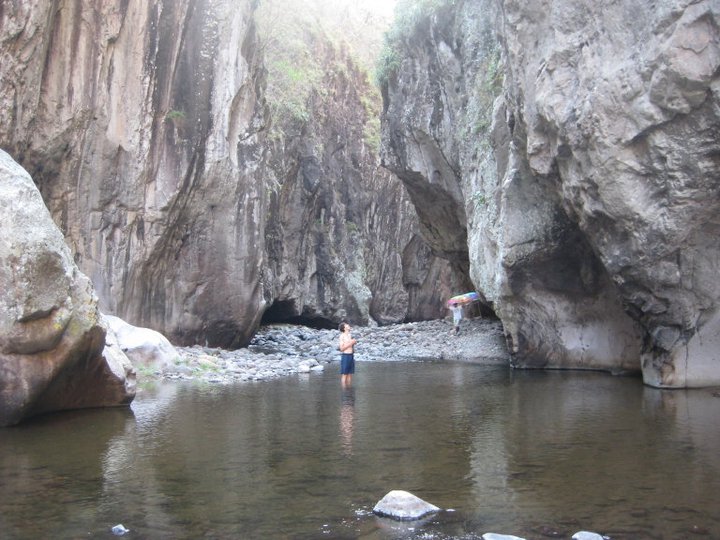
My Peace Corps Location: Matagalpa, Nicaragua

As a former Peace Corps volunteer, it is not a rare occasion that I come across an eager undergraduate looking for some guidance on the decision of whether or not to join the organization.  I also receive many requests for tips on how to make the most out of the two-year volunteer program.  Over the years, I’ve narrowed down my responses to three main categories: Continue reading