 The book mentioned in this previous post is proving difficult to stop thinking about. The historical clarifications are part of it in a purely fascinating way (no domesticated animals in the pre-Columbian New World, really?); better understanding of phenomenal events such as the potato blight of 150+ years ago, and kudzu in the present day southeastern USA, are equally illuminating, if more alarming. For anyone who has lived in the old or new tropics, this naturally leads to thinking about bananas, and then the clicking starts. And if you are lucky you end up somewhere like this (click on the image above): Continue reading
Food
To Recycle, Compost, or just Trash?
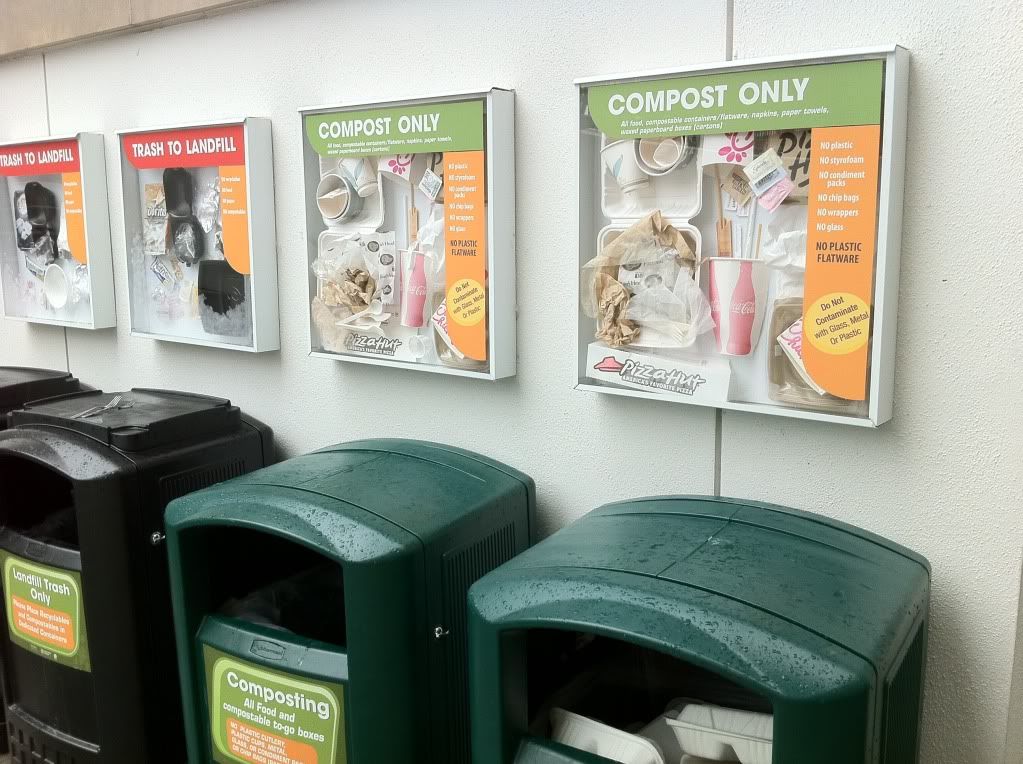 Every student’s visit to the food court in Cox Hall, one of Emory’s largest dining halls, generates quite a bit of trash. Because of the diversity of Cox’s offerings—Chick-Fil-A, Pizza Hut, the Deli, and more—this waste comes in all varieties, too: thin cardboard cartons, Styrofoam boxes, plastic knives and forks, soy sauce and ketchup packets. While sorting these out and recycling them appropriately might only be a matter of taking a few moments to look at the labels, some students feel that they don’t have the time to find out what goes into recycling, composting, or just the trash. College sophomore Daniel F. weighs in:
I like to think that I care about the environment, but there are times when I just can’t sort out what’s what. It gets confusing when you start bringing a lot of these packages together…
Emory, luckily, is making it easier for bewildered students like Daniel to live in a sustainable way. Continue reading
Onam Ice Melter
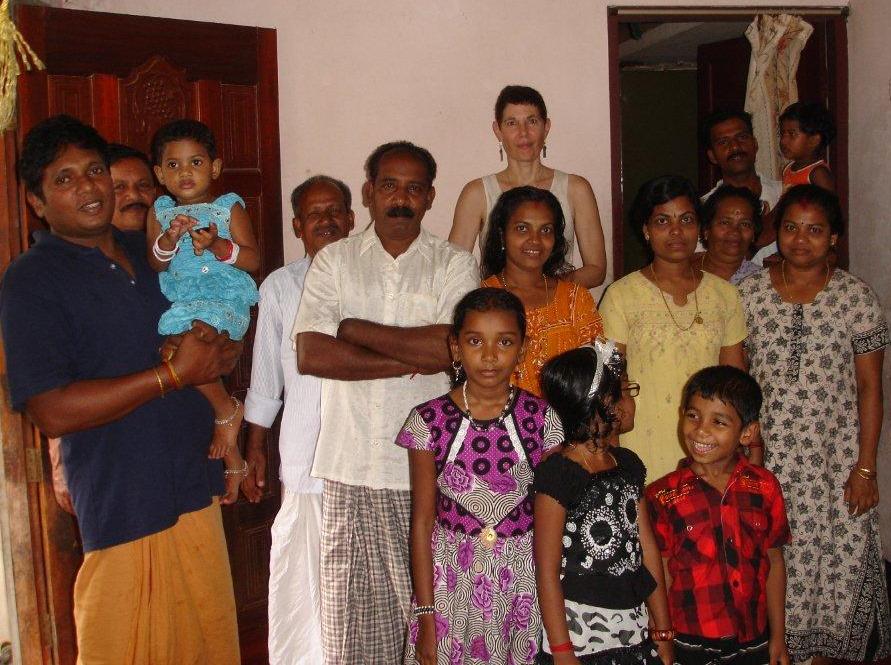
In our neighborhood of Cochin, called Thevara, we walk sometimes in the early morning or late afternoon—been doing this for over a year now. Yesterday, some ice melted on our afternoon walk. Our ice, well-melted by warm neighbors. The ice I refer to is a cultural separator between the we that has been and the we that is and will be. Continue reading
Onam Festival at Cardamom County: Staff’s Onasadya
Continuing from the last post, here is a photo slide show of Onasadya in the Staff Canteen.
Victory Gardens Redux
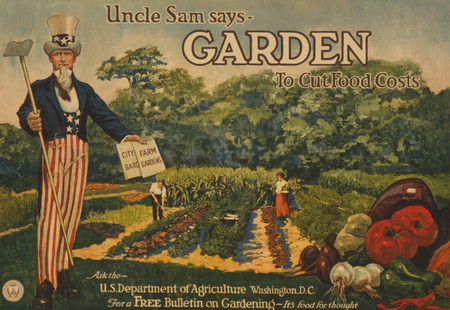
As innovative and “hot topic” as they are, the concept of urban and suburban community gardens is not actually new, nor a USA phenomenon. Just a seemingly “modern” and “developed economy” phenomenon. Innumerable acres of public and private land across the USA, U.K., Canada and Germany were being used for small scale agriculture during WWI and WWII. London’s Hyde Park, San Francisco’s Golden Gate Park and New York City’s Riverside Park (not to mention Eleanor Roosevelt’s White House lawn) all had plots for cultivation in order to mitigate the costs of growing and transporting produce during wartime. A Victory Garden campaign during WWI is said to have influenced the creation of over 5 million gardens in the USA alone. Continue reading
Monsooning Coffee & Tasting The Place
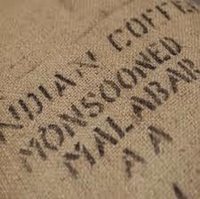 We have been beta on a service that allows an actual taste of the places where we work. Coffee, from our friends in Nicaragua; honey, wild-hunted in India, Africa and South America; the salt that Ghandi promoted; and the pepper that we have written about more than once. And so on. The point is that you can taste the difference of a food or a beverage based on where it comes from, and that is evocative. For example, coffee grows all over the world, and not only the growing conditions vary but so do the post-harvest traditions:
I head off to attend a friend’s wedding in India. It happens to be at the same time as the beginning of the monsoon season so I can’t resist the temptation of organizing to visit the coffee monsoon processing town of Mangalore on the Malabar coast. It is the only place in the world where this most unique of coffees is processed: Monsoon Malabar
I land at the new Bangalore airport which is now world-class, slick, big and impressive. It is so far removed from the old Bangalore airport I last visited sixteen months ago where you were jolted into a profound awareness that you were in a foreign country for real: with hordes of people lining the exit ramp and traffic going in six directions at once and a cacophony of horns, calls and mass humanity pressing on all sides. The new airport is much more sedate and orderly and the immersion into the wonderfully varied and exotically, pungent Indian culture is now a little more gradual. Continue reading
Onam Festival at Cardamom County: Onasadya
Continuing from the last post, here is a photo slide show of Onasadya in the All Spice Restaurant.
Onam Festival at Cardamom County
As Amie and other contributors mentioned in their posts, the Harvest Festival and the time of giving thanks has come to Kerala and to Cardamom County. I had the great opportunity to be on property and experience the colorful festival of Onam. Being part of both guest and staff, I could see all aspects of the event: from preparation to the final event. Onam is a ten day festival as Amie’s post explains, but the most important day of Onam is the 9th day, which is oddly called “First Onam” because that is the day that King Mahabali actually descends to Kerala. But any day of Onam seems like the Keralites’ spirits were soaring. All the staff at Cardamom County have great warm and happy smiles but during this festival season it felt like their warmth was doubled.
The Buffet Personality Test
There’s the Myers-Briggs test, the Jungian archetypes, the Japanese with their blood types and the astrologically inclined with their zodiac signs. These are all ways of putting people into classifications of one kind or another, to see which boxes they check and use this as a means of understanding their personalities. These taxonomies are useful for some in their attempts to easily judge books by their covers (or perhaps by their tables of contents). But I’ve got a new one: the buffet approach – comparably empirical but a lot more fun!
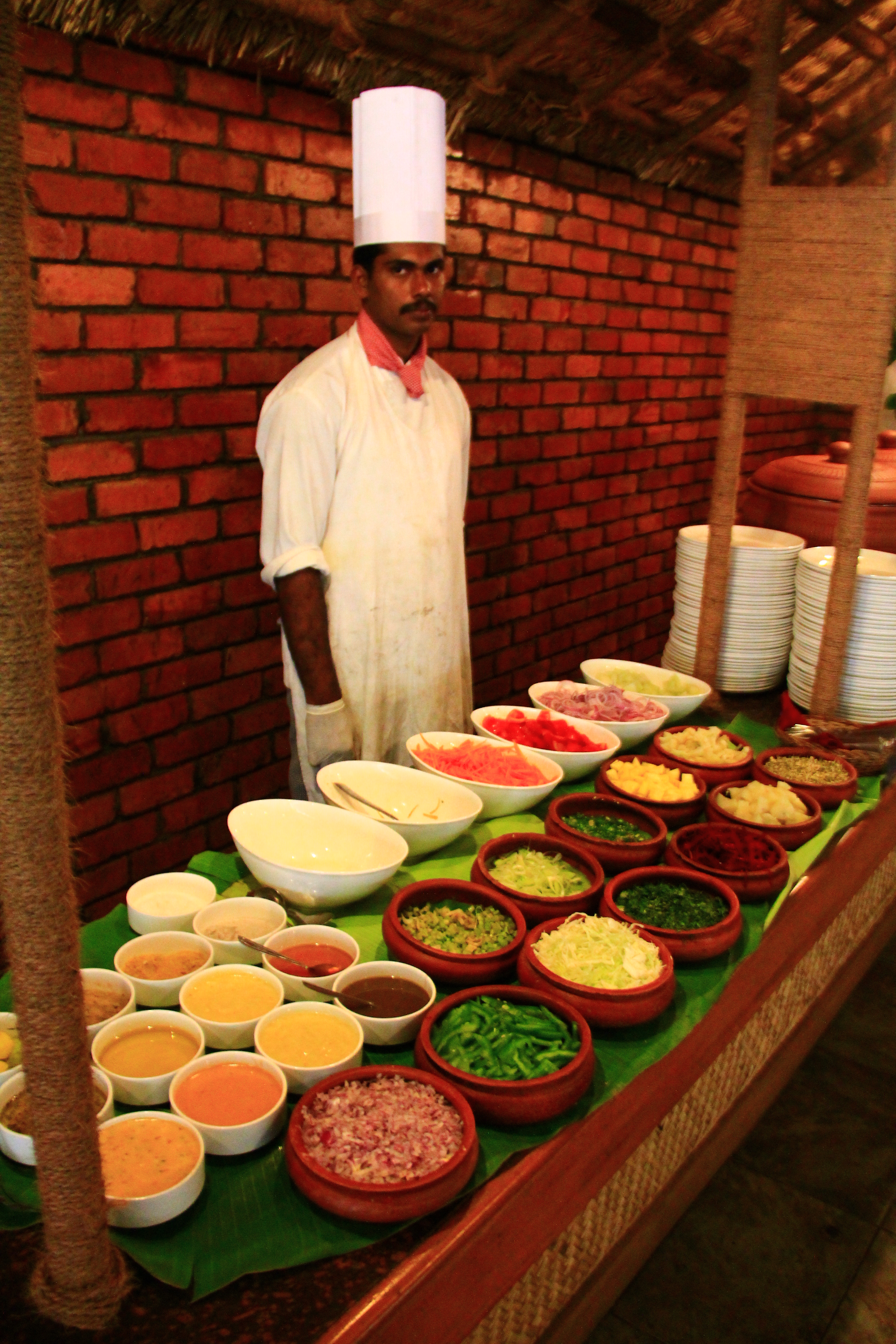 When you’re at a buffet, do you take a little of everything for the first round, then go back for bigger helpings of the dishes you liked best? Or do you browse at first, automatically writing off the red stuff for its overt similarity to a vegan rump roast and skipping the crunchy stuff for its unrecognizable position on the food chain? Or do you phase through it, bit by bit, going back for the things you’ve not yet tried? In my highly rudimentary and anthropologically unqualified analysis, I’d be willing to take your “buffet approach” as a proxy for your “approach to life.”
There are the grazers, particular and self assured. Then there are the nibblers, shy, disciplined and unimposing. And at the other extreme you have the all-out face-stuffers, decadent adventurists for whom a plate’s inadequacy of surface area is just another reminder of the fact that there aren’t enough hours in a day. Of course there would be the combo personalities, like the high-piling sharers, ambitious enough to stack up the sweets yet self-restrained and manipulative enough to make their partner eat the rest. Or the serial nibblers, philosophically conservative yet constitutionally indulgent. I’m telling you, this could be the new Rorschach test. Continue reading
Let Us Give Thanks
The Kerala Harvest Festival Onam transcends religion and region, making it one of the most important festivals of the state. All signs of abundance and prosperity are incorporated into the celebrations: Elaborate pookalams (mandalas made of flowers and leaves, shown below) adorn the courtyards of homes and business; and elaborate multicourse meals called Onamsadya are served on banana leaves.
The festival celebrates a story, not unlike the Greek myth of Persephone when she was kidnapped to the underworld but allowed to return once a year for the spirit of rebirth in spring. The Kerala story is about a beloved king during a time of great prosperity who sacrificed himself, saving the earth from an avatar of Vishnu. For his devotion he is granted the boon of being able to return to his country once a year to visit his people, who prepare for his coming with an abundant harvest to assure their King that the land still flows with milk and honey. Continue reading
Comforting Words
Everyone who has lived apart from the culture they associate with “home” is familiar with the notion of comfort food. Sometimes it is nourishing, like oatmeal, and other times more of a guilty pleasure, like this one:

As with all guilty pleasures, you avoid thought. You just enjoy. It brings you home, for a moment, wherever that may be. But sometimes, your eye is caught by the glint on the packaging and you learn something new. By the good graces of modern technology and thanks mainly to the requirements we place on companies to share helpful information about the things they produce that they call food–we may have unexpected vocabulary-enriching experiences, like this one:
Windowfarms: More on Urban Gardening
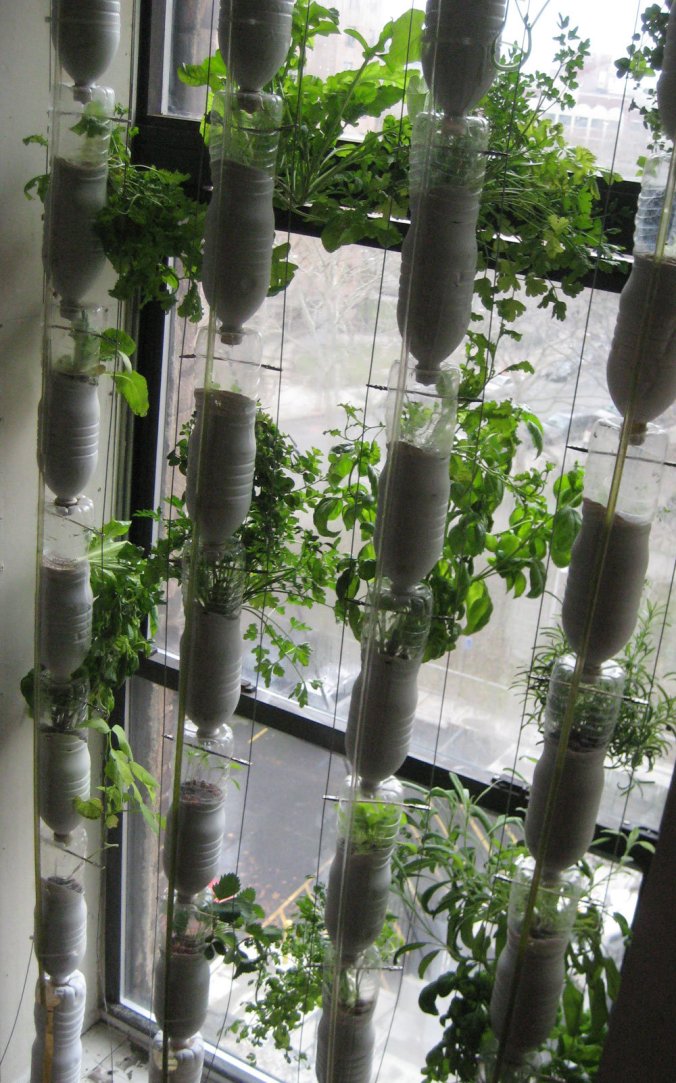
In one of my earlier posts, I discussed some of the basics of hydroponics, one of the less popular but more efficient forms of urban gardening. Today I won’t discuss the technical aspects of hydroponic gardening, but display an example of an entrepreneurial venture taking advantage of the underdeveloped market. Most people with hydroponic gardens are either aficionados or professionals – very few grow soil-less produce casually.
Windowfarms, an American open-source project concerning itself with urban agriculture, not only offers the blueprints for solar window-contained hydroponic gardens, but also the option of purchasing a kit of varying dimensions (for those less comfortable with the technical specifications). In addition to its mission of reducing urbanites’ carboon footprints by enabling them to grow their own produce, Windowfarms are being used to educate schoolchildren on the benefits and ease of urban farming.
K-12 Growth
Last month I wrote about the Dunwoody Community Garden, and commented on my surprise at its seemingly exponential rate of growth and improvement. I also promised to check out Dunwoody High School’s (DHS) current involvement with the community garden, and I can finally deliver on that one:
Grow Dunwoody is a community enterprise designed to bring gardens directly to Dunwoody’s schools. According to Danny Kanso, a senior at DHS, the purpose of the program is
to integrate hands-on learning into science, wellness, and special education, to produce renewable classroom and community resources, and to instill sustainable practices and values within our student body.
Honey, Hope & Future Cod
Milo’s post yesterday is of special interest to various initiatives we support related to food. We will have much more to say on bees (and honey), but for now, it gets us thinking. Combined with Seth’s recent post, touching on the subject of overfishing (do read Mark Kurlansky’s books related to food, in addition to Cod), provide a reminder to stop and take a breath. In a world full of challenges that daunting, how do we keep our wits about us? How do we remain, fundamentally, hopeful? An answer, but not necessarily with explanation, can be found sometimes in art (defined as you choose). If we do not solve the tragedy of the commons with fisheries, might we still hope for a beautiful future for marine life that looks something like this?
Pepper Terroir
Chili. Chili Pepper. Capsicum. Multiple monikers for a simple fruit in the nightshade family that has successfully colonized all cultures around the globe.
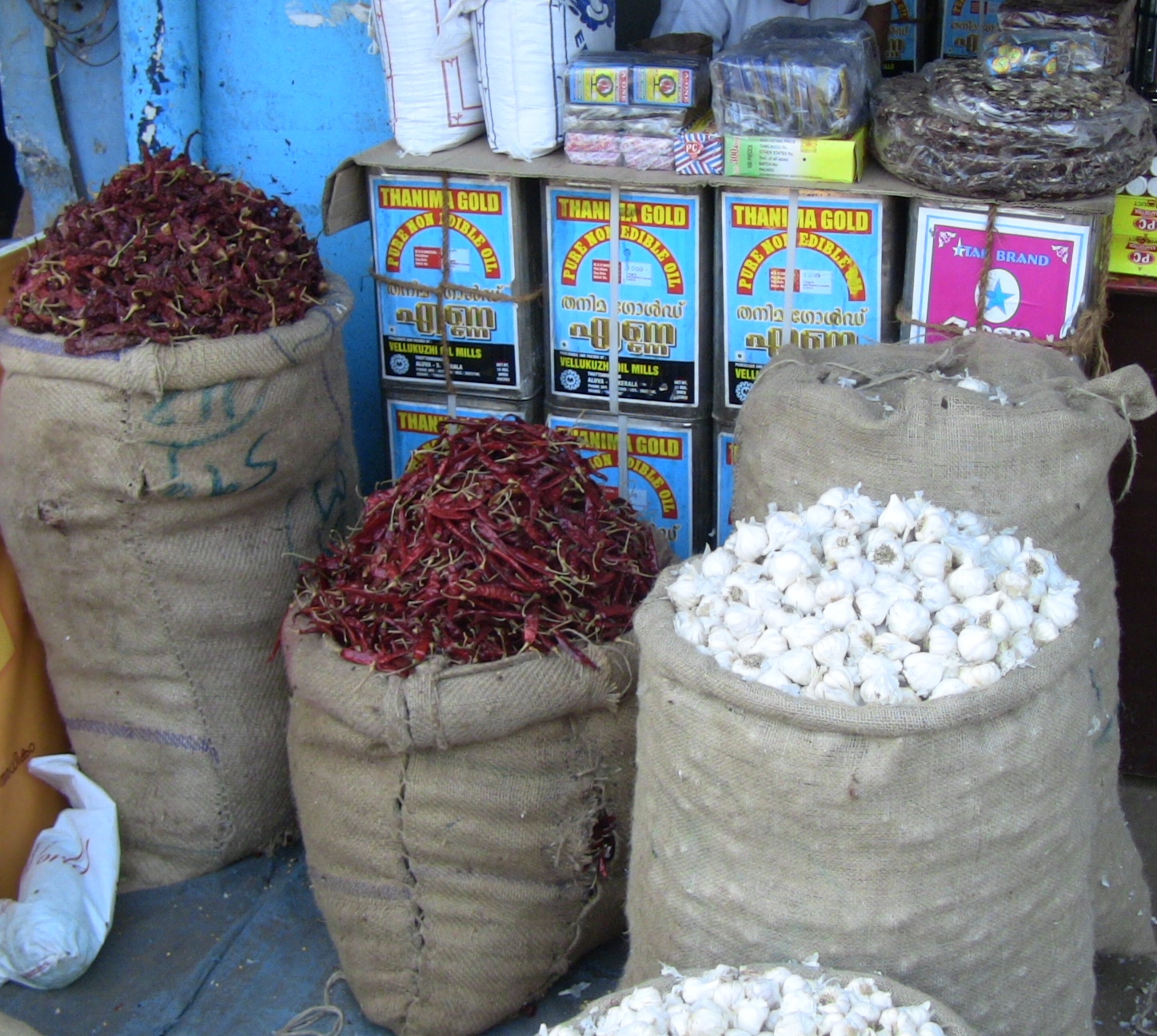
Chili Peppers and garlic at the Ernakulum Market, Cochin
This new world crop was part of the so called “Columbian Exchange”, using those newly opened passages to cross oceans and then continents. Both the Spanish and the Portuguese had interests and influence across Asia and India, and these fiery fruits were quickly incorporated into local cuisine.
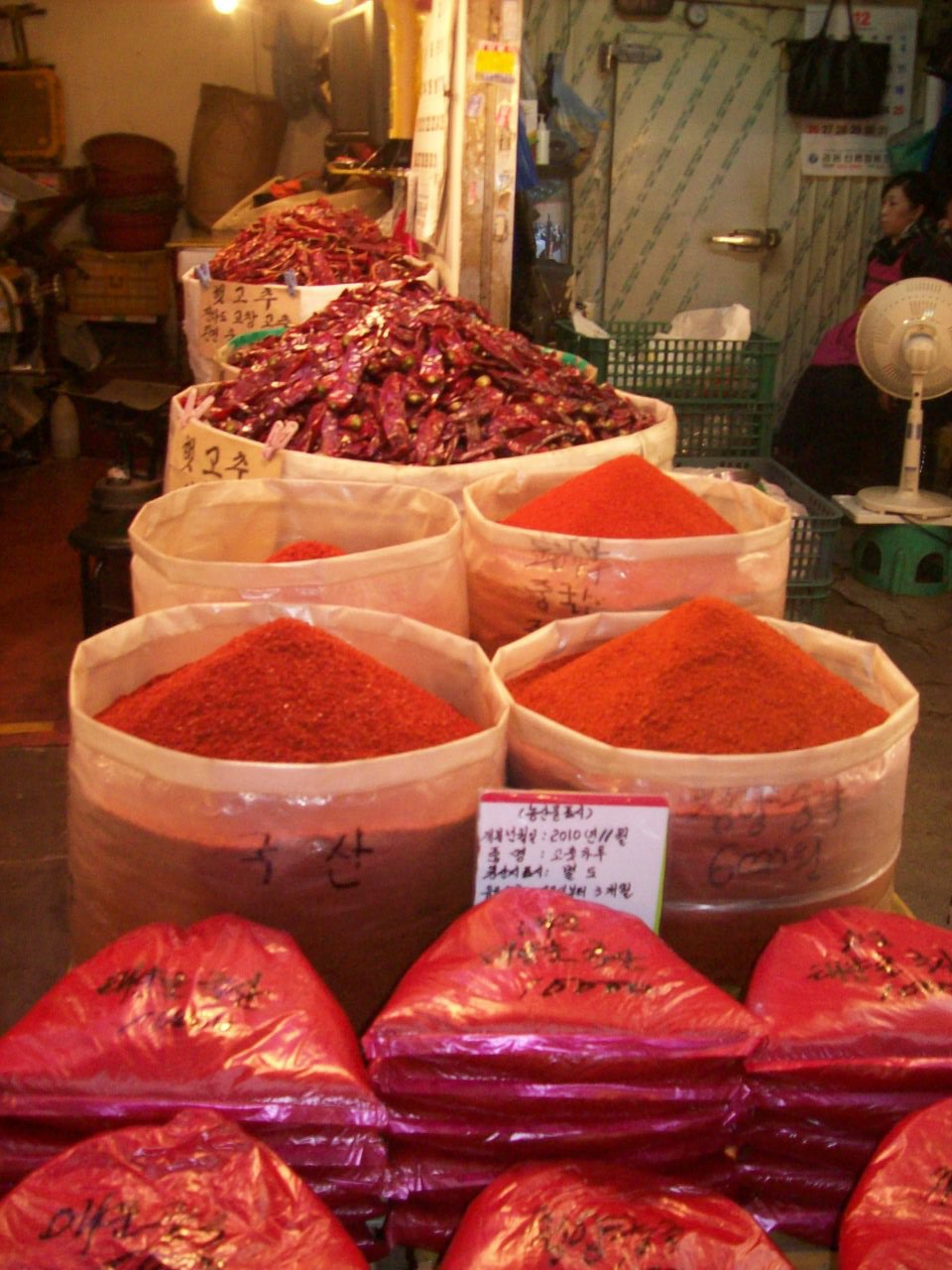
Chili Peppers (whole and ground) at Yangnyeong Market, Seoul
Oaxaca, Mexico has been a culinary mecca for decades and the chili has played an enormous role. A market excursion wouldn’t be complete without a visit to the chili stalls. As I’ve written in previous posts, this form of “shopping” goes way beyond simple provisioning. It’s a both lifestyle and a lifeline to a different time…
Mark Bittman is referring to a particular terroir in his article. But using an anthropomorphic conceit I’ll ask readers to consider the concept of “slow food” as a citizen of Pangaea.
A Better Tea Party
Our visit to Munnar’s High Range Tea plantations gave us more insight into the history of the drink than just the lively culture of the “cuppa”.
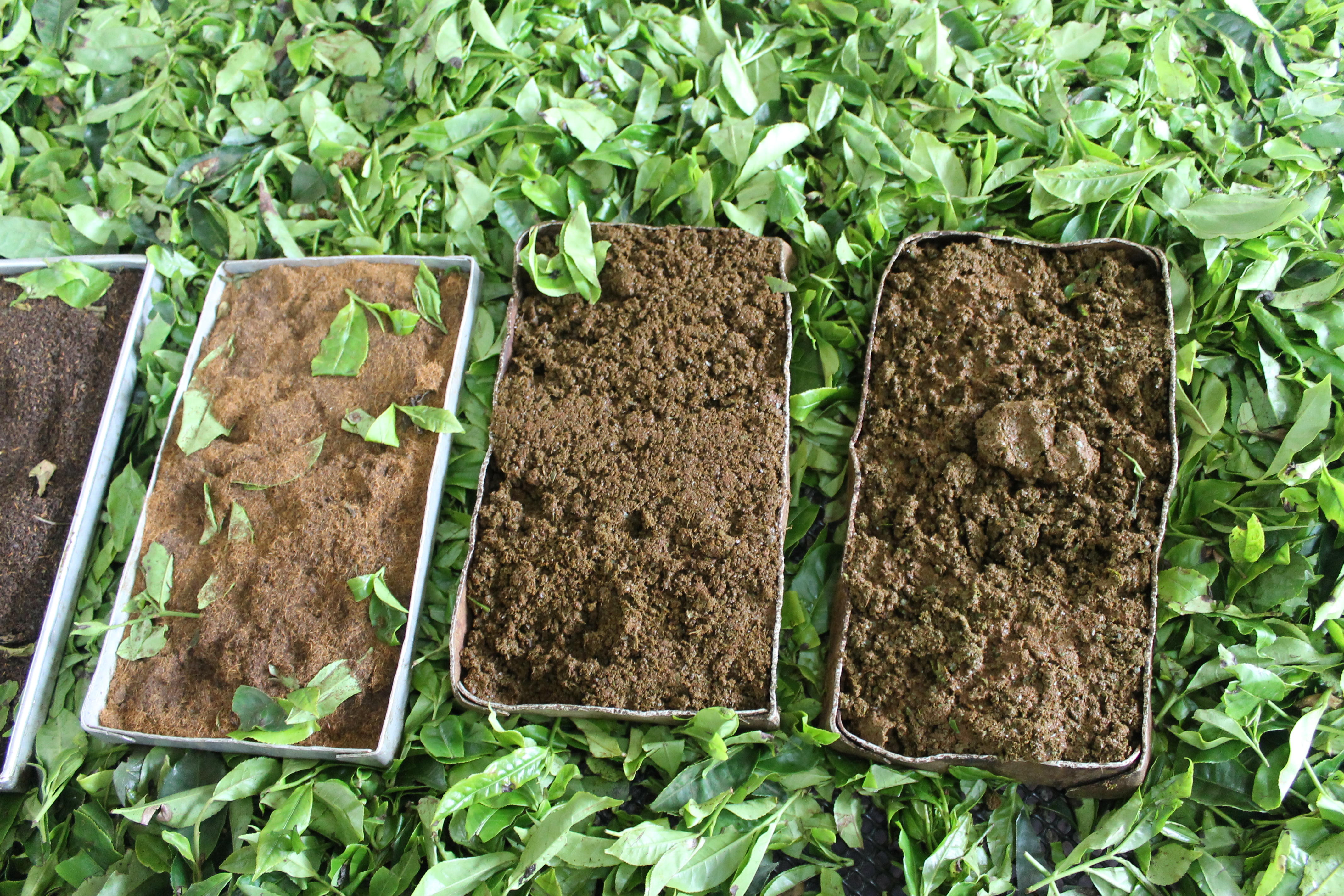
Traditionally called Chai, tea has been the backbone of numerous communities in the mountainous areas of India and Sri Lanka (formerly known as Ceylon). Schools, health clinics and even Hindu temples were built by the plantations for the betterment of the community. The Shristhi Welfare Centre, founded by a local tea plantation, sells delicious High Range strawberry preserves and handmade paper products that contributes to the rehabilitative vocational work of physically and mentally challenged children of the plantation workers. Unfortunately they were closed on Sunday when we wanted to visit.
There’s more to tea than meets the palette. I will be writing more about the Shristhi Welfare Centre, and its relation to tea, in posts to come.
The Gadus Commons
William Bradford, governor of Plymouth Colony in Massachusetts for much of the first half of the 1600s, from whom North Americans have inherited the notion of communal Thanksgiving (and incidentally my grandfather 26 generations removed) noted:
The major part [of the Pilgrims] inclined to go to Plymouth chiefly for the hope of present profit to be made by the fish that was found in that country (Cod; 67).
Fast forward a few centuries. Bottom trawling, longlining, and gillnetting during the 19th and 20th Centuries were probably the most responsible for cod’s population decline in North America. Faced with the same great abundance that had helped bring settlers to Cape Cod, huge fishing companies acted rationally to maximize their own gain, taking advantage of the bountiful commons, and this led to ruin. With the near disappearance of cod came the absence of herring, capelin, humpback whales, and squid. Continue reading
When Good, He’s Very Good
Mark Bittman took it down quite a notch when he started up-slumming with celebrities. Nothing against Gwyneth, nor Mario. Just that this fellow is better at what he does than they are at what they do. Case in point today: he is on game.
Food Exchanges Across Centuries
An article in yesterday’s Science section of the New York Times touched on a question raised in Amie’s post. Synchronicity?
Culinary Contentment at Cardamom County
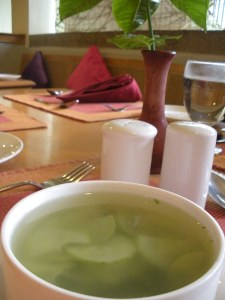 Sometimes, when you experience something so good, you want to share it with the world. This is what’s happened to me as I’ve dined at All Spice, the ethnic fusion restaurant at Cardamom County Resort. As I mentioned in a previous post alluding to the pleasures of growing one’s own herbal ingredients in an urban setting, I’m a huge fan of coriander, also known as cilantro. So when I sat down for dinner at All Spice last night, I ordered the sliced cucumber, lemon and coriander soup knowing I would love the flavor of this dish, which is an original house recipe.
 Organikos