Potoo Dreams

moon

As the sun drifts below the horizon and the Jamaican bush is lit up with stars, the Northern Potoos begin to duet. QUAAAA-QUA-QUA-QUA-QUA QUA screams one into the night. Its neighbor responds in kind. As darkness settles over our tents, we fall asleep listening to their song.

2

Potoos are very odd birds. (This group of near passerine birds are related to frogmouths and nightjars.) During the day, they are practically impossible to spot, due to their legendary camouflage. They generally freeze at the end of a branch, and their streaky brownish and grayish plumage resembles an extension of their perch. Although we checked many snags while in Jamaica, we could never find a potoo in the daytime.

At night it was another story. Potoos are nocturnal, or active at night, and they like to hunt in open fields at the edge of the forest. They have huge eyes, which glow bright orange when light is shined in their direction. With headlamps, we were able to spot potoos perched on posts hundreds of feet away. Continue reading

A Sneak Peek at Jamaican Bird Videos

We have several full hours of raw bird behavior footage from our first trip, so it’ll be a while before we have much processed to the point of sharing here, but I thought it’d be nice to have a quick preview of some things to come once we’re back from our second trip to the Blue Mountains.

In the video above, you can see four relatively common bird species in Jamaica: the American Kestrel, Northern Mockingbird, Merlin, and Orangequit. The first three species can be found in the United States but have resident populations in Jamaica, while the last is endemic to the island. The behavior exhibited in the video is typical of all the species. Continue reading

Preparing for the Blue Mountains

A friendly caterpillar I found crawling around my tent’s rainfly on one of the last days in Jamaica.

We just finished our first week back in Ithaca, where temperatures have stayed below 0ºF most of the time and therefore we have stayed indoors most of the time. Mostly we’ve been writing up all our observations from the first expedition, digitizing our paper field notes and organizing our photos and videos; playing around with bird data in Excel, eBird, and ArcGIS (a mapping-data program); and looking at maps of the Blue and John Crow mountain ranges.

Continue reading

Melton West

Melton

Note:  Hey I’m John, a new author with Raxa Collective. I am working as a field technician on an expedition studying the Jamaican Golden Swallow with Justin Proctor and Seth Inman.

While traveling in the Jamaican bush, local people would often pleasantly surprise us. While passing us deep in the bush on a donkey with a pack saddle brimming with yellow yams, a local farmer with a ragged hat and torn work shirt told us about how he just spend the last week in Toronto with his Canadian girlfriend. A group of illegal mahogany loggers, upon seeing our camera equipment, enthusiastically asked us to help them film a music video. But by far, our favorite encounter was with Melton Manuel West.

We met Melton as we set up our camp in the late afternoon near BBQ Bottom Rd. He was walking from his home in the bush to go to the market in nearby Campbells. Like most people we met, he asked us about what we were doing. Intrigued by our project, he declared he would take us to the best places in the bush to see swallows. Then he sat down nearby and just hung out near our camp. At first we were suspicious, and it was a little disconcerting. Yet before he left, we agreed that he could guide us into the hills the next day. Continue reading

A Successful Part One

View of a foggy Barbecue Bottom valley in Cockpit Country

This past weekend, the first stage of the Smithsonian’s Jamaican Golden Swallow Expedition came to a close. After a full month of exploring Cockpit Country for whatever aerial insectivores we could find, we flew back to Ithaca on the 14th. Now we will process our data and imagery for two weeks while restocking for the second trip.

The bulk of our gear laid out for washing, drying, and sorting on the Windsor Research Centre’s lawn during our last day in Cockpit Country.

Continue reading

Jamaican Columbids

Cockpit Country from “the Alps”

In rural Jamaica there appears to be a traditional pastime of hunting pigeons and doves (scientifically known as the family Columbidae). There are a total of twelve species on the island, of which seven or eight can be expected in Cockpit Country.

So far we’ve seen six of those species, and although we’d like a closer look at some like the Crested Quail-dove, we’re pretty satisfied with our luck so far. Continue reading

Roads and Trails Through Cockpit Country

A Turkey Vulture is king of the power tower

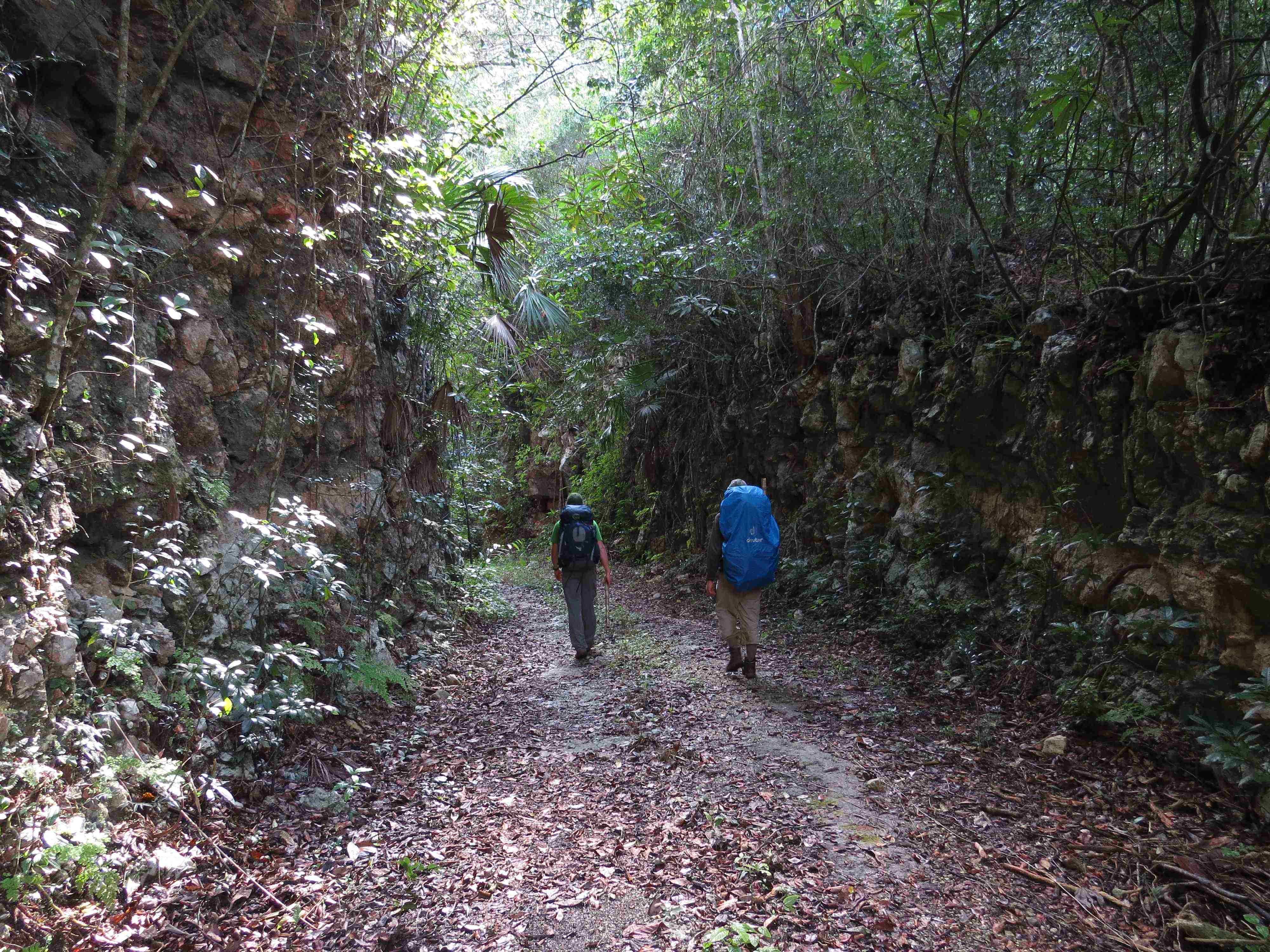
As I mentioned in my previous post, we’ve been traveling around Cockpit Country over the last week and a half by driving around from town to town and finding trails to lead us into the bush. Sometimes these trails are old roads that are clearly still sometimes used by SUVs and donkeys; often they are even older tracks that are for single-file passage and no longer pack-animal-friendly.

Justin on one of the “karstier,” more rugged valley trails

We started out our trip to Jamaica hiking some of these latter types of paths, accurately predicting that they would take us to places few people have birded and naively hoping that they would offer us views of hidden valleys or even the sky. They ended up being difficult to traverse and, as far as we can tell, not the right type of habitat for swallows. Continue reading

Cockpit Country Circumnavigated

a view from the fringe of Cockpit Country out over the plains by Seth

After a week and a half of trekking and camping out of our crappy little rental car with about four inches of clearance, John, Justin and I have completed our preliminary clockwise perimeter of Cockpit Country.

the locals in Accompong show us the start of a trail

a strangler fig lifts a karst boulder off the ground

Parking at the head of every trail into the interior that we found on our 1959 map of the area–some of which are incredibly listed as secondary highways on our 2012 road map of the country–we’ve set up a routine of hiking down trails and back all day, camping for the night, and driving out the next morning.

Continue reading

Aerial Insectivores

Cockpit Country

Cockpit Country

As we head west along the southern portion of Cockpit Country from Barbecue Bottom Road and Albert Town, we’re noticing a big difference in the amount of aerial insectivores we’re able to see while out hiking every day.

Justin and John on the trail from Windsor to Troy

During our initial excursions into the bush, we were taking densely wooded trails that required constant vigilance of the path in front of us due to shifting stones, twisting roots, and strong ground vines. In some of the worse areas we needed machetes to clear vegetation and big fallen trees, and even when we had time to look up at the skies they were often covered by thick canopy.

Continue reading

Jamaican Hummingbirds

Red-billed Streamertail (male) by Seth

During the first week of our time in Jamaica, all of us were able to see the three species of Jamaican hummingbirds, although none of us had gotten a really good look at the prize: a male Red-billed Streamertail. Male Red-billed Streamertails are iridescent green with a black cap and two extremely long tail feathers that flutter behind the birds when they flit around. The birds move quite quickly and are often in and out of your field of view in a flash, but their call is relatively loud–as is the hum from their wings–so with practice you can locate them eventually.

Jamaican Mango by Seth

Jamaican Mangos are the largest hummingbird in the country and very recognizable given their flashy purple plumage and strongly decurved bills. From what I’ve noticed they perch for fairly long periods scanning their territory for intruders (most hummingbirds do something like this all the time), and this offers good photo opportunities. Continue reading

Northern Cockpit Country Complete

One of our camps

Justin, John and I have been in Jamaica almost two weeks, and the “Sharpied” names on our Rite in the Rain notebook covers have already faded off, our shirts smell soberingly of rotting onion, and our feet are eager to be released from their boots at any opportunity. At one point John had over a hundred tick nymphs on his body––the actual count was 163––but we won’t talk any more about that.

Barn Owl startled out of an abandoned house

We’ve seen over sixty species of bird in our twelve days here, and only one of them has been a swallow: the Cave Swallow. In general, aerial insectivores like swifts and swallows have been quite scarce, which is really surprising since we’re going through huge swaths of great habitat.

Barbecue Bottom Road with John and Justin by Seth

Barbecue Bottom Road with John and Justin

Continue reading

Expedition Update

Expedition Group – From L to R: Seth, Justin, Bobo, no name donkey, John. Photo credit: Dango, a friendly local

We’re back from a three day and two night excursion into Cockpit Country along the Troy-Windsor trail. We went out with Bobo and his donkey with no name, and made it what we think added up to about twelve miles down the old, overgrown trail. Several times we had to chop through fallen trees that the donkey couldn’t go around or over, and this took up quite a bit of our time.

Photo of rotten tree we cleared by John

Eventually we hit a patch that would have taken a full day to clear so we left the donkey behind with the idea of setting out for a few hours and then coming back. Continue reading

First Days in Jamaica with Smithsonian Expedition

This slideshow requires JavaScript.

John, Justin and I have been at the Windsor Research Center for a day and getting ready for our first five or six day trip through Cockpit Country. Every single Jamaican we’ve met so far has been super friendly and helpful. We won’t be able to update as much as we’d like but hopefully every week we can send out one quick post. If you don’t hear from us though, it’s likely just because there’s some wind hitting the leaves that are reflecting the signal that the antenna here picks up and plugs into the desktop they use at Windsor. Continue reading

Packed and Ready to Go

Six checked bags, three carry-ons, and two personal items. Three tickets for travel through three airports over a course of eight hours (including layover). One rental car for forty-eight hours, and thirty nights in Jamaica, around twenty-five of which should be in the bush. We’re hoping there’ll be enough internet access at the Windsor Research Centre to have some posts published throughout the next month, but it’s possible we’ll only have time for some very detail-packed posts. Regardless, we should be back in time for Valentine’s Day, February 14th!

Continue reading

A Trio of Jamaican Endemics

Jamaica has thirty endemic bird species, which is more than any other West Indies island. Justin, John and I have a good chance of seeing a good handful of those, especially since Cockpit Country and the Blue Mountains are such well-forested and protected areas. Although none of us are the type of birder that pursue “life lists” — a checklist of the thousands of bird species in the world that one has seen — we all use eBird and are definitely interested in seeing and identifying wildlife of any sort.

And if that type of animal happens to be found only in the area that we’re passing through, then that just makes us appreciate the relative rarity a little more. Endemism in a bird species does seem to assign that bird a bit of a higher status for life-listers, for the obvious reason that you have to be able to go to the certain region to find it — you can’t necessarily spot it merely by visiting a different continent, but rather you have to go to the country, or island, or mountain range.

Continue reading

Cockpit Country

© Google

Cockpit Country, the first of the two regions we’ll be traveling through during our pair of expeditions, is an area of roughly 500mi² in northwestern Jamaica. The country is divided into parishes, which are like the counties or provinces of other countries; Cockpit Country is in the southern section of Trelawny Parish, which at one point had the most sugar plantations on the island. The sugar factories were closer to the coastal ports, but Cockpit Country, full of forest and strange limestone terrain, was (and still largely is) uninhabited and difficult to traverse.

Continue reading

Maps and Recordings

Using Cornell’s Mann Library plotter printers and the Digital Printing Center’s laminating capabilities, John, Justin and I were able to make some versions of northwestern Jamaica maps this week. Cropped to show just Cockpit Country and its environs, the maps are big and waterproof and will be perfect for field use if our Garmin Oregon 650 handheld GPS unit fails for whatever reason. This area of Jamaica is full of interesting historical and vernacular place-names like Me No Sen You No Come, Look Behind, Cutthroat, and other regions we’re interested in getting a look at, at least from afar.

Continue reading

A Brief Gear Preview

P1010526_zps280e666dSince we’re doing most of our packing today, we figured it would be a good time to share some photos of our gear before everything is stuffed into a suitcase. Below is a random selection of items we’ll be taking down to Jamaica with us, from food to insect repellent.

Starting to our left, we have a small bottle of biodegradable all-purpose soap that can be used as bodywash, shampoo, and detergent for both clothes and dishes. I’ve already sampled it on some clothing and it seems to do a great job. Seeing as you can’t take a real shower in the field for five or six days at a time, it might be good to have some of this stuff handy.

Next are two types of water container that should grant us more mobility away from our base at the Windsor Research Centre. We’ve been told that there aren’t many natural sources of water in Cockpit Country, so we need to bring our own water with us. Our solution to this problem is hiring a mule to carry water and certain heavy equipment like tents for us, so we have two 26.5L bladders and two 8L carriers for water.  Continue reading

A Word About Our Partners

Research trips, especially international ones, take a lot of money to organize and execute properly. There’s flights, gear, accommodations, food, and other logistical or supply costs that add up to a hefty sum, and field scientists can rarely afford to foot the bill themselves. That’s where large, well-funded organizations like the Smithsonian Institution come in. The coordination and leadership of a museum and research body like the Smithsonian, paired with additional support in the form of grants or gear from other groups, is what makes a successful research trip possible.

For our Jamaica expedition, we’re Continue reading

Tents and Traps

Yesterday I mentioned live mammal trapping, and our original post describing the Golden Swallow Jamaica Expedition referred to animal surveys as well. Today we tried setting up our tents and our traps, to make sure everything is in working order and also to see how fast we can build up and break down the gear. We’re each using our own personal tent — two Marmots and an Eureka — and we’ll have three Tomahawk Live Trap cages for the surveying.

Continue reading