Cockneys in Iceland

The Cockney Tourist, or Where Shall We Go To? © Look and Learn / Peter Jackson Collection / The Bridgeman Art Library

Earlier last week, I completed a working draft of one of my thesis’ chapters. Its subject matter is a bit different from what I’ve been writing about in previous months, because I more closely address trends in travel and travel literature rather than the travellers’ interactions with the environment around them. Here’s an edited (and de-annotated, so comment for further reading) version of the introduction to this chapter:

After the Napoleonic Wars, as continental Europe reopened to British travel during the 1820s, there came to be an exaggerated perception that sightseers were swarming sites of the Grand Tour, previously inaccessible due to both military and socioeconomic barriers. Many aristocratic Britons considered this type of tourist, the mere excursionist, distinct from themselves, the sophisticated travellers more interested in natural history, authentic culture, and exploration. Iceland, with its near-mythical  Continue reading
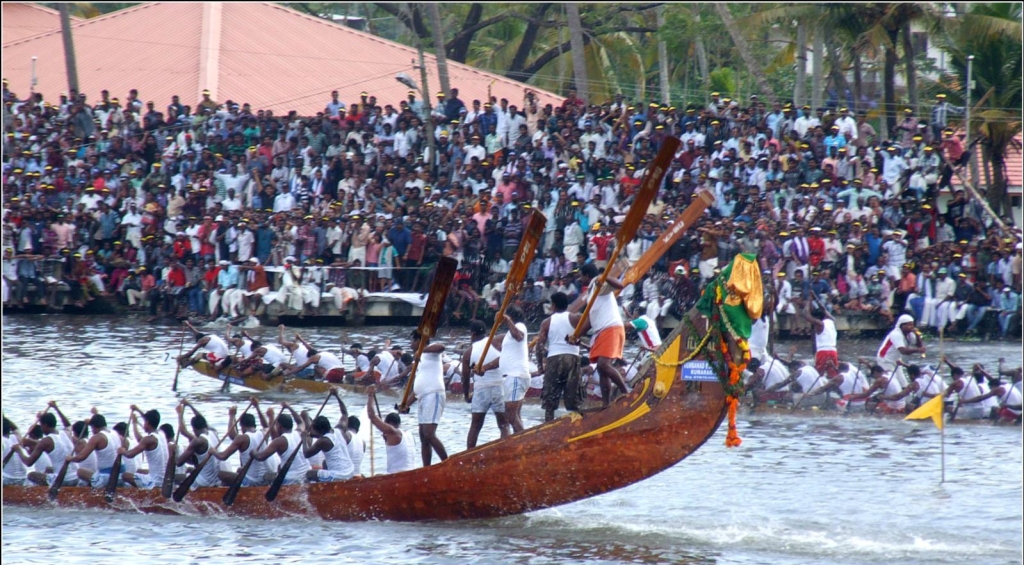
Magical Vessels

Photo credits: Ramesh Kidangoor

Photo credits: Ramesh Kidangoor

The tranquil backwaters of Kerala turn into a sports arena once every year as more than a dozen snake boats, some manned by 100- 125 oarsmen, fiercely compete with each other in the boat races called “Vallamkali”. Vallamkali are an integral part of the history and culture of the people of Kerala. Continue reading

Antarctic Exploration One Century Ago

This slideshow requires JavaScript.

Thanks to the Guardian‘s occasional history lessons via photography, like this one:

Eschewing the race for the South Pole, geologist and explorer Douglas Mawson took his scientific expedition to the eastern Antarctic – a region totally unmapped and unexplored. Here is a glimpse of the photographic archive that records their epic journey

Technology, Activism, Discontent & Keeping It Honest

Doug McLean

It was just recently when we started noticing it on the Atlantic‘s website, and needed some time to determine the fit with our blog:

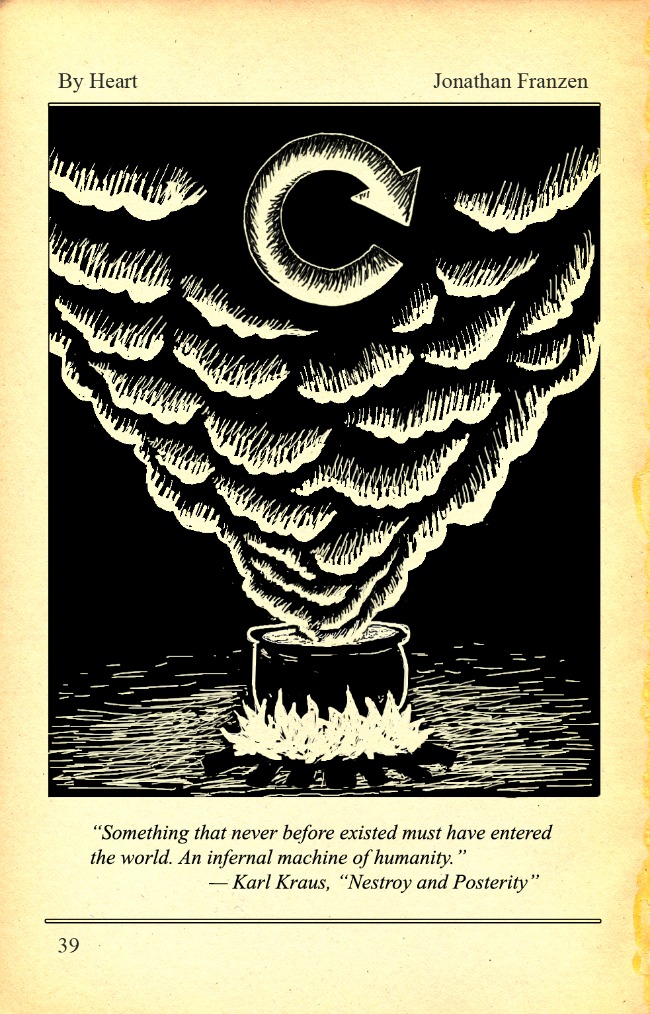
By Heart is a series in which authors share and discuss their all-time favorite passages in literature.

It took this one to make us realize the fit:

Jonathan Franzen on the 19th-Century Writer Behind His Internet Skepticism

His new book translates works by Karl Kraus, whose misgivings toward progress mirror Franzen’s belief that technology can be “very harmful” to artistic production.
 OCT 1 2013, 3:43 PM ET

We have several times linked to stories involving Franzen, and there is no question that it is in part because of his bird-loving devotions; but it is not only that.  We put ourselves in his corner a few months ago and there are plenty of paradoxes in this corner but read this to appreciate the depth of Franzen’s sense of purpose related to technology, starting with Joe Fassler’s excellent commentary:

Karl Kraus, the Austrian satirist, playwright, and critic of the mass media, was born in 1874 and ran the magazine Die Fackel (“The Torch”) from 1899 until his death. And according to novelist Jonathan Franzen, he was the first-ever iteration of what we might now call a media theorist. Continue reading

Crossing the Borders of Cuisine or Who Is General Tso Anyway?

NYTimes reporter Jennifer 8. Lee talks about her culinary mission for the origins of familiar Chinese-American dishes, that in many cases aren’t really either one and in others have combined to form a new cuisine.

Let me present the question to you: If our benchmark for Americanness is apple pie, you should ask yourself, how often do you eat apple pie, versus how often do you eat Chinese food..If you think about it, a lot of the foods that Americans think of as Chinese food are barely recognizable to Chinese. For example, I took a whole bunch of fortune cookies back to China, gave them to Chinese to see how they would react. Continue reading

Gangaikondacholapuram Temple, Thanjavur – Tamil Nadu

Photo credits : Binu Kumar

Photo credits: Binu Kumar

Gangaikondacholapuram temple is situated near the city of Thanjavur in Tamil Nadu. Dedicated to Lord Shiva, King Rajendra Chozlan built the temple 1020 -29 AD. The main Mandapa is two storied structure and dotted with pillars with exquisite carvings. There are many beautiful sculptures on the walls of the temple and its enclosures. A huge Nandhi (Shiva’s bull) made of brick and mortar presides in front of the main edifice. Continue reading

The Contribution Of Old Photographs To Thinking Ahead

This slideshow requires JavaScript.

With news this past weekend of one of the largest tropical storms in recorded human history still fresh, our antennae are up.  We believe in looking back in the interest of looking forward. The beginning and ending lines of this article can induce even those most unlikely to visit Sotheby’s next week:

For more than 100 years, nearly every time a ship ran aground off the coast of Cornwall, a man would arrive on the scene to document the wreckage. Continue reading

Encased in Ash

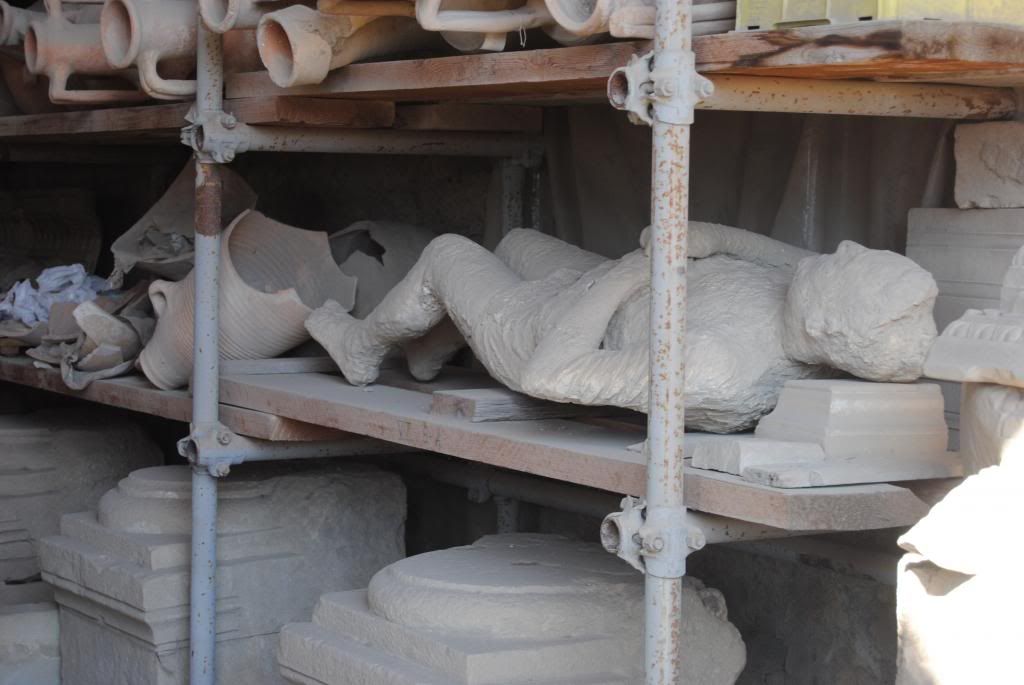
Encased in Ash – Body Mold from Pompeii

In 79AD, Mt. Vesuvius erupted with disastrous consequences for the residents of nearby Pompeii, Herculaneum, and other cities in the Campania region. Flows of boiling mud and rock rushed down the slopes, clouds of noxious fumes billowed upwards in the wind, and thousands of tons of rock and ash rained down upon the countryside. Pliny the Younger saw the eruption and likened it to a pinus, a pine tree. This may baffle some American readers, who may be accustomed to see pine trees that taper from a wide base to a narrow point Continue reading

Woody@101

Credit: Michael Ochs Archives/Getty

Last year we were a bit “off calendar” in honoring one of our favorite American Masters, this year less so. The good news is that his music and his relentless work on behalf of less fortunate people and the communities they were part of is so vast that, luckily for us, it will take some time to exhaust the full measure of his recordings.

For decades, we’ve had the Smithsonian recordings (with the help of Alan Lomax and Moe Asch) to thank for preserving both the musical and oral history of the nation. In honor of this less symmetrical birthday Rounder Records has released additional works from the archives, this time focusing on the part of Guthrie’s canon that was written for the American government.

In the Library of Congress recordings, the young musicologist and historian Alan Lomax made recordings of songs and stories in the 1940s of many of the country’s most colorful and important musicians, including Guthrie.

Along with John Steinbeck’s “The Grapes of Wrath,” it is one of the single greatest resources for understanding Depression-era Oklahoma: how the pioneer spirit reacted when confronted with crushing poverty. Continue reading

New Biography Of Gandhi

There was an uproar, just around the time that Raxa Collective was forming, over Joseph Lelyveld’s biography of Gandhi.  Many of us were new to India then, and had not understood just how much, how deeply and in how many ways Gandhi meant more than just history to all Indians. The international news coverage seemed as surprised as some of us, but generally did what they were supposed to do in reporting. This newspaper in particular seemed as objective as possible in reporting about the impact of a book that one of its own former editors had authored. Now, another biography, and we look forward to it. Thanks to the New York Times and their India Ink news service:

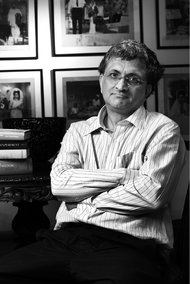
Ramachandra Guha is one of India’s foremost public intellectuals and historians. “Gandhi Before India,” his first volume of a two-part biography of Mohandas K. Gandhi, was published in India earlier this month. India Ink spoke to Mr. Guha about his decision to work on a biography of Mr. Gandhi, his choice to make Mr. Gandhi’s years in South Africa as the first volume of the biography, and Mr. Gandhi’s journey from a boy in the western state of Gujarat to his return to India as a major political figure. Continue reading

Jack London & Literature’s Role In Environmental History

Caleb Crain‘s book review of this biography will no doubt be of interest to any of our readers who follow Seth’s work on the history of environmentalism.  Subscription to the New Yorker is required, and worth it, but here is the blurb available to all prior to passing the pay wall:

Jack London never felt that he got enough meat. When he was seven, he stole a piece from a girl’s basket—an incident that he called “an epitome of my whole life.” Although his mother claimed that “he didn’t go hungry in our house!” and a childhood friend recalled being served steak during a visit, London insisted that he had been deprived. “It has been hunger,  Continue reading

The Hut of Romulus

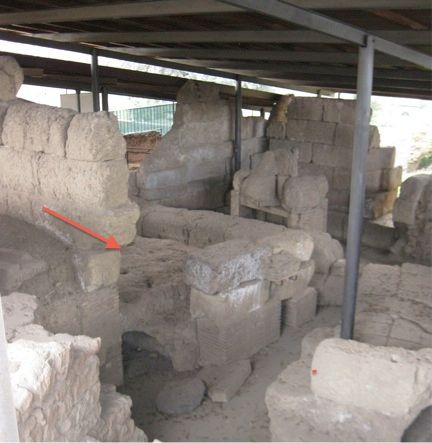
Hut of Romulus (Post holes where arrow is pointing.)

Today, all that remains of the so-called “Hut of Romulus” are the holes you see in the picture above (the slight indentations on the platform where the arrow is pointing). When intact, Romulus’ humble wattle-and-daub dwelling, located in the southwest corner of the Palatine Hill in Rome, might have looked something like this. One might have expected that the passing of nearly three millennia would not have treated well the wood, straw, and twisted bark ties of the hut, but even in its own day the Hut was prone to accidental destruction. One particularly ignominious story has a crow dropping Continue reading

A Thesis Hypothesis

Shutterstock

This week, the time has come for me to officially lay out some of the terms of my honors history thesis that I have been writing about for a few months now. Although this “hypothesis,” or explanation of what I expect to argue, won’t set my focused topic in stone, it will certainly be instrumental in guiding me at least in a broad sense as I move forward with writing this semester, and it will also help show my advisors what path I plan to take. Without further ado, here is my thesis hypothesis in a 400-word nutshell. Continue reading

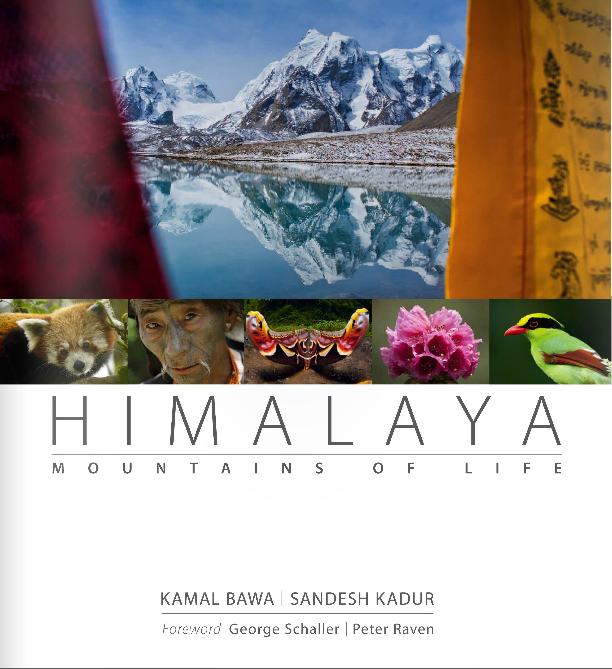
Photographer + Professor + Himalayas = Collaborative Book

The blurb is enough to get our attention, but the images on the book’s website (click the image above to see) make the journey palpable:

The Eastern Himalaya—land of Gods, of ancient mountain kingdoms, of icy peaks and alpine meadows—is like no other place on Earth. The life and landscapes of the region are as diverse, spectacular and fragile as the mountains themselves. Even today, these mountains hold many mysteries: unnamed species, primeval cultures and the promise of magical cures to heal all of humanity. Himalaya—Mountains of Life takes us on a journey of biocultural discovery, from the great canyon of Yarlung Tsangpo and the Siang Gorge in the east to the Kali Gandaki Gorge in the west. Along the way, Himalaya demonstrates through breathtaking imagery and words, why the preservation of this heritage is so important—not just for us, but for the future of all life on Earth. Continue reading

Library, Guardian Of Spiritual Treasure

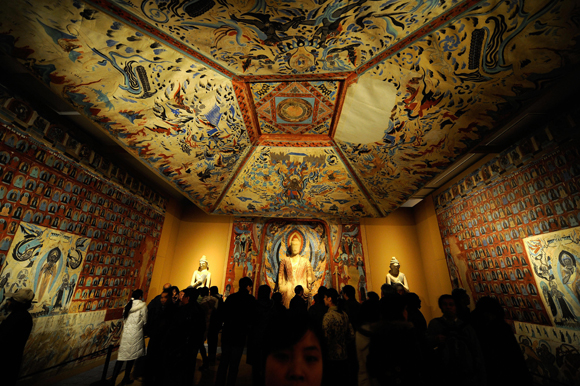
Visitors visit a replica parts of the Mogao Cave during the Dunhuang Art Exhibition in Beijing on February 20, 2008.  The exhibition displays collections mostly from the Dunhuang Grottoes which were constructed between the 4th and the 14th century, including recovered antres, original painted sculptures and their replicas from Library Cave of Dunhuang. Dunhuang, located in Jiuquan of Northwest China's Gansu province along the historic Silk Road, is in danger of being swallowed by sands of the adjacent Kumtag desert, which are creeping closer at a rate of up to four metres (13 feet) a year. (Photo credit TEH ENG KOON/AFP/Getty Images)

Visitors visit a replica parts of the Mogao Cave during the Dunhuang Art Exhibition in Beijing on February 20, 2008. The exhibition displays collections mostly from the Dunhuang Grottoes which were constructed between the 4th and the 14th century, including recovered antres, original painted sculptures and their replicas from Library Cave of Dunhuang. Dunhuang, located in Jiuquan of Northwest China’s Gansu province along the historic Silk Road, is in danger of being swallowed by sands of the adjacent Kumtag desert, which are creeping closer at a rate of up to four metres (13 feet) a year. (Photo credit TEH ENG KOON/AFP/Getty Images)

We tend to avoid topics pertaining to religion, spirituality or related highly personal matters that sometimes can lead to misunderstandings, misapprehensions, or worse; but our love of libraries, of archives, of discoveries are all satisfied in one fell swoop of a blog post, and we are particularly impressed to learn that Gutenberg may not be the only key to understanding the history of printing:

Just over a thousand years ago, someone sealed up a chamber in a cave outside the oasis town of Dunhuang, on the edge of the Gobi Desert in western China. The chamber was filled with more than five hundred cubic feet of bundled manuscripts. They sat there, hidden, for the next nine hundred years. When the room, which came to be known as the Dunhuang Library, was finally opened in 1900, it was hailed as one of the great archaeological discoveries of the twentieth century, on par with Tutankhamun’s tomb and the Dead Sea Scrolls. Continue reading

If You Happen To Be In New York City

New York University’s Institute For The Study Of The Ancient World is hosting an exhibition that speaks to those of us who love maps and the ideas they represent in historic as well modernistic terms. (GPS-guided navigation systems, we love you, but this is about your ancestors). Those ideas can be as simple as “Getting From Here To There, In Hindsight,” which might have been a subtitle to this exhibition:

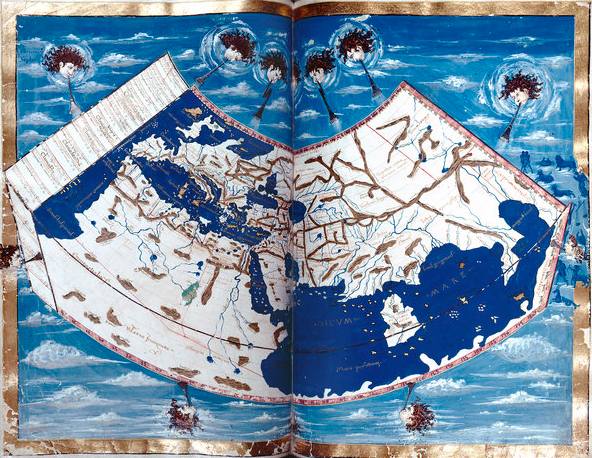
Measuring and Mapping Space will explore the ways in which ancient Greek and Roman societies understood, perceived, and visualized both the known and the unknown areas of their world. It brings together more than forty objects, combining ancient artifacts with Medieval and Renaissance manuscripts and printed books that draw upon ancient geographic treatises. Together, they provide a fascinating overview of Greco-Roman theories of the shape and size of the Earth, ancient methods of surveying and measuring land, and the ways in which geography was used in Roman political propaganda. A specially designed multimedia display examines the increasing importance of modern technologies in mapping the ancient world. Continue reading

Padmanabhapuram Palace – Trivandram

Photo credits : Nujum Myannad

Photo credits: Nujum Myannad

Padmanabhapuram Palace was the capital seat of the Travancore State until 1792, when it was shifted to Trivandrum. This magnificent home of the Travancore rulers was not a single unit, but a complex of 14 palaces spread across six and a half acres. Continue reading

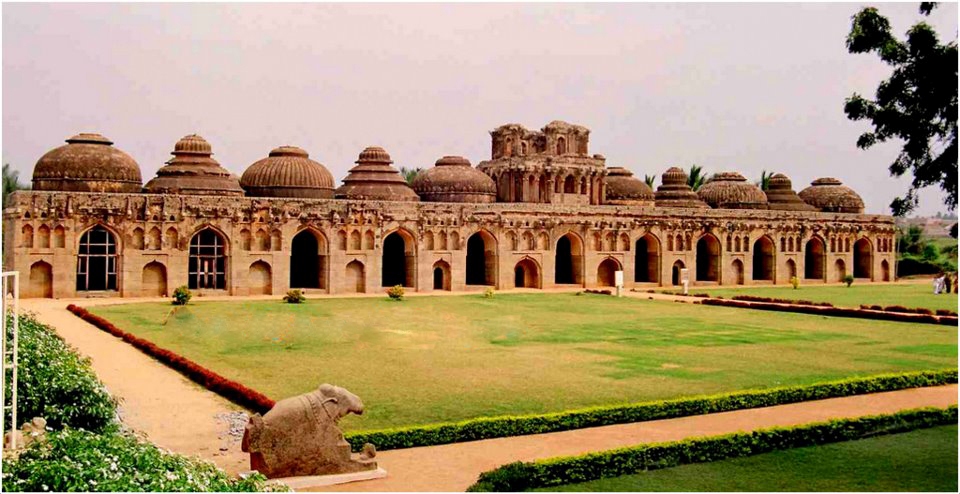
Elephant Stables – Hampi, Karnataka

Photo credit : Ramesh Kidangoor

Photo credit: Ramesh Kidangoor

The Elephant Stables are located in the UNESCO World Heritage city of Hampi in Karnataka. This long structure was constructed with majestic openings for the resting places of the royal elephants. The open area in front of the of the building was a parade ground for the elephants. The Elephant stables with their lofty domes and arches is synthesis of Hindu and Islamic forms.

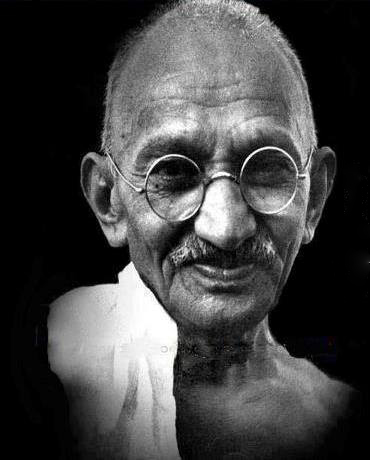
Gandhi Jayanthi

Mahatma Gandhi

Mahatma Gandhi

Gandhi Jayanthi honors the birth anniversary of Mahatma Gandhi annually on October 2nd. Known as India’s unofficial “Father of the Nation”, Mahatma Gandhi was a national icon who led the struggle for India’s independence from British colonial rule. Continue reading