The Noun Project: A Community Of Say Somethings

Click the banner above to go to the source:

I am a design technologist living in San Francisco and I have an affinity for iconography. I strongly believe everyone benefits from free, open source creative output and have created a several free icon sets for that purpose.

Batons Passing, Generation To Generation

Long before Carson and Attenborough, as noted in a post by Meg last year, there were Vedic, Buddhist and Hindu texts; Old Testament scribes, New Testament scribes, great Islamic scholars; but also there were Greek philosophers, Roman thoughts nearly lost; on and on, closer to the present with Thoreau; etc.

All providing us with a sense of reverence for, and a way to understand, the mysteries we will refer to here as Nature.  But what is next?  And who will be our interpreters and scribes?  Anyone following this site will know we are partial to Jad‘s sonically luscious and always surprising approach to making sure we understand and appreciate the world we live in; ditto for Krulwich (whom we have pointed to plenty of times but if you can only focus on one, make it this one).  Thanks to the the latter, we came upon the clip above, and with one viewing we see a possible answer.

Naturalist Inmates

Click the image above to go to the website for this unusual linking mechanism and here in particular for the history of the program:

We connect prisons with nature.

Our mission is to bring science and nature into prisons. We conduct ecological research and conserve biodiversity by forging collaborations with scientists, inmates, prison staff, students, and community partners. Equally important, we help reduce the environmental, economic, and human costs of prisons by inspiring and informing sustainable practices.

Things You Do Not Need To Know, But What The Heck

If you are a fan of these fun prizes, click the image of the book to go to the publisher’s site:

Marc Abrahams, the founder of the famous Ig Nobel Prize, offers an addictive, wryly funny exposé of the oddest, most imaginative, and just plain improbable research from around the world. He looks into why books on ethics are more likely to get stolen and how promoting people randomly improves their work, to what time of month generates higher tips for Vegas lap dancers and how mice were outfitted with parachutes to find a better way to murder tree snakes in Guam.

Abrahams’ tour through these unlikeliest investigations of animals, plants, and minerals (including humans) will first make you laugh, then make you think about the globe in a new way. Continue reading

Nothing Is Good, Frequently

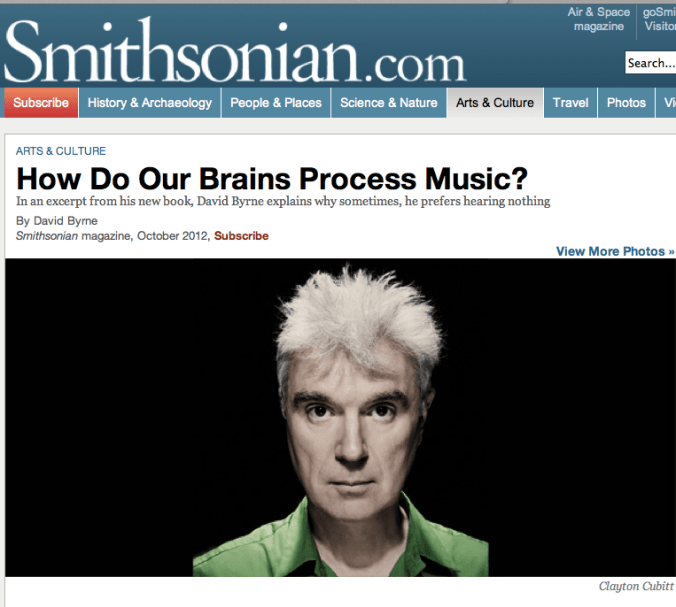
From a man who knows how to make loud noises worth listening to, the ideas (especially for those of us interested in reduction of noise pollution, click the image above to go to the  full story) here are most welcome:

Music, more than many of the arts, triggers a whole host of neurons. Multiple regions of the brain fire upon hearing music: muscular, auditory, visual, linguistic. That’s why some folks who have completely lost their language abilities can still articulate a text when it is sung. Oliver Sacks wrote about a brain-damaged man who discovered that he could sing his way through his mundane daily routines, and only by doing so could he remember how to complete simple tasks like getting dressed. Melodic intonation therapy is the name for a group of therapeutic techniques that were based on this discovery.

Math & Confidence

Click the banner to the left to go to his blog site and on the image after the jump for the post in which Robert Krulwich wonders about the “Old Rice-Grains-On-The-Chessboard Con, With a New Twist”:

Once upon a time, says the science writer David Blatner, there was this con man who made chessboards for high-end clients — in this case, a king.

The craftsman was good; his chessboards were better than beautiful. The king, he knew, loved chess. So he hatched a plan to trick the king into handing over an enormous fortune. His plan? He figured, “This king is not too good at math.”

So when the craftsman presented his chessboard at court, he told the king,

“Your Highness, I don’t want money for this. Or jewels. All I want is a little rice.”

Continue reading

What Box?

This slideshow requires JavaScript.

From the innovators who get paid to think outside the normal boundaries, and who brought us the disposable cup above, the website explains what they do in general and what they did in this case:

Sardi Innovation is an Outsourcing Business Innovation Center. 

Cookie Cup, “Sip the cofee then eat the cup” The cookie cup is made of pastry that is covered with a special icing sugar that works as an insulator making the cup waterproof and sweetening at the same time.

Cookie Cup [has collected] very  important Awards in Ecology, Marketing, Business Strategy and Design sectors.

Food, Storytelling & Art

Another session of Michael Pollan‘s course at UC Berkeley brings us back to the colorful, and colorfully clad, storyteller Peter Sellars, alluded to nearly one year ago.  Intensely bracing.  Give it the full 90 minutes it deserves (halfway through he begins making references to pre-vedic texts in India about food’s sacred role in life, and the importance of sharing it; at minute 56 he begins a very interesting discussion of Coca Cola in Kerala, and thereafter many references to wonderful phenomena in south India).

Evolutionary Biology Unhinged

From last week’s New Yorker, a book review about the challenge to the dominant strain of science related to how mental traits evolved, saying it makes no practical difference.  This is the stuff science is made of, starting with stories:

When Rudyard Kipling first published his fables about how the camel got his hump and the rhinoceros his wrinkly folds of skin, he explained that they would lull his daughter to sleep only if they were always told “just so,” with no new variations. The “Just So Stories” have become a byword for seductively simple myths, though one of Kipling’s turns out to be half true. Continue reading

Rousseau on American Democracy

Jean-Jacques Rousseau, writing in mid-18th century Geneva, discusses in The Social Contract several types of government and societies that depend on them, scorning and praising elements of each. Overall, he seems rather cynical about the possibilities of a decent society existing where the people and the government maintain an optimal state of equilibrium, but takes care not to criticize or admire one political system too closely–partly, perhaps, to avoid controversy and imprisonment or exile (which didn’t work, by the way) but also to keep his arguments logical and well-formed. He always emphasizes the generalizations, exceptions, or complexities associated with particular systems (e.g. monarchy), and rarely mentions contemporary examples when Sparta or Rome will suffice.

The Social Contract was published in 1762, and Rousseau passed away in 1778. His ideas were purportedly influential in the 1789 French Revolution (although the majority of the participants were illiterate), and it is typical to wonder what Rousseau would have thought of the execution of King Louis XVI, the formation of the National Assembly, and the rise of Maximilien Robespierre (himself an ardent supporter of Rousseau’s theories). During this year’s turbulent political season in the United States, I find myself wondering if Rousseau (who most of the Founding Fathers undoubtedly read) would have endorsed the system Americans have been so proud of.

Continue reading

Bridging Humans And Nature

Photo by Lauren E. Oakes: Basil, tomatoes, and glass floats from the outer coast at a home in Gustavus, Alaska

An excellent recent post in Green Blog (click the image above to go to the source) begins:

Basking in a surprise dose of early morning sun, we sat together on a bench made from yellow-cedar at the Gustavus Forelands Preserve, a landscape of spruce and cottonwood forests and beaches overlooking the Icy Strait waters. We were staring at a diagram on a piece of paper I had handed to Hank Lentfer, a lifelong Alaskan and longtime resident of the tiny town of Gustavus. Continue reading

Grumpy, Bird-loving Awesomeness

What if every artist made a love pact with something, anything, in the natural world?  Mr. Goldsworthy, we noted after a recent post, had already made (to our eyes, a similar cairn included) such a pact a long time before his Australia work.  Mr. Franzen, as we shall highlight as often as we can here, has made such a pact with birds.  Walton Ford, in phantasmagorical manner, check. And this fellow, on the sands down under, too.  More!

Creative, Effective, Collective Action

Thanks to our friends at Colossal for pointing us here:

I can’t speak from personal experience about the political climate in Yekaterinburg, Russia but if we take this video from the ad agency Voskhod at face value it appears the powers that be neglected the city’s infrastructure one day too long. Continue reading

Saying Nothing Well


Click the banner to the left to go to Paul Griffiths’ review:

I have nothing to say, and I am saying it.” The line, probably John Cage’s most famous statement, appears three times over in his book Silence, which Wesleyan University Press has reissued in a smart fiftieth anniversary edition that also coincides with the centenary of the author’s birth. Continue reading

Ideas Shopping

It is a snappy idea: selling ideas in the market place.  If they are worth something, how will we know?  They will be sold out (hopefully in a good way).

Bibliotherapy?   Never heard of it until now.  Snappy, again.

We do not normally pass along commercial messages, but on occasion we make an exception, as we do now; here is what the School of Life says about itself:

The School of Life is a new enterprise offering good ideas for everyday life. We are based in a small shop in Central London where we offer a variety of programmes and services concerned with how to live wisely and well.  Continue reading

Questions About Conservation At 100

First, congratulations are in order for the birthday of such conservation efforts in Britain.  And thanks to The Guardian for the provocative question and discussion that follows:

This pristine four-mile spit of shingle and sand in Norfolk is, of course, far older, but its purchase by the National Trust 100 years ago marked the beginning of a radical movement in Britain: instead of protecting specific species, the new environmentalists recognised that entire “reserves” must be created to save our wildlife. As the country’s first coastal nature reserve, Blakeney was also the British birthplace of the science of ecology, the urge to understand how species relate to each other.

Dear Pretenders, Best In Category Is Here

Commencement speech season is long over, and I barely remember this last batch, though from time to time I have an opportunity to watch those of people I admire. Thanks to the internet for that, among all its wonders. This one above does credit to the genre, and to the school, not to mention the speaker himself. I believe he is as good as any commencement speaker I have ever heard. The video of his talk has not gone viral, nor is it likely to.  But Robert Krulwich, hitherto known to us mainly by his froggy nasal tones on Radio Lab and elsewhere, has arrived. At least, he is in our pantheon.

It is rare to find a half hour so well spent as this, whether or not you have university-aged kids, are a recent or soon to graduate university student yourself, or just plain curious how the man of wonders might mete advice given the opportunity.  And thanks not least to him for introducing us to this amazing-sounding college.  We will be interviewing for interns there soon, no doubt.

p.s. Jad, our feelings about you remain the same, but your buddy is now playing leap-frog.

Note To Maggie

August 14, 2012

Dear Maggie,

We got so busy that we neglected to notice your work and its wonderful home until just now.  I may have heard someone say boingboing before, but I did not know what it meant.  Now I have one data point to help me understand it.  It looks in spirit and even in content much akin to our own style and interests on this site.

If work brings you to India, or any of the other locations where you see contributors on this site, please let us know.

Regards from Kerala,

Crist

p.s. we like your other site too. Continue reading

Thoughtful Rejoinder

Not surprisingly, The Guardian provides a second opinion on a critically important topic:

The new discourse about “natural capital” is seen by some as another step towards the degradation of the biosphere. George Monbiot wrote in such terms this week.

He argued:  “Rarely will the money to be made by protecting nature match the money to be made by destroying it. Nature offers low rates of return by comparison to other investments. If we allow the discussion to shift from values to value – from love to greed – we cede the natural world to the forces wrecking it.”But to paint such a one-sided picture is a dangerous game.

50 Years Onward, Progress Via Anthropology

Anyone born in the USA between 1930 and 1970 would recognize the two CBS journalists in this brief documentary.  Some born elsewhere in that period might recognize them as well.  Probably few outside small towns in Central New York and Central Peru would recognize the name of the professor featured here.
So That Men Are Free
McGraw-Hill Films (1963)
Reporter: Charles Kuralt
Presenter: Walter Cronkite
 

I’m Walter Cronkite. We take you to one of the remote areas of the world to the high Andes of Peru. CBS News correspondent, Charles Kuralt reporting…The seeds came here in the head of an anthropologist, a man usually the observer, not the creator of change.  Dr. Allan Holmberg of Cornell University…

Continue reading