There are needs, and there are wants.
A toothpick sculpture? Not necessary for San Francisco to demonstrate its greatness (as might have been an underlying objective of the commission). Not sufficient for that purpose either.
There are needs, and there are wants.
A toothpick sculpture? Not necessary for San Francisco to demonstrate its greatness (as might have been an underlying objective of the commission). Not sufficient for that purpose either.
 The cover illustration is not very inviting, but the reviews and blurbs in more than one newspaper make it sound worth the read:
Not really a dictionary, but a series of short essays on such topics as equality, Hell, miracles, religion, tyranny and superstition by one of the leading spirits of the Enlightenment. The tone is witty, catty, and there are many neat aphorisms such as: “Atheism does not prevent crimes, whereas fanaticism commits them.”
Incidentally, in case you are already a Voltairophile, you may want a deeper well from which to draw inspiration. In which case you may want to pay a visit to Oxford.
Now, after 50 years of studying the brain, listening to philosophers, and most recently being slowly educated about the law, the issue is back on my front burner. The question of whether we are responsible for our actions — or robots that respond automatically — has been around a long time but until recently the great scholars who spoke out on the issue didn’t know modern science with its deep knowledge and implications.
…words and other language units change systematically as they are passed from one generation to the next, much the way genes do. Charles Darwin similarly argued in 1871 that languages, like biological species, have evolved into a series of related forms….
Besides being the most useful holiday known to man (however it is celebrated, as well as whenever, and by whomever) today is the birthday of the first publication of Darwin’s On the Origin of Species by Means of Natural Selection, or the Preservation of Favoured Races in the Struggle for Life.
Did you know that Charles Darwin and Abraham Lincoln were born on the same day? And that Lincoln was responsible for making Thanksgiving a national holiday in the USA? Continue reading
This crowdsourcing of microscopic imagery arrived long before the invention of the smartphone and networked communications: the amateur has long made a mark with the microscope—in the early years, by hand drawing images that appeared underneath the lens, and, in more recent times, with the added realism brought by the photograph.
By what criterion, of all the books on all the shelves in all the libraries, does one choose a particular book? In the digital world we live in now, is that even a relevant question? For anyone who loves to walk over to the lectern in the library where the monumental OED is sitting, the answer is certainly yes, even if they very much also appreciate other forms of access to OED.
So today we pay tribute to those artisans who, along with calligraphers and paper-makers, keep the world of ideas evolving. How one binds a book could have enormous consequences, so it is surprising to see that the etymology for this word is so modern:
Bookbinding as a fine art.
1876 Encycl. Brit. IV. 42/1 Contemporary masterpieces of French, Italian, and German bibliopegy.
1885 Pall Mall Gaz. 10 Sept. 15 The Exhibition of what is known as bibliopegy.
1958 ‘M. Innes’ Long Farewell 72 Appleby, although hazy about bibliopegy, was quite certain he wasn’t a distinguished student of it.
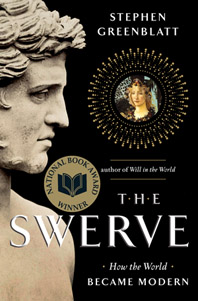 It is just the way things are. My reading list/pile is always longer/taller than I have time for. And living between the rice fields and spice-laden Western Ghats I do not have access to the kind of bookstores we took for granted while living elsewhere. Amazon does not deliver in India, nor would I put a penny in their coffers until I have the sense that they are not trying to monopolize the book trade, not to mention everything else.
Even if I had access to a great book store I might not have picked this one up off the shelf, though I admire the author’s writing. I have not been in the mood for anything too canonical or Great lately; rather merely useful, interesting, lesser reading. Short- and long-form journalism tend to be my standard fare. There was something in the pile with Greenblatt’s name on it, a magazine article, that I kept burying for months and which persistently kept resurfacing. Continue reading
 There is a clear link between the focus of this article (click the image to the right to get it) and themes we care deeply about on this site.
It provides a meaningful review of how consumer spending holds the key to a more sustainable economic value chain–which sounds obvious when stated so bluntly but the article also demonstrates that it is not as easy as it sounds.
Otherwise, we would have made more progress than we have by now.
 This week there is a profile in The New Yorker of the “organization” behind OWS, or more precisely an account of how the movement got its start. It is in front of the pay wall (click the image to the left to be taken to the article) and is intriguing from the perspective of collective action, a topic we have written about several times.
Conversations by email and phone between two fellows who have not seen each other in person in years seems to have sparked an enormous extended mobilization.
The movement’s evolution, organizationally speaking, is interesting from an entrepreneurial perspective: there is a “don’t try this at home” sense that emanates from the pages.
In a recent post, note was taken of a new bumper sticker. Milo, who normally is more of a nature photographer, was walking in Cochin this morning and started snapping photos of vehicles. Could it be?
Daniel Goleman, a superb interpreter of scientific findings, provides a look inside the mind of the Dalai Lama in a brief video, a quote from which here:
Question: What does meditation do for the brain?
Daniel Goleman: Well, the Mind & Life Institute catalyze these experiments where high, you have to say, Olympic level meditators came to brain imaging labs in the West and have their brains studied while they did different meditation practices. And what they’re finding is brain configurations that they’ve never seen before. These are different brains. For example, the left prefrontal cortex, just behind the forehead, is the center of positive emotions or part of the key… key part of the circuitry for that. And when these monks meditate on compassion, it lights up, it activates to a level that just never seen in ordinary life. And they’re finding, you know, a range of specific… state specific effects like this.
Dan Ariely explains in a series of captivating short videos how frequently irrational tendencies can lead to optimal outcomes. The Edison-Tesla example in the video above is about the tendency called “not invented here syndrome,” and the key point as he summarizes at the end is a familiar one: understood, this irrational tendency can be very useful.
Reading this post from Elizabeth Kolbert, a familiar cloud of doom came over me. Read almost anything she writes, and you will know what I mean. She writes most frequently about seemingly intractable environmental problems, and those about climate change have the most intense effect on me. But ignorance is not an option, so I read. The cloud lasted about seven hours, and parted just now in a most interesting manner. As if my head were just lifted out of the sand. First, the portion that stuck with me:
Since we can’t know the future, it is possible to imagine that, either through better technology or more creativity or sheer necessity, our children will be able to find a solution that currently eludes us. Somehow or other, they will figure out a way to avoid “a 4°C world.” But to suppose that an answer to global warming can be found by waiting is to misunderstand the nature of the problem.
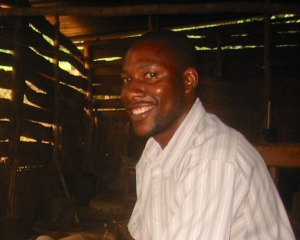 Click the photo to the left for a short essay about someone you almost certainly never heard of.
And never likely will again. It is worth the 20-30 minutes of reading time.
If he is an unsung hero, then song seems an appropriate response. You will recognize, hopefully, someone you know when you read about Raymond. Probably good to let them hear the song sooner, rather than later.
Today I saw something very odd: dozens of ladybugs crawling along the top of a recycling bin. Some were the dark red that we normally associate with ladybugs, while others were a pale orange verging on yellow. Strange looking half-formed ladybugs, seemingly crouched in tight balls, adhered themselves along the surface as well. In the midst of it all swarmed long, fat black bugs with orange spotting along their backs. What was going on here? And what was this panoply of ladybug life occurring on a recycling bin in the middle of a college campus?

Two ladybug pupae
When I afterwards looked up ladybugs, I found that I had actually witnessed something pretty cool: the full life cycle of Coccinellidae, known as the ‘ladybug’ in America but the ‘ladybird’ elsewhere in the world. It’s also known as ‘God’s cow,’ the ‘ladyclock,’ or the ‘lady fly.’ There are over five thousand species worldwide, but the name ‘ladybug’ is perhaps most readily synonymous with the image of a small, round red bug with black spots.
The ladybug, as I had seen, has four distinct phases in its life cycle. The life of the ladybug begins in an egg; small clutches hatch after three or four days at which point the larval form of the bug emerges. It may molt three to four times over a period of about twelve days before pupation (i.e., the beetle creates a pupa). Continue reading
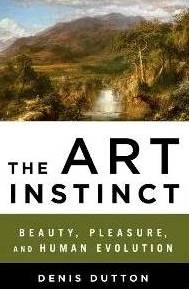
The arts in all their glory are no more remote from the evolved features of the human mind and personality than an oak is remote from the soil and subterranean waters that nurture and sustain it. The evolution of Homo sapiens in the past million years is not just a history of how we came to have acute color vision, a taste for sweets, and an upright gait. It is also a story of how we became a species obsessed with creating artistic experiences with which to amuse, shock, titillate, and enrapture ourselves, from children’s games to the quartets of Beethoven, from firelit caves to the continuous worldwide glow of television screens.
—Denis Dutton
The late philosophy professor, editor, writer (and occasional provocateur) Denis Dutton spent a great deal of his professional life closing the gap between art and science. Continue reading
This quote may not be clear without the context, so read the full story here. But following my previous mention of its author I was pleased to see that he is still writing from India, and I am most interested in this snippet because it captures a general point beyond the specific innovation he describes in the full article.
That conversation is the sound of history changing.
And not just for India. We’re at the start of a nonlinear move in innovation thanks to the hyperconnecting of the world — through social media, mobile/wireless devices and cloud computing — which is putting cheap innovation devices into the hands of so many more people, enabling them to collaborate on invention in so many new ways.

Today major news organizations are reporting that, according to the IUCN, the Western Black Rhino is officially extinct. The BBC, CNN and others must have received a press release that is not yet available on the IUCN website (as of my writing and posting this), but if you search on the terms IUCN and rhino you will find a link to the following video that provides a good visual definition of melancholic beauty:
When I see news like this, I fight the natural inclination toward depression and channel the emotional energy as best I can, using the news as a reminder of how slowly we are working at the various tasks mentioned in a string of earlier posts. It is another example of the feeling I seem to have with increasing frequency: being late.


 Organikos