Prime Directive, Reconsidered

Global climate change will soon be changing ecosystems around the world to such an extent that many species will no longer have proper habitats to survive and reproduce in. Over the past several years, the scientific community has been discussing the possibility of moving such species to new ranges in order to conserve biodiversity and reduce potential for extinction. This controversial process, known as assisted colonization or managed relocation, might be able to save some species from their current state of risk, but it may also prove dangerous for the natives of whatever area the “colonizers” are moved to. By diligently evaluating the perils and uncertainties of relocation and carefully considering the repercussions of leaving species to their shrinking habitats, The Nature Conservancy (TNC), given its mission and vision statements, should determine that in most cases, the costs of assisted colonization outweigh the benefits.

Patagonian mountains

By assisting the colonization of species with limited ability to adapt or relocate, the annual number of species gone extinct might be lowered in the coming decades. There are, however, disagreements as to whether or not humans should meddle with species movement. Continue reading
Music of the Spheres

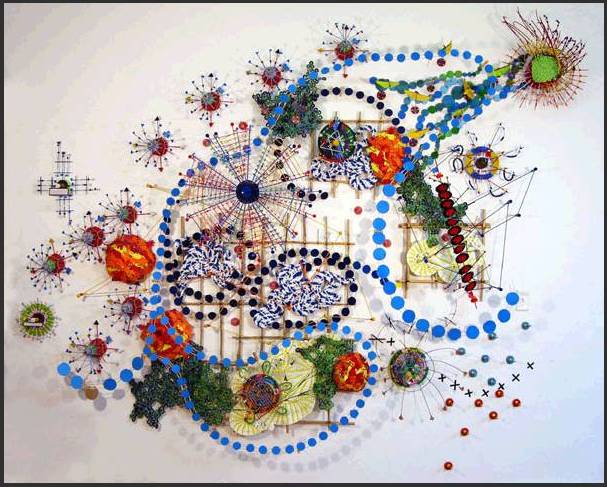
Changing Water – Gulf of Maine, 2011, Nathalie Miebach

Tones sound, and roar and storm about me until I have set them down in notes                                                              —Ludwig van Beethoven

Boston artist Nathalie Miebach found the seemingly unlikely intersection between astronomy, meteorology, ecology and basket weaving, essentially translating data into 3 dimensions… then she adds the plane of music.  For her work, Miebach was selected as a 2011 TEDGlobal Fellow.

Initially focusing her woven sculptures on data from the stars, her work was rerouted by a call from two weather scientists at Tufts University.  Intrigued by her work and it’s possible applications, they asked her to collect weather data on Cape Cod.  From that point on, winds, temperature, barometric pressures, and rainfall became part of the raw material for her artistic work. Continue reading

What Wind Can Do

Milo has commented on the next generation of wind harvesting in an earlier post, but the use of technology is only bound by the limits of inventiveness and imagination.  Even in resource poor parts of the world opportunities are available to dreamers who see the possibilities in what has been discarded.

Continue reading

Rotam fortunae non timeo!

Rotam fortunae non timeo -- "I do not fear the wheel of fortune!"

“Mortal men travel by different paths, though all are striving to reach one and the same goal… happiness,”[1] or so says Boethius, the great Roman philosopher. I think we can all agree that, no matter what we want to do or how we choose to do it, our ultimate goal is happiness. It is “the good which once obtained leaves nothing more to be desired.”[2] It doesn’t necessarily take a philosopher to realize this, though; approach any random person and he or she will probably confirm that a happy life, is, of necessity, a good one.

But what is happiness? We say we are “happy” when we get an A on a test, win an important sports game, or finish a grueling paper—but what do we mean by it? The joy from these moments, however real at the time, begins to appear ephemeral in retrospect. Think back to the 6th or 7th grade: do you still glow with warmth when you remember getting a 93 on an Earth Sciences test (if you remember at all!)? Continue reading

Occupy Language!

The collection of thoughts, links, images, etc here is meant to bring attention to ideas and actions for a challenged and challenging world.  Written and spoken language, to say the least, have been important tools to this end for some time.  The language we use on this site, by default, is a function of those of us who banded together on a given day at a given time to do this jig.  Other languages, the cultural patrimony sometimes referred to as intangible, are hopefully strengthened, rather than weakened by this effort.

This fellow makes some very important points about the English language.  We have not read his book, but from his excerpted thoughts there is good cause to read more reviews and add it to the maybe list.  Meanwhile, we make our cultural case (another reason, beyond skiiing, to put Kashmir on your map?) to keep languages alive, perhaps especially of those not included on the most-alive list:

There are anywhere from 350 to 500 million native English speakers, and up to 1 billion more who use it as a second or additional language to some extent. That’s 20% of the world’s 6.9 billion people. There are close to 7,000 languages spoken around the world today, but according to Ethnologue, 39% of the Earth’s people speak one of eight brand-name languages: Chinese, Spanish, English, Arabic, Hindi, Bengali, Portuguese, and Russian (Japanese is number 9). Of these, only English can claim global dominance.

Saving Rhyme and Reason

For me, reading has always been a route out of a chaotic world.  That doesn’t mean that I read “fluff”. Far from it.  (Anyone familiar with The Iliad  or Beowulf, knows that neither Sam Peckinpah nor Akira Kurosawa invented the specificity or depiction of violence.)  But whether sitting with my children and reading aloud, or better still, sitting with my children while we all read individually, books bring an intangible into our lives by opening doors that remain available to us indefinitely.

Frequently the educational systems in many parts of the world pressure students into making choices that seem almost binary; the “science track” or “business track” for example, setting them on an educational road that is fundamentally an express lane highway, with little chance of turn offs and detours.  These systems produce very smart people in their fields, but it doesn’t easily provide opportunities for reaching full potential. Continue reading

Wordsmithing: Conservation

In a nod to recent posts on this site about new entrepreneurial conservation initiatives, some etymology to complement the OED‘s first entry in the definition of this noun:

The preservation of life, health, perfection, etc.; (also) preservation from destructive influences, natural decay, or waste…The preservation, protection, or restoration of the natural environment and of wildlife; the practice of seeking to prevent the wasteful use of a resource in order to ensure its continuing availability

No surprises there.  A rather nice surprise, considering the world we live in today, is that most of the references, going back to 1398 and with a long line of ever-strengthening suggestions, point to a divine origin and in more recent centuries a responsibility of man to the divine, to engage in conservation.

Double Standards

Kids and young adults are very good at identifying double standards. They can tell  right away if you are preaching one thing and not acting accordingly.  On the one hand, adults talk about honesty and truth. And then one day they might ask their children to tell the aunt that dad is not home (maybe he cannot talk to her at that moment).   How many times does a parent tell his/her child to lower their voice to be respectful, but say it to the child with a strong, demanding tone? Continue reading

The Eye of the Beholder

Chris Jordan, Caps Seurat, 2011

Seattle based photographer Chris Jordan has been making visual statements about mass consumption for over ten years. Using the “artist’s eye” to be able to step back from the overwhelming truths of societies’ excesses, he simultaneously breaks down that mass consumption into its smallest part and its incomprehensible whole.

Jordan uses  commodities  that are discarded daily–plastic and paper cups, newspapers, electronics–as the “brushstrokes” to illustrate the wastefulness  in cultures of consumerism. His photographs place both conscious and unconscious behaviors under a microscope, which is often unsettling, and always thought provoking. Continue reading

Wind, Water, Light

Janet Echelman, Her Secret is Patience, Phoenix, AZ, U.S.A. 2009

American artist Janet Echelman has worked in numerous mediums throughout her career and has a long history of working collaboratively with communities outside of her own culture, whether it be Balinese textile artisans or Indian bronze castors.

A Fulbright lectureship about painting brought her to Mahabalipuram, India, a fishing village in Tamil Nadu famous for sculpture. But it was watching the millennia-old craft of weaving and working with nets that ultimately inspired the work that now defines her art. When she watched the men making piles of nets on the shore she began wondering if the material was “a way to create volumetric form without heavy, solid materials.”   Continue reading

Pause and Reflect

Land Art Installations can be as varied as the land they sit upon and the vision of the individuals who create them.   Sometimes urban and often in wilderness areas, they almost always offer a window into the hearts of their creators.

I’ve spoken about the convergence of art and architecture in previous posts, and Swedish firm Kjellgren Kaminsky Architecture was one such example.   Whereas the installation Clear Cut makes a visual statement about a particular conservation issue, Reflecting Time is a study of the interaction of  light and landscape.

The team headed north along the Norwegian coast, their only tools for this ephemeral installation 100 simple reflectors and the cameras they would need to record the work.  They climbed the seaside mountain, placing the reflectors in straight, parallel lines that defied the undulating landscape.  Then they spent time by the sea itself, marking the coast with tiny glimmers.

The tide is strong in Norway shifting the sea level up to 2 meters every day. A line of reflectors marked the coast, sometimes the reflectors lay on the ground later they float in the water. We made a ring further out in the sea untouched by the tide. It had an ephemeral glow that fascinated us.

In both cases the changing light and tides did the work, the art lay in meditating on the results.