If You Happen To Be In New York

Screen Shot 2013-11-04 at 6.31.12 PM

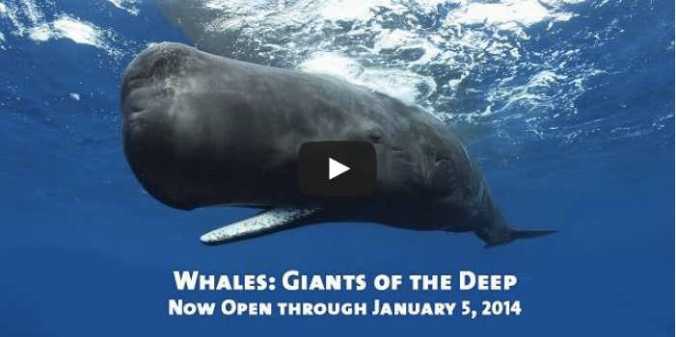
The exhibition goes well beyond that big whale you may remember in that great open space at the Museum:

Whales: Giants of the Deep explores the latest research about these marine mammals as well as the central role they have played for thousands of years in human cultures. From the traditions of New Zealand’s Maori whale riders and the Kwakwaka’wakw peoples of the Pacific Northwest to the international whaling industry and the rise of laws protecting whales from commercial hunting, the exhibition traces the close connections humans and whales have shared for centuries.  Continue reading

A Thesis Hypothesis

Shutterstock

This week, the time has come for me to officially lay out some of the terms of my honors history thesis that I have been writing about for a few months now. Although this “hypothesis,” or explanation of what I expect to argue, won’t set my focused topic in stone, it will certainly be instrumental in guiding me at least in a broad sense as I move forward with writing this semester, and it will also help show my advisors what path I plan to take. Without further ado, here is my thesis hypothesis in a 400-word nutshell. Continue reading

If You Happen To Be In London

This slideshow requires JavaScript.

The National History Museum in London is offering an opportunity to see works by a photographer whom you might have first encountered here, or you may be a member of his online community:

The world premiere of Sebastião Salgado: Genesis unveils extraordinary images of landscapes, wildlife and remote communities by this world-renowned photographer.

Sebastião Salgado: Genesis
11 April – 8 September 2013
Waterhouse Gallery Continue reading

The Truth About Komodo Dragons

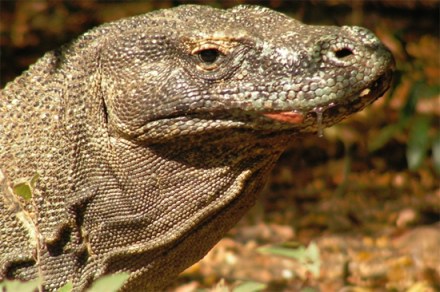
The Komodo dragon: surprisingly clean.

The Komodo dragon: surprisingly clean.

Myth-busting science writers, especially when they free a phenomenal animal from the clutch of wrongly bad reputation, are heroic folk to us:

In 1969, an American biologist named Walter Auffenberg moved to the Indonesia island of Komodo to study its most famous resident—the Komodo dragon. This huge lizard—the largest in the world—grows to lengths of 3 metres, and can take down large prey like deer and water buffalo. Auffenberg watched the dragons for a year and eventually published a book on their behaviour in 1981. It won him an award. It also enshrined a myth that took almost three decades to refute, and is still prevalent today. Continue reading

Celebrating Conservation’s Important Moments In History

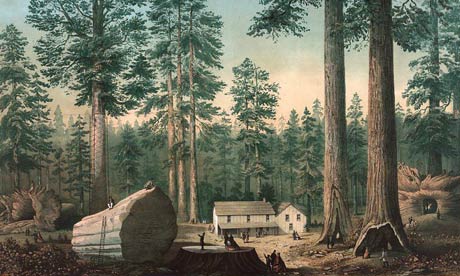
Tourists inspecting the stump of the 'Mammoth Tree' in Calaveras County, California, c1860. The 'Mother of the Forest', without its bark, can be seen in the background. Image: LoC

Tourists inspecting the stump of the ‘Mammoth Tree’ in Calaveras County, California, c1860. The ‘Mother of the Forest’, without its bark, can be seen in the background. Image: LoC

We have written about and sometimes celebrated important moments in conservation history in the past, and these celebrations are among those most responded to by readers of this blog.  A few days ago, a landmark anniversary was observed in an editorial at the newspaper that most consistently keeps us in perspective:

Today marks the 160th anniversary of a seminal, but largely forgotten moment in the history of the conservation movement.

On Monday, 27 June, 1853, a giant sequoia – one of the natural world’s most awe-inspiring sights – was brought to the ground by a band of gold-rush speculators in Calaveras county, California. It had taken the men three weeks to cut through the base of the 300ft-tall, 1,244-year-old tree, but finally it fell to the forest floor. Continue reading

Krulwich On Insect Communities Understood Through Mathematics

Another of those wonders, this time about bees, brought to you by the godfather of fun science reporters:

Solved! A bee-buzzing, honey-licking 2,000-year-old mystery that begins here, with this beehive. Look at the honeycomb in the photo and ask yourself: (I know you’ve been wondering this all your life, but have been too shy to ask out loud … ) Why is every cell in this honeycomb a hexagon? Continue reading

Smithsonian In Deep Water

This slideshow requires JavaScript.

New (to us) thanks to the Smithsonian and its supporters:

The Ocean Portal is part of the Smithsonian Institution’s Ocean Initiative. Together with the National Museum of Natural History’s Sant Ocean Hall and the Sant Marine Science Chair, the Ocean Portal supports the Smithsonian’s mission to increase the public’s understanding and stewardship of the Ocean. Continue reading

7 Ways To Understand Man’s Impact On The Earth In Recent Decades

The news headlines started carrying this story more than a week ago, but it was not until now that we had the chance to understand it.  Thanks to the Atlantic‘s coverage:

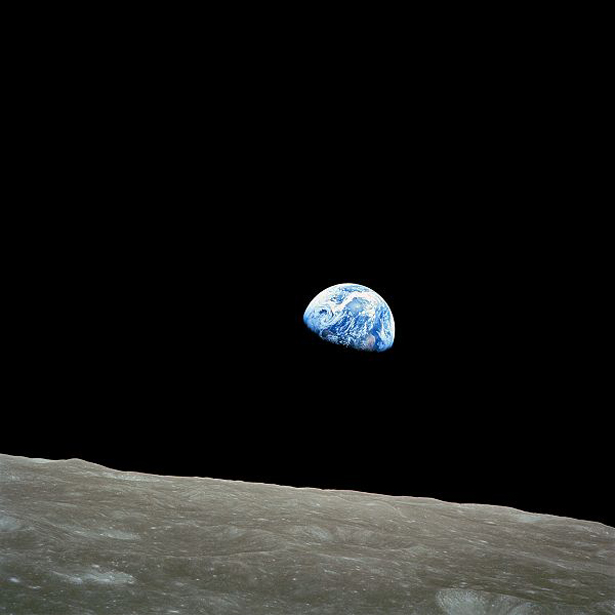
The project was built in conjunction with the U.S. Geological Survey, NASA, and TIME. The images come from the USGS-NASA’s satellite program LANDSAT, which were often stored on tapes like those in the thumbnail to the right. Google started sorting through a collection of 2,068,467 images back in 2009 — 909 terabytes of data, according to Google — finding the highest quality pixels (which is to say, shots not obscured by clouds), “for every years since 1984 and for every spot on Earth.” Continue reading

Lost City Of The Monkey God

Another great article (click the image to the left to go to the source), complementing this recent one from the New Yorker, about one special location within the region several members of Raxa Collective have called home for most of the last two decades:

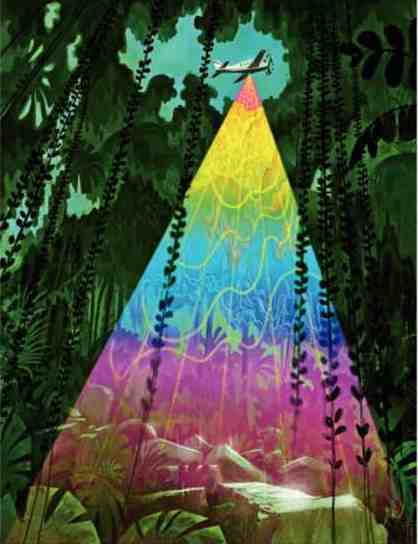
The rain forests of Mosquitia, which span more than thirty-two thousand square miles of Honduras and Nicaragua, are among the densest and most inhospitable in the world. “It’s mountainous,” Chris Begley, an archeologist and expert on Honduras, told me recently. “There’s white water. There are jumping vipers, coral snakes, fer-de-lance, stinging plants, and biting insects. And then there are the illnesses—malaria, dengue fever, leishmaniasis, Chagas’.” Nevertheless, for nearly a century, archeologists and adventurers have plunged into the region, in search of the ruins of an ancient city, built of white stone, called la Ciudad Blanca, the White City. Continue reading

Weird Businesses, Natural History Edition

Eric Prokopi, of Gainesville, in the five-thousand-square-foot fossil workshop that he built in his back yard. Photograph by Richard Barnes.

Eric Prokopi, of Gainesville, in the five-thousand-square-foot fossil workshop that he built in his back yard. Photograph by Richard Barnes.

I am not sure what to make of this.  Is it entrepreneurial conservation from a different angle? This story, in character with the New Yorker‘s brand of long form journalism, tells a remarkably odd story in must-read fashion:

Natural history goes to auction five or six times a year in America, and one Sunday last May a big sale took place in Chelsea, at the onetime home of the Dia Center for the Arts. The bidding, organized by a company called Heritage Auctions, began with two amethyst geodes that, when paired, resembled the ears of an alert rabbit. Then came meteorites, petrified wood, and elephant tusks; centipedes, scorpions, and spiders preserved in amber; rare quartzes, crystals, and fossils. The fossils ranged from small Eocene swimmers imprinted on rock to the remains of late-Cretaceous dinosaurs.

Continue reading

If You Happen To Be In London

SensButterfly


Click the image above to go to the video at the website of London’s Natural History Museum, and click here to go to an excellent podcast of an interview conducted by the Guardian‘s Camila Ruz with the exhibition’s curator, Blanca Huertas.  The exhibition is now open:


In the exhibition, butterflies are everywhere, so take care… they may even land on you or on the paths where you walk. Continue reading

Mayan-Like Patterns

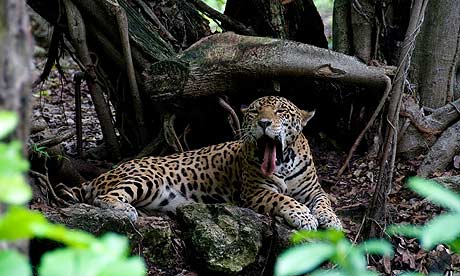
A jaguar – a symbol of Mayan royalty – is endangered but roams free in the Maya Biosphere Reserve, Guatemala. Photograph: Larry Larsen/Alamy

A jaguar – a symbol of Mayan royalty – is endangered but roams free in the Maya Biosphere Reserve, Guatemala. Photograph: Larry Larsen/Alamy

We make frequent links and comment on topics meant to raise awareness about innovative, fun and sometimes loony efforts—from the humble to the grand– to avert environmental collapse.  The dangers are real enough that we assume readers get enough of the doom and gloom elsewhere, so that we can focus our efforts on evidence of potential solutions, and encourage collective action.

The photo above accompanies a story in the Guardian worth a read, to put in perspective why it is that the Mayan calendar doomsdate hoopla, or at least some of the accompanying history, was worth a bit of attention:

…Today, much of the Mayans’ ancient homeland is a 7,700-square mile protected area in Guatemala called the Maya Biosphere Reserve. With an area greater than the states of Connecticut and Rhode Island combined, the reserve protects the largest remaining forest in Central America. Beneath the canopy, monumental vestiges of temples and palaces attest to past splendour. Similar magnificence is found in the reserve’s wildlife. The jaguar, once a symbol of Mayan royalty, still roams free in one of Central America’s last wild places. Continue reading

Nature’s Relics

This slideshow requires JavaScript.

Entomologist, author and photographer Piotr Naskrecki, based at Harvard University’s Museum of Comparative Zoology, has published a book whose photos we first saw here, and whose attention to cycads we first took note of here.  His book is available here.  For an ever-expanding catalogue of his amazing nature images with accompanying entomological (and other) interpretive guidance, see his blog here.

Nature, Balance & Harmony

Standing for millenia: Reenadinna, an ancient yew woodland in Ireland’s Killarney National Park. Photo by Universal images/Getty

Click the image above to go to the story in Aeon (read the second half for perspective on nature in the Western Ghats):

It is Reenadinna, one of the planet’s few remaining yew woods, a virtual monoculture of coniferous yew trees (Taxus baccata). They grow here on thin mossy soil, though in some places they drape directly over bare limestone bedrock. The light is green-soaked and dim beneath the crowded canopy: it looked no different this summer than it did 30 years before. Of course, three decades is a short time in the life of a yew wood, where an individual tree can live thousands of years. But it looked no different this summer than it would have done in September 1776, when Arthur Young, the great English writer on rural affairs, visited the region and exuberated on the wooded Muckross peninsula. And by the calculation of Fraser Mitchell, a botanist in Dublin’s Trinity College, it has looked that way for millennia. Continue reading

What Ice Reveals

Good news is meant to be shared., and we are excited to share the achievements of another branch of our company: La Paz Group, Heritage Conservation Project – Mammuthus. (Click on the photo to go to the BBC Nature News link.)

A year and half ago we began discussions with Discovery Channel and BBC, and the first step of our four-year media plan for Mammuthus was set in motion with the airing of “Woolly Mammoth: Secrets from the Ice” in the UK this week. Continue reading

Why Is Mimicry Funny?

In Latin it’s called Thaumoctopus mimicus, but I’d call it The Master. It’s Meryl Streep in octopus form. There are ocean animals that can change shape, imitate plants, rocks, flora, and I’ve blogged about some of them. But this octopus is special. It seems to study other creatures and then imitate them, copying their moves and their bodies. It can do sea snakes, lion fish, flatfish, giant crabs, seashells, stingrays, jellyfish and weird beings that have no name, and maybe no earthly existence. Is it imagining? I don’t know, but no scientist has ever seen a shaggy sprinting bipedal crab — until our octopus decided to be one.

Click the banner above to go to the remainder of Robert Krulwich’s blog post on this wonder.  A bit more on the same after the jump (click the image to go to the original)… Continue reading

If You Happen To Be In New York City

In New York, of all places, you can see and learn about one of our favorite phenomena.  If we have not written about it yet, we will post on this topic from the perspective of some of our own contributors who have seen this in southern Chile, and as recently as last summer Seth took photos while at Morgan’s Rock in Nicaragua.  Here is what the New York Times has to say about the exhibition at the Museum of Natural History in New York:

A thoroughly engrossing exhibition at the American Museum of Natural History that opens on Saturday — “Creatures of Light: Nature’s Bioluminescence” — teaches us quite a bit about the phenomenon. Yet it still manages to preserve that otherworldly mystery, even cherishing it — treating it as if it were one of those ecologically vulnerable bioluminescent bays of glowing plankton in the Caribbean by whose shimmer visitors could once read in the middle of the night. Continue reading