“The Great Empty,” more Full than its Sobriquet Implies

Photo © Gerrit Vyn

What will you be doing this Wednesday 5/20 at 8pm EDT? If you’re in the United States and have a television, you should consider watching a PBS Nature documentary on the Greater Sage-Grouse (male in mating display pictured left) and other wildlife members of the vast community that lives in the sagebrush plains that span eleven western states and hundreds of thousands of miles. Titled “The Sagebrush Sea,” the film is the first of its type shot and produced by the Cornell Lab of Ornithology, and it promises to be quite entertaining and educational about this vast and daunting landscape. A friend who was in one of my freshman-year classes at Cornell has been helping out in the editing room as an employee at the Lab this spring, and he tells me that its been a really rewarding experience. Just from watching the trailer below you can see why!

You can check out the PBS Nature schedule webpage to see when the broadcast Continue reading

Wild, Walk, Wonder

12onnature1-mediumThreeByTwo210-v2Keeping it wild is a wonder of its own. Thanks to Britain for that; and to the New York Times for bringing it to our attention:

The Living Beauty of Wicken Fen

In one of Britain’s oldest nature reserves, Darwin collected beetles and Saxon warlords hid from invaders. But walking there now is more than a visit to the past.

Anthropocene Perspective

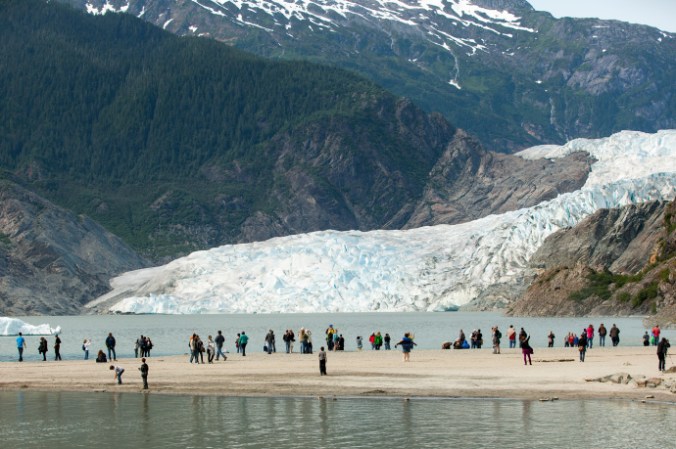
Tourists visit the the Mendenhall Glacier, in Alaska. Geologists are considering whether humans’ impact on the planet has been significant enough to merit the naming of a new epoch. CREDIT PHOTOGRAPH BY MATTHEW RYAN WILLIAMS/THE NEW YORK TIMES/REDUX

Tourists visit the the Mendenhall Glacier, in Alaska. Geologists are considering whether humans’ impact on the planet has been significant enough to merit the naming of a new epoch. CREDIT PHOTOGRAPH BY MATTHEW RYAN WILLIAMS/THE NEW YORK TIMES/REDUX

Thanks to, Michelle Nijhuis in general, for her science writing and environmental journalism–making these topics simultaneously fun and fascinating, if also sometimes depressing; and to the New Yorker for making space for this note in which she briefly explains the naming of the epoch we live in:

The duties of the Anthropocene Working Group—a thirty-nine-member branch of a subcommission of a commission of the International Union of Geological Sciences—are both tedious and heady. As the group’s chairman, Jan Zalasiewicz, whom Elizabeth Kolbert wrote about, in 2013, says wryly, “People do not understand the very slow geological time scale on which we work.” Yet the A.W.G.’s forthcoming recommendations may bring an end to the only epoch that any of us have ever known—the Holocene, which began after the last ice age, about twelve thousand years ago, and lasts to this day. The group’s members are pondering whether the human imprint on this planet is large and clear enough to warrant the christening of a new epoch, one named for us: the Anthropocene. If it is, they and their fellow-geologists must decide when the old epoch ends and the new begins.

In a paper published today in the journal Nature, Continue reading

Words, Landscapes, And Pondering Ethiopia

The most illuminating 75 minutes with earbuds on, in a long time or possibly ever (since my history with earbuds is only a few years old), by far, were spent listening to this. If you are a combined “words person” and “nature person”–how else would you have found your way to this blog?–then you will understand.

Ethiopia, from the perspective of our recent expedition which I have barely begun to process with words, was illuminated for me just a bit hearing this man talk about how we describe places and the impact that ecosystems have on us. Ecosystems serve as metaphors, he says. And that prepositions matter a great deal to how we communicate the impact ecoystems have on us, literally and metaphorically.

Ethiopia was an enriching experience, in these senses.  I will write separately on that illumination. For now, a bit more from Robert Macfarlane, the illuminator on nature, through words. After listening to the podcast of his lecture, I had to know who this was, and it brought me here:
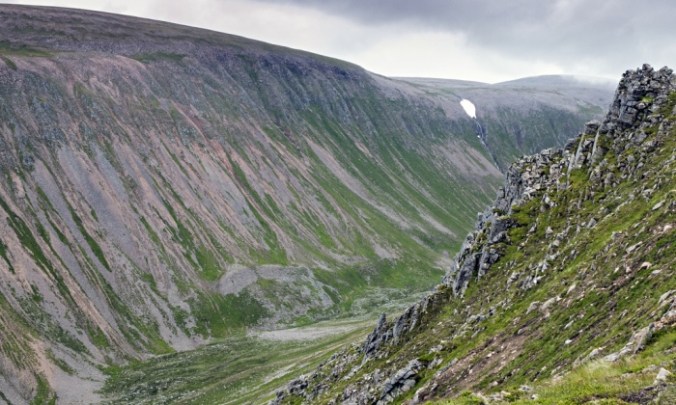
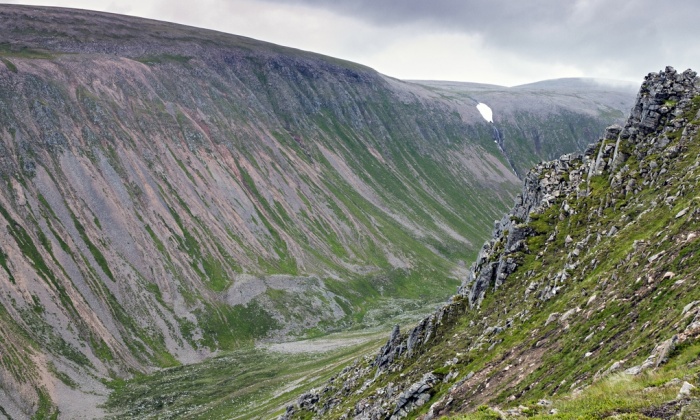
Làirig – ‘a pass in the mountains’ (Gaelic). Photograph: Rosamund Macfarlane

Làirig – ‘a pass in the mountains’ (Gaelic). Photograph: Rosamund Macfarlane

Eight years ago, in the coastal township of Shawbost on the Outer Hebridean island of Lewis, I was given an extraordinary document. It was entitled “Some Lewis Moorland Terms: A Peat Glossary”, and it listed Gaelic words and phrases for aspects of the tawny moorland that fills Lewis’s interior. Reading the glossary, I was amazed by the compressive elegance of its lexis, and its capacity for fine discrimination: a caochan, for instance, is “a slender moor-stream obscured by vegetation such that it is virtually hidden from sight”, while afeadan is “a small stream running from a moorland loch”, and a fèith is “a fine vein-like watercourse running through peat, often dry in the summer”. Other terms were striking for their visual poetry: rionnach maoim means “the shadows cast on the moorland by clouds moving across the sky on a bright and windy day”; èit refers to “the practice of placing quartz stones in streams so that they sparkle in moonlight and thereby attract salmon to them in the late summer and autumn”, and teine biorach is “the flame or will-o’-the-wisp that runs on top of heather when the moor burns during the summer”. Continue reading

Let Nature Do Its Own Work

The Pine Marten, once common in the UK, is a natural predator of the grey squirrel and has successfully reduced their numbers in Ireland. Photograph: Alamy

The Pine Marten, once common in the UK, is a natural predator of the grey squirrel and has successfully reduced their numbers in Ireland. Photograph: Alamy

Not every problem in the natural world has a solution, let alone a simple one; and there is always that law of unintended consequences, but we like the way this proposal sounds as an alternative to other forms of eradication:

Is there anything more stupid than the government’s plan to kill grey squirrels?

I ask not because I believe – as Animal Aid does – that grey squirrels are harmless. Far from it: they have eliminated red squirrels from most of Britain since their introduction by Victorian landowners, and are now doing the same thing in parts of the continent. By destroying young trees, they also make the establishment of new woodland almost impossible in many places. As someone who believes there should be many more trees in this country, I see that as a problem. A big one.

No, I oppose the cull for two reasons. The first is that it’s a total waste of time and money. Here’s what scientists who have studied such programmes have to say: Continue reading

The Beauty of Life With X-Ray Vision

Python and protea flower. The snake’s trachea is visible (credit: Arie van ’t Riet / SPL)

Thank you to the BBC’s Earth section for sharing Dutch medical physicist and artist Arie van ’t Riet’s work, which he accomplishes with his home x-ray machine and dead flora and fauna.

Arie van ’t Riet has a unique view of life on earth.

As a medical physicist based in the Netherlands, van ’t Riet teaches radiographers about radiation physics and safety. As part of his teaching program, van ’t Riet searched for an example to demonstrate and visualise the influence of x-ray energy on the contrast of an x-ray image. The higher the x-ray energy, the lower the contrast.

“I arrived at flowers. After some years I started to edit and partly colour these x-ray images. And I added animals,” he says.

Continue reading

Aliens vs. Ice Giants

Photo by Marko Korošec in Slovenia. Via thisiscolossal.com

This may look like a still from the trailer of a fictive blockbuster Aliens vs. Ice Giants, but it’s actually a photograph of nature on Mount Javornik in eastern Slovenia by Slovenian weather photographer Marko Korošec. Earlier this December, after periods of high winds, fog, and freezing temperatures, Korošec visited Mount Javornik and found everything covered in a deep layer of hard rime. Rime, or rime ice, is frost created on objects when water vapor freezes quickly. So in the photo above, perhaps a tree or small stone formation was being buffeted by freezing winds and fog, which accreted ice crystals on the structure that grew over time. The ice spikes, which apparently measured over three feet long in some cases, are formed by the continued winds that sculpt the rime into thin points.

Continue reading

Roger In Kerala

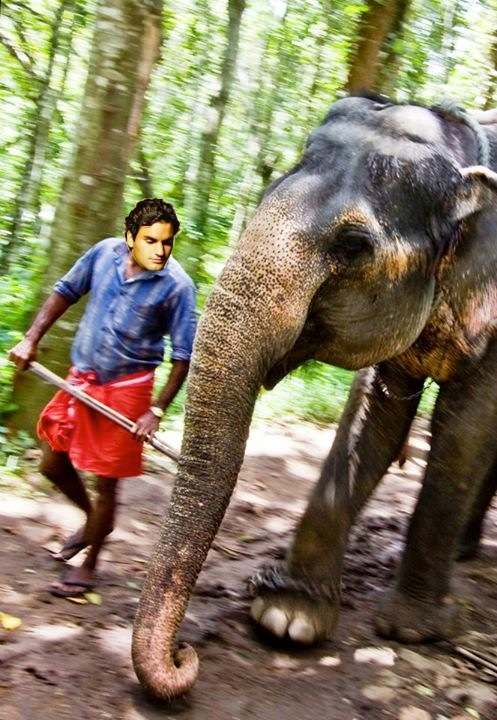
Roger Mahoot

When Seth and Milo Inman heard that Roger would be in India, and that he wanted suggestions on what he would be missing given his short time available, they thought he might be interested in visiting some of Raxa Collective’s stomping grounds in the south of the country. He would be able to get back to nature, and in an authentic way.

Seth has worked in Kerala, and Milo lived and worked here for two years. During that time, Milo took the photo above, not realizing until today that he had captured an image of Roger moonlighting as a mahoot. We hope Roger will return to show us his best moves.

Monkey Business in Dehli

monkeys_delhi2_wide-d22a7520cf5334f80c91291f185119e7a44c6aad-s4-c85

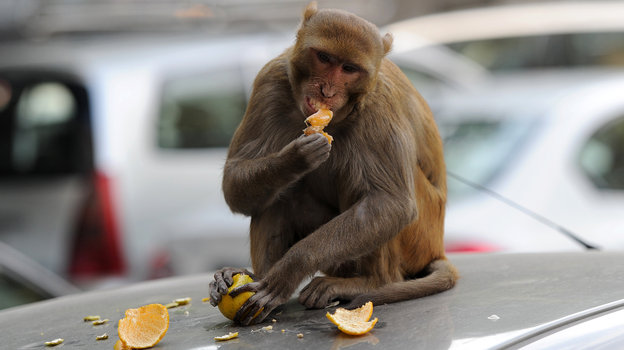
New Dehli has tried numerous schemes to control its monkey population. Photo Credit: Sajjad Hussain

We’ve had our fair share of monkey business as a garden challenge in Cardamom County. In Dehli, they’re looking for ways to monkey proof their city.

Reporting monkey raids, Sharma says, residents complain that ” ‘they’ve just taken away my clothes,’ or … ‘they have opened the fridge’ … and ‘they’ve taken out the food.’ “

The monkeys have also been known to intimidate fruit vendors and get intoxicated on stolen whiskey. Sharma says when they fail to find food, they can raise a rumpus.

You can read more in depth at the original article here. Initially, there were people who were hired to train Langurs because they were able to frighten off the smaller Rhesus monkeys. That practice was recently banned due to animal rights concerns. Now, there are 40 men hired to mimic the calls of the Langurs to scare them away. Continue reading

Monsoon Kerala

Photo credits : Ramesh Kidangoor

Photo credits: Ramesh Kidangoor

With its long monsoon season, Kerala is one of the rainiest states in India. Starting from June to August, many visitors flock to Kerala during Monsoon when the climate is cool, the nature is lush green, the atmosphere is dust free, and the streams and waterfalls of the high ranges are flowing with water. There is also the long traditional belief that the rainy monsoon season is the best time for Ayurveda treatments. Continue reading

Notes from the garden: The naming of things


Today in the Cardamom County organic garden, I have been learning the names of things.

Once someone has introduced me to a plant, I take note of its shapes and impress it upon my mind with the name. Later there is some joy, when there is a spark of familiarity among what before was a just mass of green flora.

Here, I have often been asked for my “good name”–the local way of saying what at home we’d call our “given” or “proper” name. I think there is something beautiful about being able to call a person or plant by its good name.

Continue reading

Funky Nests, Oh My!


Wren leaving her basket nest

The Cornell Lab of Ornithology is hosting a “Funky Nests” contest for their Celebrate Urban Birds project. The above image is of a wren nest in a basket in my backyard (Atlanta, GA). Continue reading

Coffee in the Ground at Xandari

Screen Shot 2022-07-22 at 9.49.50 AM

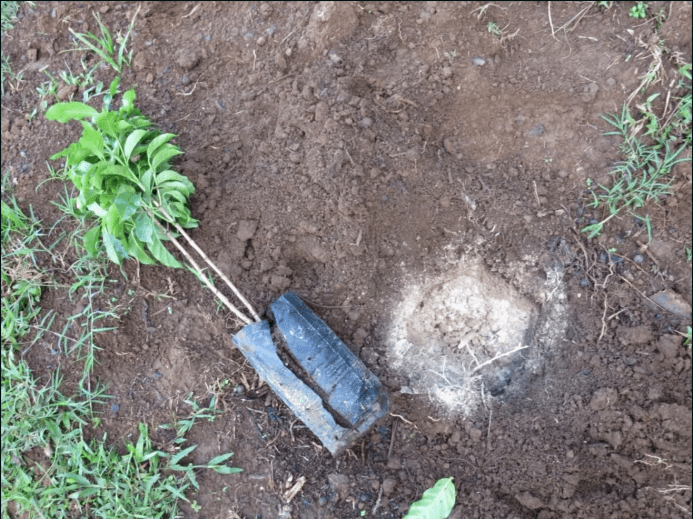
Coffee ready to be planted, next to its hole

On Monday, we began planting coffee and made great headway on getting the shrubs in the ground. Fortunately, José Luis, Xandari’s head gardener, and his team (or should we say “coffee crew” in this case?) had already done significant work in preparing the soil to receive the plants. Continue reading

Nature’s Apps

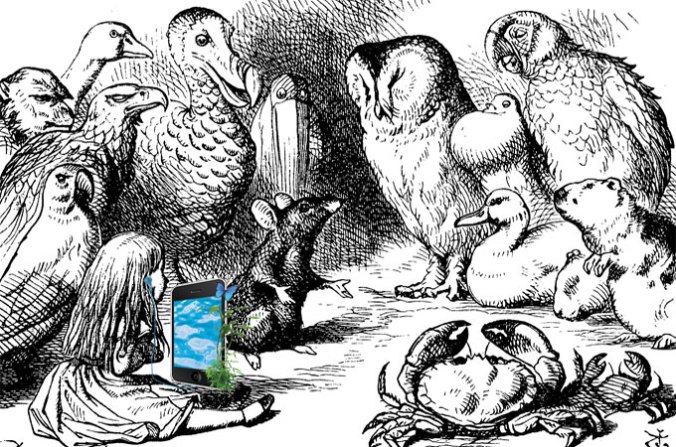
It’s not all fun and games when it comes to games featuring the environment. With some green game apps, not only can you live in your world and play in it, you can learn stuff too.

It’s not all fun and games when it comes to games featuring the environment. With some green game apps, not only can you live in your world and play in it, you can learn stuff too.

Thanks to Conservation magazine for this article, published coincidentally exactly at the time when several Raxa Collective contributors were visiting the Cornell Lab of Ornithology, which itself is participating in the App business (more on which, by Seth soon) in a manner resonant with the focus of this article:

DIALING INTO THE OUTDOORS THROUGH PHONE APPS

The Nature Deficit

Judging from the amount of time my grandkids hunch over their iPhones and iPads for game time, I’d have to say games have garnered a major portion of the younger set’s mindshare. And in my book that’s a shame. While more and more studies find that children’s outdoor time contributes to their well-being — by mitigating obesity, promoting cardiovascular, musculoskeletal, and mental health, as well as boosting academic achievement — the number of hours children spend outdoors is on the decline. (See also here.) Continue reading

Race Beyond All Reason

Barkely Race

If you have to ask why, chances are that this sort of thing will not make sense to you under any circumstance.  But since Chris Heller has taken the time and made the effort to beautifully elucidate, you might give a few minutes to this video on the Atlantic’s website, which makes us think of the Patagonia Expedition Race, except on steroids:

The Roughest, Toughest Race in the World

Jun 09, 2014 | Chris Heller

Continue reading

If You Happen To Be In Dublin

This slideshow requires JavaScript.

Thanks to Genevieve Fussell for pointing this exhibition out to all of us:

In 2009, the Irish photographer Paul Gaffney walked nearly five hundred miles through northern Spain along the Camino de Santiago. Inspired, in part, by his interest in Buddhist meditation, he set off, three years later, on a series of walking trips through rural Spain, Portugal, and France. Continue reading

Explaining Elephant Ears

Photo © Disney

Photo © Disney

When we look for scientific answers to interesting questions, the name Disney does not normally come to mind, but credit where due (thanks to Science Friday for this):

Why Are Elephant Ears So Big? And Other Pachyderm Questions

BY JULIE LEIBACH

Joseph Soltis, a research scientist at Disney’s Animal Kingdom, recently chatted with SciFri about the “words” that African elephants use to communicate. Below, Soltis has addressed a few of your pachyderm questions:
How do researchers keep bias towards human languages out of the study of elephant languages? Do a linguistics study as if the elephants were human?—@CyberResearchUS
You always have to be careful not to freely ascribe human-like capabilities to animals without evidence. For language, this is especially important. We [humans] can make a simple distinction between sentences with lots of words strung together following grammatical rules and a simple vocabulary of individual words.

Continue reading

Big Living Things

It has been a while since we linked to Krulwich Wonders, which we have done too many times to link back to all previous posts, but now is as good a time as ever to do so again:

A Question Of Biggitude: What’s The Largest Creature On Earth

by 

What’s the biggest living thing on earth? I can think of two. I’m not sure which is biggest, but neither of them is a blue whale. These are weirder. Much, much weirder.

One is a tree. The other eats trees.

This is the tree.

Continue reading

Germany’s Nature Photography Contest Winners

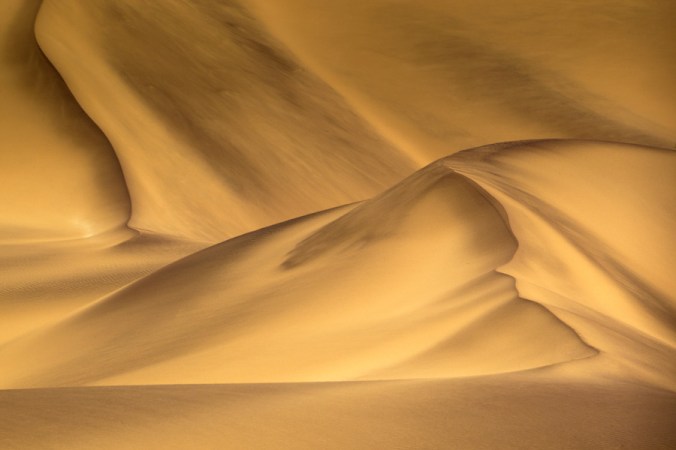
K6_Paul_Kornacker_ArtDunes

Paul Kornacker

GDT NATURE PHOTOGRAPHER OF THE YEAR 2014

We never tire of sharing the results of contests to produce the best nature photography. The photo above is the winner of this year’s Gesellschaft Deutscher Tierfotografen–a new organization and contest for us–but we are slightly partial to one or two other finalists. Continue reading

Become Ocean Is The Water Music Of Our Times

Chad Batka for The New York Times. “It’s impossible for us to separate who we are from where we are”: John Luther Adams, the composer of “Become Ocean,” in Morningside Park in Manhattan.

Chad Batka for The New York Times. “It’s impossible for us to separate who we are from where we are”: John Luther Adams, the composer of “Become Ocean,” in Morningside Park in Manhattan.

Thanks to Corinna da Fonseca-Wollheim for A Composer Attuned to the Earth’s Swirling Motion, in which John Luther Adams discusses “Become Ocean,” which will be performed on Tuesday at Carnegie Hall, and his other environmentally themed works. Their discussion rings true to us. Where we are is a large part of who we are.

That resonates with La Paz Group’s ethos. If we are not sensitive to where we are, who are we? We wonder that every day, so we recommend the article in today’s New York Times Arts section that offers a well-deserved review and praise of the work of an environmentally-inspired/concerned composer who we first heard about last July when the New Yorker‘s music critic wrote the following:

The hundredth anniversary of Stravinsky’s formerly scandalous Rite of Spring, on May 29th, raised the question of whether a twenty-first-century composer can produce a comparable shock. Perhaps not: the twentieth century elicited such a numbing array of shocks, both in art and in reality, that the game of “Astonish me”—Diaghilev’s famous command to Cocteau—may be temporarily played out. Still, astonishment comes in many forms. There are shocks of beauty, shocks of feeling, shocks of insight. Such were the virtues of John Luther Adams’s Become Ocean, a forty-two-minute piece for large orchestra, which had its première at the Seattle Symphony on June 20th. Like the sea at dawn, it presents a gorgeous surface, yet its heaving motion conveys overwhelming force. Whether orchestras will be playing it a century hence is impossible to say, but I went away reeling. Continue reading