Global Big Day 2017, Results

GBD2017b.jpg

When I left Team Sapsucker late last night it was pouring rain, a perfect punctuation to the day, telling them to stay under cover on Chan Chich’s deck since no bird would be out in the deluge. They were reviewing their lists, waiting to see if the rain would pass, allowing one final outing of the 24-hour period. I did not ask the final number, but I could tell they were happy with the day.GBD2017Result
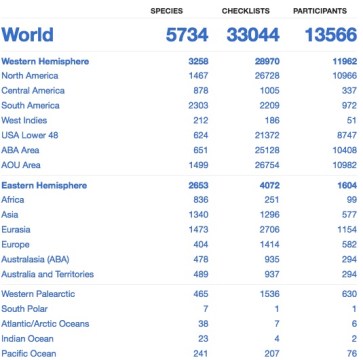
As I type this at 5am the rain has long since stopped, the early birds are out in full sonic force, competing with the howler monkeys it seems, and results on eBird’s website look impressive. My eye is drawn to the Central America numbers. Partly because I moved to the region two decades ago and have worked in each country. Partly also because the region has embraced its ornithological importance, and yesterday provided one more metric for that embrace. But mainly, because I am here in Belize and the Lab team we had here was exactly as expected, not only as birders but as people.

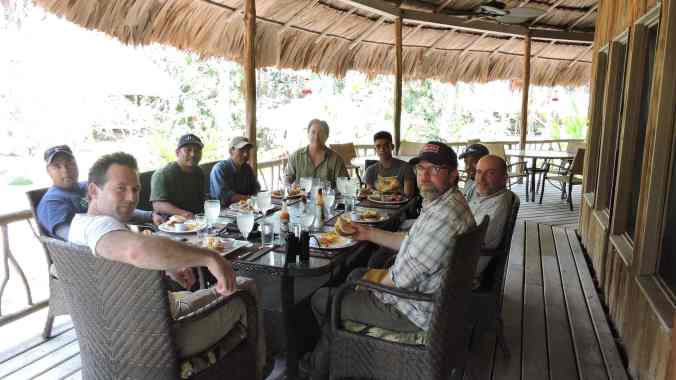
The Chan Chich guide team had an amazing day with the Team Sapsucker on Friday, and over lunch that day they all celebrated several firsts, the details of which escape me now, but they involved two new species being added to Chan Chich’s list on eBird (a big deal) and our guide Ruben adding a life list bird that day to his nearly two decades of birding accomplishments at the Lodge.
GBD@CCL.jpg

The Lab team explained the rules of the game for the following day. No assistance of any kind would be possible after midnight. Continue reading →

GrowFood Carolina

how-growfood-works.png

I am always on the lookout for simple but effective graphics illustrating ideas that we attempt to put into action in our various projects–why reinvent the wheel? By rabbit hole good fortune, after I was referred to the Coastal Conservation League as a regional leader in entrepreneurial conservation for the southeastern USA, one of their programs, as illustrated above and described in words below, came to my attention:

The Conservation League started its Food and Agriculture program in 2007 with the goal of protecting South Carolina’s small, family farms. Between 1992 and 1997, more than 200 acres of rural land were converted every day to urban uses, placing South Carolina in the top ten states in the nation for rural land loss. We quickly realized that small farmers lacked access to the infrastructure available to industrial farms, and were therefore unable to say “no” when a developer offered to buy their land. The League saw a food hub as critical to our work protecting rural landscapes and improving quality of life across the coastal plain. Continue reading →

Winged Muses

13BIRDMUSIC-superJumbo.jpg

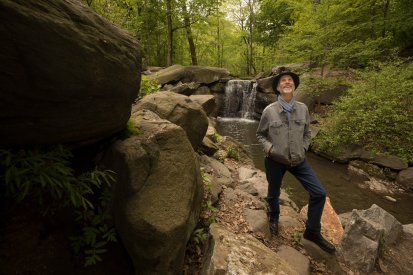
The composer John Luther Adams in Central Park, listening for his winged muses. Credit James Estrin/The New York Times

Occasionally we have reason to think of muses; every day we think of birds. Today birds are the muse. We have linked to this composer’s work once previously, and I am happy with the coincidence of reading again about this composer on Global Big Day in this review by Michael Cooper, Listen to ‘Ten Thousand Birds’ and Its Warbling, Chirping Inspirations:

New York is not usually considered a naturalist’s paradise. But John Luther Adams, the Pulitzer Prize-winning composer and former environmental activist, did not have to walk far from his Harlem apartment this week to be serenaded in Morningside Park and Central Park by choirs of robins, sparrows, flickers, catbirds and, finally, a wood thrush, with its poignant “ee-o-lay” song.

”That’s the one that started it all for me, 40-however-many years ago,” Mr. Adams, 64, said as he paused in a sun-dappled spot in Central Park’s North Woods to savor the wood thrush’s melody. Continue reading →

Introducing The Team Prepping For Global Big Day At Chan Chich Lodge

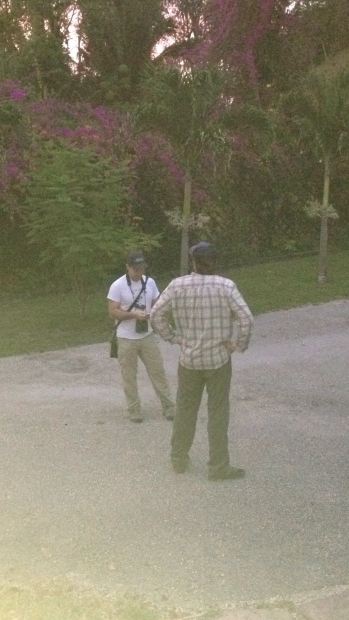
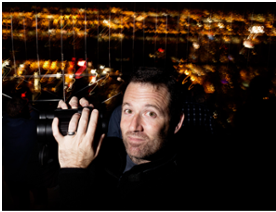
GBD1On day two in Belize with Team Sapsucker introductions are due. The photo to the left, taken at about 5am today in front of Chan Chich Lodge’s reception area, shows two of them. The best information I could find to share with you about Andrew Farnsworth is on Songbird SOS Productions, where he says:

“I like the challenge of trying to figure out how to go birding when there’s a traffic jam on first avenue. It’s cool to be able to study birds in a city… Some people have seen technology as the end of all things natural, but there’s a whole other side to it that gives us access to a world that we would otherwise not have seen.” Continue reading →

More Remarkable Thought Superbly Communicated

I was impressed enough the first time I heard him that I have been on the lookout for more. This was another hour well spent hearing his deep historical perspective:

How do we make sense of today’s political divisions? In a wide-ranging conversation full of insight, historian Yuval Harari places our current turmoil in a broader context, against the ongoing disruption of our technology, climate, media — even our notion of what humanity is for. This is the first of a series of TED Dialogues, seeking a thoughtful response to escalating political divisiveness. Make time (just over an hour) for this fascinating discussion between Harari and TED curator Chris Anderson.

Another Hirst Heist?

Head

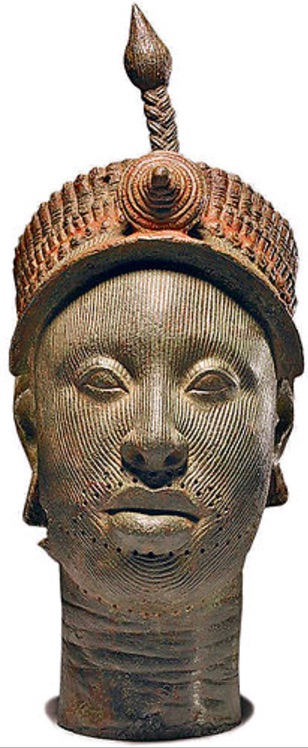
HEAD OF IFE
Brass statue, from Nigeria (A.D. 1400-1500)
“It is one of a group of 13 heads, superbly cast in brass, all discovered in 1938 in the grounds of a royal palace in Ife, Nigeria, which astonished the world with their beauty. They were immediately recognized as supreme documents of a culture that had left no written record, and they embody the history of an African kingdom that was one of the most advanced and urbanized of its day.’’
Credit: Trustees of the British Museum

The first podcast I ever listened to was this one, back earlier in this decade.World100 Although neither the BBC nor the British Museum is maintaining the website, it is still there. I recommend getting ahold of the podcast that you can find here among other places.

Object #63 did not particularly stand out more than any of the others chosen for this innovative historical exhibit that I listened to without visual cues. But I do remember it because the description was as vivid as any (pasted after the jump). So, I am sorry to be reminded of this piece again due to the modern world’s confused and confusing approach to art as represented by this so-called bad boy (aka fraud), who is still at his naughty ways according to this news item today:

There’s controversy in Venice for Damien Hirst, the British artist who has occasionally drawn accusations that his pieces are not always wholly original but inspired by others’ work.

At the Venice Biennale this week, the Nigerian artist Victor Ehikhamenor accused Mr. Hirst of copying a well-known ancient Nigerian brass artwork, “Head of Ife,” found in 1938 in Ife, Nigeria, without giving it the proper historical recognition it deserves. Continue reading →

Free Will, An Idea We Normally Do Not Question

Sapolsky.jpgThanks to WNYC, a radio station that has innovated the proliferation of the podcast with shows like Radiolab, for all that it brings to our attention on a regular basis. Seems strange to say it, but one reason we listen, related to the reasons why share on this platform and more broadly explaining (we think) why we do what we do: we choose to do all this because we care and our free will allows us the choice to do this rather than other things.

I cannot remember the last time I thought about free will, it is so obvious and taken for granted. So thanks also to WNYC for old school interviewers like Leonard Lopate, who also shine in the podcast ecosystem. His show is how I came to know of this new book, which led to my (surprised) thinking now about free will. Click the image above to go to the half-hour conversation. It motivated me to find out more. In addition to this 2009 TED Talk this brief interview in the newsfeed of his university is a compelling soundbite on a very  after listening to the broad-ranging topics of the WNYC conversation:

Stanford biologist Robert Sapolsky ponders the best and worst of us, plus free will

With the publication of his latest book, Robert Sapolsky tackles the best and worst of human behavior and the nature of justice in the absence of free will. Continue reading →

Communicating An Idea Clearly

yuval8.jpg

When I followed a link to a recording of his lecture, which happened after reading a review of his book, I could not yet have answered clearly as I can now an important question related to Yuval Noah Harari. Is it the core idea, or is it how he communicates that is more compelling? Yesterday I read this op-ed of his in the Guardian and it was as sticky for the last 24 hours as what I heard in that lecture in March, but perhaps not because of the idea.

I say this because the future he describes, in which artificial intelligence is pervasive and essential to the sense of value guiding our lives, is not one I am immediately attracted to, to put it mildly (I say this surrounded by a half million acres of very real forest and very real wildlife and a community of wonderfully real people with whom I enjoy hosting other wonderfully real visitors). And yet the argument he makes, and specifically the structure and description he uses for that argument, are compelling. And worth a few minutes of reading:

Most jobs that exist today might disappear within decades. As artificial intelligence outperforms humans in more and more tasks, it will replace humans in more and more jobs. Many new professions are likely to appear: virtual-world designers, for example. But such professions will probably require more creativity and flexibility, and it is unclear whether 40-year-old unemployed taxi drivers or insurance agents will be able to reinvent themselves as virtual-world designers (try to imagine a virtual world created by an insurance agent!). Continue reading →

Citizen Science, Mushroom Edition

04-magic-mushrooms.w710.h473.2x.jpg

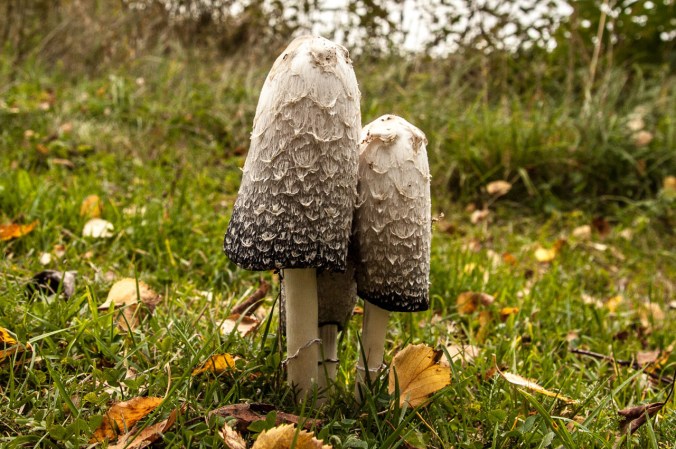
Photo: Johan Hansson/Creative Commons Attribution

We have a mycological leaning on this platform, which started due to Milo’s interest, which was infectious.  So, our news filters pick up stories like this; normally I avoid sharing the stories involving hallucinogens, though I read the serious ones myself. I do not expect stories like this one below from New York Magazine, so this was a pleasant surprise:

Meet the Citizen Scientists Who Think Mushrooms Have Superpowers

By

Last month, around 2,500 people with some connection to hallucinogenic drugs gathered at the Oakland Marriott City Center in Oakland, California for what might best be described as the psychedelics state of the union. Psychedelic Science 2017, as it was more formally known, drew professionals of all stripes: chemists who make the hallucinogens, neuroscientists who study their effects on the brain, therapists who discuss their after-effects on patients, shamans and healers who administer the drugs, and anthropologists like Joanna Steinhardt, who are trying to make sense of the meaning of psychedelic culture. Continue reading →

Foxes, Habitat & De-Wilding

Five red fox kits around the tree.jpg

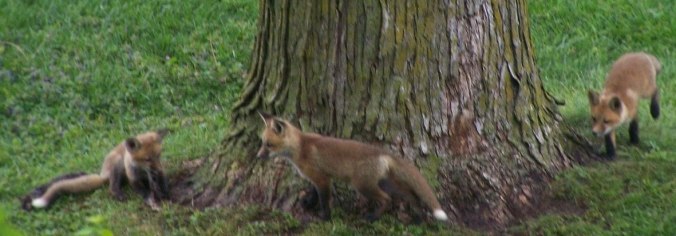
I recently received some photographs showing a family of foxes that had taken up residence near a home in the countryside an hour away from Kansas City. The foxes were wild, but even in this semi-rural landscape the foxes did not appear wild to me.

Vixen near the lakeIt was something about the context, seeing them in a yard I recognized well, that made me think about the essence of wildness. In the last year I have seen a number of grey foxes in the forests of Chan Chich and like most of the wild animals they do not seem to be afraid of humans; neither attracted to nor repelled by fear.

Vixen Apr 27 2017.jpgThe animal-human dynamic in both cases, the semi-rural home (of my in-laws, as it happens) setting of the foxes as well as those at Chan Chich seem to be one of peaceful coexistence, even apparent disinterest.  The human-animal dynamic is anything but disinterested, which the photos illustrate and that we see evidence of every day among Lodge guests. People want to see animals in their natural habitat. The animals’ apparent lack of fear of humans is related to the fact that there has been no hunting in the surrounding half million acres of forest for a couple generations.
It may also be that the foxes around the yard of the home in these photos also have not been hunted but something tells me that the foxes that seem habituated in and around human populations are different from those in these wild forests. I cannot quite articulate why I think that but today this book review got me thinking differently about the essence of wildness:

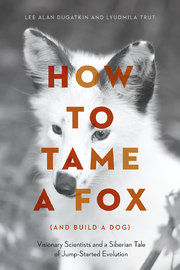
zuk-master180Imagine a time when scientists worked in secret, wondering if government officials would declare their research counter to state interests, endangering not only the personal liberty of the scientists themselves but their ability to let the experiments take them where the facts led. A time when how good a scientist you were was not all that mattered — what was important was how well you fit into political and ideological dictates. No, this is not a setup for a book ripped from yesterday’s CNN feed. Instead, it is the backdrop to a story that is part science, part Russian fairy tale and part spy thriller.

“How to Tame a Fox” sets out to answer a simple-seeming question: What makes a dog a dog? Put another way, how did an animal that started out as a bloodthirsty predator become one that now wants nothing more than a nice belly rub and the chance to gaze adoringly at a member of another species? Continue reading →

Does The Monkey Smile?

SpiderMonkey.jpg

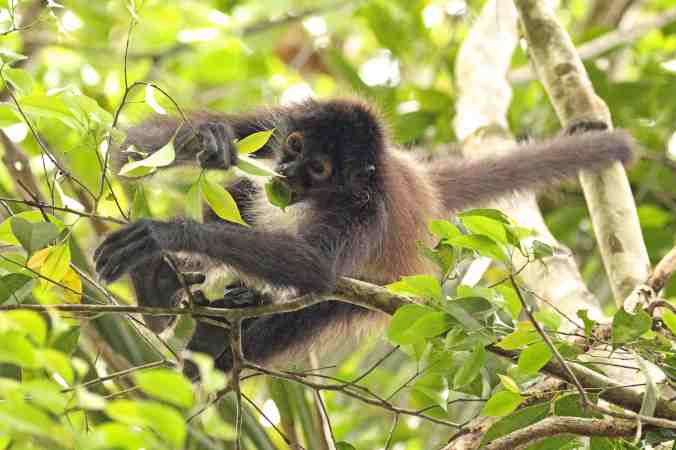
When sharing wildlife photos here, whether from guests or some of our own, the idea is to provide constant reminders, to ourselves and to everyone else, of the value of conservation. Even with a title of a post meant to draw a smile, it is not to be cute so much as to address the wonder of the moment captured in the camera. I really do wonder whether the margay purrs. And Chrissy Mason’s photo of the margay helped me wonder that more effectively.

The photo above, and the one below–both also shared by Chrissy–got me thinking about whether primates really smile, or whether it just looks that way to us (you must have seen that photo, reportedly a selfie taken by a macaque, that sure looks like a knowing grin). Continue reading →

Learning Archeology In Situ At Chan Chich Lodge

2013 Burial 10.jpg

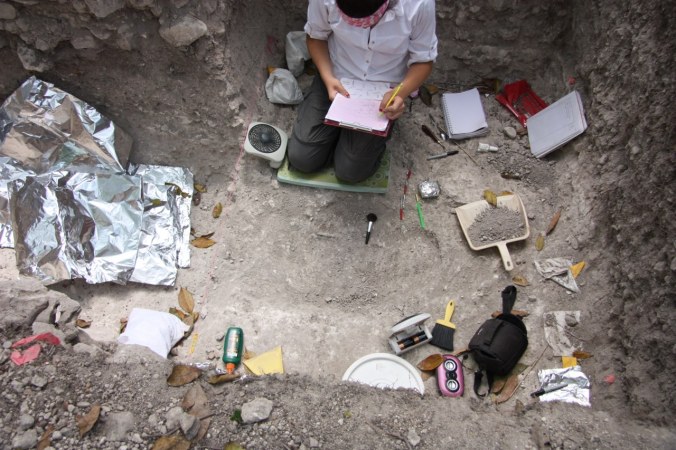
We recently posted a brief description of this program in the events section on the Chan Chich Lodge website, and here we provide a longer description written by the program organizers. The photos are from recent years of the program. I am looking forward to welcoming Professor Houk and his team of archeology students to Chan Chich Lodge few weeks from now, and especially looking forward to the opportunity guests of the lodge will have to join the evening lecture series, discussing the history of the location and particular discoveries from the site:

1997 Tomb 2 Plate.jpg

Guests of Chan Chich Lodge are the most recent inhabitants of the ancient Maya city of Chan Chich. Abandoned around AD 900, the once proud buildings, plazas, courtyards, reservoirs, gardens, and fields were gradually reclaimed by the jungle for over 1,100 years… Continue reading →

Big Day Pledge

clo_logo_2_351px

As we have in past years, in solidarity with our friends and colleagues at the Cornell Lab of Ornithology, we are sharing the pledge drive as far and wide as we can, and look forward to doing our part more specifically in a couple weeks:

BigDay_Email-banner_032817

On May 9th, the Cornell Lab of Ornithology’s top birding team will begin the long journey to the Yucatan Peninsula for Big Day 2017. Big Day is an all out midnight-to-midnight birding event to see who can identify the most species in a 24 hour period. Team Sapsucker hopes to find the most birds yet — by identifying 300 bird species. Continue reading →

Escapist Noir

Print

In Melville films starring Alain Delon, cops and robbers feel interchangeable. Illustration by Malika Favre

In these pages our norm is to give visitors reasons to escape urban life and immerse in nature, join conservation initiatives, support communities at home and in faraway places alike. When we need a brief getaway from all that, we occasionally do it in reverse. In places where we can be reminded of mankind’s occasional flashes of genius. One of my favorite critics has me thinking about being in a big, dark room in New York City in the coming days:

This is how you should attend the forthcoming retrospective of Jean-Pierre Melville movies at Film Forum: Tell nobody what you are doing. Even your loved ones—especially your loved ones—must be kept in the dark. If it comes to a choice between smoking and talking, smoke. Dress well but without ostentation. Wear a raincoat, buttoned and belted, regardless of whether there is rain. Any revolver should be kept, until you need it, in the pocket of the coat. Finally, before you leave home, put your hat on. If you don’t have a hat, you can’t go.

Melville was born almost a hundred years ago, on October 20, 1917. The centennial jamboree starts on April 28th and ends on May 11th, followed by a weeklong run of “Léon Morin, Priest” (1961), starring Jean-Paul Belmondo in the title role. (Thanks to Godard’s “Breathless,” released the year before, Belmondo was at the time the coolest Frenchman alive, so what did Melville do? Put him in a dog collar and a black soutane.) In all, the festival, which after New York will travel to other cities, comprises twelve features and one short. Only a single work is missing, a rarity entitled “Magnet of Doom” (1963). Continue reading →

For The Wordies In Our Midst

ap_070703038854_wide-8db38f345e52dcc1cd10af2ed21699e9704f7293-s1400-c85

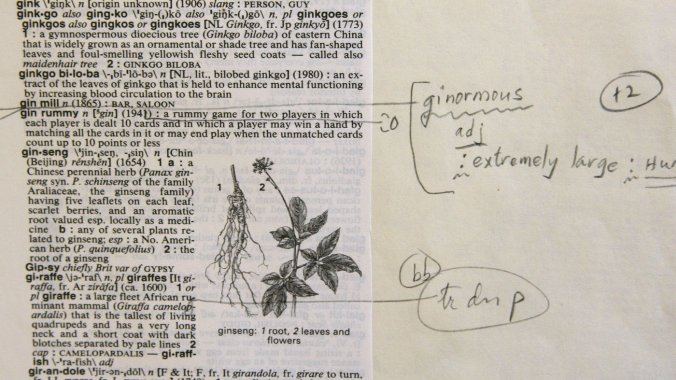
A galley proof shows some of the work that went into adding “ginormous” to Merriam-Webster’s 2007 collegiate dictionary. Charles Krupa/AP

We care about the meaning and use of words about as much as we care about the specific themes words are used in these pages to evoke in all manner of variation: conservation, community, collaboration, food, etc. Among us are perhaps some repentant grammar scolds, so thanks to the Atlantic’s Megan Garber for this review, which I was led to read after listening to an interview with Kory Stamper (click the image above to go to that podcast):

The Case Against the Grammar Scolds

The lexicographer Kory Stamper’s new book, Word by Word: The Secret Life of Dictionaries, is an eloquent defense of a “live and let live” approach to English.

lead_960 (7)

Louis du Mont / Getty

Continue reading →

Does The Margay Purr?

MargayC1

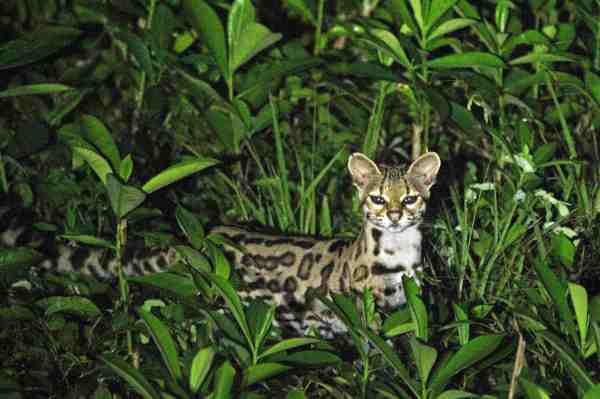
Thanks for this photo go to a mom and daughter team who were out every day recently from pre-dawn until late evening, absorbing all on display at Chan Chich Lodge and its surrounding forests. Their last night, sharing the night safari with the family who contributed here, was a golden opportunity, so to speak. This margay looks so content, and intent, in a feline way, that I cannot help but wonder whether these wild cats purr.

Skip The Machine, Skip The Packs, Come To Where The Juice Is Fresh Every Day

Juicero.jpg

Do You Need a $400 Juicer?

Anything that can be labeled “the Keurig of” makes my skin crawl. Thanks to Ellen Huet and Olivia Zaleski at Bloomberg for pointing out more anecdotal evidence of the genius of PT Barnum. Why put juice in plastic packs? Why then squeeze it from a machine, let alone such a pricey one? Why not take a week off grid, let us pluck the fruits and vegetables of your choice, and have it served as often as you like as a refresher on the back to nature idea? From many cities in the USA, you can buy a round trip ticket to Belize for the same cost of a machine that will squeeze juice packs for you. Juicero will set you back, while Chan Chich Lodge will set you forward:

Silicon Valley’s $400 Juicer May Be Feeling the Squeeze

Two investors in Juicero were surprised to learn the startup’s juice packs could be squeezed by hand without using its high-tech machine. Continue reading →

Cavafy, Ithaca

cover_cavafy_pbIf you already read this,  you likely treated yourself to the poem the author referenced. I continue to lean on Kazantzakis but perhaps the best outcome for me of reading what Daniel Mendelsohn published in the current issue of the New Yorker was a direction to his translation of Cavafy:

An extraordinary literary event: Daniel Mendelsohn’s acclaimed two-volume translation of the complete poems of C. P. Cavafy—including the first English translation of the poet’s final Unfinished Poems—now published in one handsome edition and featuring the fullest literary commentaries available in English, by the renowned critic, scholar, and international best-selling author of The Lost. Continue reading →

Team Sapsucker, Looking Forward To Global Big Day In The Yucatan Peninsula

We are looking forward to Andy’s arrival in Belize, with his team mates from the Lab and others from Belize. When I say “we” I am referring to the entire staff and community at Chan Chich Lodge.

As Global Big Day draws closer, it is time to introduce Andrew Farnsworth, Captain of Team Belize. We love the idea of the healthy competition among the 3 teams that will spend their Big Day birding the Yucatán –  and the Chan Chich guiding team especially looks forward to assisting the Lab team. Continue reading →

Foraging Classes

HornFarmCenterLogoStacked-72-540x540WhiteBGA mushroom dropped in on my life, in an unexpected manner, and now I find myself wandering to unexpected places, such as rural Pennsylvania. I am sharing here mainly as a record of how I have come across the resources that inform how we approach bringing foraging to Chan Chich Lodge.

So, bravo and thanks to our friends at the Horn Farm Center for Agricultural Education, which is my latest find in these wanderings. I particularly like their clearly laid out information on the educational resources they offer, most notably this section on foraging classes: Continue reading →