Chocolate & Nobel Prizes

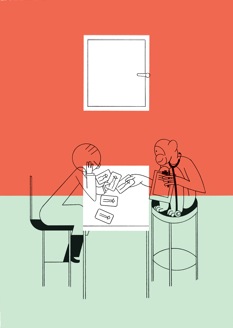
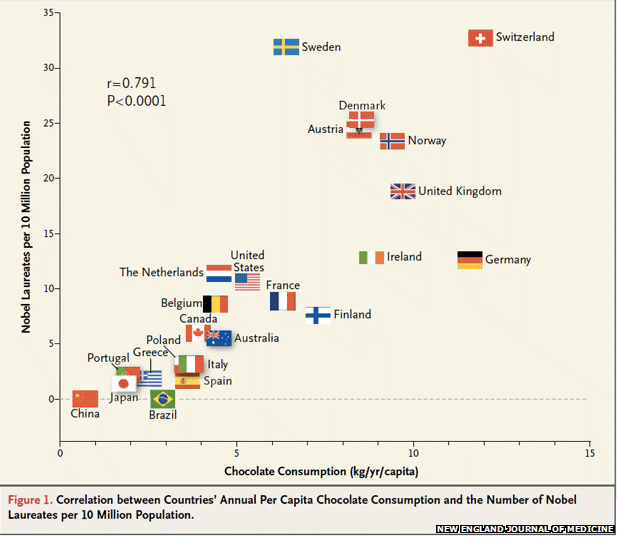
Most reporting on this recent scientific finding had a fun spin, for obvious reasons.  But was it Ig-worthy work?  While only subscribers to the New England Journal of Medicine can access the study directly, the most serious review (and the most entertaining illustration) of its significance is here:

In the study, Messerli explains:

“It seems most likely that in a dose-dependent way, chocolate intake provides the abundant fertile ground needed for the sprouting of Nobel laureates.  Continue reading

Support Your Local Marine Ecologist: They Uncover These Delightful Little Surprises

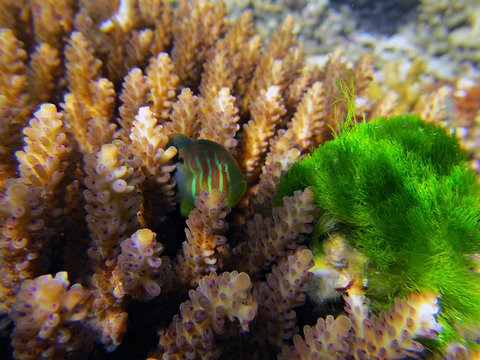
Danielle Dixson/Georgia Tech. Gobidon histrio, a goby fish species, protects coral from the menacing seaweed Chlorodesmis fastigiata.

Click the image to go to the story at Green Blog:

In the waters surrounding the Fiji Islands, the coral reef has vigilant defenders. Researchers have discovered that when alerted by chemical signals transmitted by corals, two resident species of the goby fish will swing into action and limit a growth of seaweed that contributes to the bleaching of precious reefs.

The gobies, inch-long gemlike creatures, report to the affected areas of the corals and nibble the aberrant seaweed back into place, making it look “like somebody went out there with little hedge trimmers,” said Mark Hay, a marine ecologist at Georgia Tech. Continue reading

Another Good Reason To Reduce Your Carbon Footprint

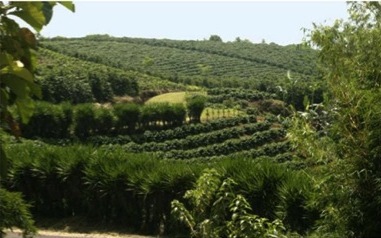
Coffee plantations surrounding Xandari, Costa Rica.
Photo: Emilia Ferreira

It is not a journal we regularly read, but the topics in this particular study–coffee and climate change–we follow closely.  Click the banner above to read the (accessible to non-scientists) article:

Coffee (Coffea L.) is the world’s favourite beverage and the second-most traded commodity Continue reading

Earthly Constellations

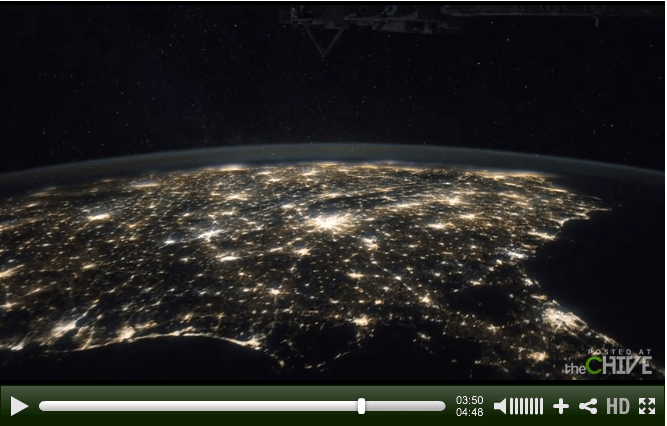
Thanks to Krulwich Wonders for the link and the observation, five minutes well spent looking and listening (click the image above to go to the video):

In this video, we are flying over the Earth, looking down and seeing what astronauts see when it’s nighttime, when lightning storms flash like June bugs, when cities look like galaxies, when you can see where people are. It’s quietly astonishing.

Daniel Decker, Come To Kerala!

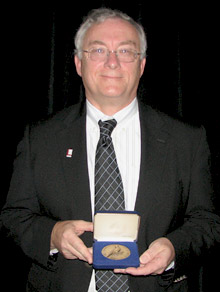
Daniel Decker holds a medal for the Aldo Leopold Award.

From time to time we extend invitations that reflect our appreciation for individuals making heroic contributions to the arts and sciences.  Professor Decker is more than worthy, as you can see in the story about the prize he just received (click the image to the left to go to the full story):

Decker’s research and outreach work has promoted a long-term vision of wildlife management by addressing how human dimensions have impact in such areas as suburban wildlife, adaptive harvest management, community-based management, hunter retention and wildlife habituation in national parks.

Continue reading

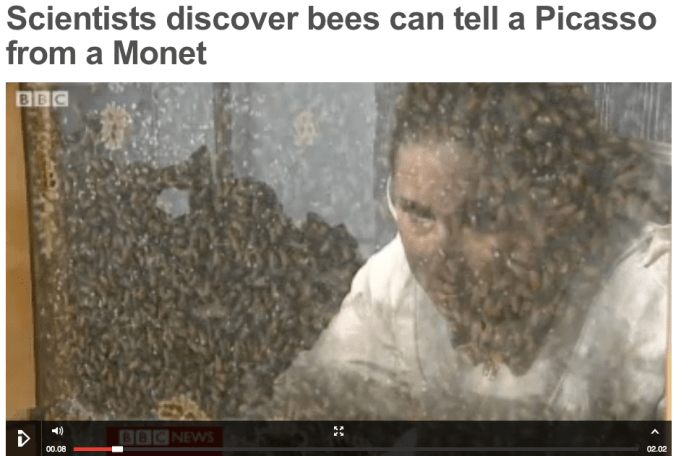
Science, Bees, Art

Click the image above to go to the video:

Scientists in Australia have discovered bees have a remarkable ability to distinguish different types of paintings.

The experiments, carried out at the University of Queensland, showed the bees could pick a Monet over a Picasso.

The aim of the research is to discover more about how bees search for food and help us understand how humans learn.

Technology & Happiness

Yarek Waszul

From the New York Times (click the image to the left to go to the source), a recent story covered a topic that one of our contributors would likely post on, if he was not on the road, toting his mobile device around in that cute sleeping bag.  As an aside, Neema was quoted in a story related indirectly to this one:

Speed, instant gratification, accessibility — these are a few of the appealing hallmarks of digital technology. It’s no coincidence that we love our smart wireless devices: Humans are a notoriously impatient species, born with a preference for immediate rewards.

Shrinking Antarctic Ozone Hole?

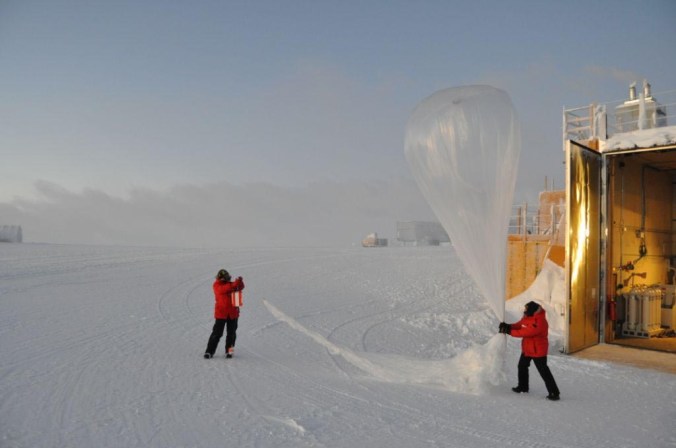
Staff at the South Pole get ready to release a balloon that will carry an ozone instrument up to 20 miles in the atmosphere, measuring ozone levels all along the way. NOAA image from 2011.


Click the image above to go to the story:

Warmer air temperatures high above the Antarctic led to the second smallest seasonal ozone hole in 20 years, according to NOAA and NASA satellite measurements. This year, the average size of the ozone hole was 6.9 million square miles (17.9 million square kilometers). The ozone layer helps shield life on Earth from potentially harmful ultraviolet (UV) radiation that can cause skin cancer and damage plants. Continue reading

Mysterious Bird, Carefully Studied

This slideshow requires JavaScript.

From Smithsonian‘s website a story about the most mysterious bird in North America:

Black swifts, Cypseloides niger, are among the most enigmatic birds in North America. Continue reading

Carbon Mapping

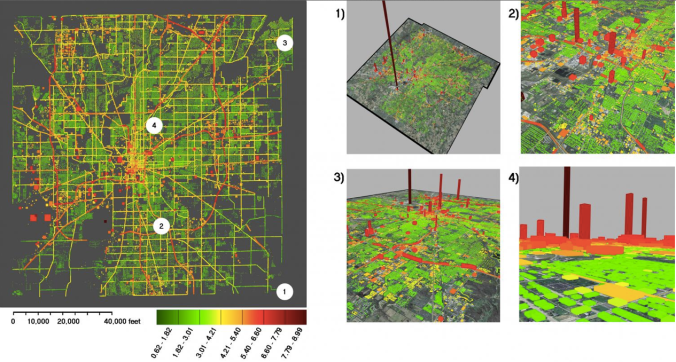
With Hestia, researchers from Arizona State University have a detailed understanding of where CO2 is being emitted from the urban landscape. This map shows where CO2 is emitted across the city of Indianapolis, Indiana, and combines data from sources including factories, automobiles on roadways, homes, and power plants. Credit: Bedrich Benes and Michel Abdul-Massih

Click the image above to read more about this at Phys.org:

Dubbed “Hestia” after the Greek goddess of the hearth and home, researchers presented the new system in an article published October 9 in Environmental Science and Technology. Hestia combines extensive public database “data-mining” with traffic simulation and building-by-building energy-consumption modeling. Its high-resolution maps clearly identify CO2 emission sources in a way that policy-makers can utilize and the public can understand. Continue reading

Cases Illustrating The Value Of Ecosystem Services

This website is on nominally and practically about bird life, but is also more broadly about the health of the planet where birds live.  This is a great resource on how to value the services that ecosystems provide.  Click the banner above to go to the source:

Ecosystem services are the benefits we receive from nature, such as provision of crops or medicinal plants, the control of pests (Birds control insect pests in farmlands and forests), the regulation of climate, the reduction of flood risk (BirdLife Partners are restoring forests that will help buffer communities against climate change), and opportunities for cultural, spiritual and recreational experiences. Continue reading

If You Are Not Sure About The Need For That Meeting In Hyderabad

You must be a subscriber to Science or have access through a library in order to read beyond the Abstract (or you can purchase it here) of what is clearly a good explanation and rationale for the meeting currently under way in Hyderabad:

World governments have committed to halting human-induced extinctions and safeguarding important sites for biodiversity by 2020, but the financial costs of meeting these targets are largely unknown. Continue reading

Bioluminescence To Commemorate Columbus In The New World

Dimitri Deheyn/Scripps Institution of Oceanography
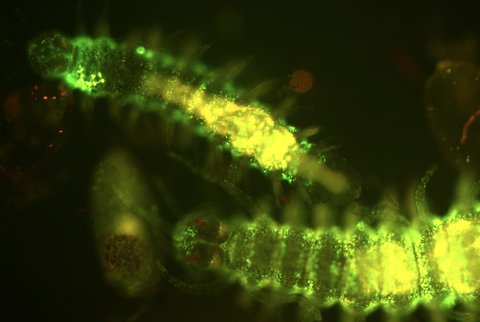
Columbus may have seen fireworms like these glow green just before making landfall in the Americas.

From today’s Green Blog on the New York Times website a note in honor of Columbus Day (and doctoral student discoveries) click the image above to go to the story:

…At 10 p.m. on Oct. 11, 1492, Christopher Columbus saw a glimmer in the distance as he stood on the deck of the Santa María. The faraway flash was “so small a body that he could not affirm it to be land,” Columbus wrote, referring to himself in the third person. Continue reading

Feathers, Evolution’s Pride And Joy

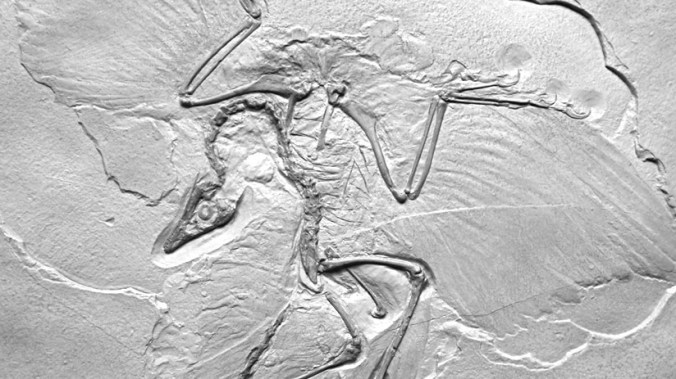
Thor Hanson/Basic Books. Thor Hanson’s own cast of Archaeopteryx lithographica presents what he calls the “ancient wing written in stone.”

Click the image above to go to a podcasted interview with Thor Hanson, author of Feathers:

“To this day, they are the most efficient insulation known. We haven’t been able to match them with synthetics, and I think it boils down to that growth process and the fact that you can make these fine, fine branching structures. The key to insulation is what they call loft — how much air can you hold in a small space? And because feathers are so beautifully and finely branched, they can hold a great deal of tiny, tiny air pockets in that branched structure. And that’s what people try to mimic with synthetics, but haven’t been able to match feathers for that yet, because it’s difficult to manufacture finely branched structures.” Continue reading

Batons Passing, Generation To Generation

Long before Carson and Attenborough, as noted in a post by Meg last year, there were Vedic, Buddhist and Hindu texts; Old Testament scribes, New Testament scribes, great Islamic scholars; but also there were Greek philosophers, Roman thoughts nearly lost; on and on, closer to the present with Thoreau; etc.

All providing us with a sense of reverence for, and a way to understand, the mysteries we will refer to here as Nature.  But what is next?  And who will be our interpreters and scribes?  Anyone following this site will know we are partial to Jad‘s sonically luscious and always surprising approach to making sure we understand and appreciate the world we live in; ditto for Krulwich (whom we have pointed to plenty of times but if you can only focus on one, make it this one).  Thanks to the the latter, we came upon the clip above, and with one viewing we see a possible answer.

Animals We Know, Way Back When

Click the banner for the podcast:
Mammoths and saber-toothed cats may be the most famous beasts of the Ice Age. But they shared the prairie with horses and camels, too—both of which evolved in North America and crossed the ice bridge into Eurasia, before disappearing here. Matthew Kohn (Distinguished Professor, Department of Geosciences Boise State University Boise, Idaho) and Christopher Hill (Associate Dean, Graduate College Associate Professor, Anthropology Boise State University Boise, Idaho) talk about the lesser-known fauna of the Ice Age.

Thermal Imaging, Elephant Listening

©Elephant Listening Project. A thermal image of a juvenile forest elephant drinking minerals dissolved in water at the Dzanga Bai, Central African Republic. Different color palettes can be selected for the images (this one used “rainbow”) while the videos and the image at right were captured using the “iron” color palette.

We first saw the photos in a magazine, and then realized two of our own contributors work under the same roof as the Elephant Listening Project.

Click the image to the left to go to their website for photos and videos of the amazing new approach to listening.  We just returned there to see the new photo to the left and listen to some new recordings they have provided.

And then it dawned on us that we are currently identifying the theme of Summer 2013 internships and our related contribution to conservation at the Periyar Tiger Reserve, which has a healthy population of Asian elephants who may benefit from some listening.

Maybe one of our Lab-based contributors will help us with an introduction to their office mates in the Elephant Listening Project?
2012 Ig Nobel Prizes

Ig Nobel Prize Winner Dr. Elena Bodnar demonstrates her invention (a brassiere that can quickly convert into a pair of protective face masks) assisted by Nobel laureates Wolfgang Ketterle (left), Orhan Pamuk, and Paul Krugman (right). Photo credit: Alexey Eliseev, 2009 Ig Nobel Ceremony

Further to the theme started with reference to the book, now: Continue reading

Things You Do Not Need To Know, But What The Heck

If you are a fan of these fun prizes, click the image of the book to go to the publisher’s site:

Marc Abrahams, the founder of the famous Ig Nobel Prize, offers an addictive, wryly funny exposé of the oddest, most imaginative, and just plain improbable research from around the world. He looks into why books on ethics are more likely to get stolen and how promoting people randomly improves their work, to what time of month generates higher tips for Vegas lap dancers and how mice were outfitted with parachutes to find a better way to murder tree snakes in Guam.

Abrahams’ tour through these unlikeliest investigations of animals, plants, and minerals (including humans) will first make you laugh, then make you think about the globe in a new way. Continue reading

Evolutionary Biology Unhinged

From last week’s New Yorker, a book review about the challenge to the dominant strain of science related to how mental traits evolved, saying it makes no practical difference.  This is the stuff science is made of, starting with stories:

When Rudyard Kipling first published his fables about how the camel got his hump and the rhinoceros his wrinkly folds of skin, he explained that they would lull his daughter to sleep only if they were always told “just so,” with no new variations. The “Just So Stories” have become a byword for seductively simple myths, though one of Kipling’s turns out to be half true. Continue reading