The Wind Power Debate Gets More Interesting

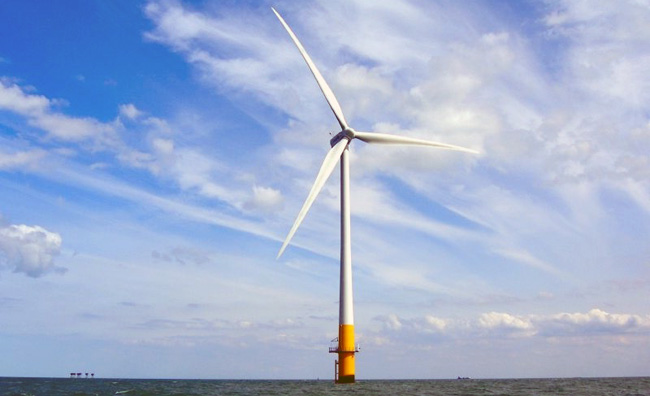
An offshore wind turbine, part of the London Array wind farm site, located in the outer Thames Estuary, about 70 miles east of London. Image: phault via flickr

An article in Inside Science (click the image above to go to the article) discusses new research demonstrating that wind power might be able to generate all the world’s electricity needs without large atmospheric effects:

There is enough energy for people to reap from the wind to meet all of the world’s power demands without radically altering the planet’s climate, according to two independent teams of scientists.

Wind power is often touted as environmentally friendly, generating no pollutants. It is an increasingly popular source of renewable energy, with the United States aiming to produce 20 percent of its electricity by wind power by 2030. Still, there have been questions as to how much energy wind power can supply the world, and how green it actually is, given how it pulls energy from the atmosphere. Continue reading

Why Organic?

Click the banner above for the press release from Stanford University’s Center for Health Policy on the results of a new meta-analysis published in the Annals of Internal Medicine:

They did not find strong evidence that organic foods are more nutritious or carry fewer health risks than conventional alternatives, though consumption of organic foods can reduce the risk of pesticide exposure. Continue reading

Infrared Elephants

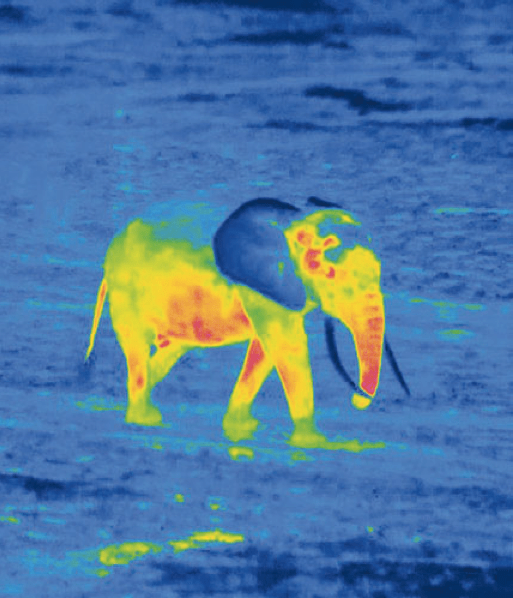
Click the image above for the story called “Forest Elephant Chronicles” in this month’s American Scientist, about new technology for understanding elephant behavior in the wild:

…What inspired your team to try thermal imaging?

Acoustic monitoring has allowed us to study elephant behavior, without bias, over 24-hour cycles. Their activity cycle is nearly equally distributed day and night, but they prefer to enter forest clearings at night. This is where we can observe the elephants directly. We suspect that different types of interactions occur at night because the types of calls differ then. But we have only the beginnings of an understanding of what the acoustic signals mean. We need to investigate this with visual observation. Also, important behaviors may not have identifying sounds associated with them, and we need to know what these are….

Continue reading

From Old Tools, New Knowledge

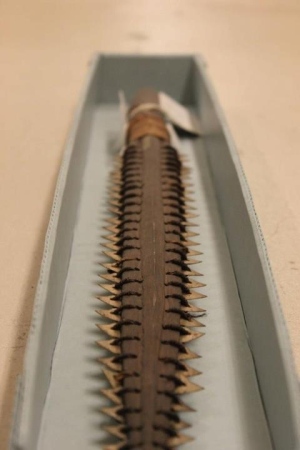
Weapons from the Gilbert Islands contain the teeth of shark species no longer found in the area. Photo by J. DREW/COLUMBIA UNIV.

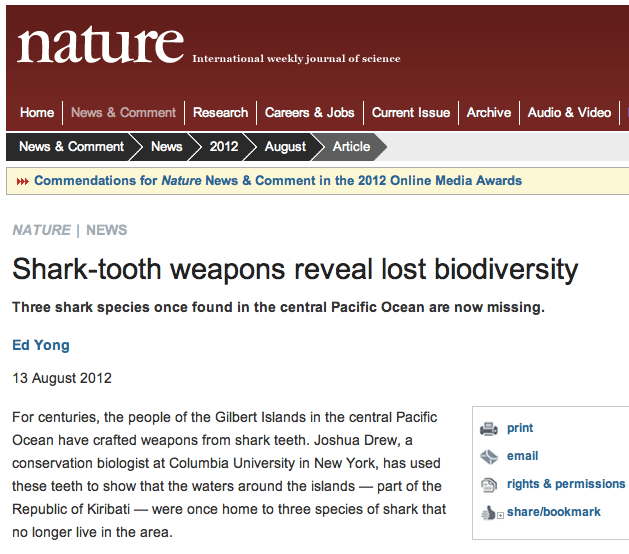
Click the headline image above, or the photo to the left to go to the story:

“This is shadow biodiversity,” said Drew, presenting his results at the 2012 Ecological Society of America Annual Meeting in Portland, Oregon, last week. “Three sharks disappeared from these reefs before we even knew that they existed there.”

Drew analysed 124 shark-tooth weapons housed in the collection of the Field Museum of Natural History in Chicago, Illinois. The artefacts included swords, tridents and a 4-metre-long lance, dating back over 120 years.

All are built in the same way: the islanders drill hole in the teeth and lash them to buttresses of wood with cords made from coconut leaves.

Ocean Health Index

Click the logo to the left for the site of this useful index:

From the many millions who count on ocean fisheries for their livelihoods to the uncounted lives saved by intact coral reefs during the 2004 Asian tsunami, people all over the world depend upon healthy oceans. But how healthy are our oceans?

Continue reading

Socially Mediated Discovery

This Green Lacewing is an entirely new species, discovered in a set of Flickr photos. (Photo: Species ID/Guek)

Click the banner above for a link to a publication we have just come across that looks quite interesting. Click the photo above for the source of the discovery explained in this story (quoted below).  There are still plenty of flora and fauna that have not been identified.  One of the hopes of nature conservation is to get further down the path to identifying and understanding all our co-habitants on this planet. It should come as no surprise that social media and photographers like Hock Ping Guek play a critical role in this race against time:

The lacewing Guek had photographed in May 2011 was quite distinctive. Beneath long antenna sat its bulbous, iridescent eyes in front of a turquoise thorax supported by six translucent legs. Continue reading

Aesop’s Wisdom

From Science (click the image to the left for the full story) a short piece about the wisdom of not being too rational:

A thirsty crow comes across a pitcher partly filled with water but can’t reach the water with his beak. So he keeps dropping pebbles into the pitcher until the water level rises high enough. A new study finds that both young children and members of the crow family are good at solving this problem, but children appear to learn it in a very different ways from birds.

Measure For Measure

Sustainable development has been in an experimental, invent it as we go state for about two decades.  The good news is that the model has been experimented with.  The less good news is that the progress of those experiments is outpaced by less sustainable development.  Nonetheless, half glass full, it is heartening to see a bit of progress in a developed economy, especially in tough economic times.  Measurement: what a concept!

Measures of ‘capital’ will show how much natural resource – such as fish – is left, rather than just how much is being used. Photograph: Cathal Mcnaughton/PA

Click the image above to go to the story:

The state of England’s natural world and the sustainability of its society and the economy is due be published on Tuesday, tracking everything from bees, butterflies and birds to long-term unemployment, social mobility in adulthood, and knowledge and skills.

Engineering a Conversation

Guest Author: Siobhan Powers

My roomie Chi-Chi recently blogged about miscommunication between clients and architects so I thought it may be timely to bring to light some of my own recent difficulties in conversation and work development. I could not even begin to blog about engineer-non-engineer relations as that would take all day and there’s no point-we’re nerds to the core, I’ve realized and thus, misunderstood. Recently, however, I’ve found not just confusion between myself and non-engineers, but also with my fellow engineers-my people!

I have had few moments of serious language barriers during my time in India. Most people speak at least a little English, and if not there are pictures and hand gestures that can get points across. Shopping and dining is easy enough. Camping with strangers? You’ll find something to talk about (reference my other blog post– shout-out to Chief and Wise Eyes!). Engineering conversations, however, are not like this-there are no commonalities across language boundaries that can be pointed at and then nodded about, but instead there are abstract concepts like energy and science (gasp!).

Gijo and I talking over some data in the engineering office.

Continue reading

Worth Half A Minute

Thanks to the Environment section of the New York Times, its website, the “Green” and the “Science” initiatives on that site, the above quick video of an invention that may change clean up procedures for one of the scariest new energy trends (read the story here, and then scroll down that site for earlier stories on fracking itself):

In fracking, a mix of water, sand and chemical additives is injected into a drilling well under heavy pressure to release natural gas from shale deposits. At the end of the process, some of the chemical-laden water returns to the surface along with salts, radioactive elements and other contaminants absorbed from the shale. Safely disposing of the waste from fracking without contaminating drinking water and waterways has been a major environmental and health concern.

Intra-Galactic Weather Forecasting

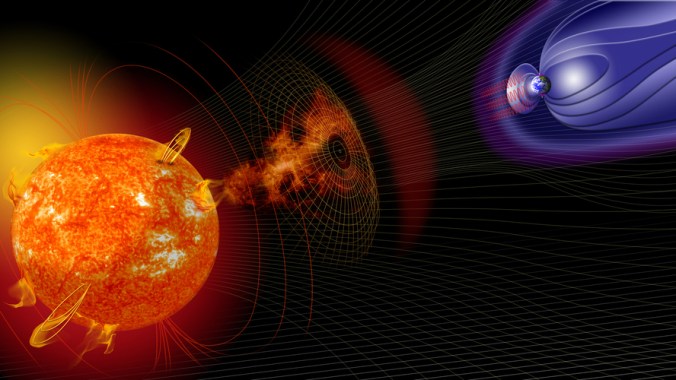
A NASA artist’s illustration of events on the sun changing the conditions in near-Earth space.

Click the image above to go to the 5-minuted podcasted explanation of a project you have likely never heard of.  But it sounds important (perhaps to explain why sometimes your mobile phone gets inexplicably scrambled) and as with the story here it may inspire the career aspirations of a few young clever dreamers:

“When one of these big storms comes in, it can actually change and flex the magnetic field around the Earth,” Stratton says. “So we’ll measure that and then we’ll see how all of that energy that’s coming out of the sun deposits into the Earth’s magnetic field, into the radiation belts.”

Ordinary satellites wouldn’t survive so much radiation. So Stratton and a large team at the Applied Physics Lab have spent years designing and building two very tough spacecraft.

Each of the spacecraft is an octagon about 4 feet tall. But once they are in space, they will deploy booms that extend about the length of a football field.

Try Doing This On Your IPhone

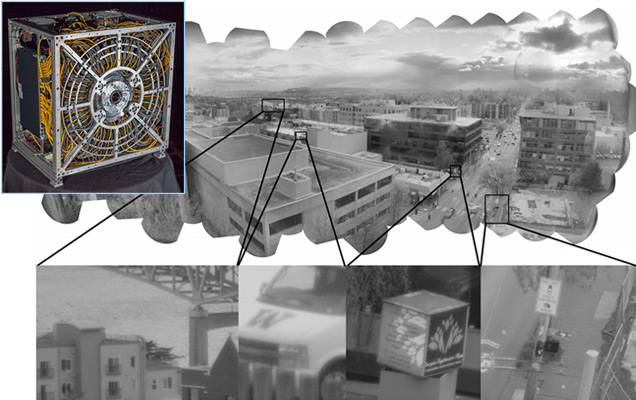
Credit: Duke University Imaging and Spectroscopy Program

Click the image above to go to the item, on the website of Science:

Such cameras could be useful for any number of military, commercial, or scientific purposes, the researchers suggest, changing the central challenge of photography from “Where should we point the camera?” to “How do we extract useful data from these superhuge images?”

If You Happen To Be On Earth June 6th

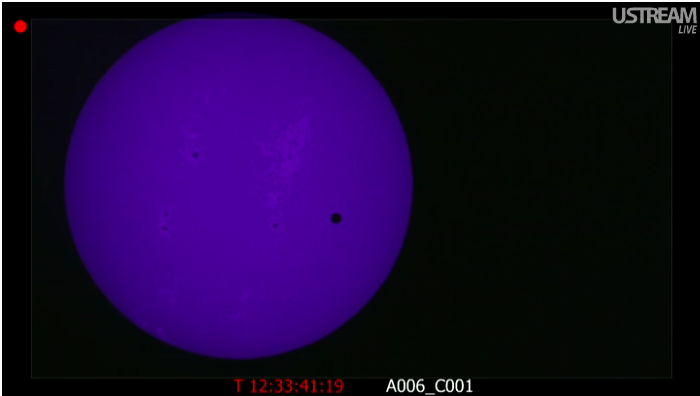
According to NASA, transits of Venus across the disk of the Sun are among the rarest of planetary alignments.  The last time it occurred, in 2004, I happened upon some wonderful pinhole viewing boxes set up in a Paris park.  (The 2004 transit allowed full visibility throughout Europe, where I happened to be living at the time.) Continue reading

Kahneman Fest

Portrait of Daniel Kahneman, author of Thinking, Fast and Slow, and winner of the 2002 Nobel prize in economic science. New York, NY, April 17 2012.

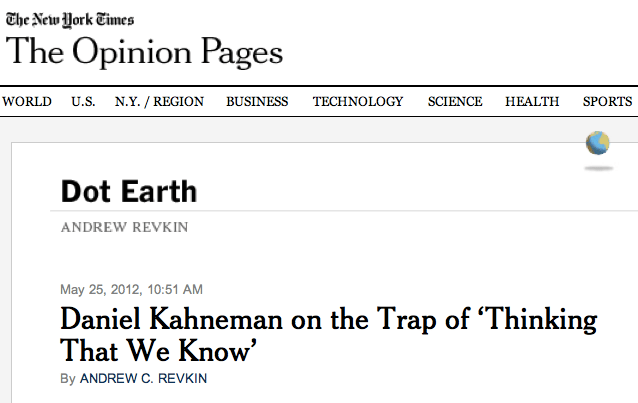
Click the image above to go to the interview, in Der Spiegel, in which our intellectual superhero finally explains why familiarity feels so good:

Of course, there are other mechanisms of advertising that also act on the subconscious. But the main effect is simply that a name we see in a shop looks familiar — because, when it looks familiar, it looks good. There is a very good evolutionary explanation for that: If I encounter something many times, and it hasn’t eaten me yet, then I’m safe. Familiarity is a safety signal. That’s why we like what we know.

Continue reading

Stories In The Service Of Science Education

Andrew Revkin’s contributions to the New York Times, via Dot Earth, make a subscription to their website worthwhile; add in video with Daniel Kahneman addressing the National Academy of Sciences, and the value skyrockets.  68 minutes and 51 seconds later, you will know more about what you do not know; and likely appreciate the way that knowledge reached you.

We have pointed to evidence of this scholar’s general awesomeness, also to his 2011 book and to an event quite some time ago all without any video demonstration of his combined intellectual and communication capacities.  Click the image below to go to Revkin’s coverage, which includes the video of a surprisingly accessible lecture.

Nurturing Nature

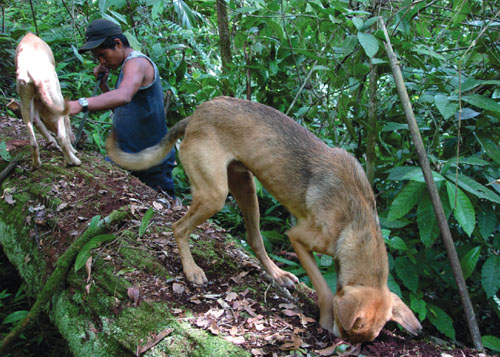
Dog domestication may have given anatomically modern humans an advantage over Neandertals. Studies of modern-day hunters suggest that dogs help people hunt more efficiently and ensure a more plentiful food supply. Here, a Mayangna hunter in Nicaragua works with his dogs to pursue an agouti (a rabbit-sized rodent) in a hollow trunk. The best dogs sometimes help these indigenous hunters bring in more than 50 kilograms of meat per month. Photo, Menuka Scetbon-Didi.

(Click the image above to go to the story in Scientific American):

One of the classic conundrums in paleoanthropology is why Neandertals went extinct while modern humans survived in the same habitat at the same time. Continue reading

Celebrate Urban Birds

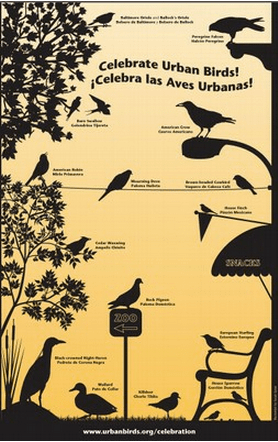
Screen Shot 2012-12-22 at 8.01.16 AMFor the past year, I have been working at the Cornell Lab of Ornithology for the project Celebrate Urban Birds. Distinct from other citizen science projects the Lab of O. is involved with, such as eBird or FeederWatch, Celebrate Urban Birds (CUBs) stays true to its name and hones in on the celebratory aspect of studying birds: artwork, festivals, education, and other activities promoting community. Of course, there is still data involved. Thousands of forms have been filed—both electronically and physically—containing information on sightings of the sixteen focal species within 10-minute observation periods. These observations, along with notes about sighting location, are the source of data for the project. Participants include the address from which they are looking for birds in the ten minutes, describe the general amount of greenery and pavement in the area (as well as the size of the area itself), and list whether they saw, did not see, or were not sure about each of the sixteen species. This information constitutes a checklist that can be compiled into a larger repository of sightings in various types of green spaces around the country; the CUBs website contains species maps according to the number of observations in the last 90 days, marking where, say, a Brown-headed Cowbird has and has not been seen.

Continue reading

Food Puzzles

The New Yorker‘s Dana Goodyear is a foodie’s food writer.  She reports on topics you maybe did not know you did not know about; but after, you realize you wanted to know. Her most recent blog post (click the image to the left) describes research asking questions which, in the spirit of science, may leave the non-scientist scratching their head (but read the post to the end to see how the puzzle is put together): Continue reading

Commoner’s Dilemma


A Perfect Moral Storm: The Ethical Tragedy of Climate Change 
by Stephen Gardiner, Oxford, 512 pp, £22.50, July 2011, ISBN 978 0 19 537944 0
 

Click the LRB banner above to go to the review of this important book, which starts:

For the benefit of anyone who has spent the past decade or so on a different planet, the most frequently asked questions about climate change on this one are as follows. Is it getting warmer? Yes, surface temperatures have risen by 0.8°C from pre-industrial levels. Are humans causing it? Almost certainly.