Many Stripes. Many Tales. Few Tigers.

When I decided to come to Kerala this summer for my internship, I got most excited not entirely about my work, but really about seeing a tiger. I can’t even remember the last time I went to a zoo, but I know deep in my closet I have a dusty photo of me and a tamed tiger from Thailand. At this time, seeing a wild tiger was actually more of a WILD idea. Since I’m working next to the Periyar Tiger Reserve, a home to approximately 40 tigers and many other animals, I’m practically neighbors with them and awaiting a miraculous moment to see a tiger before my trip to Delhi.

As a Korean descendent, I must introduce you all to some Korean culture and explain why I’m writing a blog post that is dedicated just to tigers. I’m sure a lot of my Korean folks will agree that tigers and Koreans go way back. My relationship with tigers started when I was 3 years old when my grandmother told me a story about a tiger that smoked using bamboo pipes.  My reaction was: “Really? Tigers smoke, too?”

Source & Credit: Picture of a Tiger at SamChunSa (삼천사) at BookHanSan (북한산)

Continue reading

Being Full of It: A Meaningful Word

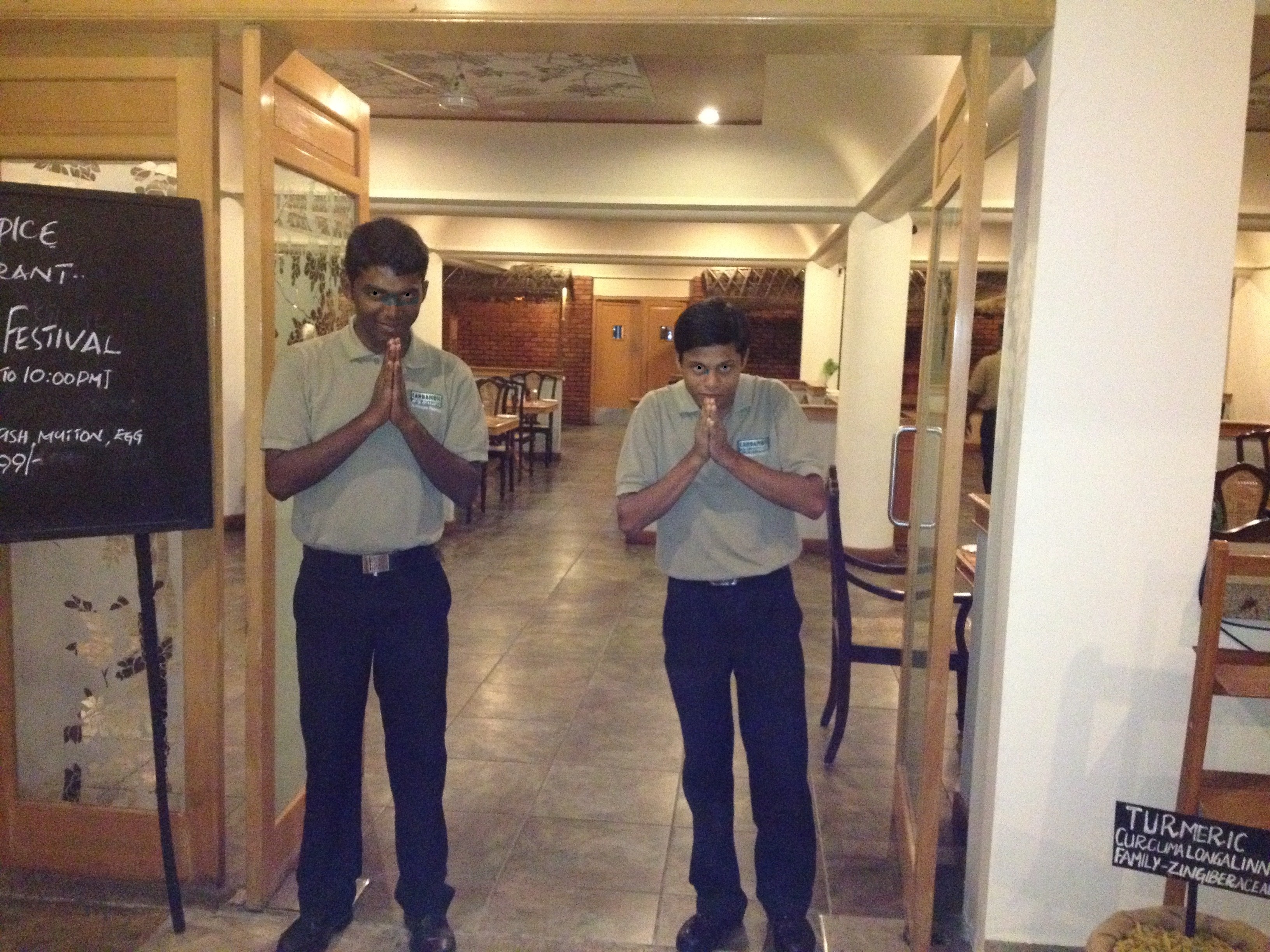
Since arriving in Kerala, I have been greeted many ways.  I have exchanged many smiles and hellos, and I have been veiled with jasmine garland and pressed with traditional dika.  However, the greeting I find most profound lies in a single word: Namaskaram.

Two people, worlds apart, meet with this word.  Each of their hands draws together in a prayerful pose in the nest of their individual chests.  With a bow of their heads, they utter, “Namaskaram.”  At first, it seemed like a simple interaction, yet when I asked the native people for the meaning, I learned that it has a much deeper connotation.

A signal of respect.  A promise of hospitality.  A notion of putting aside one’s ego.  All of these meanings are understood with Namaskaram.  I witness and experience them with nearly every interaction among the people here at Cardamom County, but the latter meaning, putting aside one’s ego, has struck a powerful chord in me. Continue reading

Wordsmithing: Cousin

In Kerala, and perhaps other parts of India, “auntie” or “uncle” are terms of endearment among youth for anyone of “respectable” age.  No blood ties are necessary. In many Western cultures the OED definition tends to prevail, respectively, for these two terms:

A sister of one’s father or mother; also, an uncle’s wife (= aunt-in-law).

A brother of one’s father or mother; also, an aunt’s husband (= uncle-in-law).

And cousins?

Continue reading

The Cyberspace Jungle

Today, we are bombarded with information. Millions of bits–photos, text, video–stream by us every second we’re on the web. And we’re always on the web. Mobile devices on 3G (and now “4G”) and lightweight laptops able to access nearly ubiquitous WiFi hotspots mean that the modern age is certainly the information age. And the Internet continues to grow riotously; like a tropical rain forest, millions of unique niches exist, but they are inhabited here instead by users and data. And much like a natural ecosystem, the internet is also inextricably interlinked and interdependent: hyperlinks, reference pointers, and social media make the Internet a pseudo-organic entity that has its gaze turned not only outward (towards expansion) but also inward (towards connections). In its own way, the internet is an oddly beautiful thing. The freewheeling, ever-shifting topography of the web means that from second-to-second it’s never quite the same place.

But for all its seductive beauty and facile utility Continue reading

USA Refresher

Before there was social media as we know it today, there was social media.  Social reformers and thinkers of all varieties have centuries of experience not just using the tools of social media, but utilizing them.  Leveraging them.  August 28, 1963 in Washington, D.C. was one of the days when the USA experienced a moment of truth, and when social media included word of mouth, television/radio simulcast and later replay.

This is the day when the man who spoke longest on that day is remembered officially.  One minute into the above video he begins speaking, but the memory is affected, no matter how many times one has seen, heard or read these words, most when that man talks about his hopes for the future of a country that had a history of injustice, but also a history of reform, change, improvement. Continue reading

Wordsmithing: Greenhew

This noun, now rarely used, is a word that might have been used in one of Seth’s historical notations on Pilgrims in the New World, who came to understand how the indigenous communities made productive, careful use of the land:

1. Green vegetation growing in a wood or forest and serving as a cover for game.

Continue reading

Wordsmithing: Walkabout

For anyone who has seen the Nicholas Roeg film, from 1971, that takes this word as its title, the definition is visual.  You could watch that film with no sound and understand this word.  Try it.

Or you might start with the OED definition and etymology which notes that this noun is of Australian origin but begins with a generic, modern catchall meaning and gives specifics on the origin second (after the jump; of particular value, see the last sentence of the 1979 reference):

1.  A person who travels on foot, esp. for an extended period of time; a swagman or traveller.

Continue reading

Wordsmithing: Trend

A beautiful origin, thanks to OED for reminding us, of a word that has come into the possession of statisticians, demographers, political scientists and such:

1. A rounded bend or circuit of a stream.

c1630    T. Risdon Chorogr. Surv. Devon   In the trend of Touridge,‥stands Meeth. Continue reading

Wordsmithing: Tribal

Western travelers to Kerala at first can be startled by the frequent use of this word, which has been replaced by the word indigenous in other parts of the world, but whose noun form has special mention in OED:

A member of a tribal community (usu. in pl.). Chiefly Indian English.

1958    New India: Progress through Democracy iii. vi. 378   Illiteracy is almost universal among tribal peoples.‥ Tribals are being trained as teachers.

1964    Economist 18 Apr. 261/1   More are arriving daily, among them Christian and Buddhist tribals.

1979    South China Morning Post (Hong Kong) 28 Dec. 3/1   Teams of mountain tribals are to join the search for three Singapore Air Force Skyhawks which disappeared over the northern Philippines eight days ago.

The word has no “tone” to it, at least not perceptible to foreigners living in Kerala.  Continue reading

Wordsmithing: Altruistic

We have made references to this word and its relatives on several occasions but as yet failed to formalize it.  According to the OED it is defined as:

1. Unselfishly concerned for or devoted to the welfare of others.

And, a bit of a surprise:

2.Animal Behavior. Of or pertaining to behavior by an animal that may be to its disadvantage but that benefits others of its kind, often its close relatives.

Continue reading

Wordsmithing: Zoo

It is one of the words that most children associate with wildlife. Does it qualify as a word?  OED shows the etymology of these three letters as:
c1847    Macaulay in Life & Lett. (1878) II. 216   We treated the Clifton Zoo much too contemptuously.
1886    C. E. Pascoe London of To-day (ed. 3) iv. 65   The ‘Zoo’ in time past was as favourite a fashionable resort as Rotten Row.

Wordsmithing: Authentic

We have been using this word for years as a shorthand for one of the core objectives of our entrepreneurial conservation work: collaborating with communities to assist in the retention of heritage that has meaning, and that those communities feel should remain essentially as it was.  It is therefore interesting to consult OED (finally) on exactly what this means.

Top of the list of entries:

a. Of authority, authoritative (properly as possessing original or inherent authority, but also as duly authorized); entitled to obedience or respect.

Continue reading

Wordsmithing: Bibliopegy

By what criterion, of all the books on all the shelves in all the libraries, does one choose a particular book?  In the digital world we live in now, is that even a relevant question?  For anyone who loves to walk over to the lectern in the library where the monumental OED is sitting, the answer is certainly yes, even if they very much also appreciate other forms of access to OED.

So today we pay tribute to those artisans who, along with calligraphers and paper-makers, keep the world of ideas evolving.  How one binds a book could have enormous consequences, so it is surprising to see that the etymology for this word is so modern:

Bookbinding as a fine art.

1876    Encycl. Brit. IV. 42/1   Contemporary masterpieces of French, Italian, and German bibliopegy.

1885    Pall Mall Gaz. 10 Sept. 15   The Exhibition of what is known as bibliopegy.

1958    ‘M. Innes’ Long Farewell 72   Appleby, although hazy about bibliopegy, was quite certain he wasn’t a distinguished student of it.

Wordsmithing: Development

From the perspective of anyone immersed in the economic paradigm known as sustainable development, the first entry in OED‘s definition of the word development will be much appreciated.

1. A gradual unfolding, a bringing into fuller view; a fuller disclosure or working out of the details of anything, as a plan, a scheme, the plot of a novel.

Continue reading

Wordsmithing: Sustainability

While the development economics paradigm known as sustainable development has been with us for merely a generation or so, the adjective sustainable goes back to 1611, according to OED.  A derivative of that adjective, the noun sustainability, came into use much more recently, which may explain the name attached to the paradigm:

1980    Jrnl. Royal Soc. Arts July 495/2   Sustainability in the management of both individual wild species and ecosystems is critical to human welfare.

We cannot help but agree with the application in that reference.

Wordsmithing: Pilgrim

For approximately 90o years now, according to OED,  those of us with wanderlust might properly be defined as a person

on a journey, a person who travels from place to place; a traveller, a wanderer, an itinerant…

…in short, a pilgrim.  That, according to the first entry defining the word according to its oldest usage.  The second definition gives the now more familiar context of journeying to a sacred place as an act of religious devotion, but qualifies that by adding that a pilgrim makes a journey as an act of respect, or homage to a place of particular significance or interest (without necessarily any religious context).  Getting the utility of this word into more widespread practice would be progress, indeed.

Darker Shade Of Green

Summer '11 by Elle Grace Miller

As people around the world attempt to work their economies out of doldrums (or whatever you call this moment in history), those who can are reconsidering how they distribute their budgets.  Some who previously didn’t use cost as the deciding factor in their purchases, whether for food, household products like toilet paper or cleaners, or big ticket items like cars or construction materials, etc. are now beginning to think twice about their choices. This holds true for items carrying labels such as organic, green, eco-friendly, shade grown, etc…the bigger the budget bite, the more likely the convictions that drive these decisions are put to the  test. Continue reading

Occupy Language!

The collection of thoughts, links, images, etc here is meant to bring attention to ideas and actions for a challenged and challenging world.  Written and spoken language, to say the least, have been important tools to this end for some time.  The language we use on this site, by default, is a function of those of us who banded together on a given day at a given time to do this jig.  Other languages, the cultural patrimony sometimes referred to as intangible, are hopefully strengthened, rather than weakened by this effort.

This fellow makes some very important points about the English language.  We have not read his book, but from his excerpted thoughts there is good cause to read more reviews and add it to the maybe list.  Meanwhile, we make our cultural case (another reason, beyond skiiing, to put Kashmir on your map?) to keep languages alive, perhaps especially of those not included on the most-alive list:

There are anywhere from 350 to 500 million native English speakers, and up to 1 billion more who use it as a second or additional language to some extent. That’s 20% of the world’s 6.9 billion people. There are close to 7,000 languages spoken around the world today, but according to Ethnologue, 39% of the Earth’s people speak one of eight brand-name languages: Chinese, Spanish, English, Arabic, Hindi, Bengali, Portuguese, and Russian (Japanese is number 9). Of these, only English can claim global dominance.

Wordsmithing: Conservation

In a nod to recent posts on this site about new entrepreneurial conservation initiatives, some etymology to complement the OED‘s first entry in the definition of this noun:

The preservation of life, health, perfection, etc.; (also) preservation from destructive influences, natural decay, or waste…The preservation, protection, or restoration of the natural environment and of wildlife; the practice of seeking to prevent the wasteful use of a resource in order to ensure its continuing availability

No surprises there.  A rather nice surprise, considering the world we live in today, is that most of the references, going back to 1398 and with a long line of ever-strengthening suggestions, point to a divine origin and in more recent centuries a responsibility of man to the divine, to engage in conservation.