Writers Write, But How?

eugenides-writer-233Hemingway was, characteristically, brief and to the point about writing: eternity, or its absence, compels. Others recommend where, or with whom, as they comment on the craft of writing. But the best, according to Eugenides, in simultaneous commendation of and recommendation to this group of writers, keep Papa’s black and white truth ever in perspective:

…To follow literary fashion, to write for money, to censor your true feelings and thoughts or adopt ideas because they’re popular requires a writer to suppress the very promptings that got him or her writing in the first place. When you started writing, in high school or college, it wasn’t out of a wish to be published, or to be successful, or even to win a lovely award like the one you’re receiving tonight. It was in response to the wondrousness and humiliation of being alive. Remember? Continue reading
An Essay On The Essay, Disguised As A Book Review

Sisley-Snow

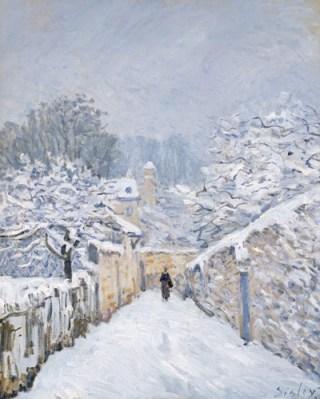
‘Snow at Louveciennes’ by Alfred Sisley, 1878

It had not occurred to me that an essay, let alone a collection of essays, on this particular topic was needed.  But then, perhaps it helps make the point about the importance of essays, and here we have one of the finest living essayists in the English language at work making the case:

Winter Adam Gopnik
Quercus, pp.288, £18.99, ISBN: 9781780874449
Adam Gopnik’s dazzlingly knowledgeable and beautifully told essays on winter began life as the Massey Lecture Series on Canadian National Radio, the Canadian Reith lectures. But dismiss from your mind any of the rather  Continue reading

Writing With A Sense Of Place

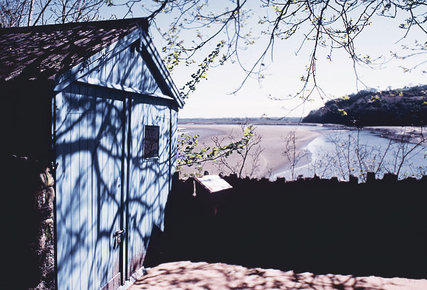
Jonathan Player for The New York Times. Dylan Thomas’s writing shed in Laugharne.

If writers should write, and they should, then where should they do it?  Perhaps a philosopher knows best (click the image above to read the full item):

…One does not have to be a Thoreau or a Rousseau for one of these modest spaces to supply what is needed to write. Identification with nature is not required (if indeed it were possible); a certain harmony with nature is already broken by putting pen to paper. Continue reading

Byron’s Daughter, Randomness And A Great Science Writer

The Royal Society’s recognition is enough to make even the author blush (in the video above, just barely visible in the fifth minute):

From the invention of scripts and alphabets to our current world of blogs and tweets, James Gleick tells the story of information technologies that changed the very nature of human consciousness. ‘The Information’ is the story of how we got here and where we are heading.

Professor Jocelyn Bell Burnell DBE FRS, Chair of the judges, said: “The Information is an ambitious and insightful book that takes us, with verve and fizz, on a journey from African drums to computers, throwing in generous helpings of evidence and examples along the way.  It is one of those very rare books that provide a completely new framework for understanding the world around us. It was a privilege to read.”

James Gleick said: “This is a very unexpected surprise. I am not a scientist, but I have my nose pressed against the glass. I visited the Royal Society 12 years ago to research a biography of Isaac Newton. It is a pleasure to be back again.”

An Old Fashioned Art And A Lesson In Craft

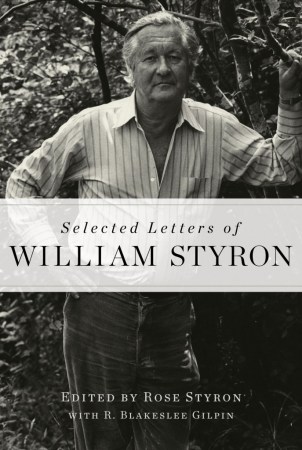
You do not need to be a fan of William Styron to appreciate the letters in this book; you only need to care about the art and craft of writing; so we thank the author’s friends at Paris Review for making these samples available (see below):

“A great book should leave you with many experiences, and slightly exhausted at the end,” explained William Styron in his 1954 Art of Fiction interview. “You live several lives while reading it. Its writer should, too.” Such is the experience in reading Styron’s Selected Letters, edited by Rose Styron and published this week. Alongside major cultural and political events of the latter half of the twentieth century are intimate accounts of family life, depression, writing, frustrations, and friendships.

Continue reading

Dispatch From Santiago

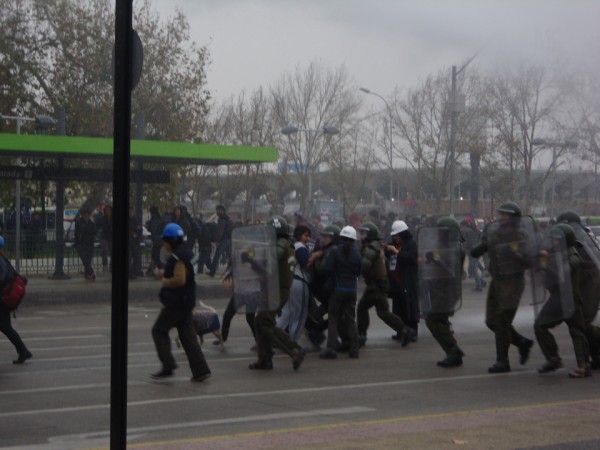
We do not know him (yet) but he has written an insightful article, worthy of some of our own favorite writers (where is Michael, you might reasonably ask):

Two particular days have helped me appreciate the variability and unexpected nature of reporting. One morning during my first week on the job at The Santiago Times (a English-language newspaper in Chile’s capital that covers Chilean and Latin American news), I picked up a pitch to go to a press conference the next day concerning homelessness in Chile. I was working on a different article when, an hour later, my editor poked his head into the writers’ room. Continue reading

Silent Spring At 50, Rachel Carson At 105

U.S. Fish and Wildlife Service Photo

The book is as important as ever. Its author, whom we pantheistically canonized once already in advance of this anniversary for the book, is worthy of some background reading. Click the image to the left to go to a post by the New Yorker‘s Archive Editor, which will link you to other pieces in the New Yorker by and about Rachel Carson:

“Silent Spring” has proved to be so important that Carson herself has been a bit overshadowed by it. When she finished “Silent Spring,” Carson was fifty-five. She’d had a lengthy, but nowadays easily overlooked, career as an award-winning, best-selling writer of natural histories—the sorts of books that are written, nowadays, by Richard Dawkins or Bill Bryson.

Writers Should Write

Thanks to one of Atlantic Monthly’s most talented writers, who mostly writes on topics unrelated to our site, we came across the above.  For many of us it is the first time hearing Hemingway’s spoken voice–we know only his written voice(s).  The last line says it all.

Field Guides?

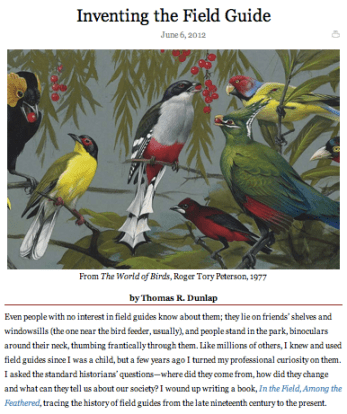
Click the image at left to go to the source.

We have a strong connection on this site to the world of birds, birding, birders and the guides who intersect on each of those.  Salim took the lead in helping us decide to put more attention on birds.  We were convinced it was a good idea with the following Vijaykumar established among serious birders visiting this site.

Our efforts picked up steam when Martin joined in the fun and Seth started reporting from Ecuador; after Ben saw his thousandth bird while in Kerala we were hooked.

Now that we are, we seem to notice more and more interesting resources related to the world of birding.  Interpretive guiding has been important to several of us for our entire adult careers and this article tells a great story about the books that help one subset of all that field guiding.

And In Other News…

One day shy of a  fourth opportunity to have a bit more fun with Michael’s mysterious invisibility, foiled.    He is back, so we do not need to make reference to other young men of letters who stopped writing and made us all wish otherwise.  And thankfully there was no resemblance to the story of Yuri Andropov after all, either.  Nor to the even less humorous, or more humorless, current event question that Amy Davidson asks in her most recent blog post.

Let’s change the subject.  Earthquake. No humor in that either.  But for a rare short-form piece by John McPhee, take a look here, to help put such events in perspective.  Amie, Milo and Adrien were all in the location McPhee describes, at the time when that piece first appeared.  The folks who manage that ever-improving site where it was first posted perform a great service of recycling archival material when news brings an old piece to new relevance.  Yesterday’s mention of Pete Seeger makes this worthy of recycling. It is, itself, a recycling of personal history along with a moving observation of the good guy’s aura:

His voice is a little shaky now (he talks the songs as much as sings them), his banjo picking is a little uncertain, and he required the help of his grandson, a powerful singer and guitarist with a perfect sixties name: Tao Rodríguez-Seeger. But he gave a lovely performance, and when he reappeared at the end, to sing “Down by the Riverside (Ain’t Gonna Study War No More)” with Ani and her band, there was nothing but love in that room.

Where’s Michael?

His last post was one week ago.  He departed Kerala just two days ago.  We miss him already.  Does anyone remember the “Where’s Yuri?” series in the early 1980s, at a time when the leader of the Soviet Union was not seen in public for an extended period–a radio host in New York started a daily taunt to the Soviets, asking this in jest…