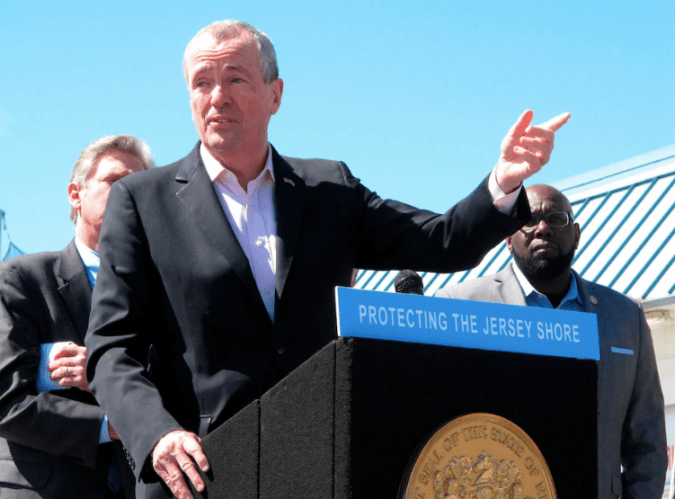
New Jersey Gov. Phil Murphy (D) speaks at a news conference on the boardwalk in Point Pleasant Beach, N.J., in 2018 before signing a bill banning offshore oil and gas drilling. (Wayne Parry/AP)
Alternative energy sources are the requirement for the future. We can only hope that positive leadership actions such as this aren’t vetoed by an administration that would like to keep progressive plans as a thing of the past.
New Jersey aims to lead nation in offshore wind. So it’s building the biggest turbine port in the country.
Gov. Phil Murphy (D) said his state will build the country’s first port dedicated to assembling the turbines that will go up not just in New Jersey but across the Eastern Seaboard.
For New Jersey, it is about more than just tackling climate change. Just as Texas is the de facto capital of the U.S. oil and gas industry, New Jersey wants to be an economic engine for offshore wind.
“We have a huge opportunity,” said Tim Sullivan, chief executive of the New Jersey Economic Development Authority. “Somebody’s going to get to be the Houston of American offshore wind.”
To make sure New Jersey plays that role, the state government is planning to turn 30 acres along the Eastern Shore of the Delaware River 20 miles south of Wilmington, Del., into a staging area for assembling the massive turbines. Taller than 800 feet, the turbines will tower higher than the Washington Monument.
State leaders are also hoping to coax factories to the rural area, too, and have set aside 25 acres for potential turbine part manufacturers. They aim to start construction next year and launch operations by 2024. Another 160 acres will be available for future development.
“We’ll be able to be the focal point for the industry in this part of the country,” Murphy said in an interview.
The port is part of the state’s broader plan to get all of its electricity from clean energy by the middle of the century. New Jersey, already one of the nation’s fastest-warming places, wants to generate 7,500 megawatts from offshore wind by 2035 — enough to power half of New Jersey’s homes.
 Our
Our 




 The image to the right is from twenty years ago, during my first foray into the world of coffee. It is not the most flattering photo, but it will do. I was eight, on location with my brother and parents at
  The second foray was in 2011, back in the same region of Nicaragua, but as an intern documenting the