Marin Headlands, California
Bird of the Day: Red-tailed Hawk
Marin Headlands, California
Marin Headlands, California

The Mauna Loa weather observatory in Hawaii. The Guardian will publish the Mauna Loa carbon count every day. Photograph: Courtesy of NOAA
Our thanks to the Guardian for this reminder of our shared responsibility:
Why the Guardian is putting global CO2 levels in the weather forecast
As CO2levels climb, the carbon count is a daily reminder we must tackle climate change now
The simplest measure of how the mass burning of fossil fuels is disrupting the stable climate in which human civilisation developed is the number of carbon dioxide molecules in the atmosphere.
Today, the CO2 level is the highest it has been for several million years. Back then, temperatures were 3-4C hotter, sea level was 15-20 metres higher and trees grew at the south pole. Worse, billions of tonnes of carbon pollution continues to pour into the air every year and at a rate 10 times faster than for 66m years.
At the dawn of the industrial revolution, CO2 was at 280 parts per million (ppm) in the atmosphere. By 1958, when the first measurements were made at Mauna Loa in Hawaii, it had reached 315ppm. It raced past 350ppm in 1986 and 400ppm in 2013.
The Guardian will now publish the Mauna Loa carbon count, the global benchmark, on the weather page of the paper every day.
“When I read the letter from Guardian reader Daniel Scharf encouraging us to include information on climate change in our weather forecasts, we thought it was a fantastic idea,” said the Guardian’s editor-in-chief, Katharine Viner. Continue reading
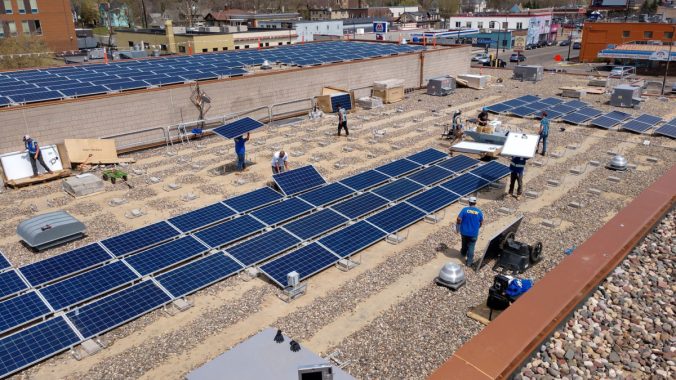
EnterA 204-kilowatt community solar array being installed on the roof of the Shiloh Temple International Ministries in Minneapolis. COURTESY OF COOPERATIVE ENERGY FUTURESa caption
Thanks to Maria Gallucci and Yale e360 for this:
Energy Equity: Bringing Solar Power to Low-Income Communities
Millions of Americans lack access to solar energy because they cannot afford the steep upfront costs. Now, more than a dozen states are adopting “community solar” programs that are bringing solar power and lower energy bills to low-income households from New York to California.
Workers receive job training while building a shared solar farm in Platteville, Colorado. COURTESY OF GRID ALTERNATIVES
Isbel “Izzy” Palans lives in a small cabin nestled among mountain peaks and towering trees in the Colorado Rockies. Her home is often shaded and, during the long winters, buried under heaps of snow. Her monthly utility bills show credits for solar electricity production, but no solar panels are affixed to her roof. Instead, the power comes from a solar array some 60 miles away in a nearby valley.
Last year, the panels nearly slashed her energy bill in half. “I’ve been thrilled,” said Palans, a 76-year-old retired waitress who relies partly on Social Security benefits to make ends meet.
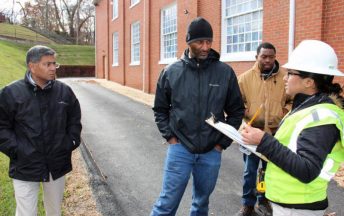
Solar contractor Brad Boston (center) and utility representatives meet with engineer Pranay Kohli to discuss a community solar project at DuPont Park Seventh Day Adventist Church in Washington, D.C. COURTESY OF GROUNDSWELL
Palans is a subscriber to a 145-kilowatt solar array project run by Holy Cross Energy, a rural utility cooperative. Built with state funding, the program provides solar credits to more than 40 low-income households in western Colorado that otherwise wouldn’t have the financial or technical means to access renewable energy. The venture is just one of a growing number of so-called “community solar” projects across the United States focused on delivering renewable energy — and the cost-savings it can provide — to low-income households, from California to Minnesota to Massachusetts. Continue reading
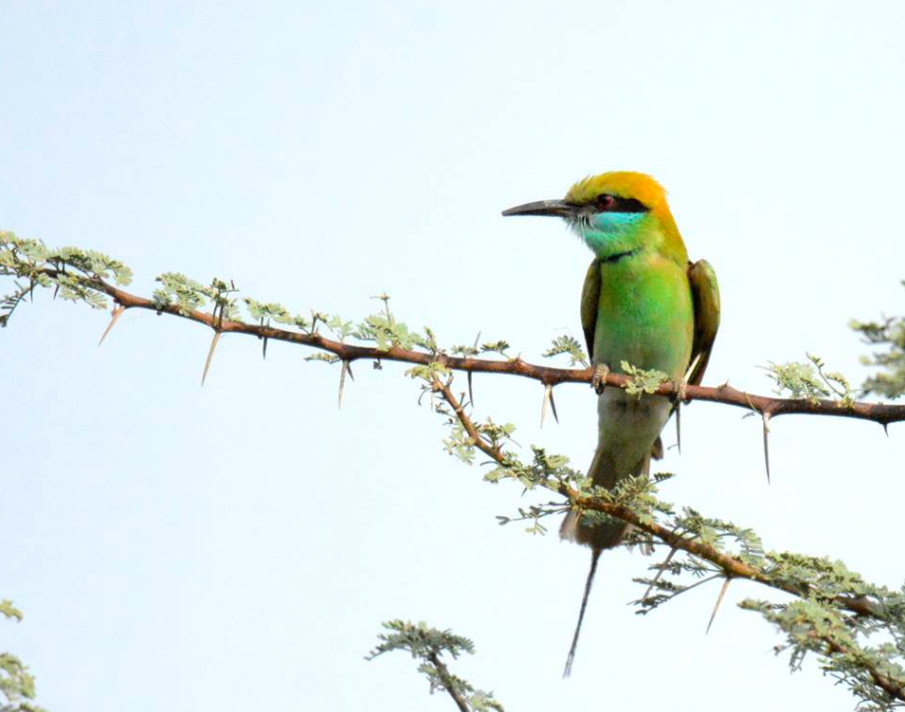
Najafgarh Dwarka Road, Delhi
 Authentica, mentioned a couple of times prior to the current series of posts, has the character of a startup but its goal is the opposite of disruption.
A major disruption already happened, and if one of the antonyms of disrupt is organize, then that is what we are doing. Authentica is part of a nascent movement in Costa Rica to provide market opportunities to artisans, farmers, food producers and others who design, craft, grow and cook things that are essentially Costa Rican. The disruption they faced is not the story we want to tell. The reversal of that disruption is the story. One example is Organikos. Continue reading

Photo Credit: Stephen Crafts
Santiago Island, Galapagos, Ecuador
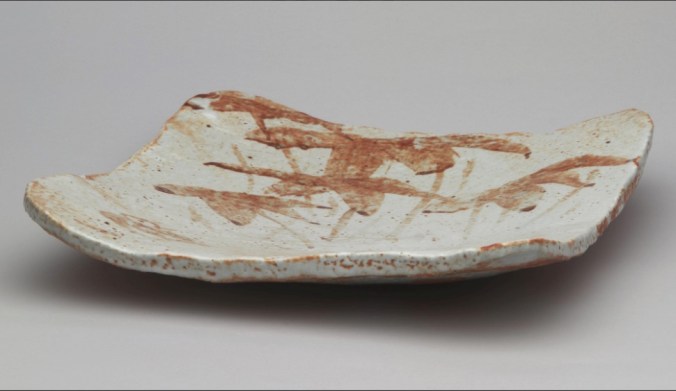
Kitaoji Rosanjin. Square platter with rounded edges. 1954
In preparing to exhibit things we believe represent Costa Rica well enough that we would want travelers to take some such things home with them, MOMA’s The Value of Good Design provides a valuable pause. The image above, from the MOMA show, is an example of good design of a tactile thing. As the video below shows that is what good design means in MOMA’s estimation, namely things that you want to look at as much as you want to touch or use.
Costa Rica, and its visitors, would benefit from an exhibition of things that are useful, inspiring, and/or in good taste. Our contribution to this effort has focused on coffee, so we are inclined to think about taste in the gustatory sense, as in what flavors and aromas please. This type of pleasure is more ephemeral than something you can look at and touch over and over.
 Another sense of good taste, which also has value: we do not consider it in good taste to sell things in Costa Rica that are foreign-made replicas of Costa Rican traditional arts and crafts. And that has been very much on our mind. It is a challenge we have signed on to. The MoMA exhibition inspired Nikil Saval to share a few thoughts about How “Good Design” Failed Us and they strike me as relevant to our own current challenge to be tasteful:
In 1958, the American radical sociologist C. Wright Mills was invited to address the International Design Conference, in Aspen. The lecture he gave, “Man in the Middle: The Designer,” criticized a number of its audience members for being willing dupes in the grand illusion that was consumer society. Continue reading

Uttarakhand
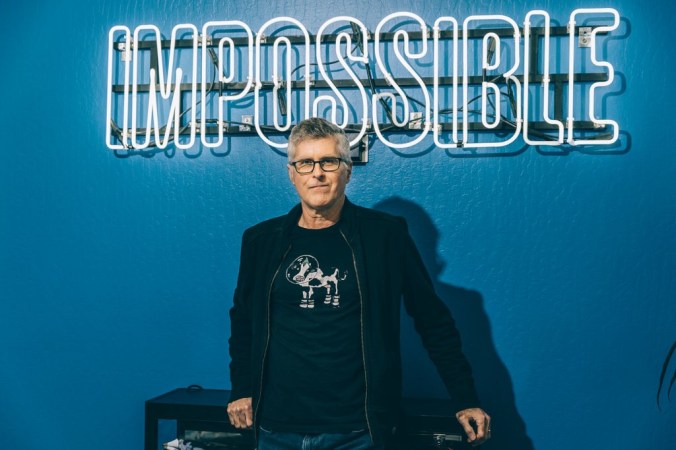
“Our whole focus is on making products that deliver everything that meat lovers care about,” said Pat Brown, the chief executive. Matt Edge for The New York Times
We were waiting patiently for this day to come. Impossible has had our attention for a couple years now, but who knew when it would go really big? The time is now:
Behold the Beefless ‘Impossible Whopper’
Burger King is introducing a Whopper made with a vegetarian patty from the start-up Impossible Foods. The deal is a big step toward the mainstream for start-ups trying to mimic and replace meat.
OAKLAND, Calif. — Would you like that Whopper with or without beef?
An Impossible Foods burger on the grill at the company’s headquarters in Redwood City, Calif.CreditJason Henry for The New York Times
This week, Burger King is introducing a version of its iconic Whopper sandwich filled with a vegetarian patty from the start-up Impossible Foods.
The Impossible Whopper, as it will be known, is the biggest validation — and expansion opportunity — for a young industry that is looking to mimic and replace meat with plant-based alternatives.
Impossible Foods and its competitors in Silicon Valley have already had some mainstream success. The vegetarian burger made by Beyond Meat has been available at over a thousand Carl’s Jr. restaurants since January and the company is now moving toward an initial public offering.
White Castle has sold a slider version of the Impossible burger in its 380 or so stores since late last year. Continue reading
Telegraph Hill, California
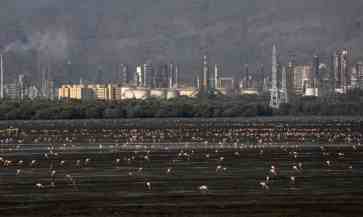
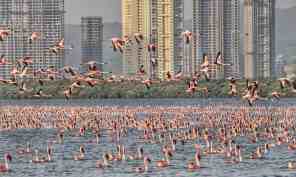
Flamingos eat plankton in front of an industrial area at Sewri mudflats, Mumbai. Photograph: Divyakant Solanki/EPA-EFE
Payal Mohta reported from Mumbai for this story in the Guardian that caught our attention with images of urban flamingos. An unusual beauty can be the result of a common problem. As it is important to understand nature in wilderness areas, which is our strong preference, it is also important to understand these man-made phenomena:
People watch flamingos from a boat during the Bombay Natural History Society’s flamingo festival. Photograph: Hindustan Times/Hindustan Times via Getty Images
There is an air of anxious excitement among the urban professionals and tourists on board our 24-seater motorboat as we enter Thane Creek.
A chorus of “oohs” and “aahs” breaks out as we spot the visions in pink we came to see – hundreds of flamingos listlessly bobbing in the murky green water – followed by the furious clicking of cameras.
Flamingos at Sewri. Photograph: Hindustan Times/Hindustan Times via Getty Images
Then, almost as one, the birds skim the water and take off in sync. “They always stay together,” says Prathamesh Desai, who has been organising birding excursions in the city for seven years. “They are an extremely gregarious species.”…
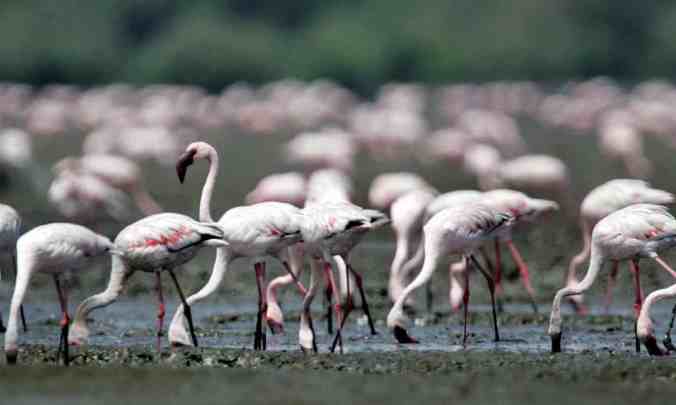
Flamingos at Sewri. Photograph: Hindustan Times/Hindustan Times via Getty Images
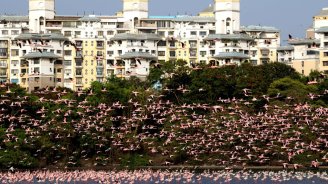
Flamingos flock to Mumbai between September and April, but this year there are almost three times more birds than the amount that usually flocks to the area.
Bachchan Kumar/Hindustan Times via Getty Images
That story continues after the jump below. First, thanks to National Public Radio (USA)’s Audrey Nguyen and Sarah Oliver for producing and bringing this story to our attention with this opening line (which goes on to credit the Guardian story as its source):
Around this time every year, tens of thousands of flamingos flock to Mumbai to feed. But this year, there are almost three times more than the normal amount in the city — about 120,000.
The reason for the influx is currently a mystery. But some scientists believe that pollution in the birds’ natural habitat might be one factor at play… Continue reading

Gangavthi, Karnataka
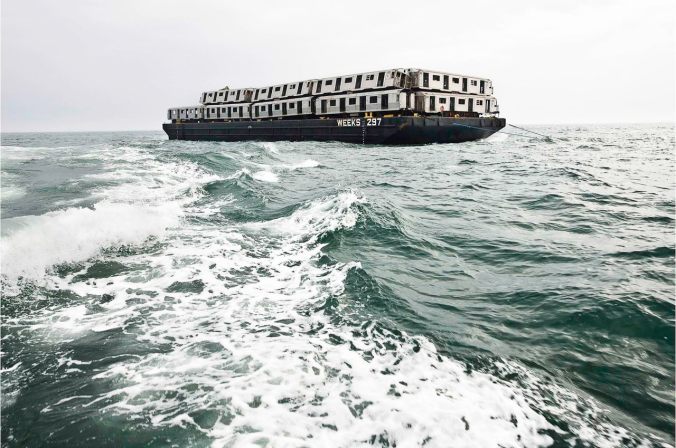
Subway cars set sail on a barge in “Weeks 297, 2008.” STEPHEN MALLON
Thanks to Winnie Lee and Atlas Obscura:
Photographing the New York City Subway Cars That Retired as Artificial Reefs
How Stephen Mallon captured this unusual voyage to the bottom of the ocean.
The rooftops of subway cars. “Abbey Road, 2008.” STEPHEN MALLON
The photographer Stephen Mallon specializes in documenting man’s industrial-scale creations. During his career, he’s focused his lens on the recycling industry, the largest floating structure ever built, and the transportation and installation of a new bridge in New York City. So it wasn’t surprising when, in 2008, he was drawn to an unusual program spearheaded by the MTA New York City Transit system: a multi-phased artificial reefing project that saw the shells of 2,580 decommissioned subway train cars repurposed and dropped into coastal waters off New Jersey, Delaware, Maryland, Virginia, South Carolina, and Georgia, between 2001 and 2010.
The abstract beauty of stripped-down vehicles in “Transfer, 2009.” STEPHEN MALLON
Mallon arranged to follow the outdated subway cars as they were prepared and cleaned, loaded onto barges, and finally plopped into the sea. As he traveled with a crew in a tugboat to get his shots, the photographer developed his sea legs.
Subway cars hoisted in the air in “Mind The Gap, 2008.” STEPHEN MALLON
“I was never underwater, so just needed to keep myself steady on the back of the boat. It’s kind of like surfing or skiing—just keep your balance, keep the horizon line straight, bend your knees, and don’t fall overboard,” Mallon says. Continue reading
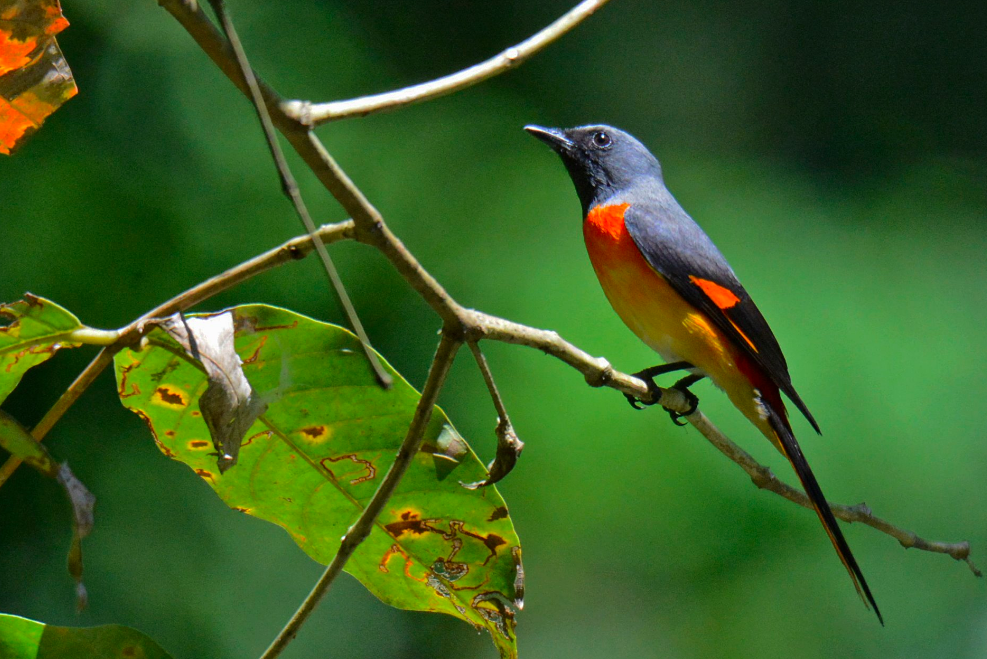
Andaman Islands

Lotus flower seed heads and raw, un-puffed lotus seeds.
Lotus flower first appeared in these pages years ago, but its seeds were never mentioned. Time to correct that. We missed the opportunity to mention this book when it was first published–we missed the enthusiastic review–but better late than never. Thanks to the folks at Gastropod for the shoutout in a recent episode that gives Thor Hanson and his book their due:

When seeds first evolved, hundreds of millions of years ago, they not only revolutionized the plant world, but they also eventually sowed the path for human civilization. Today, it’s nearly impossible to eat a meal without consuming a plant embryo—or many. But how did seeds come to play such a critical role in human history? Why might one seed in particular, the lotus seed, hold the secret to immortality? And, perhaps just as importantly, how does this magical seed taste?
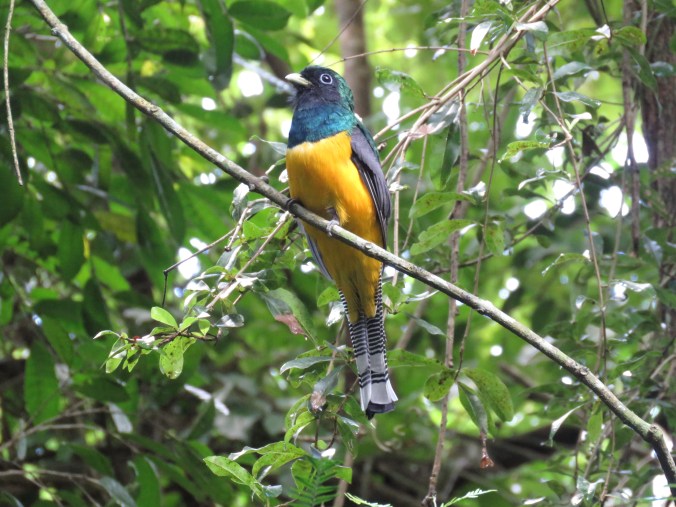
Iguazú, Argentina
Last week, we visited producers of various arts and crafts on the eastern side of Costa Rica. Our first stop was in the Central Valley, just before crossing over to the Caribbean slope, in a coffee shop. There, a man showed us his ceramic work, which we had seen one example of previously. All of it was beautiful, but the one below was the one we chose to purchase as a sample. And here it is, in the morning sun.

It brought to mind the old documentary above, which anyone in the USA public school system might have seen in their 7th grade art class. In less than half an hour, that film clinically explains and demonstrates visually what goes into making something the traditional way. This man, here and now in Costa Rica, is hand-crafting these coffee makers. The material is organic, as is the design, which pays tribute to Costa Rican tradition, as well as to pre-Colombian indigenous tradition. The coffee seems to taste the better for it.
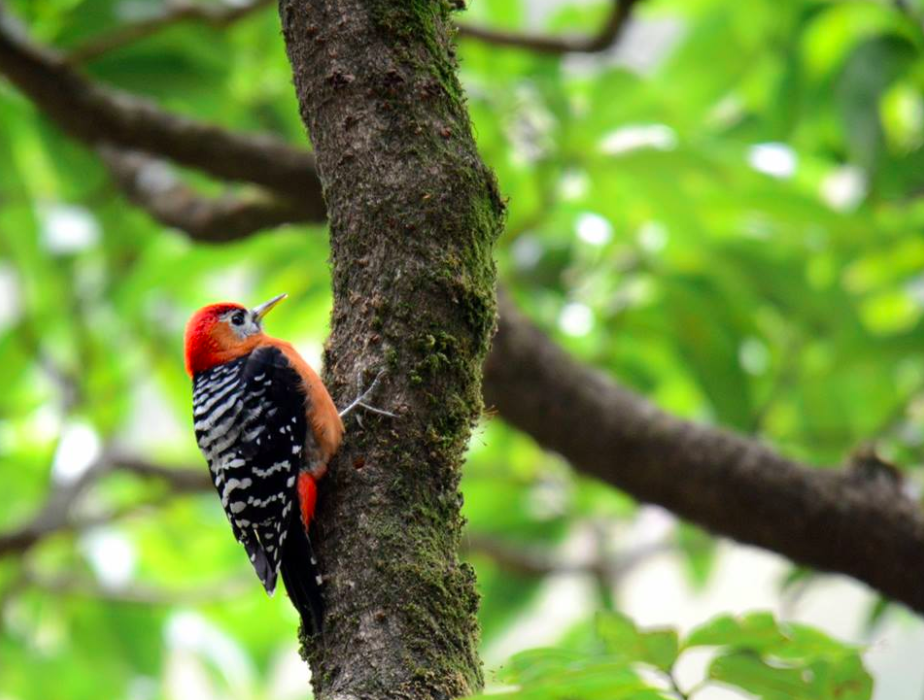
male – Uttarakhand
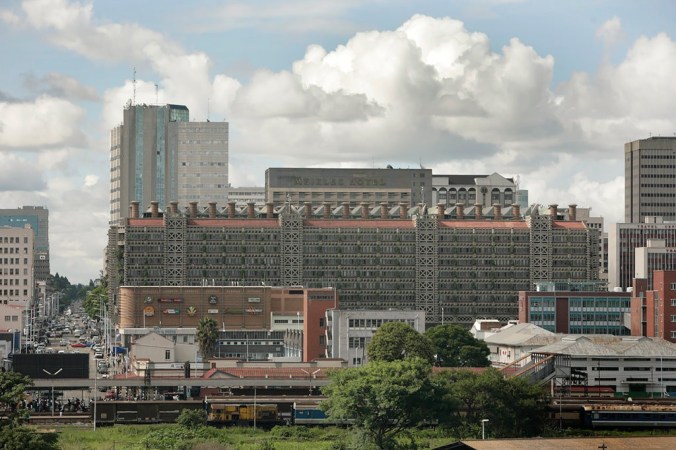
The air conditioning system of the Eastgate Centre in Harare, Zimbabwe, was inspired by termites’ nests. Credit David Brazier, via Wikimedia Commons
It’s been quite some time since we posted about biomimicry. Thanks as always to JoAnna Klein for this illuminating story:
What Termites Can Teach Us About Cooling Our Buildings
“We think humans are the best designers, but this is not really true,” a researcher said.
In the capital of Zimbabwe, a building called Eastgate Centre holds nearly 350,000 square-feet of office space and shops. It uses 90 percent less energy than a similar sized building next door.
What’s Eastgate Centre’s secret? Termites.
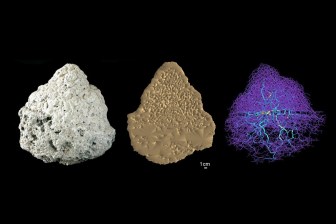
Three views of a termites’ nest, including from left, a photo of the nest, a tomography of the the nest’s interior and the networks of galleries and paths in it. Credit G. Theraulaz, CRCA, CBI, CNRS, Toulouse
In the 1990s, Mick Pearce, the building’s architect, took his inspiration from mounds built by fungus-farming termites he saw on a nature show. The insects created their own air conditioning systems that circulated hot and cool air between the mound and the outside.
As architects and builders seek new and improved ways to cool buildings without using more energy in a warming world, a study of another type of termite mound suggests that Mr. Pearce won’t be the last human to take design tips from these cockroach cousins. Continue reading








 Organikos