Los Altos, California
Bird of the Day: Lesser Goldfinch
Los Altos, California
Los Altos, California
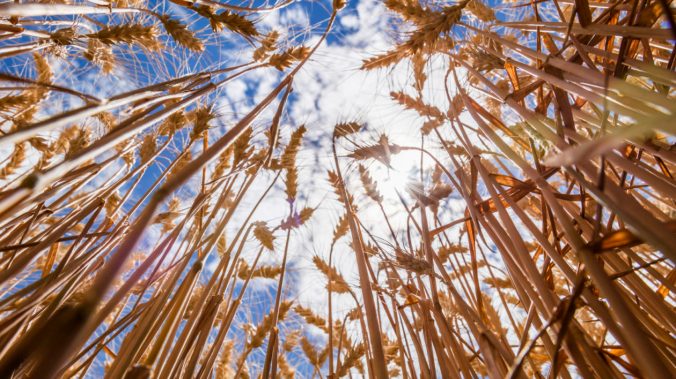
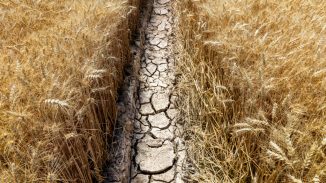
A view of wheat grown on Meaker Farm, Montrose, Colorado. Photo © Ken Geiger/TNC
While on the topic of food, thanks to Dustin Solberg and Cool Green Science for this:
Dirt to Soil: A Farmer’s Tell-all Puts Soil First
Circle irrigation tire tracks remain in the challenging soil conditions on a wheat farm in Colorado. Photo © Ken Geiger/TNC
Quite a few years back, while working the wheat harvest in the middle of Oklahoma, I met a leathery skinned farmer. He lived through the dusty, hardscrabble, droughty years of the Great Depression, and experience had taught him plenty. I still recall his silver belt buckle, his straw cowboy hat, and the funny joke he told me about the buffalo on a buffalo nickel, which I can’t repeat here. He wanted me to know, and so told me in no uncertain terms, that there’s one way, and one way only, to plow a field.
We were standing then in the fresh golden stubble of a wheat field. It was hot. We’d just finished combining and after a day of steady motion we were finally still, the diesel engines at rest. I can still recall the animated force in his muscly hands – he made his fingers into the tines of a chisel plow – to make his point as vividly as I recall what he said: “You’ve got to set the plow deep.”
The trouble was, he was wrong.
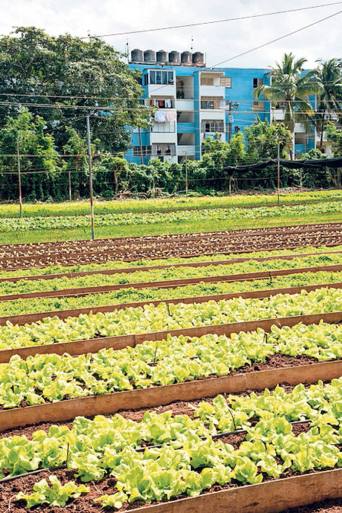
Green: an organic farm in Cuba © Getty
Thanks to FT’s Sarah Murray for this story–Organic farming’s growth only part of answer to food sustainability:
The approach has an impact far beyond its scale but questions remain over yields
While only a tiny proportion of the world’s agricultural land is devoted to organic farming, some argue that it punches above its weight in contributing to more sustainable farming practices. “Its influence goes far beyond the 1 per cent of land that is managed organically,” says Verena Seufert, assistant professor at the Institute for Environmental Studies at VU University Amsterdam. “It is influencing the debate by highlighting food sustainability and how big an impact the food we eat has on many of our environmental problems,” she says. Yet while some believe that organic agriculture could play a bigger role in helping feed the world, environmental advocates see it as one option in a number of more sustainable approaches to farming. Continue reading

Thattekad Bird Sanctuary, Kerala
Thanks to Lewis Page and the folks at Sierra for this selection of bird-viewing options:
6 Exciting Birdwatching Webcams
Vicariously join in on the springtime migration from your couch
Birding is a sport for the intrepid—its participants rise at ungodly hours, bundle in layers, and sit silently for hours, all in hopes of seeing a winged animal that may never arrive. But for those who aren’t quite ready to trek outdoors into wintry-remnant weather, or who might be stuck in front of a computer when they wish they weren’t, there’s another, tamer option. Indeed, the miracles of modern webcam and streaming technology have afforded even the lowliest of couch potatoes ample portals into a variety of avian worlds. And the advent of spring means that flocks of migratory birds are en route north from their winter haunts—which means it’s about to be primetime for bird cams. Here are a few to watch in the coming months.
The Mississippi River’s Migratory Birds
On a small island in the middle of the Mississippi River’s Lake Onalaska, near the Wisconsin-Minnesota border, stands a slowly rotating camera on a pole. Continue reading
Andaman Islands
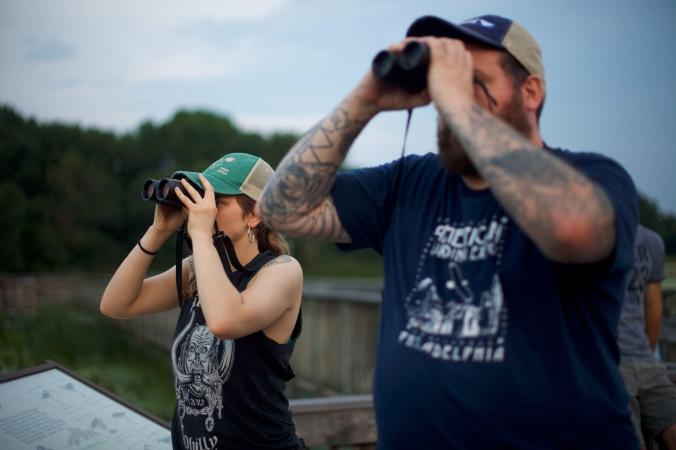
Caleb Hunt (left) and Tony Croasdale at the John Heinz National Wildlife Refuge at Tinicum in Philadelphia. In a city known for its punk underground and avian history, the friends have found an overlap that celebrates both niches. Photo: Mark Makela
I do not have a tattoo. If I did, it may be that a bird would adorn my arm. Our efforts to promote the joys of birdwatching combined with the conservation benefits that come from increased concern for bird habitat all suggest that I would be susceptible. I came of age during the emergence of punk rock, so the possibilities are there:
Welcome to Birdpunk: A Subculture of a Subculture
Punk has always been about embracing different forms of expression. Meet the people who are putting birding on that spectrum.
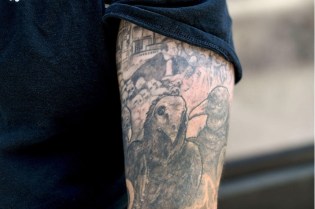
A trio of vultures serve as badges of Croasdale’s birding obsession. Photos: Mark Makela
It’s the evening golden hour at the John Heinz National Wildlife Refuge at Tinicum. A whirlwind of swallows swims through the soft light, chasing midges into a frenzy. Nearby on a platform a handful of birders scans the dimming sky, exposed to the marsh and its blood-thirsty elements.
A trio of vultures. Photo: Mark Makela
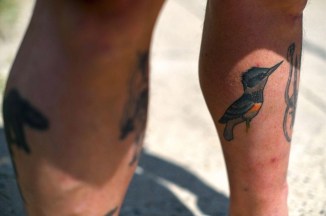
In plain T-shirts and khakis, the group blends into the woods-y backdrop—with two exceptions. Caleb Hunt, a bookkeeper for an adult-entertainment boutique, rocks a Philly Punx tank top with a fanged, horned Benjamin Franklin splashed across the front. Next to her, Tony Croasdale, the leader of today’s walk, sports an aviary of skin art. A Swallow-tailed Kite, Belted Kingfisher, Scissor-tailed Flycatcher, Greater Racket-tailed Drongo, Scarlet Tanager, and three types of vultures bedeck his legs, collarbone, and arms.
Croasdale’s tattoos pay homage to two of his biggest life passions: birding and punk rocking. He plunged into the first as a kid when his father took him to Philadelphia’s Pennypack Park to learn about kingfishers. Continue reading
female – Ventanilla, Peru

My father loved books ravenously, and his always had a devoured look to them. Illustration by Rose Wong
Kathryn Schulz came to my attention four years ago, and we immediately deemed her worthy of an invitation to Kerala. We linked to two more of her articles after that, but re-reading the first essay, it is easy to recall what “ignorance is bliss” means. The world was, as always, facing challenges. But I had no clue then what 2019 would look and feel like, so I enjoyed that essay differently then than I do now.
I am in need of more frequent diversions from the daily news, not to hide but to remember what matters. Times like these call for tangible reminders of what is good and healthy for us, much as comfort foods at certain other times are required to anchor us to better thinking. Food seems the most common thing to turn to for comfort, but books are a better one because ideas that come from books are not just to be remembered, but to renew inspiration, commitment, and determination related to values:
My Father’s Stack of Books
When he was a child, books were gifts. For his daughters, he made sure they were a given.
When I was a child, the grownup books in my house were arranged according to two principles. One of these, which governed the downstairs books, was instituted by my mother, and involved achieving a remarkable harmony—one that anyone who has ever tried to organize a home library would envy—among thematic, alphabetic, and aesthetic demands. The other, which governed the upstairs books, was instituted by my father, and was based on the conviction that it is very nice to have everything you’ve recently read near at hand, in case you get the urge to consult any of it again; and also that it is a pain in the neck to put those books away, especially when the shelves on which they belong are so exquisitely organized that returning one to its appropriate slot requires not only a card catalogue but a crowbar. Continue reading
Photo Credit: Stephen Crafts
Isabela Island, Galapagos, Ecuador
 We have already linked to stories about life after warming enough that it borders on repetitive. No choice, as the book to the right makes very clear. This recent short video by the author will make you wince. There is something about visual cues on this topic that make it tougher to listen without being distracted. One of the better conversations with him is this one hour+, so if you only have that much time for him, make the best of it:
After years of hovering on the periphery of American politics, never quite the star of the show, it seems that climate change is having a moment. Continue reading


The Ogelthorpe University Museum of Art is one of the gems of the Atlanta area, for good reason. Not only does the museum have its own well curated collections, it receives visiting collections that are timely and powerful.
Tara Rice‘s Grandmother Project photographic series highlights the historically matriarchal influence within African cultures, coinciding with the project based in Senegal “promoting health, well-being and rights of women and children in developing countries through grandmother-inclusive and intergenerational programs that build on communities’ cultural values and resources.”
The photo series dovetails perfectly with the female centric collection of sculptures and masks in the sister exhibit, Stories Without an End.
Stories Without an End: Power, Beauty and Wisdom of Women in African Art of the Mehta Collection
January 18 – April 21, 2018
The exhibition Stories Without an End: Power, Beauty and Wisdom of Women in African Art of the Mehta Collection includes a selection of 50 classically carved wooden sculptures and masks drawn from the collection of Dileep and Martha Mehta.
The exhibition represents art from more than 25 ethnic groups spanning 12 countries. These objects are gathered into thematic groups including women in governance, maternity, idealized beauty, and female ancestors.
OUMA members Dileep and Martha Mehta are collectors of African and Asian arts. Their African art collection, including objects in this exhibit, has greatly benefited from diligent sourcing by and wise counsel of African Art dealers Tamba Kaba and Sanoussi Kalle.
This exhibition was developed by Elizabeth H. Peterson, OUMA director, and organized by Amanda Hellman, PhD, curator of African art, Michael C. Carlos Museum, Emory University.
Stories Without an End was inspired in part by the work of the Grandmother Project (GMP) an American 501(c)(3) nonprofit organization and a Senegalese NGO with representatives throughout the USA and abroad. GMP, with headquarters in Senegal, works with elders in West African villages to fight the maltreatment of young girls. This includes bettering maternal and child nutrition, reproductive health, and marriage standards. The exhibition title is inspired by the GMP initiative “stories without an ending,” which is a tool used to facilitate communication via the elders. For more about the Grandmother Project please visit www.grandmotherproject.org.
The Grandmother Project: Photographs by Tara Rice
January 18 – April 21, 2019
The Grandmother Project (GMP) develops community approaches that promote positive and sustained improvements in the lives of girls, children, women, and families by building on existing cultural and community values, roles and assets in southern Senegal. Continue reading
Kanha National Park, Madhya Pradesh
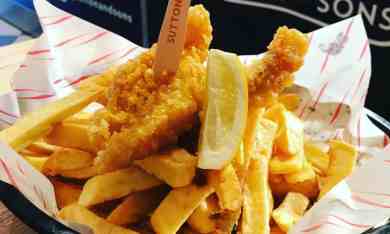
Vegan fish and chips from Sutton and Sons. Photograph: Sutton and Sons
The last time I posted on banana blossoms it was because a bunch of bananas outside our kitchen window coincided with an article about vegan fish and chips. Today, a bit more of the same coincidental mixing of kitchen and reading. I just tasted a sample of the fifth batch of banana ceviche made by the kitchen assistant for Organikos, who spent seven years assisting in the kitchen of a Peruvian family. Each time she has made banana ceviche I have wondered whether it was a lucky batch. It is that good. And today’s was as good as each previous batch. Now as I turn to my review of options for what to post about on this platform, I have encountered a story with the photo above, and the photo below, with a headline guaranteed to pull me in:
Banana blossom: the next vegan food star with the texture of fish
Sainsbury’s is to include the flower, which hails from south-east Asia, in its ready meals
Thanks to Anna Berrill and the Guardian for that, and for the several ideas that will guide me at the farmer’s market this morning:
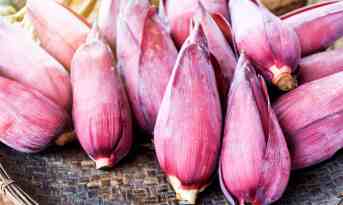
Banana blossom can also be eaten raw and has a chunky, flaky texture. Photograph: Suwatwongkham/Getty Images/iStockphoto
Following on from beetroot burgers and jackfruit curries, the next star of the vegan “meat” world hails from the gardens of south-east Asia and looks somewhat like an artichoke.
Banana blossom, also known as a “banana heart”, is a fleshy, purple-skinned flower, shaped like a tear, which grows at the end of a banana fruit cluster. Traditionally used in south-east Asian and Indian cooking, it can also be eaten raw and its chunky, flaky texture makes it an ideal substitute for fish.
Sainsbury’s, which will be rolling out a series of plant-based meals later this year, is to include banana blossom in its ready meals in the hope the flower will catch on among a burgeoning population of shoppers looking for meat-free alternatives. Continue reading
Dunwoody, GA

LUISA RIVERA / YALE E360
We have been on watch for citizen science stories since the early days of this platform. Seth had just accepted an offer to work at the Cornell Lab of Ornithology, and typical of him, did his homework on what he had committed to. Since then, dozens of first person and linked-to citizen science stories from other members of our community have appeared in these pages. Thanks to Yale e360 and Jessica Leber for this story about how far and wide the practice has spread, and a few of its more amazing discoveries:
Species Sleuths: Amateur Naturalists Spark a New Wave of Discovery
Scientists have not kept pace with the work of discovering new species. Now, a growing number of committed hobbyists – ranging from a Belgian bus driver to a California cybersecurity expert – are out in the field, igniting a boom in documenting the world’s biodiversity.
COURTESY OF TERRI CLEMENTS
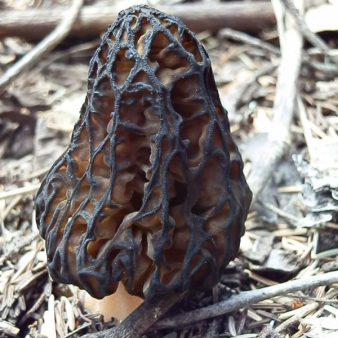
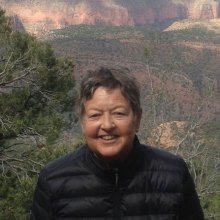
When mushroom hunter Terri Clements found a unique specimen near her home in Arizona, she couldn’t be certain by its appearance that she’d stumbled across a new species. She tracked down a commercial lab that would process DNA from samples she collected and studied the resulting sequences. Only later did she cold email a mycological scientist, who confirmed her work. As a result, this December, she became part of a team publishing a scientific paper describing her new mushroom species, Morchella kaibabensis, along with three others.
Mushroom hunter Terri Clements used DNA sequencing to confirm a new species of black morel, Morchella kaibabensis, she found near her home in Arizona.
A former restauranteur and real estate executive who retired in 2012, Clements has no formal scientific training beyond her college microbiology minor. But using a combination of traditional taxonomy — the science of describing, naming, and classifying life on earth — and increasingly accessible DNA classification tools, she’s now hooked on documenting fungi either previously unknown in her region, or, just as often, new to science. “I spend hours and hours on it,” she says. “It’s like a full-time job for which I don’t get paid.”
Her work puts her in the ranks of an increasingly vibrant group of hobbyists busy documenting unexplored species on the planet, ranging from a chemical engineer in France, to a cybersecurity specialist in California, to retirees like Clements. Many study organisms from specific groups of fungi, insects, and other invertebrates that are less charismatic and surveyed than the orchids, birds, and butterflies that have long attracted the public’s interest. Continue reading
 The first reference was in 2017, with a brief reverie on tastes associated with places. Organikos next appeared in early 2019, most recently here. And today just a quick further note to clarify that while chocolate and other taste of place items are in testing to be offered by Organikos, specialty coffee from various regions in Costa Rica is the first product. The simple reason is that coffee is in so many ways the most important product of this country, and set the stage for the country’s many remarkable achievements, including those yet to come. Organikos will focus on specialty coffee because it has a following as strong now as any time in history.
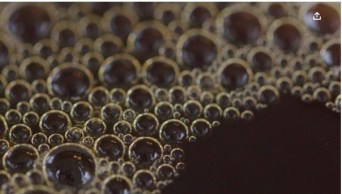
In the new wave of coffee fanaticism, attention to tasting notes and pairings rivals that of the world of wine.
In this short video posted this morning Rachel Lipstein helps define the current intense wave of interest:
Coffee, ambrosia of the capitalist and the creative alike, is many things: a fixture of social ritual, the product of a vast agricultural production steeped in colonialist history, and the most widely used psychoactive drug in the world. Entire economies rest upon its cultivation and its caffeine content…
That is an intense opening statement, and sets the stage for the video’s goal of helping a lay person understand the obsession a bit better:
…Its modern permutations go far beyond cream and sugar: fair-trade designations, additions of alternative milks such as soy or pea-protein, a preparation with butter and oil (for optimized biohacking), or simply with a piece of shortbread dunked in. It has inspired legal and moral crusades and “love is brewing” theme weddings. The latest installment in The New Yorker’s Annals of Obsession video series features a group of specialty-coffee experts and explores the fringes of the fascination…
Coffee is the taste of many places other than Costa Rica, but this is home, so here we go. We have already roasted, packaged and labeled coffee in trial markets, and have made some important adjustments as we prepare to launch formally in a few months. In earlier posts you could see the font we thought was best with which to write the name Organikos. We have decided otherwise for the time being, in part because with the newer design, as the logotype for Organikos evolves, we hope to have a smaller footprint with a message that fits on one side (versus front and back of package labeling).
 Organikos