Great Rivers Are Worthy Of Great Restoration Projects

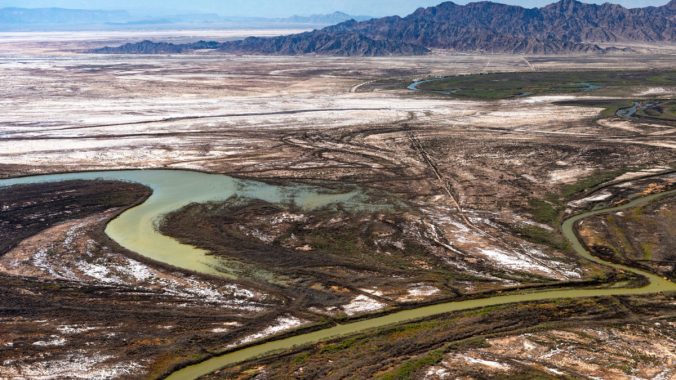
CORiverMX-100819-0623_DeltaAerial_web.jpg

The Colorado River delta in Baja California is now a mosaic of largely dried-up river channels and tidal salt flats. TED WOOD
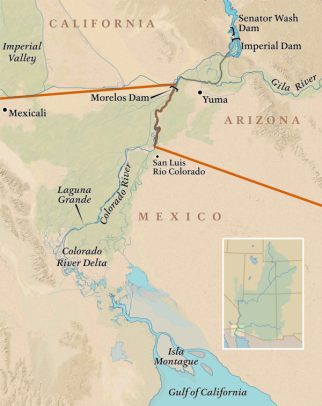
DetailMap_C_26_Delta_web.jpg

Downstream from the Morelos Dam, the Colorado River delta now runs dry before reaching the Gulf of California. MAP BY DAVID LINDROTH

When the first couple of stories about the Colorado River ran in Yale e360, it was difficult to imagine how much more there might be to say about it. But now the last article in the series, Restoring the Colorado: Bringing New Life to a Stressed River, provides an example of saving the best for last:

The Colorado River has been dammed, diverted, and slowed by reservoirs, strangling the life out of a once-thriving ecosystem. But in the U.S. and Mexico, efforts are underway to revive sections of the river and restore vital riparian habitat for native plants, fish, and wildlife. Last in a series.

CORiverMX-100819-0513_Morelos-Dam_web.jpg

The Morelos Dam on the U.S.-Mexico border, where the Colorado’s remaining water is diverted to cities and farms in Mexico. SUPPORT FOR AERIAL PHOTOGRAPHS PROVIDED BY LIGHTHAWK

From the air, the last gasp of the Colorado River is sudden and dramatic. The pale green river flows smack into the Morelos Dam on the U.S.-Mexico border, and virtually all of it is immediately diverted into a large irrigation canal that waters a mosaic of hundreds of fields — alfalfa, asparagus, lettuce, and other vegetables, their vivid green color clashing against the sere desert. The slender thread of water that remains in the Colorado’s channel continues to flow south, but is soon swallowed up by a sea of sand, far short of its delta, which lies 100 miles farther on.

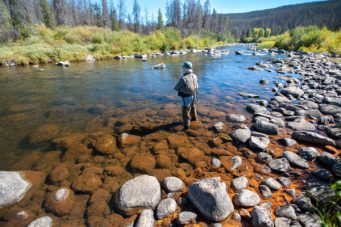
TU-CO-20100912-0190_COFishing_web.jpg

A fisherman on the upper Colorado River in northern Colorado. Low water flows have endangered fish populations and led last year to the closing of parts of the river to fishing.

The Colorado River once surged through the delta during high flows, carrying so much water at times that shallow draft steamboats chugged hundreds of miles up the river into the U.S. with loads of freight. The water in the delta nourished a vast fertile landscape, a fitting end to a river known as the Nile of North America.

“The river was everywhere and nowhere,” the naturalist Aldo Leopold wrote during a 1922 canoe trip to the delta, describing the waterway as it ebbed, flowed, braided, and stalled into pools, nourishing a rich and diverse ecosystem of “a hundred green lagoons,” a “milk and honey wilderness” with thick stands of cottonwoods and willows that provided habitat for hundreds of species of birds. The delta’s marshes, mudflats, and white sand beaches were home to clapper rails, bitterns, mallards, teal, and clouds of egrets.

Bobcats, puma, deer, and wild boar wandered the delta’s forests. Leopold was searching for the jaguar that roamed there, but didn’t see any. Continue reading

Seven Generations

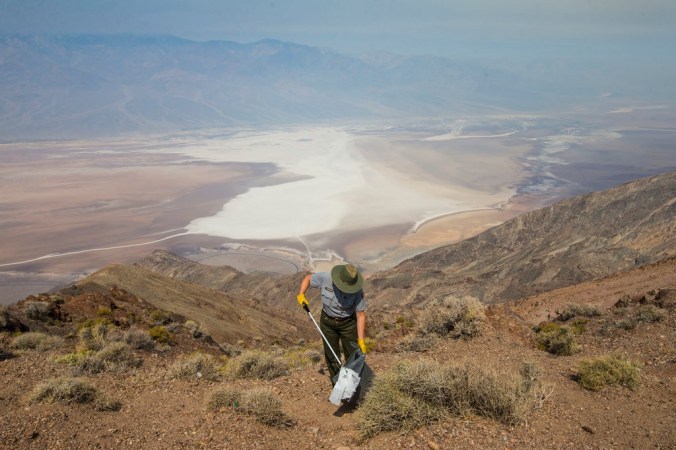
A custodian in Death Valley National Park, which would gain 40,000 acres under the measure. Credit Chase Stevens/Las Vegas Review-Journal, via Associated Press

At a time when the current administration and it’s legislative supporters are busy dismantling the environmental protections that have been painstakingly developed for over half a century, this bipartisan achievement is surprising, and heartening news.

Senate Passes a Sweeping Land Conservation Bill

The Senate on Tuesday passed a sweeping public lands conservation bill, designating more than one million acres of wilderness for environmental protection and permanently reauthorizing a federal program to pay for conservation measures.

The Senate voted 92 to 8 in favor of the bill, offering a rare moment of bipartisanship in a divided chamber and a rare victory for environmentalists at a time when the Trump administration is working aggressively to strip away protections on public lands and open them to mining and drilling.

“It touches every state, features the input of a wide coalition of our colleagues, and has earned the support of a broad, diverse coalition of many advocates for public lands, economic development, and conservation,” said Senator Mitch McConnell, Republican of Kentucky, the majority leader.

Western lawmakers of both parties have been working for four years on the bill, which will next be taken up by the House of Representatives, where it also enjoys bipartisan support.

“This package gives our country a million acres of new wilderness, protects a million acres of public lands from future mining, permanently reauthorizes the Land and Water Conservation Fund and balances conservation and recreation for the long term,” said Representative Raúl Grijalva, the Arizona Democrat who heads the House Natural Resources Committee. “It’s one of the biggest bipartisan wins for this country I’ve ever seen in Congress.” Continue reading

The Most Interesting News Today

17mag-climeworks-image2-jumbo-v2.jpg

The greenhouse in Hinwil where Climeworks uses carbon dioxide pulled from the air to grow fruits and vegetables. Luca Locatelli for The New York Times

When this platform started in 2011 it was two young men, one a senior at Amherst College and the other a sophomore at Cornell University, who thought it would be useful to share their experiences with other students. It continued beyond their summer internships. At some point, hard to pinpoint the date, it started serving as a daily exercise for me. It became an exercise in finding something in the world that is worthy of attention, as much as possible something that inspires hope rather than reinforces dread (though that has been unavoidable from time to time).

The title I give to today’s post is impossible to justify with any metrics, but read on and you may see my point. Jon Gertner, for this first time featured in our pages, and for what is likely the longest of any longform treatments of any topic in the New York Times, thank you for making it about this:

17mag-climeworks-image1-jumbo.jpg

Christoph Gebald, left, and Jan Wurzbacher, the founders of Climeworks, at their plant in Hinwil, Switzerland. Luca Locatelli for The New York Times

The Tiny Swiss Company That Thinks It Can Help Stop Climate Change

Two European entrepreneurs think they can remove carbon from the air at prices cheap enough to matter.

17mag-climeworks-image3-jumbo

A pilot project at a Swiss university that uses Climeworks equipment to make methane out of airborne CO₂. Luca Locatelli for The New York Times

Just over a century ago in Ludwigshafen, Germany, a scientist named Carl Bosch assembled a team of engineers to exploit a new technique in chemistry. A year earlier, another German chemist, Fritz Haber, hit upon a process to pull nitrogen (N) from the air and combine it with hydrogen (H) to produce tiny amounts of ammonia (NH₃). But Haber’s process was delicate, requiring the maintenance of high temperatures and high pressure. Bosch wanted to figure out how to adapt Haber’s discovery for commercial purposes — as we would say today, to “scale it up.” Anyone looking at the state of manufacturing in Europe around 1910, Bosch observed, could see that the task was daunting: The technology simply didn’t exist.

Over the next decade, however, Bosch and his team overcame a multitude of technological and metallurgical challenges. He chronicled them in his 1932 acceptance speech for the Nobel Prize for Chemistry — an honor he won because the Haber-Bosch process, as it came to be known, changed the world. His breakthrough made possible the production of ammonia on an industrial scale, providing the world with cheap and abundant fertilizer. The scientist and historian Vaclav Smil called Haber-Bosch “the most important technical invention of the 20th century.” Bosch had effectively removed the historical bounds on crop yields, so much so that he was widely credited with making “bread from air.” By some estimates, Bosch’s work made possible the lives of more than two billion human beings over the last 100 years. Continue reading
The Original “Third Place”

Louie Chin

A friend of mine recently posted on social media about beautiful libraries in Halifax, as well as other favorites, including the Boston Public Library. We’ve written about libraries countless times on this site, both due to their clear cultural importance, as well as their impact within our family. It reminded me how libraries have been part of our lives since early toddlerhood for our sons, starting in Ithaca, where they were born, and in Paris, the American Library (the largest English-language lending library on the European continent) where they discovered authors like Philip Pullman and Terry Prachett. There are no limitations for what libraries have meant to our family over the years.

Thanks to sociologist Eric Klinenberg for this opinion piece.

To Restore Civil Society, Start With the Library

This crucial institution is being neglected just when we need it the most.

Is the public library obsolete?

A lot of powerful forces in society seem to think so. In recent years, declines in the circulation of bound books in some parts of the country have led prominent critics to argue that libraries are no longer serving their historical function. Countless elected officials insist that in the 21st century — when so many books are digitized, so much public culture exists online and so often people interact virtually — libraries no longer need the support they once commanded.

Libraries are already starved for resources. In some cities, even affluent ones like Atlanta, entire branches are being shut down. In San Jose, Calif., just down the road from Facebook, Google and Apple, the public library budget is so tight that users with overdue fees above $20 aren’t allowed to borrow books or use computers.

But the problem that libraries face today isn’t irrelevance. Indeed, in New York and many other cities, library circulation, program attendance and average hours spent visiting are up. The real problem that libraries face is that so many people are using them, and for such a wide variety of purposes, that library systems and their employees are overwhelmed. According to a 2016 survey conducted by the Pew Research Center, about half of all Americans ages 16 and over used a public library in the past year, and two-thirds say that closing their local branch would have a “major impact on their community.” Continue reading
Longform & Shortform & Waning & Waxing

p06yh66g.jpgJames Rebanks had come to my attention twice before. I found him compelling both times but because he was described in shorthand as the tweeting shepherd, my interest waned as quickly as it waxed. Now, after listening to him on a third occasion, and because of his music choices (on a show that illuminates a person beyond their words, through their musical taste), he won my attention back.

Mainly, I was intrigued that he brings his experience to bear in a consultancy that sounds like it has plenty of overlap with our own practice. And once I discovered that he had taken a break from tweeting I decided to venture onto that platform, which I rarely do, to try to understand that part of him better. And that led further afield and allows me to suggest that longform communication suits him better than shortform:

Meat Where They Are

vegan-burger-1_custom-69b8aeff56bf284ed1349c739dc345cf0336364d-s1200-c85.jpg

Focusing less on the meat-free or health aspects of plant-based dishes, like this jackfruit burger — and more on their flavor, mouthfeel and provenance — could go a long way toward getting meat lovers to choose these options more often. That’s according to research by the World Resources Institute’s Better Buying Lab in conjunction with food chains, marketers and behavioral economists. Westend61/Getty Images

As much as I would like to dedicate another post to a shout out for Carolyn Kormann, since her latest posting is on a topic I am following closely, something else seems even more of the moment.

BWW-Pete_Buttigieg.jpg

Against the image of the millennial left, Pete Buttigieg appears to be a relatively prosaic Presidential candidate, but, in his own understated way, he is suggesting a sharp break with the past. Illustration by Tyler Comrie; Source Photograph by Alex Wong / Getty

Just after reading this brief profile of a remarkable person, I read something as seemingly different as could be in this story about changing food preferences by Maria Godoy. In the profile, this quote two thirds of the way through stood out:

…“So much of politics is about people’s relationships with themselves,” Buttigieg said. “You do better if you make people feel secure in who they are.”…

In the food story, just reading the caption in the image above you get the same message: meet people where they are. As sensible in politics as in changing food preferences. For all our attention to the important ecological reasons to reduce or even better to eliminate animal protein consumption, better to appeal to what most people most quickly respond to, namely their existing preferences. Meat where they are seems like the best option, so show how another option is tastier, healthier, or whatever is the most salient point for a particular type of consumer according to Godoy’s reporting:

…”The language for meat, and beef in particular, just sounds so much more delicious,” says Daniel Vennard. And labels like “meat-free,” “vegan,” and “vegetarian” tend to be turn offs for consumers. “People don’t create positive associations with how it’s going to taste and don’t feel it’s very indulgent.”

And that’s a real problem for Vennard: As head of the World Resources Institute’s Better Buying Lab, it’s his job to work with food companies, behavioral economists and marketing experts to find ways to get people to eat more sustainably. Or, as he puts it, to make “this party sound even better than the other party.”…

When Pictures Are Worth a Thousand Words

_105461276_mediaitem105461275

With none of the usual traffic clogging the capital, Sunday football devotees took to the streets.

I remember car free days in Paris with pleasure, sunny autumn weather topped by cyclists, pedestrians and skaters enjoying wide boulevards and narrow city lanes alike. New York City has a smaller scale version, with a 2 mile stretch of lower Broadway, plus a mile up in Washington Heights.

_105461998_mediaitem105461997

The event also allowed skateboarders to show off their skills.

No traffic days taking place in developing countries somehow feels all the more impactful, especially considering it’s a monthly event, rather than an annual one! Thanks to the BBC for bringing this to our attention with the story No traffic in Addis Ababa as Ethiopia marks Car Free Day:

Thousands of people have marked Car Free Day in cities across Ethiopia by walking and exercising.

_105462371_052075291-1

The measure was implemented by the government of Prime Minister Abiy Ahmed, who was came to office last April after his predecessor resigned.

Major roads were shut as Health Minister Amir Aman led the walk in the capital, Addis Ababa.

This was the first Car Free Day held in Ethiopia to promote healthy living, and to reduce pollution on roads usually clogged with traffic.

Tents were also set to offer free health checks to those who were walking and exercising.

_105461278_mediaitem105461277

All photos by Eduardo Soteras, AFP

Mr Amir is trying to change that and Car Free Day will be held on the last Sunday of each month, he adds. Continue reading
Epic Waste, Cowboys & Spaceships

190204_r33673

Slat cares deeply about the environment, but, for him, the appeal of cleaning the oceans is also about puzzle solving. Illustration by Cristiana Couceiro

In the pantheon of writers we have linked out to since 2011, of those who focus on science and/or environmental issues Carolyn Kormann is a relatively recent arrival. Since I started noticing her work three years ago she has started 2019 with an especially strong duo of stories. One is a longform profile and a must-read if you have been even just glancing at the headlines about giant garbage patches swirling in the ocean. How to deal with epic waste after the fact, after the out-of-sight-out-of-mind approach that has been building this mess for decades, is no simple matter. Nor is the man she introduces us to.

Kormann-Cost-of-Climate-Change

Last year, the U.S.’s carbon-dioxide emissions increased by an estimated 3.4 per cent, the second-largest gain in the past two decades.Photograph by Fernando Moleres / Panos Pictures / Redux

The profile of Slat is compelling, disturbing and inconclusive–hallmarks of the type of profile I most appreciate when the subject involves seemingly intractable environmental challenges. The other item is shorter, with a pair of metaphors for economic periods that I wish I had known earlier. If you only have time for one, read about William Nordhaus’s many contributions to the otherwise dismal science, especially his description of the economic transformation from my lifetime to that of the next generation:

The False Choice Between Economic Growth and Combatting Climate Change 

In 1974, the economist William Nordhaus described the transition from a “cowboy economy” to a “spaceship economy.” In the former, he wrote, “we could afford to use our resources profligately,” and “the environment could be used as a sink without becoming fouled.” But, in the spaceship economy, “great attention must be paid to the sources of life and to the dumps where our refuse is piled.” He added, “Things which have traditionally been treated as free goods—air, water, quiet, natural beauty—must now be treated with the same care as other scarce goods.” Toward the end of his landmark paper, “Resources as a Constraint on Growth,” Nordhaus discussed the possible adverse effects of energy consumption, most notably the “greenhouse effect.” Continue reading

Connecting the Dots Between Technology & Nature Conservation

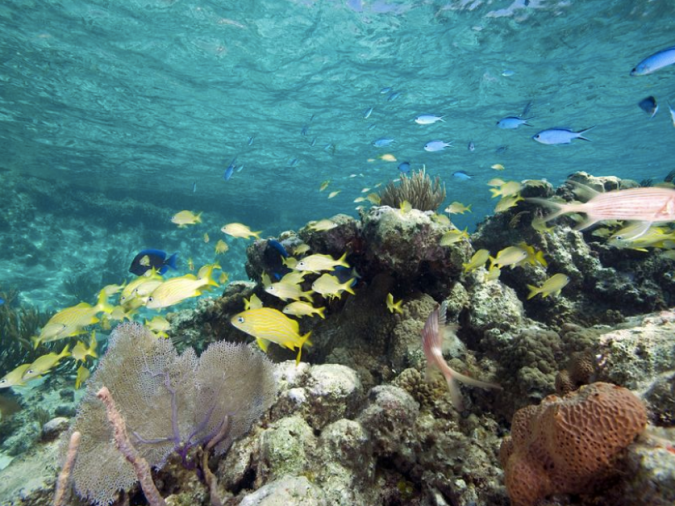
REEF FISH, BAHAMAS Fish congregate near a shallow reef in Exuma Cays Land and Sea Park. © Jeff Yonover

Those familiar with our work will recognize the word valorization, which is an essential element of what we write about and what we do. It’s increasingly important to note that Nature, made more fragile with each passing year by human impact climate change, requires human efforts to protect and hopefully, turn back the clock on damage already done; and it appears to be human nature that maintain a direct  correlation between how something is valued and the amount of attention it gets.

We’re particularly impressed by this example of tech collaboration. Thanks to the Nature Conservancy for highlighting these stories…

The Caribbean Needs Tourism, and Tourism Needs Healthy Coral Reefs

AI and social media are helping quantify the economic value of coral reefs

The Caribbean region is more dependent on tourism than any other region in the world—the sector accounts for over 15 percent of GDP and 13 percent of jobs in the region. And almost all visitors to the Caribbean take part in some activity that relates to coral reefs—either directly, like snorkeling and scuba diving, or indirectly, like enjoying sandy beaches, eating fresh seafood and swimming in crystal waters. That means the health of the Caribbean’s tourism industry—and thus the whole regional economy—is dependent on the health of its coral reefs.

But just how much value do reefs produce? After all, “what gets measured gets managed and improved.” The Nature Conservancy (TNC) recently released the results of a study that focused on reef-adjacent activities and the value they generate for the tourism industry, island governments and Caribbean communities. This study, which builds on an earlier body of globally focused research produced by TNC, found that reef-adjacent activities alone generate an estimated $5.7 billion per year in the Caribbean from roughly 7.4 million visitors. When combined with reef-dependent tourism activities, they generate $7.9 billion total from roughly 11 million visitors.

In other words, a major draw for people traveling to the Caribbean are activities related to coral reef ecosystems, and both the tourism industry and other aspects of the local economies depend on healthy coral reefs to keep this relationship afloat. This evidence offers a pivotal opportunity for advancing coral conservation initiatives not only in the Caribbean but around the world, as it can catalyze both the tourism industry and local governments and communities to invest in protecting and restoring coral reefs for the benefit of economies and incomes.

We now know that these natural wonders are responsible for generating billions of dollars, sustaining livelihoods and anchoring economies in the Caribbean as well as other tropical destinations across the globe. And that should translate into a major incentive to conserve them.   Continue reading

Warrior Gems

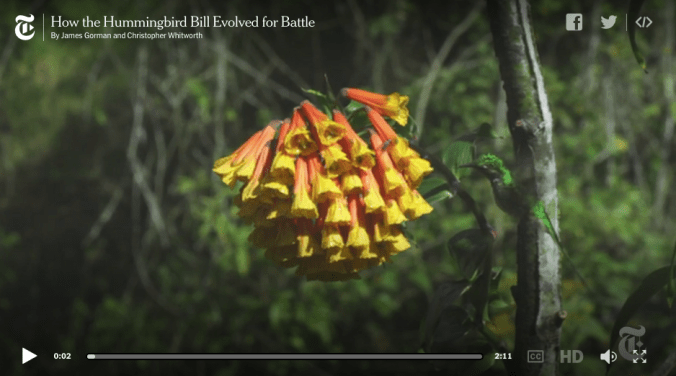
In the South American tropics, where hummingbirds must compete for food, evolution has drastically reshaped their bills. Credit Christian Irian

Hummingbirds are some of the most gemlike and visually striking birds in the “new world”, but those who have spent any time watching them know that striking can also be used as an apt verb to describe their behavior. Fiercely territorial, it’s not surprising that scientists are making more and more discoveries related to the evolution behind their development. (Click on image above to view the video)

The Hummingbird as Warrior: Evolution of a Fierce and Furious Beak

Winsomely captured in poems and song, the birds are yielding new secrets about their astounding beaks and penchant for violence.

If you want to know what makes hummingbirds tick, it’s best to avoid most poetry about them.

Bird-beam of the summer day,

— Whither on your sunny way?

Whither? Probably off to have a bloodcurdling fight, that’s whither.

John Vance Cheney wrote that verse, but let’s not point fingers. He has plenty of poetic company, all seduced by the color, beauty and teeny tininess of the hummingbird but failed to notice the ferocity burning in its rapidly beating heart.

The Aztecs weren’t fooled. Their god of war, Huitzilopochtli, was a hummingbird. The Aztecs loved war, and they loved the beauty of the birds as well. It seems they didn’t find any contradiction in the marriage of beauty and bloodthirsty aggression.

Scientists understood that aggression was a deep and pervasive part of hummingbird life. But they, too, have had their blind spots. The seemingly perfect match of nectar-bearing flowers to slender nectar-sipping beaks clearly showed that hummingbirds were shaped by co-evolution.

It seemed clear that, evolutionarily, plants were in charge. Their need for reliable pollinators produced flowers with a shape that demanded a long slender bill. Hummingbird evolution obliged.

But hummingbirds also heard the call of battle, which demanded a different evolutionary course. Some of those slender, delicate beaks have been reshaped into strong, sharp and dangerous weapons.

In a recent paper organizing and summing up 10 years of research, Alejandro Rico-Guevara and his colleagues at the University of California, Berkeley, shared evidence gathered by high-speed video about how the deadly beaks are deployed in male-to-male conflict.

Like the horns of bighorn sheep or the giant mandibles of stag beetles, hummingbird beaks are used to fight off rivals for mates. This is sexual selection, a narrow part of natural selection, in which the improvement of mating chances is the dominant force. Continue reading