Sustainability in both concept and practice has a long history in Scandinavian cultures in general, and Sweden in particular. As consumers become more conscious of the finite nature of materials, upcycling has to eventually be considered more mainstream. We applaud this type of public and private sector leadership that is the very definition of entrepreneurial conservation.
Anna Bergstrom had a dilemma. She loved the glitzy world of high fashion, but had also come to feel that it was unsustainable and bad for the planet. She’s now found peace of mind by running a stylish shopping mall in Sweden, where everything is second-hand.
“Do you notice the smell?” Anna Bergstrom says, as she surveys her mall from the mezzanine level. “It smells nice here, doesn’t it?”
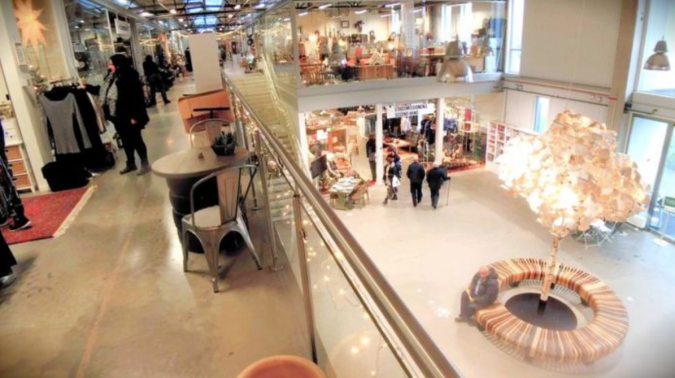
It’s very important to Anna that this place is enticing, because she feels it is making a statement. Everything for sale here, in 14 specialist shops covering everything from clothes to DIY tools, is recycled.
She is usually turned off by the smell of second-hand stores, she explains, even though she adores vintage fashion. For most people flea-markets and charity shops carry a stigma, she thinks – a mark left by countless bad experiences. Too often they are worthy but depressing, Anna says. Her mission is to bring second-hand shopping into the mainstream.
The mall itself is spacious and appealing, almost Ikea-like. An art installation – a tree and circular bench all fashioned from recycled materials – greets customers at the entrance. There is even a coffee shop and gift-wrapping service.
The mall is called ReTuna. “Tuna” because that’s the nickname for the city where it is based – Eskilstuna, an hour’s train journey west of Stockholm – and “Re” because the goods on sale have been recycled or repurposed.
It was set up by Eskilstuna’s local government in 2015, in a warehouse which used to house trucks for a logistics company. Continue reading →
Rutabaga tagliatelle, from Olmstead, in Brooklyn.Photograph by Evan Sung
In the interest of cutting back meat consumption, my eye is easily caught these days by pretty shiny things, like the image above, but even more so by rich description, especially when the history of a food is illuminated. This brief history of one root vegetable, accompanied by a couple of beautiful photos, led me to the book below right. Click the book image to go to the source.
The Swiss botanist Gaspard Bauhin was born in Basel in 1560, and he dedicated his life to obsessively cataloguing the vegetable world. To present-day historians, he’s notable primarily for his botanical thesaurus “Pinax Theatri Botanici” (“An Illustrated Exposition of Plants”), published in 1623. But, among cooks, he’s sometimes recalled for his lesser work, published in 1620: “Prodromos Theatri Botanici” (“Prologue to the Exposition of Plants”), a compendium of flora in which he describes a plant with vivid yellow flowers, a spray of leaves, and massive, hairy roots “more or less similar to those of turnip or carrots.” It was a specimen that had never before appeared in any scientific list of plants: the rutabaga.
The rutabaga is a culinary underdog. It struggles to shine among its fellow root vegetables.Photograph by Matthias Haupt / Picture Press / Redux
The annals of botany abound with claims that Bauhin was not only rutabaga’s biographer but also its inventor: that he found it growing wild and domesticated it; that he was a civic-minded scientist seeking a cold-resistant turnip to feed his chilly countrymen and not (more likely) a monomaniacal scholar who spent his life ensconced in an herbarium, scrivening endless latinate lists of plant names. “The turnip is older than history,” the caption on a color plate in a 1949 issue of National Geographic declares. “The rutabaga almost modern.” In fact, the vegetable has been around at least since ancient-Roman times, when the naturalist Pliny the Elder, writing in the first century, described an edible root “between a radish and a rape”—meaning the plant from which rapeseed oil derives, which is a cultivar of the same species. Bauhin writes that in his time the vegetable was widely grown in “the cold Noric fields of Bohemia,” where it was eaten pickled or mashed and was called simply “root” by its cultivators. Continue reading →
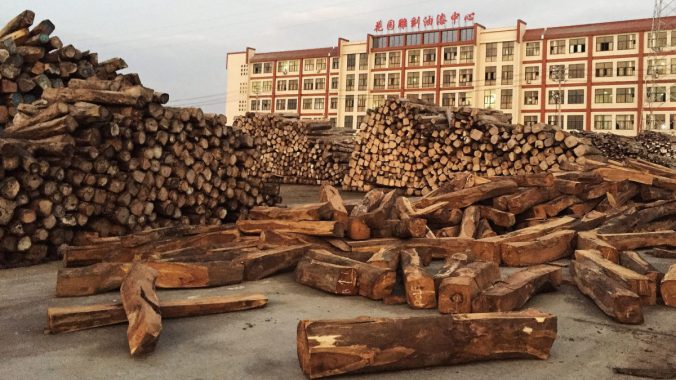
The most widely traded illegal wild product in the world today is rosewood, an endangered hardwood prized for its use in traditional Chinese furniture. An e360investigation follows the trail of destruction and corruption from the forests of Madagascar to furniture showrooms in China.
Logged wood on a path near Masoala National Park in northeast Madagascar. The park has been plundered not just of rosewood but many types of tropical hardwood. EDWARD CARVER
Fampotakely, a sandy village in northeast Madagascar, at first seems an unlikely destination for migrants. It has no hospital, no secondary school, no electricity, and limited well water. Yet its population has exploded to 5,000 in recent years. A few of the houses, usually made from dried palm leaves and stalks, now have concrete foundations and solar panels. Fampotakely’s relative wealth is due to its strategic location in the illegal timber trade: it’s downriver from Masoala National Park, home to some of the world’s most valuable rosewood.
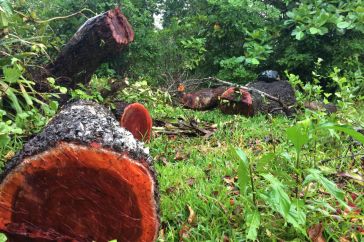
Waterways around Fampotakely, Madagascar run blood red from rosewood stored underwater while waiting for ships to transport it to China. EDWARD CARVER
For the last decade, men from all over the region have gone into the park’s dense forests to work as loggers, a job that pays well by local standards. They cut down the massive trees, carve grooves in the logs, and use climbing vines to drag them to the nearest waterway. With rafts made from other felled trees, they use bamboo poles to float the precious hardwood toward Fampotakely and other villages along the Indian Ocean coastline. Continue reading →
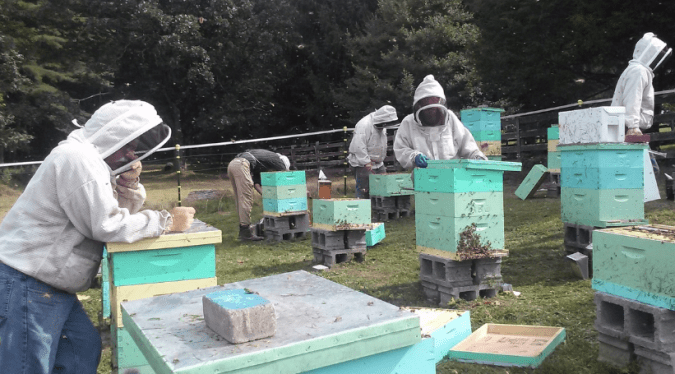
Members of the Appalachian Beekeeping Collective inspect one of their apiaries. The collective trains displaced coal miners in West Virginia on how to keep bees as a way to supplement their income. Courtesy of Kevin Johnson
We never tire of highlighting good news about bees. Thanks to NPR, Jody Helmer, and the Salt for bringing us this to our attention.
Scyphers was fortunate to find a construction job, but it paid 2/3 less than what he earned underground. He often took odd jobs to make ends meet. One of those odd jobs included building hives and tending bees for the Appalachian Beekeeping Collective.
“I wish this group had been here 30 years ago,” he says. “Our region needs it.” Continue reading →
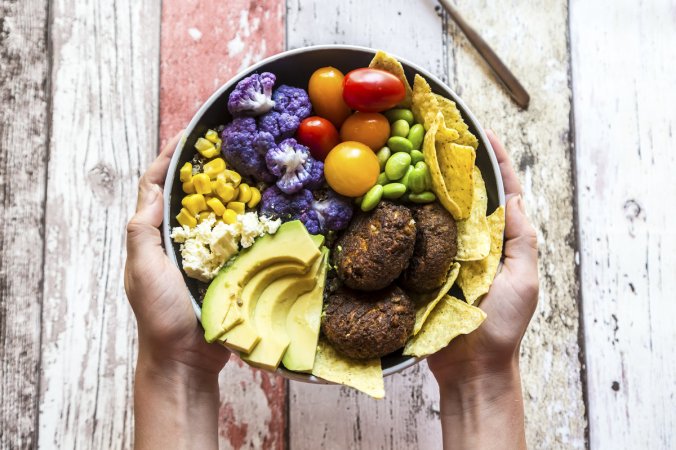
To help protect the planet and promote good health, people should eat less than 1 ounce of red meat a day and limit poultry and milk, too. That’s according to a new report from some of the top names in nutrition science. People should instead consume more nuts, fruits and vegetables, legumes, and whole grains, the report says. The strict recommended limits on meat are getting pushback. Westend61/Getty Images/Westend61
Preparing ahead for a meal to be cooked today, I was reading this recipe, whose image (below) was competing for my attention with the image above. The picture above is eye-catching, at least to me, a visual cue leading me to the type of meal I should be thinking about more often. It is a big picture picture. I have red lentils in the cupboard, and I intend to prepare them today, so the recipe won the race for my attention.
Melissa Clark’s red lentil soup.CreditJoseph De Leo for The New York Times. Food Stylist: Monica Pierini.
The story by National Public Radio (USA) waited. It is about diet, with the kind of explanatory information that motivates me to find lentils more appealing, and to understand why meals like this should dominate the weekly menu:
What we eat – and how our food is produced – is becoming increasingly politicized.
Why? More people are connecting the dots between diet and health – not just personal health, but also the health of the planet. And the central thesis that has emerged is this: If we eat less meat, it’s better for both.
So, how much less? A new, headline-grabbing report — compiled by some of the top names in nutrition science — has come up with a recommended target: Eat less than half an ounce of red meat per day. That works out to about 3.5 ounces — or a single serving of red meat — per week. And it’s far less red meat than Americans currently consume on average: between an estimated 2 and 3 ouncesper day. Continue reading →
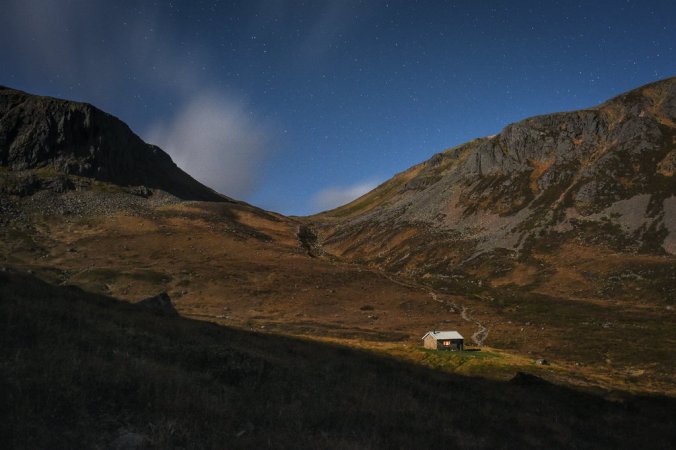
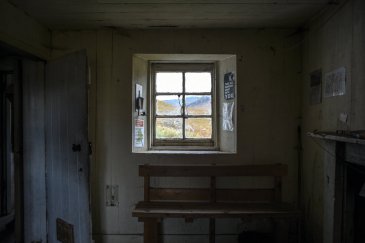
The Hutchison Memorial Hut, colloquially called the Hutchie Hut, illuminated by moonlight in Scotland’s Cairngorms National Park. Stephen Hiltner/The New York Times
How did Stephen Hiltner know? I was just looking through photos from the 2009 edition of the Patagonia Expedition Race, and remembering the huts along the way. They were perfect places to escape the realities of the rest of the world, in order to contemplate more clearly. With perspective. They could come in handy for plenty of folks these days, I am sure. Seems certain to me now that those huts at the southern tip of the South American continent were built by folks from the hills sampled in the story below:
Rustic shelters called bothies — more than 100 of which are scattered throughout England, Wales and Scotland — are an indispensable, if little-known, element of British hill culture.
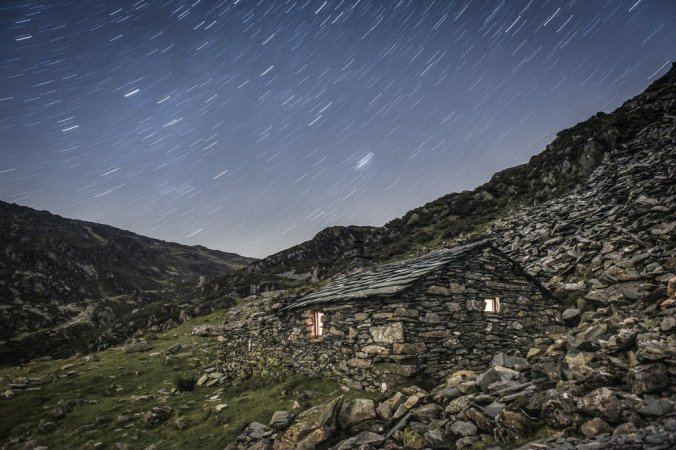
Warnscale Head at night. Since bothies are often built with local stones, they’re easily camouflaged in their surrounding landscapes. Stephen Hiltner/The New York Times
Shenavall Stephen Hiltner/The New York Times
By the time the tiny hut came into view, nestled high in a corrie in Scotland’s 1,748-square-mile Cairngorms National Park, I’d trekked for nearly nine miles, three of which, regrettably, I’d had to navigate after nightfall. The hike, through a broad valley in the Eastern Highlands called Glen Derry, carried me past groves of Scots pines and over a series of streams, some of which, lined with slick steppingstones, made for precarious crossings. All the while, two rows of smooth, eroded mountain peaks enclosed me in an amphitheater of muted colors: hazel-hued heather, golden grasses. Though much of my walk was solitary, the flickering glow in the hut’s main window, I knew, meant I’d have some company for the night and the warmth of a fire to greet me. Continue reading →
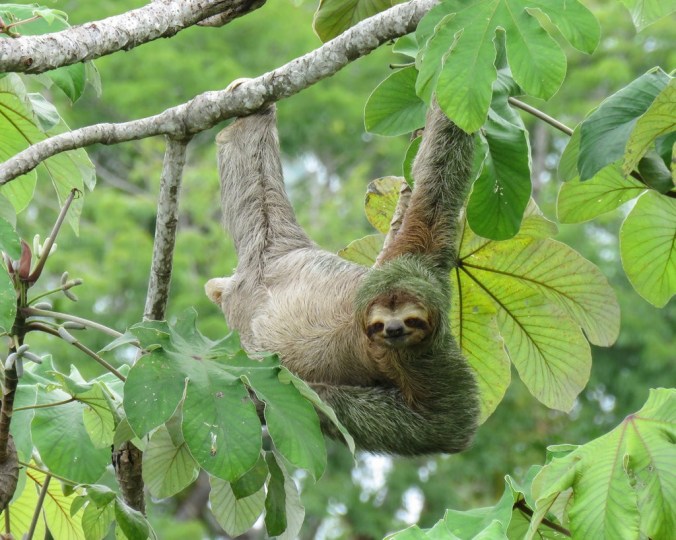
I had never heard the name guarumo for this tree before. Cecropia is the name we have commonly heard for it in Costa Rica. Veronique Greenwood, who we have linked to twice until now, has contributed more than vocabulary to me through this article. I am particularly thankful for the realization that cacao can be more useful than I had been aware. Beyond the benefits of being grown organically it may play a key role in regenerative forest development. This, entrepreneurial conservation in mind, must become a variable by which Organikos sources chocolate in Costa Rica:
A study showed that when some animals find a crucial resource, they can survive in changing environments and even thrive.
Look closely up in the trees of a shade-grown cacao plantation in eastern Costa Rica, and you’ll see an array of small furry faces peering back at you. Those are three-toed sloths that make their homes there, clambering ever so slowly into the upper branches to bask in the morning sun. You might also spot them munching on leaves from the guarumo tree, which shades the cacao plants. Continue reading →
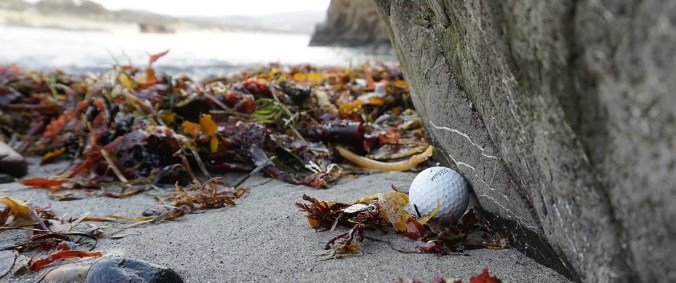
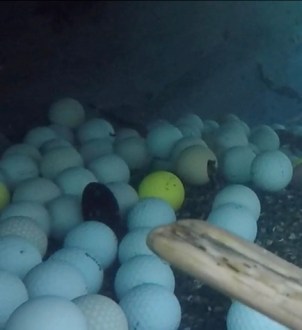
Reading further, I sensed that Yale e360 was being a bit polite saying “thousands” — more than 50,000 balls have already been extracted over two years. The article linked to National Public Radio’s coverage of the same story, with this slightly more aggressive headline:
During my PhD years I got to be reasonably competent at the game of golf. I can say I even loved the game. One odd bi-product of my dissertation was that I learned of the perils to the planet from out of control golf course development. Then I felt compelled to give up the game. (I did play a bunch during the mid-1990s, in Costa Rica, as I slowly learned of those perils.) Recently I found the clubs I used to play with, and the shoes, while cleaning out a store room in Costa Rica. I left them there.
To this day I have some close friends who play golf. I never comment on this topic in front of them, because my message is easily misconstrued. I am not against all golf. I just think there are more than enough courses already built on this planet. A moratorium on building more would make me happy. My friends already have more than enough courses to play on. Anyway, this topic is of interest now for a new, very specific reason. And it comes as a bit of a surprise what a big problem golf balls are in the ocean. The website of the organization that is featured in both articles can be reached by clicking the image below:
I remember advertisements from not that long ago that encouraged you to daydream about hitting balls endlessly into the ocean from cruise ship voyages with golf tees on the back of the ship. At first I thought maybe that kind of weird pleasure was the culprit, considering all the other dirty outcomes of cruising. But it’s complicated, as I learned from The Plastic Pickup website:
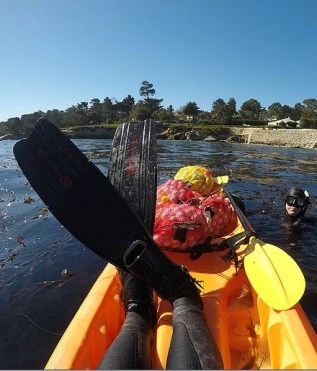
In the spring of 2016, my dad (Mike Weber) and I (Alex Weber) were freediving along the central coast of California in the shallow waters adjacent to the Pebble Beach golf course, when we came across a discovery that had never been reported before. Thousands of golf balls blanketed the seafloor, and inhabited nearly every crack and crevice in the underwater and onshore environment. The overabundance of inorganic materials was overwhelming but for a second it did not phase us. As we began diving to the bottom to collect the balls, we realized what perfect freediving training it was and the whole operation felt like a fun game; we were having a blast. But soon, the enormity and vast scale of the pollution set in and it made me feel sick to my stomach. To preface this day, for a few years prior I had been spending at least an hour a day down at the beach collecting microplastics and nurdles after heavy storms would wash them ashore. As a kid I was raised in the sea, boogie boarding everyday after school in kindergarten, scuba diving as soon as I was allowed to, and spending each summer day swimming offshore to hang out with dolphins and swim through giant kelp forests. To me the ocean was a peaceful home as well as my favorite teacher, so the discovery of such a large scale underwater plastic problem both shocked me and also captivated my curiosity. What began as a day of freediving resulted in a project that has changed my life ever since.
The next dive-able day, we were underwater early in the morning equipped with mesh bags and a new diver, Jack Johnston. Jack and I had been long time friends since middle school, and spent all our time together either underwater or on mountains, so he didn’t need much convincing to come along. Jack’s reaction was similar to mine, but his wildly curious mind helped him stay positive and motivated. That day we collected nearly 2,000 golf balls which was just the start of what grew into The Plastic Pick-Up. As we continued diving, we were not only collecting golf balls, but data too…
Read the whole story here. And if that interests you, there is another website that mentions a different Alex and his buddy Andrew who have also found a mission-driven business focused on ocean cleanup:
to Bali Indonesia that would inevitably change their lives and the fate of the ocean. Devastated by the amount of plastic in the ocean, they set out to find out why no one was doing anything about it. Continue reading →
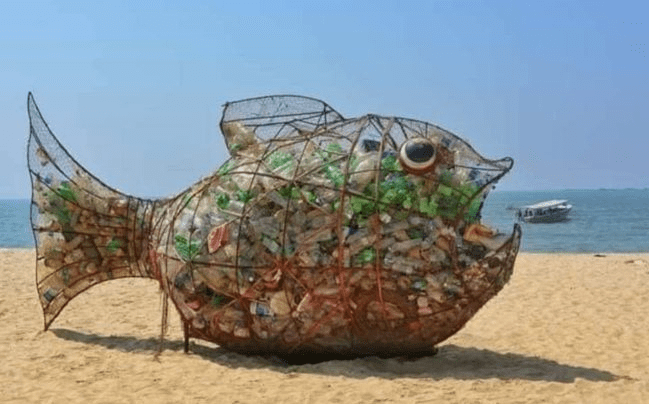
As some rumors swirl around the internet that there will be more plastic than fish by 2050, there are also some great stories about local recycling, like this one about Goby the fish.
This local beach decided to do something simple, instead of placing a ton of boring old garbage cans around the beach, they made a giant see through fish out of some barbed wire and mesh, and added a sign to it that said, “Goby loves plastic, please feed him”. Continue reading →
After two decades of drought, Lake Mead in Nevada is just 40 percent full. TED WOOD
Thanks to Jim Robbins and Yale e360 for this second installment, and especially to Ted Wood for photography as visually compelling as the implication of the story:
With the Southwest locked in a 19-year drought and climate change making the region increasingly drier, water managers and users along the Colorado River are facing a troubling question: Are we in a new, more arid era when there will never be enough water?
Scientists at the University of Arizona are using tree rings to study centuries of drought conditions in the Colorado River Basin.
In the basement of the University of Arizona’s Laboratory of Tree-Ring Research, the fragrant smell of pine hangs in the air as researchers comb through the stacks of tree slabs to find a round, 2-inch-thick piece of Douglas fir.
They point out an anomaly in the slab — an unusually wide set of rings that represent the years 1905 to 1922. Those rings mean it was a pluvial period — precipitation was well above average — and so the trees grew far more than other years.
“In 1905, the gates opened and it was very wet and stayed very wet until the 1920s,” said David Meko, a hydrologist at the lab who studies past climate and stream flow based on tree rings. “It guided their planning and how much water they thought was available.”
Mark Harris, a water manager in Grand Junction, Colorado.
The planning was that of the states that share the water of the Colorado River. Worried that a burgeoning California would take most of the water before it was fairly divvied up, representatives from the other Colorado River Basin states, presided over by U.S. Secretary of Commerce Herbert Hoover, came together in 1922 to develop an equitable apportionment. They looked at flow measurements and figured that the river contained an average of 15 million acre-feet. They divided the Colorado River states into two divisions – the upper basin and the lower basin, with the dividing line in northern Arizona near the Utah border. The upper basin states — Utah, Wyoming, Colorado, and New Mexico — agreed not to take more than a total of 7.5 million acre-feet and to allow the other half to flow south to the lower basin. The agreement they signed was called the 1922 Colorado River Compact, also known as the Law of the River. Continue reading →













 Organikos