Author of Extreme Conservation, Interviewed

9780226366265.jpg

We recommend this interview in the Atlantic, with the author of the book above, a veteran conservationist reckoning with his career studying animals in the most extreme places on Earth:

In the winter of 2011, Joel Berger and his colleague Marci Johnson happened upon a ghostly Arctic death scene. Body parts and tufts of brown fur poked out of a frozen lagoon. This was all the biologists could find of a herd of 55 musk oxen they had been following.

The cause of mass mortality, they later determined, was an ice tsunami, the result of an unusual storm that slammed seawater and ice into the lagoon where the unfortunate musk oxen stood. Berger is a conservationist who works in some of the most hostile environments in the world, and he studies the enigmatic species, like musk oxen, that live there. His new book, Extreme Conservation, chronicles his career in Alaska, Siberia, Namibia, Tibet, Mongolia, and Bhutan. He is now a biologist at Colorado State University and a senior scientist at the Wildlife Conservation Society. Continue reading

A Story That May Make Your Day

CalleCarrizalView

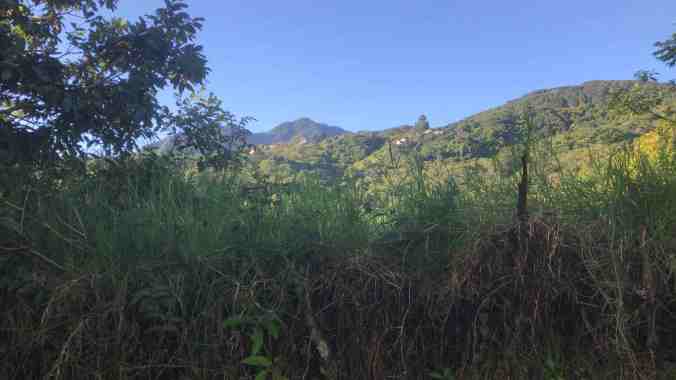
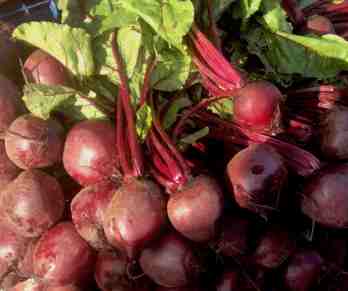
FMBeets.jpgThe view above is a stretch of Continental Divide passing through Costa Rica’s central valley. The snapshot is taken from the road close to our home. I hike these mountains most mornings. On Saturdays I visit the farmer’s market in the town square. Beets were on my shopping list this week. One of the very few culinary banes of my youth, beets are now a favorite. A single shot glass of borscht, served to me in Leeuwarden, Holland solved that problem for me in 2004.
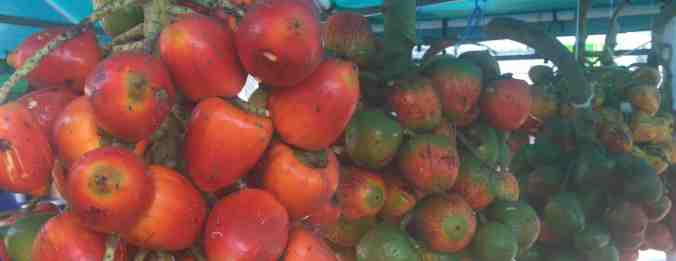
FMPejibaye.jpg

Pejibaye, a fruit from one of the many palm varieties growing in this region, is considered a local staple. We find that it has a resemblance to chestnut, so we use it to prepare stuffing to accompany the roasting of something or other on the fourth Thursday of November.

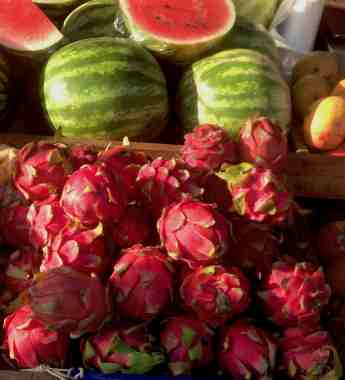
FMDragonFruitThis time of year dragon fruit appears and if it is a sunny morning their color is motivational. That is, I find their color energizing.

But something about the name must explain why, as with beets in my youth, I have not been motivated to eat this fruit.

I am waiting for someone to demonstrate the best way.

AmesTrue.jpg

I listen to a mix of music and podcasts during the mountain walks. Music energizes the steep uphill grinds while podcasts fill the downhills and straightaways, where I can concentrate. I recommend clicking on the My Ames Is True tab here and I also recommend not reading the blurb describing what it is about. Enjoy the surprise. This podcast is best listened to with no introduction, except for the fact that it is told by Michael Lewis on This American Life. It may make your day.

Celebrating Labor Day, Usual Style

The chef Alvin Cailan made his name on eggs—in sandwich form, at a food truck called Eggslut, in L.A. At the Usual, he has graduated to chicken, battered and fried so that its crust is as craggy as a mountain range. It’s served with blueberry muffins and house-made ranch, plus a garlicky hot sauce on request. Photograph by Christaan Felber for The New Yorker

The photo above is an immediate trigger for me, in that today is Labor Day in the USA. It is a holiday I recall with fondness from my youth. It signified the end of summer, which was never in itself to be celebrated, but it also signified the beginning of school. And for me school was the center of life, so the closing of summer meant back to all good things. This year, as summer closes, not so much. But the photo above allows me a moment of solace.

Amie and I recently passed through Los Angeles en route to a wedding, and came across this “questionably named”restaurant (not the one pictured above, but the one referred to in the first paragraph below). I do not think of myself as a prude, but when I see a name like that I immediately become uninterested. The shock of the new is not the problem. Coarsening of language and culture is the problem. Enough. A good rule of thumb might be something like this question: would you be happy telling your young child(ren) the name of this place where we are going to eat?

But then again I am occasionally surprised by how, after judging a book by its cover, I can reconsider and think otherwise. In this case the cover of the book (i.e. the name of the restaurant) is still one I would rather have been different, but the contents of the book have my full attention. Thanks to Hannah Goldfield for providing this case in point:

Standout Fried Chicken Amid Familiar Fare at the Usual

At Alvin Cailan’s first sit-down restaurant, in the Nolitan Hotel, the Eggslut creator graduates to the full bird.

For the chef Alvin Cailan, the egg came first. The egg sandwich, to be specific, a messy, photogenic one on a brioche bun, first served in 2011, from a food truck, questionably named Eggslut, in Los Angeles. Eggslut became a pop-up in New York (since popped down) and then a mini-chain, with several outposts in the L.A. area and one in Las Vegas. Cailan built his name on the egg. Now, at the Usual, his first proper sit-down venture, recently opened in the Nolitan Hotel, he has graduated to the chicken. Continue reading

The Future Is Bright, And Getting Brighter

A locust rests on some vegetation at a y

TENGKU BAHAR / GETTY

The future is bright, in one alarming way. Ed Yong explains, in his latest story The Very Hot, Very Hungry Caterpillar (anyone with children or grandchildren, or who has read books to a younger generation will appreciate the title) that climate change will help insects thrive. While that may be interesting for biodiversity it has implications for humans worth considering now, before too late:

Since the dawn of agriculture, humans have been unwillingly nourishing insects by growing plants that they then devour. Their mandibles consume somewhere between 10 and 20 percent of crops produced around the world. And these losses are likely to grow as the world slowly warms.

By looking at how insects will respond to rising temperatures, a team of researchers led by Curtis Deutsch and Joshua Tewksbury have calculated how rice, maize, and wheat—which provide 42 percent of humanity’s calories—will fare as the globe heats up. The results aren’t pretty.

They estimate that the portion of these grains that’s lost to insects will increase by 10 to 25 percent for every extra degree Celsius of warming. Continue reading

Eye of the Beholder

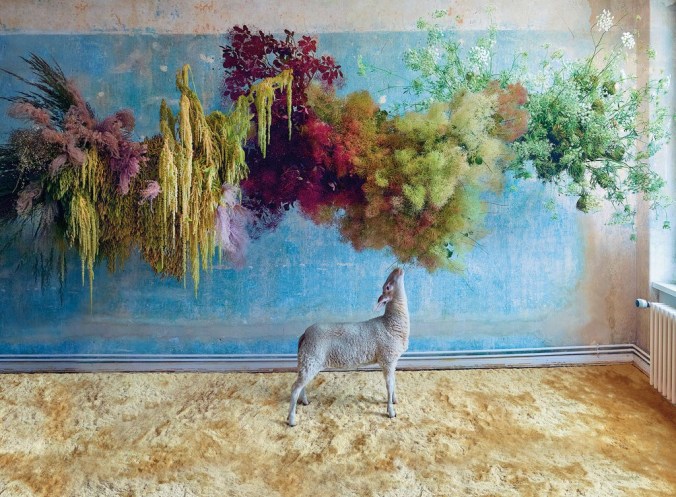
The Berlin-based florist Ruby Barber of Mary Lennox created some of her signature cloud arrangements with once-neglected weeds. A composite of individual arrangements, from left, of weeping amaranth and fresh and dried wild grasses; an abundant gathering of the once-humble smoke bush, now a fashionable challenger to traditional hothouse flowers; and Queen Anne’s lace. Credit Photograph by Guido Castagnoli. Flowers styled by Mary Lennox

Ralph Waldo Emerson may have written that a weed is just “a plant whose virtues have not yet been discovered,”  but another way of stating it is that a weed “is a plant growing in the wrong place”. The current revalorization of the “common weed”– aesthetically, culinarily and nutritionally — dovetails beautifully with much of what we highlight on this site.  Thanks to Ligaya Mishan of the NYTimes for the refocus.

How the Common Weed Has Grown on Florists (and Chefs)

From the flower arrangement to the plate, this is the era of the formerly unwanted plant.

A WEED IS UNWANTED: That is its definition. It is a plant that we have deemed to have no value because it contributes nothing to our life, neither nourishment nor beauty. Why should it help us when it doesn’t need us to survive, its seeds borne on the idlest gust, taking root and thriving in even the cruelest terrain? It stands wholly apart from human civilization, hardy and self-sustaining, mocking our hegemony, claiming the earth as its own. Worse, it is a predator, stealing resources — real estate, sunlight — from the plants we do value and rely on, crowding them out, threatening their existence and, by extension, ours.

A weed is never singular but an army. Its legions sweep across land like the Golden Horde, “always three steps ahead of the gardener, traveling underground, seeding by the million, smothering all in their path,” says the British writer and landscape designer Isabel Bannerman. Her husband and partner, Julian Bannerman, frames it slightly less savagely: The garden “is a bit like having a party. What we call weeds are the uninvited guests.” And in the Swedish writer and illustrator Elsa Beskow’s picture book “The Flowers’ Festival,” originally published in 1914 as “Blomsterfesten i Tappan,” they appear as exactly that, a rabble of thistles, chickweed, nettles and burdock, “scoundrels and beggars and ragamuffins” all, consigned to a ditch outside the garden to glower while the violets and orchids revel. “But we’re flowers, too,” the weeds roar.

But their time has come. Continue reading

Color Conservation

The hues in the Forbes Collection include the esoteric, the expensive, and the toxic. Photograph by Jason Fulford for The New Yorker

Color is such a constant in our lives that it seems odd to consider any need for it’s conservation. How it exists in nature, how we humans perceive it, and how we’ve use the technology of the time to preserve it, has been relevant for tens of thousands of years. The Forbes Collection archives in the Harvard University’s Fogg Art Museum highlights the work of it’s founder, Edward Waldo Forbes, for whom “pigment hunting and gathering was not just a matter of creating an archive of lost or languishing color. It was about the union of art and science.”

Treasures from the Color Archive

The historic pigments in the Forbes Collection include the esoteric, the expensive, and the toxic

How blue can it get? How deep can it be? Some years ago, at the Guggenheim Bilbao, I thought I’d hit on the ultimate blue, displayed on the gallery floor. Yves Klein, who died at thirty-four, was obsessed with purging color of any external associations. Gestural abstraction, he felt, was clotted with sentimental extraneousness. But, in search of chromatic purity, Klein realized that even the purest pigments’ intensity dulled when combined with a binder such as oil, egg, or acrylic. In 1960, he commissioned a synthetic binder that would resist the absorption of light waves, delivering maximum reflectiveness. Until that day in Bilbao, I’d thought Klein a bit of a monomaniacal bore, but Klein International Blue, as he named the pigment—rolled out flat or pimpled, with saturated sponges embedded in the paint surface—turned my eyeballs inside out, rods and cones jiving with joy. This is it, I thought. It can’t get any bluer.

Until YInMn came along: the fortuitous product of an experiment in the materials chemistry lab at Oregon State University in 2009. Intending to discover something useful for the electronics industry, Mas Subramanian and his team heated together oxides of manganese, yttrium, and indium at two thousand degrees Fahrenheit. What emerged was a new inorganic pigment, one that absorbed red and green light waves, leaving as reflected light the bluest blue to date. Subramanian sent a sample to the Forbes Collection in the Straus Center for Conservation and Technical Studies, at Harvard University, where it sits with twenty-five hundred other specimens that document the history of our craving for color.

Among the other blues on the Forbes’s shelves is Egyptian Blue, a modern approximation of the first synthetic pigment, engineered five millennia ago, probably from the rare mineral cuprorivaite, a soft mid-blue used for the decoration of royal tomb sculpture and the wall paintings of temples. Later, blues strong enough to render sea and sky were made from weathered copper-carbonate azurite—crystalline bright but sometimes darkening in an oil binder. In 1271, Marco Polo saw lapis lazuli quarried from a mountain at Badakhshan, in what is now Afghanistan. Laboriously prepared by removing impure specks of glinting iron pyrite, it became ultramarine—as expensive, ounce for ounce, as gold, and so precious that it was initially reserved for depictions of the costume of the Virgin. In addition to these, the Forbes Collection has a poor man’s blue—smalt made from crushed cobalt containing potassium glass, which weakens, eventually, to a thin greeny-brown gray.

The Forbes Collection owes its existence to a belief in the interdependence of art and science, but it is also an exhaustive archive of cultural passion. A display features Vantablack, which absorbs 99.96 per cent of light, and has to be grown on surfaces as a crop of microscopic nanorods. In 2016, the sculptor Anish Kapoor saw the pigment’s potential for collapsing light, turning any surface into what appears to be a fathomless black hole, and he acquired the exclusive rights to it. An outcry from artists, who objected to the copyright, prompted the Massachusetts manufacturer NanoLab to release Singularity Black, created as part of the company’s ongoing research with nasa, to the public, and the artist Stuart Semple to make the World’s Pinkest Pink available to any online buyer willing to declare himself “not Anish Kapoor.” But Kapoor obtained a sample of the pink pigment, and used it to coat his middle digit, which he photographed and posted online for Semple.

Narayan Khandekar, the head of the Straus Center for Conservation and Technical Studies, takes pleasure in such skirmishes, secure in the knowledge that he presides over something weightier: a priceless resource for understanding how works of art are made, and how they should be preserved. The Department of Conservation and Technical Research was founded, in 1928, by Edward Waldo Forbes, the director of Harvard’s Fogg Museum from 1909 to 1944. Today, the Forbes’s vast library of color and its technical laboratories are housed in the museum’s steel-and-filtered-glass rebuild, designed by Renzo Piano. Rows of pigments in tubes, jars, and bowls are visible through the doors of floor-to-ceiling cabinets. Khandekar had the winning idea of displaying them as if unspooled from a color wheel: reds at one end, blues at the other. There are the products of nineteenth-century chemical innovation—viridian green, cadmium orange, and the chrome yellow with which van Gogh was infatuated but which, over time, has begun to darken his sunflowers. But at the heart of the Forbes Collection are the natural pigments that were the staples of painters’ inventories before chemically synthesized paints replaced the impossibly esoteric, the dangerously toxic, the prohibitively expensive, and the perilously fugitive. Continue reading

Plastics Conservation Science

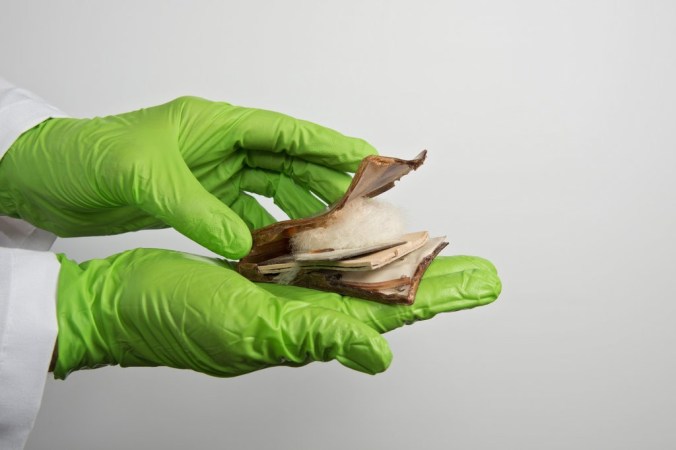
Dr. Odile Madden, of the Getty Conservation Institute in Los Angeles, holding a piece of degrading plastic for use in trying out new methods of preservation. Credit Melissa Lyttle for The New York Times

The irony of the need to conserve aging national treasures or works of art configured from plastics and other petroleum-based materials in the time of the “Pacific Vortex” and other plastic-created environmental disasters is difficult to miss. It never would have occurred to any of us that a field called “Plastics Conservation Science” has any need to exist.

And yet, it does…

These Cultural Treasures Are Made of Plastic. Now They’re Falling Apart.

Museum conservators are racing to figure out how to preserve modern artworks and historical objects that are disintegrating.

The custodians of Neil Armstrong’s spacesuit at the National Air and Space Museum saw it coming. A marvel of human engineering, the suit is made of 21 layers of various plastics: nylon, neoprene, Mylar, Dacron, Kapton and Teflon.

The rubbery neoprene layer would pose the biggest problem. Although invisible, buried deep between the other layers, the suit’s caretakers knew the neoprene would harden and become brittle with age, eventually making the suit stiff as a board. In January 2006, the Armstrong suit, a national treasure, was taken off display and stored to slow the degradation.

Of an estimated 8,300 million metric tons of plastic produced to date, roughly 60 percent is floating in the oceans or stuffed in landfills. Most of us want that plastic to disappear. But in museums, where objects are meant to last forever, plastics are failing the test of time.

“It breaks your heart,” said Malcolm Collum, chief conservator at the museum. The Armstrong suit’s deterioration was arrested in time. But in other spacesuits that are pieces of astronautical history, the neoprene became so brittle that it shattered into little pieces inside the layers, their rattling a brutal reminder of material failure.

Art is not spared either, as Georgina Rayner, a conservation scientist at Harvard Art Museums, showed at the American Chemical Society’s national meeting in Boston this month.

Claes Oldenburg’s “False Food Selection,” a wooden box containing plastic models of foods like eggs and bacon, a banana and an oatmeal cookie, now appears to be rotting. The egg whites are yellowing, while the banana has completely deflated.

In museums, the problem is becoming more apparent, Dr. Rayner said in an interview: “Plastics are reaching the end of their lifetimes kind of now.”

Of all materials, plastics are proving to be one of the most challenging for conservators. “I find plastics very frustrating,” said Mr. Collum. Because of the material’s unpredictability and the huge variation in forms of deterioration, he said, “it’s just a completely different world.”

Continue reading

A Time and Place for the Public Service Announcement

One of the many Advocacy Priorities of the National Association of Clean Water Agencies (NACWA)

While indoor plumbing is more or less taken for granted, not everything that can flush, should. Thanks to the NYTimes for clarifying the basics.

Should I Flush It? Most Often, the Answer Is No

It might seem harmless at first: a thread of dental floss tossed in the toilet, a contact lens swirling down the drain of the bathroom sink. But even the tiniest of items can contaminate waterways.

The small fragments of plastic contact lenses are believed to be contributing to the growing problem of microplastic pollution. Pharmaceuticals, which are also frequently flushed down the drain, have been found in our drinking water, and the consequences are not fully known.

Larger products like wipes and tampons are also clogging sewer systems, resulting in billions of dollars in maintenance and repair costs.

Wondering what’s safe to flush or wash down the drain? We spoke with several wastewater management experts who explained why many frequently disposed items belong in a garbage can, not the toilet. Continue reading

Immigrants Get The Job Done, And Then Some

merlin_138352845_f571bf2c-060d-424c-93b6-afdaa2d56fe8-superJumbo.jpg

Hamdi Ulukaya, the founder and chief executive of Chobani, arrived in the United States 24 years ago with $3,000 to his name. He now runs a company with annual sales of $1.5 billion.CreditCole Wilson for The New York Times

A few contributors on this platform are children of immigrants. Some are immigrants. And we love Greek yogurt. And we love a good shepherd to riches story. So, why not celebrate one of our own, so to speak?

Hamdi Ulukaya of Chobani Talks Greek Yogurt and the American Dream

A Turkish immigrant of Kurdish descent, Mr. Ulukaya brought Greek yogurt to the mainstream. Along the way, he began hiring refugees, a move that drew threats from fringe websites and far-right commentators.

Hamdi Ulukaya arrived in the United States in 1994 with $3,000 in his pocket. He was an immigrant from Turkey, hoping to learn English and find his way in a new country.

Today, Mr. Ulukaya is a billionaire. Chobani, the Greek yogurt maker he founded in 2007, has annual sales of about $1.5 billion, and Mr. Ulukaya owns most of the privately held company. Continue reading

Europe And The Race To Car Electrification

ElectricCars.jpg

Thanks to Adam Vaughan and the Guardian for this update on this race:

Electric cars exceed 1m in Europe as sales soar by more than 40%

Milestone reached nearly a year after China but ahead of the US

3963.jpg

Between January and June around 195,000 plug-in cars were sold across the EU, Iceland, Liechtenstein, Norway and Switzerland. Photograph: Miles Willis/Getty Images for Go Ultra Low

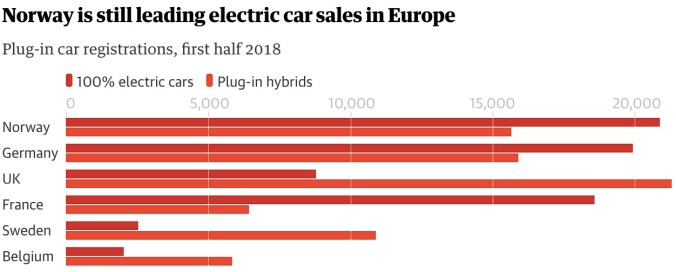
There are now more than a million electric cars in Europe after sales soared by more than 40% in the first half of the year, new figures reveal.

Europe hit the milestone nearly a year after China, which has a much larger car market, but ahead of the US, which is expected to reach the landmark later this year driven by the appetite for Tesla’s latest model.

Between January and June around 195,000 plug-in cars were sold across the EU, Iceland, Liechtenstein, Norway and Switzerland, a 42% increase on the same period a year before. Continue reading