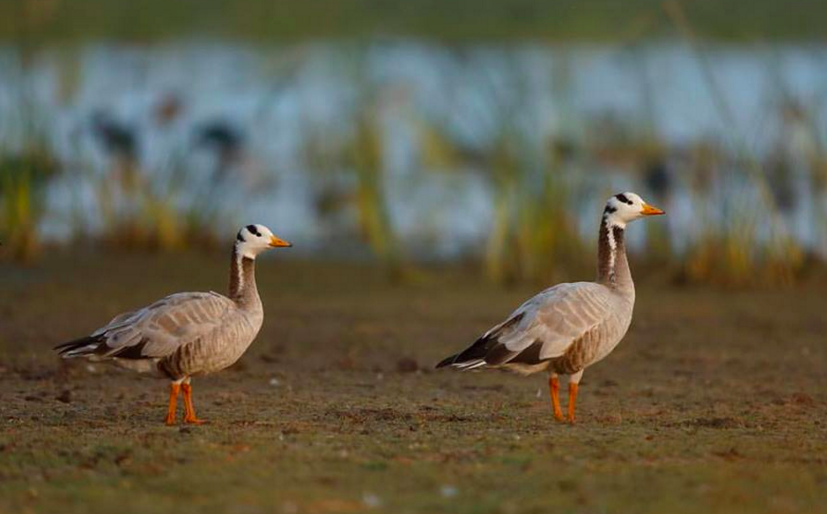
Little Rann of Kutch, Gujarat
Little Rann of Kutch, Gujarat

Alexandre Antonelli references the International Plant Names Index to identify specimens.
Rose Lincoln/Harvard Staff Photographer
Our practice was born in Costa Rica, so we sometimes may appear partisan when it comes to celebrating the sciences related to biodiversity. Costa Rica has impressive credentials in that realm, especially relative to its size as a country. But we are very clear on the fact that it would take dozens of Costa Rica-sized biodiversity hotspots to match the scale of the Amazon region, and it is no surprise that studies like those of these scholars are carried out with Amazonian data:
The Amazon as engine of diverse life
“Most evolutionary research focuses on how new species form. But we want to understand how whole ecosystems evolve,” said Alexandre Antonelli.
Rose Lincoln/Harvard Staff PhotographerA recent study says that many of the plants and animals that call Latin America home may have had their roots in the Amazon region.
The study, co-authored by Harvard Visiting Scholar Alexandre Antonelli and an international team of researchers, says that a dynamic process of colonization and speciation led to the formation of the American tropics, which is the most species-rich region on the planet. The study is described in a paper published in the Proceedings of the National Academy of Sciences.
“We were astonished to detect so much movement across such different environments and over such large distances,” said Antonelli, the study’s lead author. “Up until now, these natural dispersal events were assumed to be quite rare. Our results show how crucial these events have been in the formation of tropical America’s unique and outstandingly rich biodiversity.” Continue reading
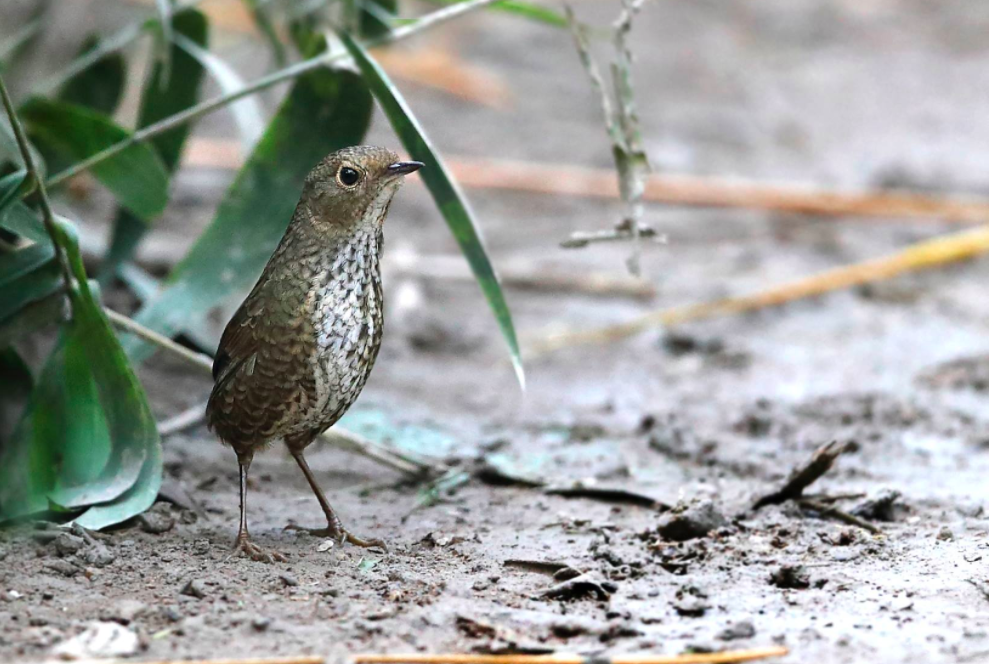
Jim Corbett Tiger Reserve, Uttarakhand

A “hunger stone” exposed by the low level of water in the Elbe river is seen in Decin, Czech Republic, on Thursday. The low level of water caused by the recent drought has exposed the stones on the river bed. Petr David Josek/AP
Thanks to National Public Radio (USA) for this:
Drought In Central Europe Reveals Cautionary ‘Hunger Stones’ In Czech River
People visit a famous “hunger stone” exposed by the low level of water in the Elbe river in Decin, Czech Republic, on Thursday. Petr David Josek/AP
A lengthy drought in Europe has exposed carved boulders, known as “hunger stones,” that have been used for centuries to commemorate historic droughts — and warn of their consequences.
The Associated Press reports that hunger stones are newly visible in the Elbe River, which begins in the Czech Republic and flows through Germany.
“Over a dozen of the hunger stones, chosen to record low water levels, can now be seen in and near the northern Czech town of Decin near the German border,” the AP writes. Continue reading

Sunderbans National Park, West Bengal

Switching to LEDs has been estimated to save consumers up to £112 a year. Photograph: imageBroker/Rex/Shutterstock
Arthur Neslen at the Guardian shares the news, in Europe to ban halogen lightbulbs, that we have been waiting to hear for years:
After nearly 60 years of lighting homes halogens will be replaced with more energy efficient LEDs
After nearly 60 years of brightening our homes and streets, halogen lightbulbs will finally be banned across Europe on 1 September.
The lights will dim gradually for halogen. Remaining stocks may still be sold, and capsules, linear and low voltage incandescents used in oven lights will be exempted. But a continent-wide switchover to light-emitting diodes (LEDs) is underway that will slash emissions and energy bills, according to industry, campaigners and experts.
LEDs consume five times less energy than halogen bulbs and their phase-out will prevent more than 15m tonnes of carbon emissions a year, an amount equal to Portugal’s annual electricity usage. Continue reading
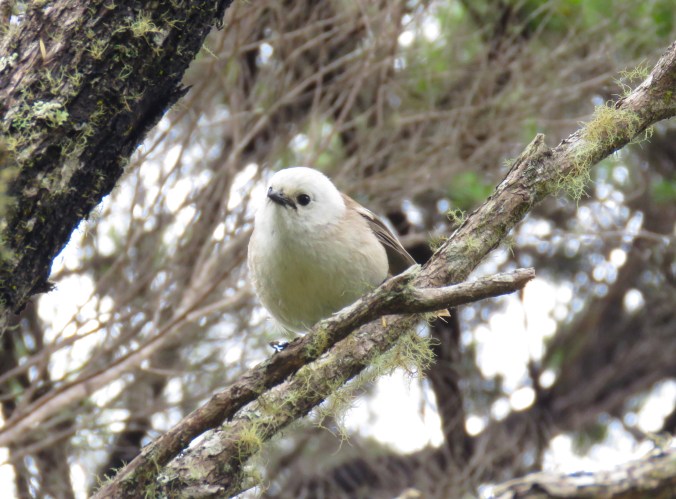
Rangitoto Island, New Zealand

Heidi Younger
The Blue Orchard Bee recently came to our attention thanks to Natalie Boyle. However, it seems the species has some competition as potential saviors of the farming industry. This article by Catherine M. Allchin, Honeybees Are Hurting. What Else Can Pollinate Our Food?, illustrates how…
…The dominant pollinator is under siege, straining the business of farming. Now growers are turning to alternative species to help their crops.
Jim Freese grows apples, pears and cherries on 45 acres in the north-central part of this state, on sagebrush-studded land his grandfather bought in 1910.
Walking among trees laden with shiny red cherries, Mr. Freese recalled that four years ago his trees were not producing well and his farm was financially struggling. Like many growers, he had been relying on rented honeybees to pollinate his cherry trees every spring, along with wild bees and other insects.
But that year, spring was expected to be cool. “Honeybees will just sit in the hive in cooler weather,” Mr. Freese said. He needed a way to ensure more flowers would develop into fruit than in the past.
At a horticulture meeting, he learned that blue orchard bees — a native species that doesn’t make honey or live in hives — could be used to supplement honeybee pollination. Blue orchard bees will fly at cooler temperatures.
Mr. Freese bought 12,000 cocoons and set them in his orchard to emerge when the trees bloomed. His investment paid off. “We doubled our cherry production from any previous record year,” he said.
His wife, Sandee Freese, said: “The little bees have been a godsend.”…
Continue reading
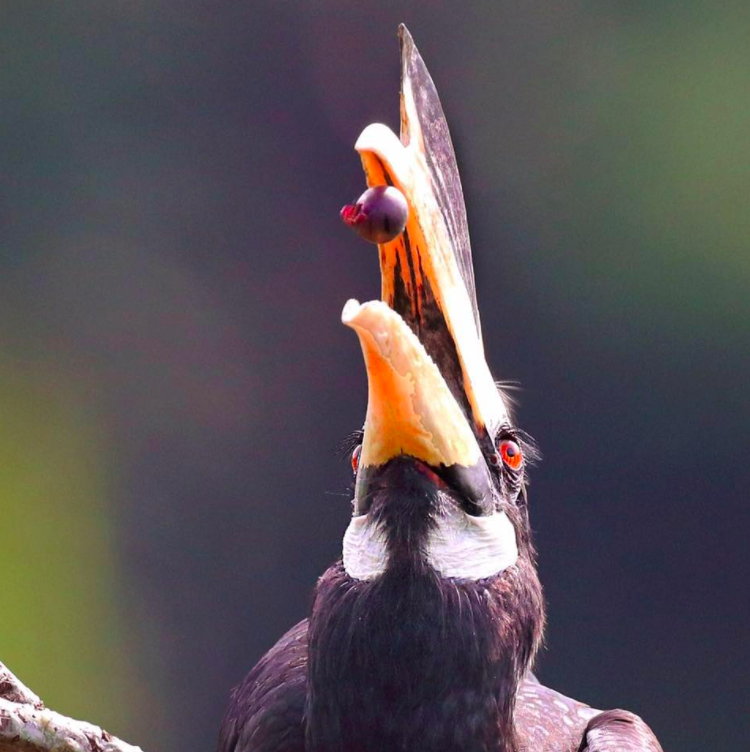
Mapusa, Goa
WIKIMEDIA COMMONS
In a perfect dovetail with yesterday’s nod to one science writer, today we nod to the contributions of ancestral ways in helping scientists better understand the life cycles of forests. Thanks to Richard Schiffman for this interview:
Lessons Learned from Centuries of Indigenous Forest Management
In an interview with Yale Environment 360, botanist Charles M. Peters discusses how, in an era of runaway destruction of tropical forests, the centuries-old ecological understanding of indigenous woodland residents can help point the way to the restoration of damaged rainforests.
Over centuries, even millennia, indigenous communities have developed interdependent systems of agriculture and forestry that are uniquely suited to the ecological requirements of the land they inhabit. Yet even today, says Charles M. Peters, the Curator of Botany at the New York Botanical Gardens, that skill and knowledge often remain unacknowledged, with some government officials and conservationists arguing that indigenous communities should sometimes be excluded from protected lands that are part of their historical territory.
Members of the Kenyah Dayak indigenous group conducting forest surveys in Western Borneo in the early 1990s. CHARLES PETERS
In an interview with Yale Environment 360, Peters — author of the recently published book, Managing the Wild: Stories of People and Plants and Tropical Forests — discusses what he has learned from 35 years of working with indigenous forest communities; explains how indigenous farming, even slash-and-burn agriculture, can actually improve forest health; and reflects on the need to enlist indigenous groups as allies in the struggle to preserve and restore tropical forests. Continue reading
male – Baja California Sur, Mexico

 Science writing has been one of our favorite themes since we started this platform. The quality with which science is explained in clear language is good for the planet, we think. Carl Zimmer is probably the most cited science writer during these eight years, for good reason. The interview above from late 2016, if you are convinced about the importance of science writing, is about as good as it gets for hearing a master explain his craft in very personal terms. It was recorded just weeks after the most fateful (with regard to science) presidential election in recent USA history. Zimmer takes a “just the facts” approach to the interview, and neither punches, nor pulls punches, with regard to the environmental and other science policy mess-making that had just begun. He just shares his craft.

Carl Zimmer: ‘Heredity is central to our existence… but it’s not what we think it is.’ Photograph: Mistina Hanscom/Lotta Studio
He has a new book out, which we have not read, but we are glad that it has brought him out on book tour. In the interview below, from just a couple weeks ago, we get a quick read on what he is saying now:
Carl Zimmer is a rarity among professional science writers in being influential among the scientists on whose work he writes and comments – to the extent that he has been appointed as professor adjunct in the department of molecular biophysics and biochemistry at Yale University. Zimmer has just published his 13th book, She Has Her Mother’s Laugh, a survey of “the power, perversions and potential of heredity”. Continue reading
Boston, Massachusetts

Will Nissen’s bees north of Bakersfield, Calif. Credit Ilona Szwarc for The New York Times
Thanks to Jaime Lowe for this:
The Super Bowl of Beekeeping
Almond growing in California is a $7.6 billion industry that wouldn’t be possible without the 30 billion bees (and hundreds of human beekeepers) who keep the trees pollinated — and whose very existence is in peril.
Honeybees on a removable frame from a bee box in the Central Valley. Credit Ilona Szwarc for The New York Times
Every February, white petals blanket first the almond trees, then the floor of the central valley, an 18,000-square-mile expanse of California that begins at the stretch of highway known as the Grapevine just south of Bakersfield and reaches north to the foothills of the Cascades. The blooms represent the beginning of the valley’s growing season each year: Almond trees are first to bud, flower and fruit. At the base of the trunks sit splintered boxes — some marked with numbers, some with names, some with insignias — stacked two boxes high on a wooden pallet that fits four stacks. Inside the boxes are bees, dancing in circles and figure-eights and sometimes just waggling. With almond season comes bee season. Everyone in the valley knows when it’s bee season. There are bee-specific truckers; motels occupied by seasonal workers; annual dinners to welcome the out-of-towners; weathered pickups with license plates from Montana, North Dakota, South Dakota, Texas and Florida parked in front of orchards at all hours of the night. And those ubiquitous boxes. Continue reading
Leimhakong, Manipur
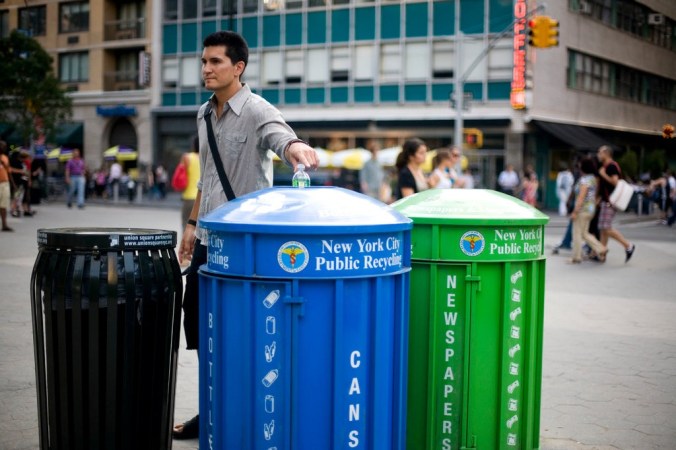
Color-coordinated waste baskets for waste recycling in New York City. Credit Ramin Talaie/Corbis, via Getty Images
Thanks for this interview full of incisive interview quetions by David Bornstein, who is co-founder of the Solutions Journalism Network, which supports rigorous reporting about responses to social problems. Thanks to Mitch Hedlund, executive director of Recycle Across America, for the explanatory answers in the interview that follows:
The Conflict of Interest That Is Killing Recycling
Some of the biggest recycling operations are owned by landfill companies whose profits improve when recycling doesn’t work well.
Mitch Hedlund, executive director of Recycle Across America. Credit Shelly Mosman/Recycle Across America
In the past few years, one of the core pillars of the environmental movement — recycling — has fallen on hard times. News dispatches reveal hundreds of cities and counties scaling back their recycling programs because of the high costs associated with processing recyclables and the lack of demand for the materials. A new conventional wisdom is gaining ground suggesting that recycling may not be worth the effort.
But is that true? And has recycling ever gotten a fair shake? After decades, less than a third of municipal solid waste is recycled — and much of that is contaminated with garbage, which diminishes or destroys its value. Almost 50 years after the first Earth Day, are we really ready to admit defeat and return to the “Mad Men”-era ethos of the “throwaway society”?
There may be another way. For most of the past decade, Recycle Across America, a nonprofit organization I covered in this column six years ago, has been demonstrating that it’s quite possible to get people to recycle properly, just as it’s possible to get most people to wear seatbelts, quit smoking and stop driving drunk. But the recycling industry has never taken the logical steps needed to create a successful societywide recycling habit — and today it may not be in the economic interest of some of the big recycling companies to build it. Recently, I spoke with Mitch Hedlund, the founder of Recycle Across America, about this dilemma and the possibility that a recycling collapse can be avoided. Continue reading

Carara National Park, Costa Rica
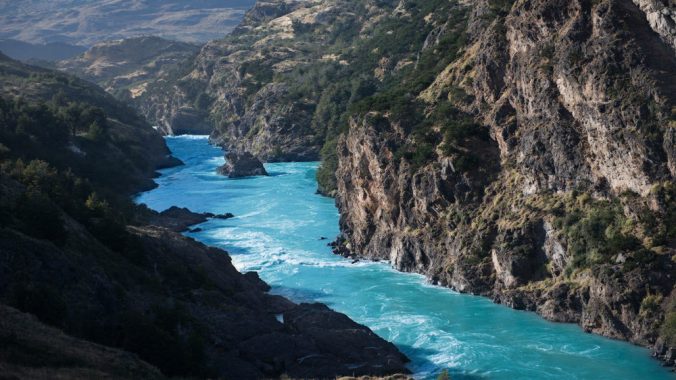
The free-flowing Baker River in Chile’s Patagonia region. Permits for a major hydroelectric project on the waterway were revoked in 2014 amid protests. LOUIS VEST/FLICKR
Dams in Patagonia are the gift that keep on giving, in terms of awakening activism and forcing raised awareness of the value of waterways. I first mentioned my experience in Chile here. I came back to the idea a few more times. Thanks to Jens Benohr and Patrick Lynch for this reminder, and for letting us all know where this seems headed from a legal point of view:
Should Rivers Have Rights? A Growing Movement Says It’s About Time
Inspired by indigenous views of nature, a movement to grant a form of legal “personhood” to rivers is gaining some ground — a key step, advocates say, in reversing centuries of damage inflicted upon the world’s waterways.
A Chilean energy company is seeking permits to restart the building of an unfinished dam along the San Pedro River. CARLOS LASTRA
Chile is a land of rivers. Along its narrow 3,000-mile length, thousands of rivers and wetlands bring freshwater and nutrients down from the Andes Mountains to the Pacific Ocean. Together, these river systems drain 101 major watersheds that support both terrestrial and marine ecosystems, ranging from arid lands in the north to blue whale nurseries off of Patagonia in the south.
Chile’s second-longest river, the 240-mile Biobío, once tumbled fast and wild through deep gorges and spectacular scenery on its way from the Andes to the sea. The Biobío was one of the world’s great whitewater rafting venues — until the 1990s, when the first of three large hydroelectric dams was built across the river. Over the past two decades, the Biobío dams have flooded more than 13,000 acres, displaced hundreds of families of the indigenous Mapuche people, turned long stretches of this once-unruly river into placid reservoirs, and caused abrupt fluctuations in water levels that have wrecked nesting habitat for native birds and disrupted the river’s natural rhythms. Continue reading
Jekyll Island, Georgia, USA
We love all creatures great and small, even (we try as best we can) the pesky ones. It is not because we are generous, though we hope we are. It is because we see their value. For hopefully obvious reasons, pollinators are our favorite bees. Our lives depend on them. That is why we have featured dozens of stories about them. Thanks to National Public Radio (USA) for this one:
Watch This Native Pollinator Build Her Bee-Jeweled Nest
A female blue orchard bee forages for nectar and pollen on Phacelia tanacetifolia flowers, also known as blue or purple tansy. Blue orchard bees are solitary bees that help pollinate California’s almond orchards. Josh Cassidy/KQED
While honeybees and their buzzing hives and hyper-fertile queens get all the press for pollinating our food supply, the hard-working blue orchard bee is one of 4,000 bee species native to North America that does its solitary work in relative obscurity. That is, until now.
In the video, you can see how this bee builds its nests, alternating mud and a purple nectar-pollen mixture in hollow, skinny spaces. The blue orchard bees are preparing a purple lunch box of sorts for their offspring so they have food to eat in the tunnel. The blue orchard bees’ work looks more like jewelry or even scoops of trendy ube ice cream than a nest. Continue reading




 Organikos