
Estero San Jose, Baja California Sur, Mexico
Estero San Jose, Baja California Sur, Mexico
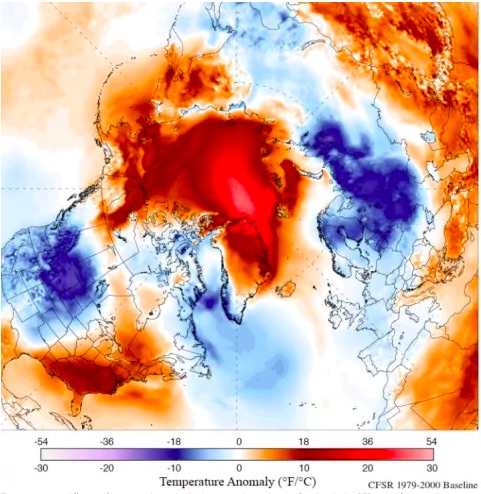
The temperature difference from normal over the Arctic averaged over the next five days in the GFS model forecast. (University of Maine Climate Reanalyzer)
Is it cataclysm or is it a rendering of what we already thought we knew? In case you missed it, there was some startling news that came with this image to the left, that does not look like anything we have ever seen. And the article starts like this:
While the Eastern United States simmers in some of its warmest February weather ever recorded, the Arctic is also stewing in temperatures more than 45 degrees above normal. This latest huge temperature spike in the Arctic is another striking indicator of its rapidly transforming climate.
On Monday and Tuesday, the northernmost weather station in the world, Cape Morris Jesup at the northern tip of Greenland, experienced more than 24 hours of temperatures above freezing according to the Danish Meteorological Institute. “How weird is that?” tweeted Robert Rohde, a physicist at the University of California at Berkeley. “Well it’s Arctic winter. The sun set in October and won’t be seen again until March. Perpetual night, but still above freezing.”
This thaw occurred as a pulse of extremely mild air shot through the Greenland Sea.
Warm air is spilling into the Arctic from all sides. On the opposite end of North America, abnormally mild air also poured over northern Alaska on Tuesday, where the temperature in Utqiaġvik, previously known as Barrow, soared to a record high of 31 degrees (minus-1 Celsius), 40 degrees (22 Celsius) above normal. [continue to the article]
Alarming? We think so. Clear? We do not think so. Eric Lach, Deputy News Editor at The New Yorker, has this brief helpful interpretation, with a much easier to understand illustration:
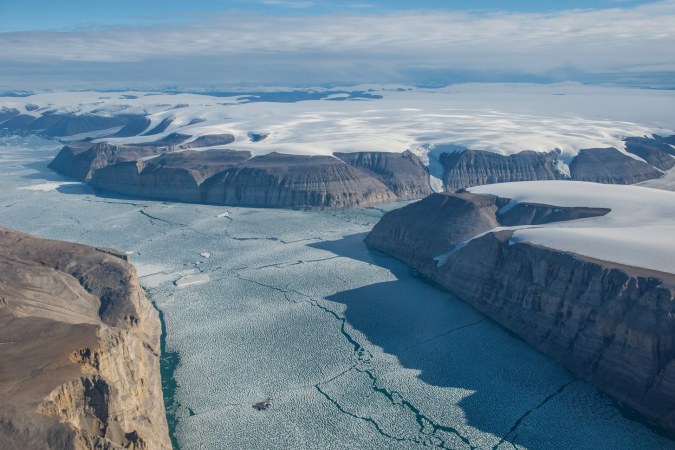
Many media outlets now regularly cover instances of extreme weather in remote corners of the world. How should readers understand these reports? Photograph by Esther Horvath / Redux
How to Read Today’s Big Climate-Change Headline
This week brought news from the Arctic. “Arctic temperatures soar 45 degrees above normal, flooded by extremely mild air on all sides,” the Washington Post declared, in a headline. The article below that headline detailed how, on Monday and Tuesday, at the northern tip of Greenland, temperatures rose above freezing for a full twenty-four-hour period—extremely unusual for this time of year—while temperatures across “the entire Arctic north of 80 degrees latitude have averaged about 10 degrees (6 Celsius) above normal since the beginning of the calendar year.”
All sorts of media outlets now regularly cover instances of extreme weather in remote corners of the world. And yet how should readers understand these reports? Are the ups and downs of climate change something to follow in the newspaper, like the Mets or the Yankees? [continue to the post]
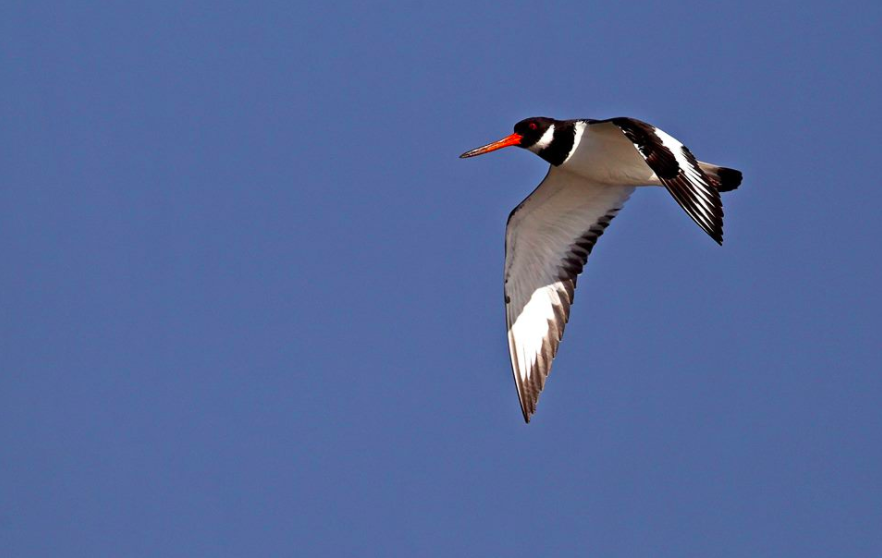
Bada, Gujurat
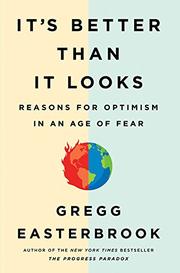 If you only have a minute, this will do, courtesy of Kirkus Review (read the remaining couple paragraphs of that review by clicking on the book cover to the left):
Cheer up, world: we’re killing each other less, except in our cars, and living in a boom. Thus this contrarian pep talk by longtime Atlantic contributor Easterbrook (The Game’s Not Over: In Defense of Football, 2015, etc.).
Optimism is out of style, but by the author’s account, it shouldn’t be. When Donald Trump came into office, the unemployment rate was low enough that the number “would have caused economists of the 1970s to fall to their knees and kiss the ground.”…
But in less than half an hour you can get the author’s spoken digest of the book here:

And if that interests you, and you want more but not the whole book, try this, courtesy of Carnegie Council for Ethics in International Affairs:

Baja California Sur, Mexico
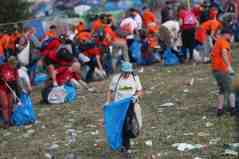
The cleanup … Glastonbury 2017. Photograph: Matt Cardy/Getty Images
This headline in the Guardian–Glastonbury festival set to ban plastic bottles in 2019—accompanying the photo to the right is well timed for me:
Emily Eavis says festival is working on ‘enormous project’ to ban plastic bottles on site when it returns after year off in 2018
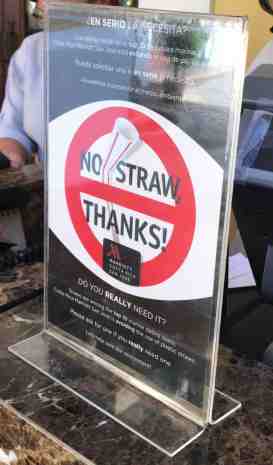 That story continues after the jump, but I want to add to this post an image I just photographed when visiting the Costa Rica Marriott Hotel San Jose that was built more than two decades ago. Amie and I were friends with the managers of that property from the mid- to late-1990s, but had lost track of what this property has been up to lately. And I was very happy to learn today that they have recently earned five leaves in the CST program, whose board of directors I served on in the mid- to late-1990s. Bravo, Marriott! And as I snapped this photo, I was told that starting next month this property will have no straws, even if someone says they “really need one” (as the text on the sign says near the bottom). Double bravo!
We have reported on efforts in India, during our years there, to reduce noise pollution using similar signage. Whoever designed this sign for the Marriott property in Costa Rica was thinking along the same lines, graphically speaking. While I am in Costa Rica this week, I hope to have more to report, but for now, back to Glastonbury: Continue reading
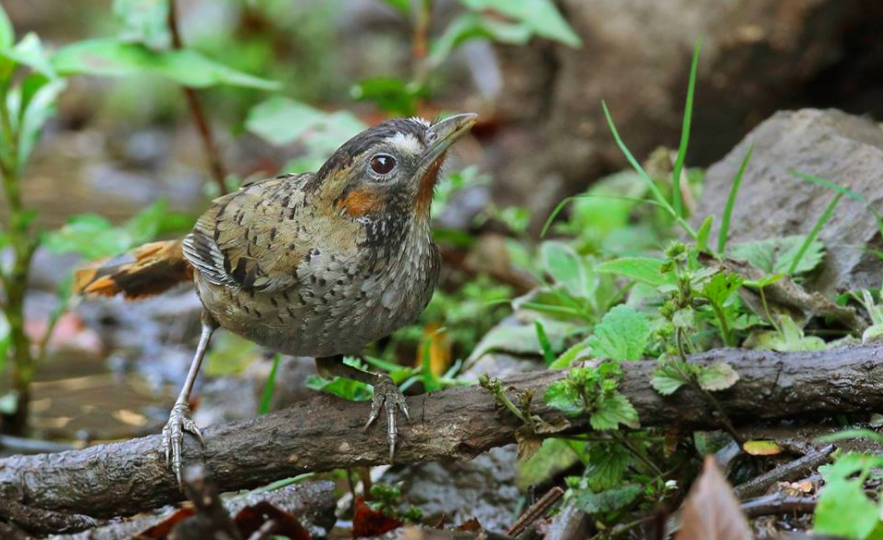
Pangot, Uttarakhand
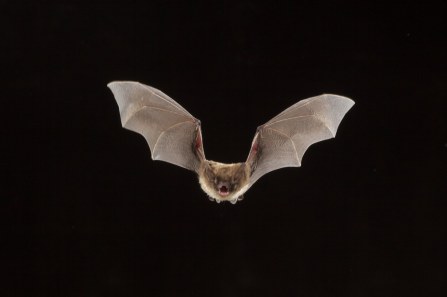
Since white-nose syndrome was first identified, just twelve years ago, it has spread to thirty-one states. The consequences—for bats, humans, and the U.S. economy—could be disastrous. Photograph by Michael Durham / Minden Pictures / Getty
Once you see the photo to the left, more than likely you will bypass this post. We have found this over dozens of occasions when we have posted about this animal. But think twice; read this first (thanks to J. R. Sullivan, an editor for Men’s Journal writing on the New Yorker website):
Late last summer, the biologist Mark Gumbert began flying over the farmlands of Iowa, looking for bats. As the animals foraged and moved through the night, he followed from above, circling the rivers and fields in his single-engine Cessna 172, trying his best not to lose the signals from their transmitters. Over the past decade or so, Gumbert has pioneered the study of bat migrations using radio telemetry, a method of wildlife tracking typically reserved for caribou, moose, and other big game, which tend to travel at moderate speeds. “A wolf running across the ground can move pretty quick, but they’re not going to run all night,” Gumbert told me recently. A bat, on the other hand, can be nearly impossible to trail on foot or by truck. Gumbert and his team at Copperhead Environmental Consulting were the first to observe an entire migration from the air, and they have since conducted surveys in New York, North Carolina, Ohio, Tennessee, West Virginia, and elsewhere. But the project that brought Gumbert to Iowa was unlike any he had undertaken before—tracking the northern long-eared bat, Myotis septentrionalis, a species that is among those most threatened by a dangerous fungal disease called white-nose syndrome. Continue reading

Dinokeng Game Reserve, Pretoria, SA
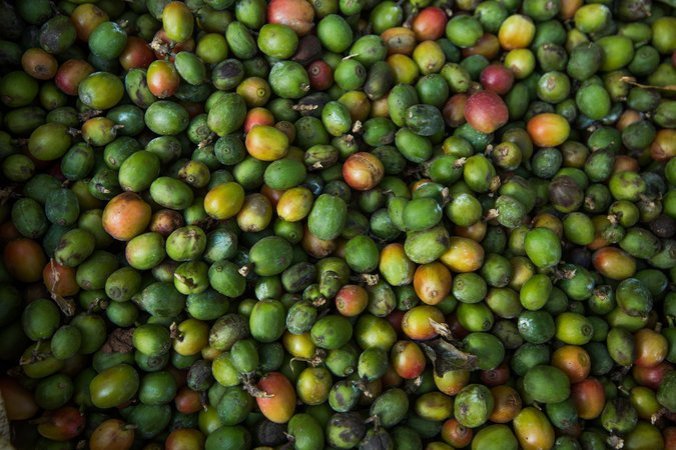
Ah, our favorite trifecta of the 2010-2017 era: coffee and birds and India! (Not to mention that the 2 species of birds featured in the article have graced this site in our Bird of the Day feature!) Just because we are back in Costa Rica does not mean the topics covered in this article are any less important to us. Thanks to Karen Weintraub for this:
Coffee Beans Are Good for Birds, Fancy Brew or Not
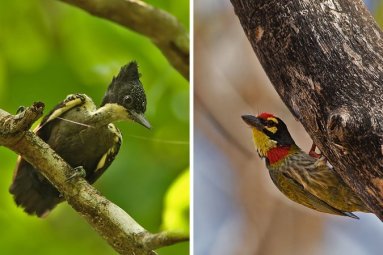
Left, a heart-spotted woodpecker. Right, a coppersmith barbet bangalore. Credit Left, Ramki S.; Right, Shashank Dalvi
Birds are not as picky about their coffee as people are.
Although coffee snobs prefer arabica beans to robusta, a new study in India found that growing coffee does not interfere with biodiversity — no matter which bean the farmer chooses.
In the Western Ghats region of India, a mountainous area parallel to the subcontinent’s western coast, both arabica and robusta beans are grown as bushes under larger trees — unlike in South America, where the coffee plants themselves grow as large as trees, said Krithi Karanth, who helped lead the study, published Friday in the journal Scientific Reports. Continue reading

Great Rann of Kutch

The Garden Court at Southdale Shopping Center, Edina, Minnesota, circa 1965 Minnesota Historical Society
When Malls Saved the Suburbs From Despair
Like it or not, the middle class became global citizens through consumerism—and they did so at the mall.
“Okay, we’ll see you in two-and-a-half hours,” the clerk tells me, taking the iPhone from my hand. I’m at the Apple Store, availing myself of a cheap smartphone battery replacement, an offer the company made after taking heat for deliberately slowing down devices. A test run by a young woman typing at a feverish, unnatural pace on an iPad confirms that mine desperately needed the swap. As she typed, I panicked. What will I do in the mall for so long, and without a phone? How far the mall has fallen that I rack my brain for something to do here. Continue reading

Lake Titicaca, Peru

lillisphotography / Getty / Emily Jan / The Atlantic
We do not normally link to the writing of science fiction authors, nor is the topic of the essay below typical of the themes in our 2011-2018. But it is not unheard of; nor is it too late to add more to this short thread of links to sci-fi authors. If Bruce Sterling catches your attention with these first few paragraphs pasted below, you may want to go to The Atlantic to read the rest:
Stop Saying ‘Smart Cities’
Digital stardust won’t magically make future cities more affordable or resilient.
The term “smart city” is interesting yet not important, because nobody defines it. “Smart” is a snazzy political label used by a modern alliance of leftist urbanites and tech industrialists. To deem yourself “smart” is to make the nimbyites and market-force people look stupid.
Smart-city devotees all over this world will agree that London is particularly smart. Why? London is a huge, ungainly beast whose cartwheeling urban life is in cranky, irrational disarray. London is a god-awful urban mess, but London does have some of the best international smart-city conferences.
London also has a large urban-management bureaucracy who emit the proper smart-city buzzwords and have even invented some themselves. The language of Smart City is always Global Business English, no matter what town you’re in.
So if grand old London is smart, with its empty skyscrapers, creepy CCTV videocams, and sewers plugged with animal fat, then we probably needn’t fret about the Elon Musk sequins and stardust of digital urbanism. Better to reimagine the forthcoming urban future as a mirror of Rome, that “Eternal City,” where nothing much ever gets tech-fixed, but everything changes constantly so that everything can remain the same. Continue reading
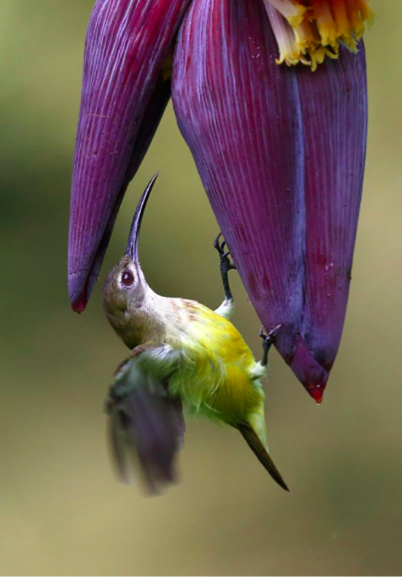
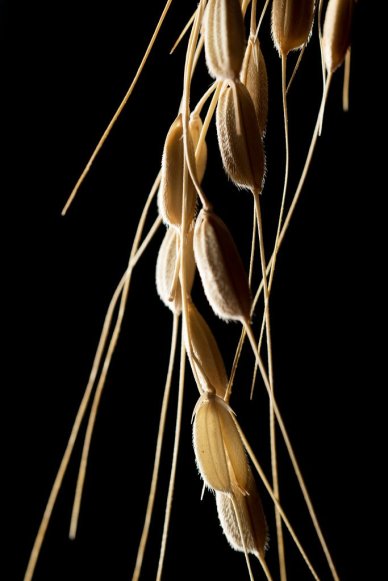
Upland red bearded rice, which grows in the Moruga district in Trinidad, turned out to be a missing culinary link between enslaved people in coastal Georgia and a group of slaves who were able to buy their freedom by fighting for the British in the War of 1812. Credit Karsten Moran for The New York Times
Our interest in rice was not simply because we started this platform while carrying out work in south India, where rice is central to life. We learned during those years that rice is as 1493 a food item as any, with footprints in each major region of the world. Kim Severson has been featured in our pages twice before, both times for food-related history. Now, she brings us a gem of a story titled Finding a Lost Strain of Rice, and Clues to Slave Cooking:
CHARLESTON, S.C. — Among the biologists, geneticists and historians who use food as a lens to study the African diaspora, rice is a particularly deep rabbit hole. So much remains unknown about how millions of enslaved Africans used it in their kitchens and how it got to those kitchens to begin with.
That’s what made the hill rice in Trinidad such a find.
The fat, nutty grain, with its West African lineage and tender red hull, was a favored staple for Southern home cooks during much of the 19th century. Unlike Carolina Gold, the versatile rice that until the Civil War was America’s primary rice crop, the hill rice hadn’t made Lowcountry plantation owners rich off the backs of slaves.
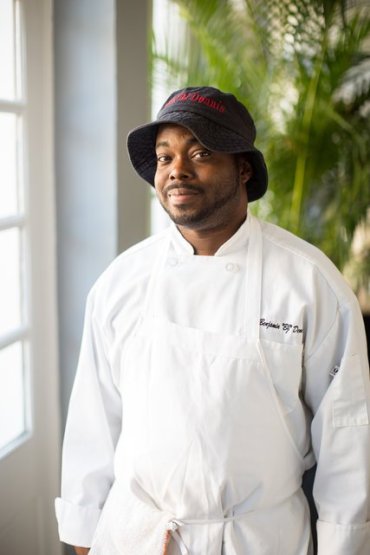
B.J. Dennis, a chef in Charleston, S.C., has dedicated himself to tracing Gullah-Geechee heritage through food. He traveled to Trinidad and found rice that could be traced back to slaves in coastal Georgia. Credit Hunter McRae for The New York Times
It didn’t need to be planted in watery fields surrounded by dikes, which meant that those who grew it weren’t dogged by malaria. You could grow it in a garden patch, as did many of the slaves who had been taken from the rice-growing regions of West Africa. This was the rice of their ancestors, sustaining slaves and, later, generations of Southern cooks both black and white.
Even Thomas Jefferson was a fan. Some researchers think he is the one who helped spread hill rice throughout the South, giving gifts of the African seed from a 30-gallon cask a ship captain brought him from Africa in 1790. But by World War I, the rice had all but disappeared, a victim both of cheaper imports that were easier to produce and of the Great Migration, in which millions of African-Americans left the rural South.
That’s why B.J. Dennis, a Gullah chef from Charleston, was stunned to find the rice growing in a field in Trinidad, tended by a farmer descended from slaves who once lived in Georgia. Continue reading

Mad Island Marsh Preserve, Matagorda, TX
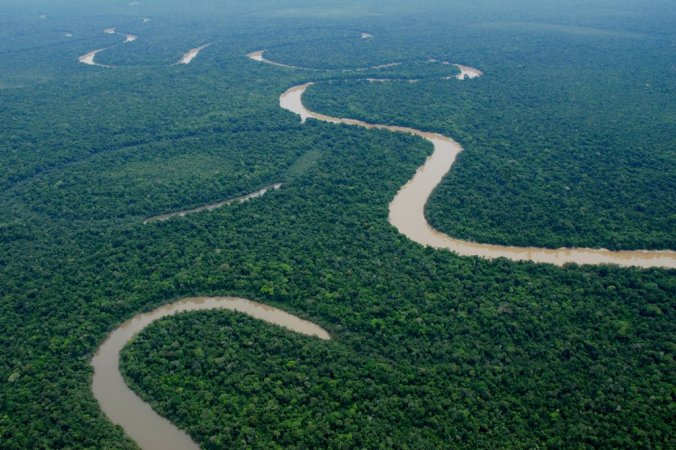
The Yaguas River of the Yaguas National Park in Peru, one of the Western Hemisphere’s newest national parks. Credit Álvaro del Campo/The Field Museum
Thanks to JoAnna Klein, whose article on a lionfish initiative in Florida a couple years ago put her on our radar; we have linked to her stories many times since. This story below is arguably the most profound, in terms of scale:
Peru Moves to Protect ‘One of the Last Great Intact Forests’
A parrot snake, also called the Amazonian palm viper (Bothriopsis bilineatus). Credit Álvaro del Campo/The Field Museum
While the United States may be weakening protections for wilderness, the creation of Yaguas National Park protects millions of acres from development and deforestation.
The remote rain forests in Peru’s northwest corner are vast — so vast that the clouds that form above them can influence rainfall in the western United States. The region contains species, especially unusual fish, that are unlike any found elsewhere on Earth. Scientists studying the area’s fauna and flora may gain insights into evolutionary processes and into the ecological health and geological history of the Amazon.
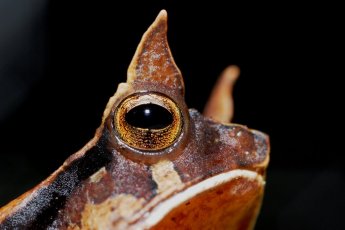
A beaked toad (Rhinella ceratophrys). Credit Álvaro del Campo/The Field Museum
Now the area has become home to one of the Western Hemisphere’s newest national parks. Yaguas National Park will protect millions of acres of roadless wilderness — and the indigenous people who rely on it — from development and deforestation.
“This is a place where the forest stretches to the horizon,” said Corine Vriesendorp, a conservation ecologist at The Field Museum in Chicago, one of many organizations that worked to win the national park designation, Peru’s highest level of protection. “This is one of the last great intact forests on the globe.” Continue reading

L- male; R- female
Mahananda Wildlife Sanctuary, West Bengal
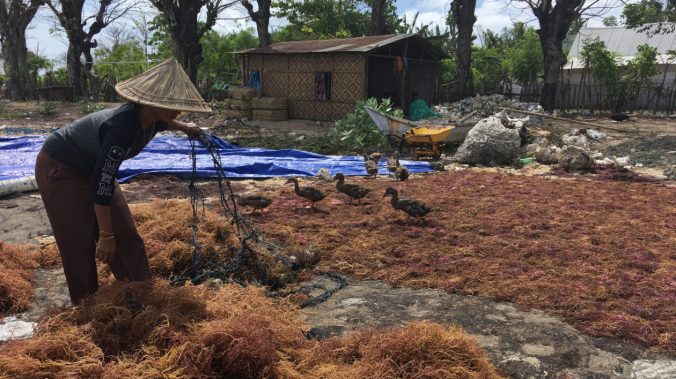
Seaweed harvesting in Takalar, Indonesia. Photo © Tiffany Waters / The Nature Conservancy
The subject of seaweed farming, which we sometimes refer to as kelp farming, is of keen interest to us because of the relationship to conservation; our thanks to Tiffany Waters at Cool Green Science:
Seaweed Farming: A Gateway to Conservation and Empowerment
Seaweed seedlings. Photo © Tiffany Waters / The Nature Conservancy
“What does your husband do while you’re working on the seaweed lines?”, we ask. She laughs and says in Bahasa, “He does the cooking and the cleaning.”
It’s day 6 of our field visit to Indonesia and we’re in Takalar visiting our fifth island and third seaweed farm of the trip. On the brink of the ‘extreme season,’ stifling hot is an understatement, but the light breeze from the Flores Sea provides a welcome break from the three flights and 2-hour van trip that brought us here. Continue reading

 Organikos