Agripreneurship On The Rise

This exciting project came to our attention a little over a year ago, and we’re excited to see that it’s going full steam ahead!

This is an Embark Fellowship campaign. If we raise our target, Brown University will donate $25,000 to our project!

What’s up with fish?

The world’s population is growing rapidly, and the global demand for animal protein—from fish to poultry, beef, and pork— is growing with it. But there’s a problem: animal feeds are made from wild-caught fish like anchovies and sardines. These fish are caught using highly destructive fishing methods that result in unintentional by-catch and the destruction of coral reefs. One third of global fish catch doesn’t go towards direct human consumption; it goes to feeding animals. As a result, more than 85% of the world’s fisheries are exploited. We are feeding fish to other animals, and it doesn’t make sense.

Meanwhile, the world’s population is increasing rapidly and is projected to hit 9.7 billion by 2050. We desperately need a new way to feed a growing population that is not at odds with the health of our oceans.

Meet the black soldier fly.
Continue reading

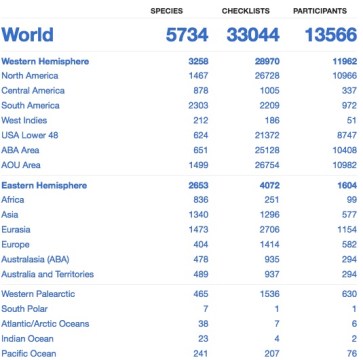
Global Big Day 2017, Results

GBD2017b.jpg

When I left Team Sapsucker late last night it was pouring rain, a perfect punctuation to the day, telling them to stay under cover on Chan Chich’s deck since no bird would be out in the deluge. They were reviewing their lists, waiting to see if the rain would pass, allowing one final outing of the 24-hour period. I did not ask the final number, but I could tell they were happy with the day.GBD2017Result

As I type this at 5am the rain has long since stopped, the early birds are out in full sonic force, competing with the howler monkeys it seems, and results on eBird’s website look impressive. My eye is drawn to the Central America numbers. Partly because I moved to the region two decades ago and have worked in each country. Partly also because the region has embraced its ornithological importance, and yesterday provided one more metric for that embrace. But mainly, because I am here in Belize and the Lab team we had here was exactly as expected, not only as birders but as people.

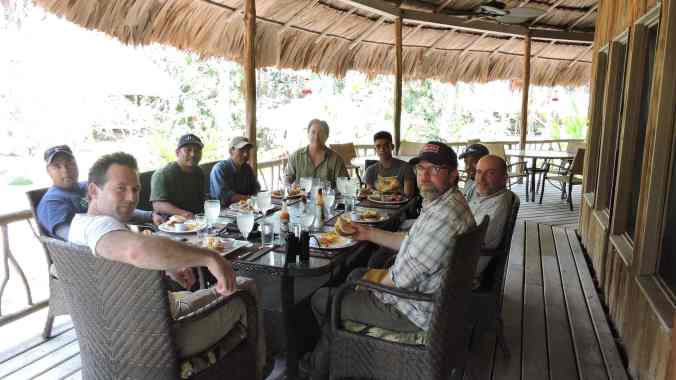
The Chan Chich guide team had an amazing day with the Team Sapsucker on Friday, and over lunch that day they all celebrated several firsts, the details of which escape me now, but they involved two new species being added to Chan Chich’s list on eBird (a big deal) and our guide Ruben adding a life list bird that day to his nearly two decades of birding accomplishments at the Lodge.

GBD@CCL.jpg

The Lab team explained the rules of the game for the following day. No assistance of any kind would be possible after midnight. Continue reading

GrowFood Carolina

how-growfood-works.png

I am always on the lookout for simple but effective graphics illustrating ideas that we attempt to put into action in our various projects–why reinvent the wheel? By rabbit hole good fortune, after I was referred to the Coastal Conservation League as a regional leader in entrepreneurial conservation for the southeastern USA, one of their programs, as illustrated above and described in words below, came to my attention:

The Conservation League started its Food and Agriculture program in 2007 with the goal of protecting South Carolina’s small, family farms. Between 1992 and 1997, more than 200 acres of rural land were converted every day to urban uses, placing South Carolina in the top ten states in the nation for rural land loss. We quickly realized that small farmers lacked access to the infrastructure available to industrial farms, and were therefore unable to say “no” when a developer offered to buy their land. The League saw a food hub as critical to our work protecting rural landscapes and improving quality of life across the coastal plain. Continue reading

Winged Muses

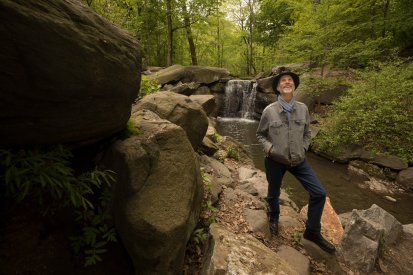
13BIRDMUSIC-superJumbo.jpg

The composer John Luther Adams in Central Park, listening for his winged muses. Credit James Estrin/The New York Times

Occasionally we have reason to think of muses; every day we think of birds. Today birds are the muse. We have linked to this composer’s work once previously, and I am happy with the coincidence of reading again about this composer on Global Big Day in this review by Michael Cooper, Listen to ‘Ten Thousand Birds’ and Its Warbling, Chirping Inspirations:

New York is not usually considered a naturalist’s paradise. But John Luther Adams, the Pulitzer Prize-winning composer and former environmental activist, did not have to walk far from his Harlem apartment this week to be serenaded in Morningside Park and Central Park by choirs of robins, sparrows, flickers, catbirds and, finally, a wood thrush, with its poignant “ee-o-lay” song.

”That’s the one that started it all for me, 40-however-many years ago,” Mr. Adams, 64, said as he paused in a sun-dappled spot in Central Park’s North Woods to savor the wood thrush’s melody. Continue reading

Environmentalism, It’s Just Good Business

Solar panels at the Googleplex, headquarters of Google in Mountain View, Calif. Its data centers worldwide will run entirely on renewable energy by the end of this year, the technology giant announced in December. Credit Smith Collection/Gado, via Getty Images

Although the current administration may be cloaking themselves in a fog of denial, we’re happy to read that much of corporate America is staying the course of their own emissions goals.

Nearly half of the Fortune 500 biggest companies in the United States have now set targets to shrink their carbon footprints, according to a report published Tuesday by environmental organizations that monitor corporate emissions pledges. Twenty-five more companies adopted climate targets over the last two years, the groups said.

Almost two dozen companies, including Google, Walmart and Bank of America, have pledged to power their operations with 100 percent renewable energy, with varying deadlines, compared with just a handful in 2015. Google’s data centers worldwide will run entirely on renewable energy by the end of this year, the technology giant announced in December.

“We believe that climate change is real, and it’s a severe crisis,” said Gary Demasi, who directs Google’s energy strategy. “We’re not deviating from our goals.” Continue reading

Introducing The Team Prepping For Global Big Day At Chan Chich Lodge

GBD1On day two in Belize with Team Sapsucker introductions are due. The photo to the left, taken at about 5am today in front of Chan Chich Lodge’s reception area, shows two of them. The best information I could find to share with you about Andrew Farnsworth is on Songbird SOS Productions, where he says:

“I like the challenge of trying to figure out how to go birding when there’s a traffic jam on first avenue. It’s cool to be able to study birds in a city… Some people have seen technology as the end of all things natural, but there’s a whole other side to it that gives us access to a world that we would otherwise not have seen.” Continue reading

More Remarkable Thought Superbly Communicated

I was impressed enough the first time I heard him that I have been on the lookout for more. This was another hour well spent hearing his deep historical perspective:

How do we make sense of today’s political divisions? In a wide-ranging conversation full of insight, historian Yuval Harari places our current turmoil in a broader context, against the ongoing disruption of our technology, climate, media — even our notion of what humanity is for. This is the first of a series of TED Dialogues, seeking a thoughtful response to escalating political divisiveness. Make time (just over an hour) for this fascinating discussion between Harari and TED curator Chris Anderson.

Cruise Ships Rarely Bring Good Tidings

Kujawinski-Cruise-Ships-Arctic-1200.jpg

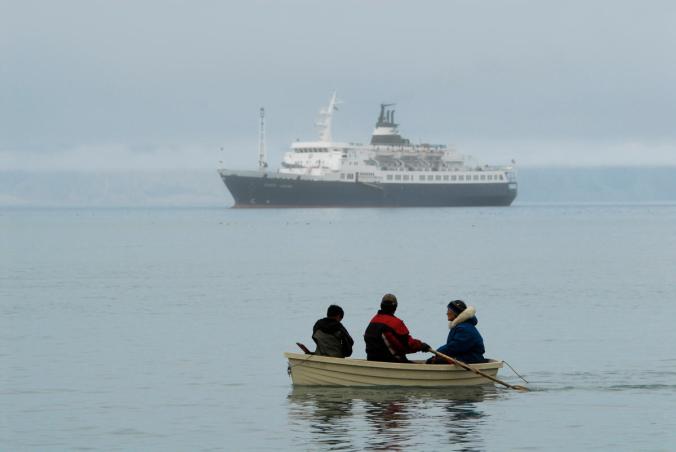
The presence of cruise ships in the Northwest Passage is among the dilemmas that climate change is creating for Canada’s Inuit people amid their struggle to balance environmental and economic concerns. PHOTOGRAPH BY KIKE CALVO / REDUX

It is our view, based on news reports like this that appear constantly in myriad variations from around the world, that with few exceptions cruise ships are problematic. Here is just one more datapoint:

THE COMPLICATED RELATIONSHIP BETWEEN CRUISE SHIPS AND THE ARCTIC INUIT

Last summer, the Crystal Serenity, a luxury cruise ship, embarked on a monthlong voyage through the Northwest Passage, the sea route that winds through Canada’s Arctic archipelago. The Serenity, which can accommodate more than a thousand passengers, headed through the same waters as had H.M.S. Resolute, which, in August of 1853, set out to rescue a group of British explorers and ended up trapped in the ice for the better part of a year. The Arctic Ocean is warmer than it was a hundred and sixty-three years ago, and the Crystal Serenity, accompanied by a British icebreaking vessel, made the voyage without dire incident. It is the largest cruise ship to sail through the Northwest Passage, and its voyage signalled the economic changes that are coming to the vast region as a result, in part, of climate change. Continue reading

Lost Rice, Found Alive

image005_custom-74fcf2c593047698233b11f237300862d88e143a-s1400-c85.jpeg

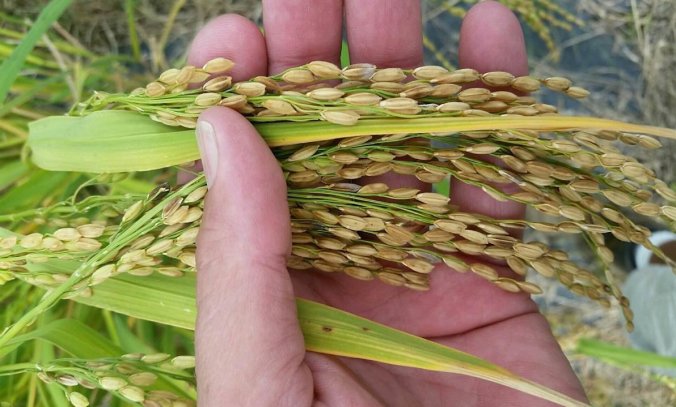
An upland rice strain. Courtesy of Brian Ward

Thanks to the salt and National Public Radio (USA) for this story about the strain of a grain means so much to billions of people around the world:

A grain of rice, like a grain of sand, sifts through your hands with a mysterious and lovely sameness. Mostly white or tan, hundreds or thousands of grains pour smoothly out of buckets, out of burlap, into bowls, with a sound like small waterfalls. Rice seems so simple, really. And yet, because it plays a central role in world cuisines, these modest grains can carry the weight of history. Sometimes that history is deeply surprising. Continue reading

Another Hirst Heist?

Head

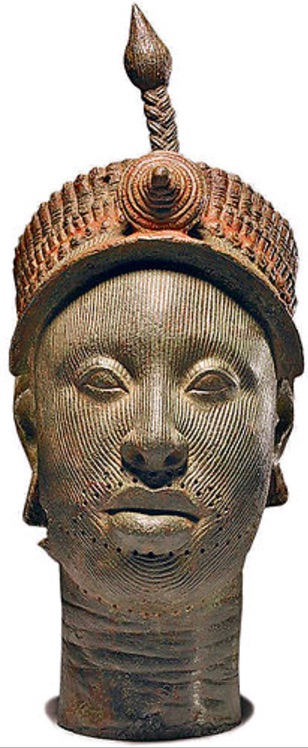
HEAD OF IFE
Brass statue, from Nigeria (A.D. 1400-1500)
“It is one of a group of 13 heads, superbly cast in brass, all discovered in 1938 in the grounds of a royal palace in Ife, Nigeria, which astonished the world with their beauty. They were immediately recognized as supreme documents of a culture that had left no written record, and they embody the history of an African kingdom that was one of the most advanced and urbanized of its day.’’
Credit: Trustees of the British Museum

The first podcast I ever listened to was this one, back earlier in this decade.World100 Although neither the BBC nor the British Museum is maintaining the website, it is still there. I recommend getting ahold of the podcast that you can find here among other places.

Object #63 did not particularly stand out more than any of the others chosen for this innovative historical exhibit that I listened to without visual cues. But I do remember it because the description was as vivid as any (pasted after the jump). So, I am sorry to be reminded of this piece again due to the modern world’s confused and confusing approach to art as represented by this so-called bad boy (aka fraud), who is still at his naughty ways according to this news item today:

There’s controversy in Venice for Damien Hirst, the British artist who has occasionally drawn accusations that his pieces are not always wholly original but inspired by others’ work.

At the Venice Biennale this week, the Nigerian artist Victor Ehikhamenor accused Mr. Hirst of copying a well-known ancient Nigerian brass artwork, “Head of Ife,” found in 1938 in Ife, Nigeria, without giving it the proper historical recognition it deserves. Continue reading

Model Mad, Down Under

John Church in Hobart in September 2010. He is known internationally for helping to bring statistical and analytical rigor to longstanding questions about sea level rise. Credit Peter Boyer

We continue to keep our eyes open for stories that offer inspiration even in the face of apparent adversity.

A Parable From Down Under for U.S. Climate Scientists

HOBART, TASMANIA — John A. Church, a climate scientist, did not look or sound like a man who had recently been shoved out of a job.

Speaking softly and downing coffee at an outdoor cafe in this old port city, he sounded more like a fellow fresh off a jousting match. “I think we had a win — a bigger win than I ever anticipated,” Dr. Church said in an interview last month.

Australian climate science went through an upheaval last year, one that engaged the press and the public in defending the importance of basic research. In the end, Dr. Church did indeed lose his job, but scores of his colleagues who had been marked for layoffs did not. Some of them view him as having sacrificed his career to save theirs.

What happened in Australia shows the power of an informed citizenry keeping watch on its government. And it may turn out to be a precursor to an attack on fundamental climate research in the United States.

Continue reading

Free Will, An Idea We Normally Do Not Question

Sapolsky.jpgThanks to WNYC, a radio station that has innovated the proliferation of the podcast with shows like Radiolab, for all that it brings to our attention on a regular basis. Seems strange to say it, but one reason we listen, related to the reasons why share on this platform and more broadly explaining (we think) why we do what we do: we choose to do all this because we care and our free will allows us the choice to do this rather than other things.

I cannot remember the last time I thought about free will, it is so obvious and taken for granted. So thanks also to WNYC for old school interviewers like Leonard Lopate, who also shine in the podcast ecosystem. His show is how I came to know of this new book, which led to my (surprised) thinking now about free will. Click the image above to go to the half-hour conversation. It motivated me to find out more. In addition to this 2009 TED Talk this brief interview in the newsfeed of his university is a compelling soundbite on a very  after listening to the broad-ranging topics of the WNYC conversation:

Stanford biologist Robert Sapolsky ponders the best and worst of us, plus free will

With the publication of his latest book, Robert Sapolsky tackles the best and worst of human behavior and the nature of justice in the absence of free will. Continue reading

Sound, Noise & Wilderness

lead_960c

I’m sorry, what was that? Ints Kalnins / Reuters

Sound is often profound. Noise often annoys. Thanks as always to Ed Yong, touching on a topic we have been sensitive to for some time now:

A Not-So-Silent Spring

Even America’s protected areas are being subjected to harmful levels of noise pollution.

If a tree falls in the forest, and there’s no one around, the National Park Service will still hear it. Continue reading

Communicating An Idea Clearly

yuval8.jpg

When I followed a link to a recording of his lecture, which happened after reading a review of his book, I could not yet have answered clearly as I can now an important question related to Yuval Noah Harari. Is it the core idea, or is it how he communicates that is more compelling? Yesterday I read this op-ed of his in the Guardian and it was as sticky for the last 24 hours as what I heard in that lecture in March, but perhaps not because of the idea.

I say this because the future he describes, in which artificial intelligence is pervasive and essential to the sense of value guiding our lives, is not one I am immediately attracted to, to put it mildly (I say this surrounded by a half million acres of very real forest and very real wildlife and a community of wonderfully real people with whom I enjoy hosting other wonderfully real visitors). And yet the argument he makes, and specifically the structure and description he uses for that argument, are compelling. And worth a few minutes of reading:

Most jobs that exist today might disappear within decades. As artificial intelligence outperforms humans in more and more tasks, it will replace humans in more and more jobs. Many new professions are likely to appear: virtual-world designers, for example. But such professions will probably require more creativity and flexibility, and it is unclear whether 40-year-old unemployed taxi drivers or insurance agents will be able to reinvent themselves as virtual-world designers (try to imagine a virtual world created by an insurance agent!). Continue reading