Kenya Burns Over 100 Tons of Illegal Ivory

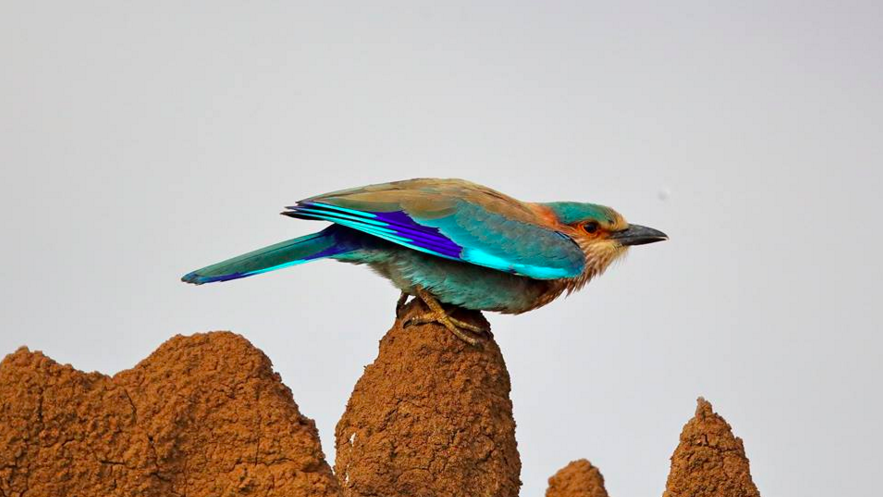
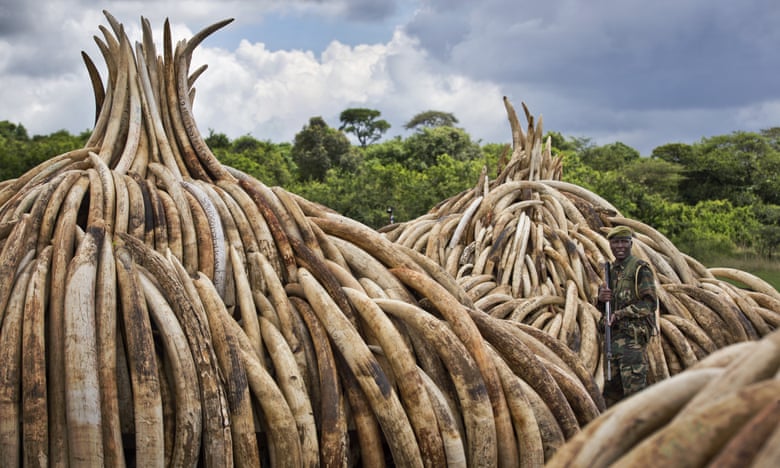
Kenya will burn about 105 tonnes of elephant ivory and 1.5 tonnes of rhino horn in 11 large pyres, about seven times the amount previously burned in a single event. Photograph: Ben Curtis/AP via The Guardian

We featured poaching a few weeks ago here, in the case of primates, and we have discussed the illegal ivory trade and other endangered wildlife on the black market before. This weekend, Fiona Harvey reports for the Guardian, Kenya burned a massive amount of tusks from poached elephants, in a symbolic act of destruction that presumably cost the black market millions of dollars, and thousands of elephants their lives:

Tusks from more than 6,000 illegally killed elephants will be burned in Kenya on Saturday, the biggest ever destruction of an ivory stockpile and the most striking symbol yet of the plight of one of nature’s last great beasts.

The ceremonial burning in Nairobi national park at noon will be attended by Kenya’s president, Uhuru Kenyatta, heads of state including Ali Bongo Ondimba of Gabon and Yoweri Museveni of Uganda, high-ranking United Nations and US officials, and charities. A wide network of conservation groups around the world have sent messages applauding the work.

Continue reading

Must-Read Editorial

01fagin-blog427

Thanks to the New York Times for carrying this in prominent placement:

A Mine vs. a Million Monarchs

In recent years, Angangueo’s 5,000 inhabitants have been cursed by calamities natural and manufactured. Snowstorms, mudslides and flash floods have terrorized the town. Hulking piles of mine tailings line the main road, barren reminders of the silver, gold and copper mining that petered out a quarter-century ago after defining the community for 200 years.

Even the monarch butterflies that are the focus of the “magic town” tourism campaign are suffering. Millions still roost on nearby mountains, a wintertime spectacle that attracts the visitors from “El Norte” who are the town’s economic lifeline. But the overwintering population of monarchs has fallen by almost two-thirds over the past dozen years, and this year’s better-than-usual aggregation was abruptly devastated in March by another freak snowstorm, the worst in years. Continue reading

Photos Worth Viewing

131057014004857876_ruben_salgado_escudero_spain_3rd-place_professional_portraiture_2016_1.pr-fdd94b9ac90bcf41006731d34441184f9bd48803-s1400-c85

A young man from Bali, Indonesia, shows off his rainbow-colored rooster before a cockfight. Courtesy of Ruben Salgado Escudero and the World Photography Organization

Thanks to National Public Radio (USA) for reminding us that it is that time of the year, again, when Sony culls through hundreds of thousands of entries to narrow the field down to a handful of exceptional photos:

6 Sensational Photos From A Global Contest With 230,000 Entries

One photo of a pensive Congolese woman in her distinctive makeup could be mistaken for a Renaissance painting. Another, of a coal plant sending smoke plumes over a town in China, looks like a still from a 1950s propaganda film. And another, of a little girl yawning during an Indonesian festival, will just make you smile. Continue reading

Discovering Gold in the Greater Antilles (Part 2)

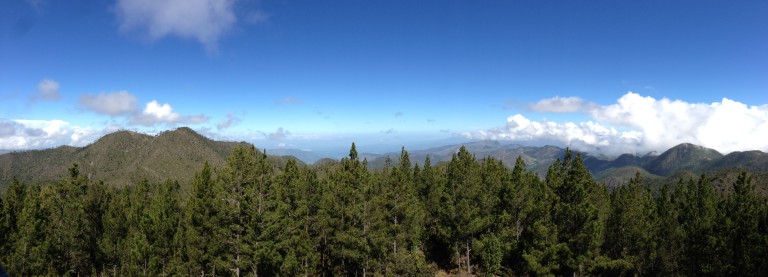
View of Parque Valle Nuevo from the top of the Pajon Blanco Fire Tower; Dominican Republic.

This post follows a previous piece, which you can read here.

And so we set out on an adventure of a lifetime with the underlying goal of studying a bird and using what we learned to help save that bird, while simultaneously nourishing an already burgeoning sense of local stewardship over Hispaniola’s feathered friends and the habitats they so deeply depend upon. We set the bar high from the beginning, and I can be honest in saying that I feel good about what we accomplished and where the project stands today.

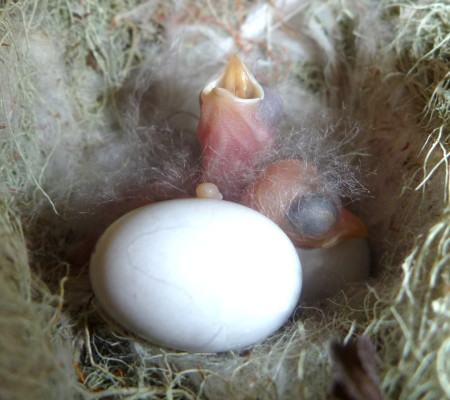
Two Golden Swallow chicks have just hatched. One begs for food, one contemplates life, and one refuses to come out; Parque Valle Nuevo, Dominican Republic, 2014.

However, as opposed to trying to tackle an impossible play-by-play of what transpired over those next three years (thankfully all of that information is in my master’s thesis and can be yours for just three easy payments of $29.99), I’m going to take a slightly different approach. I’m going to share with descriptions of images (and feelings) that go through my head when somebody kindly asks me, “So how’d that Golden Swallow Project go?” Little does that person know how much weight a question like that can have, or how it causes me to temporary black-out as my mind boards a high-speed emotional (and perhaps somewhat spiritual) roller-coaster from which there is little hope for return for at least the ensuing two minutes. So let’s go for a ride.

Continue reading

Library Charisma

01COLORADO1-master768

An old sheep barn and loafing sheds will one day house books. Credit Allison Amend

It has not been long since our last linkage out to a “library love” story. But this one is combined with a travel/journey and a conservation ethos–themes we enjoy seeing addressed together. Worth a read, thanks to the Travel section of the New York Times:

I am perched on a slippery roof ridge at the Buffalo Peaks Ranch in the rain, feet sliding on ancient asphalt shingles atop rotting plywood decking, tethered only by a rope. For fun.

With me on the roof are five other volunteers who are donating their time and brawn to create a live-in rural library in Colorado, helping the booksellers Jeff Lee and Ann Martin realize their dream.

In the course of their 20 years at the independent Denver bookstore Tattered Cover, Mr. Lee and Ms. Martin have accumulated more than 32,000 volumes on the American West (my first novel, “Stations West,” is among them). Seeking to share the books, and their love of Colorado, the pair, who are married, have leased the Buffalo Peaks Ranch, about two hours from Denver, to house their collection. Continue reading

Purity Is Never Out Of Date

germanbeer_custom-b386ef6cf1c1b0762fcba4c0b18588f8df0b00ef-s1400-c85

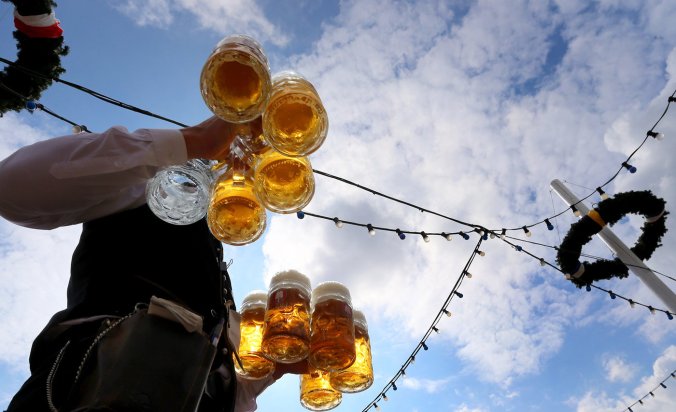
A waiter carries beers at the Theresienwiese fair grounds of the Oktoberfest beer festival in Munich, southern Germany, last September. For centuries, a German law has stipulated that beer can only be made from four ingredients. But as Germany embraces craft beer, some believe the law impedes good brewing. Karl-Josef Hildenbrand/AFP/Getty Images

Laws can come and go, as far as we are concerned (and we get the point here), but purity remains forever of value (thanks to National Public Radio, USA):

Germany’s Beer Purity Law Is 500 Years Old. Is It Past Its Sell-By Date?

With more than 1,300 breweries producing some five-and-a-half thousand different types of beer, Germany is serious about the amber nectar. There’s even a word for it –bierernst – which means “deadly serious” and translates literally as “beer serious.”

This sober attitude applies particularly to the German beer purity law known as the Reinheitsgebot. Introduced in 1516 by Duke Wilhelm IV of Bavaria, the decree allows for only hops, barley, water and, later, yeast in every Stein. For 500 years, this recipe has served Bavaria very well, and for the last century, the rest of Germany. Continue reading

Macroentomotography

Composite image by Levon Biss via ThisIsColossal

About five years ago we featured a piece that coined the term “entomotography,” and we’ve been sharing stories about insects frequently since then; one was even closely related to this post and could have shared the title, of bees photographed close-up. The specimens shown below, however, are not single photos but actually composite images of thousands of shots in the best lighting for each angle, stitched together to create amazing results. Kate Sierzputowski writes for ThisIsColossal:

Commercial photographer Levon Biss typically shoots portraits of world-class athletes—sports players caught in motion. His new series however, catches subjects that have already been paused, insect specimens found at the Oxford Museum of Natural History. The series originally started as a side-project capturing the detail of bugs that his son would catch at home, and is now displayed at the museum in an exhibition titled Microsculpture.

Composite image by Levon Biss via ThisIsColossal

Continue reading

Speedier Retrofitting of City Buildings

Image by Shutterstock.com via Conservationmagazine.org

Lots of energy is wasted by buildings that don’t have appropriate insulation or efficient HVAC systems. We’ve shared stories on lower-impact construction, like this recent piece on passive homes, and Conservation Magazine now has an article on a new way to decide on the city scale what buildings to retrofit – replace old types of windows, switch out light bulbs, etc. – based on research in Massachusetts. Prachi Patel reports:

In 2015, buildings of all types accounted for 40 percent of all energy consumption in the U.S. and 20 percent of the nation’s carbon dioxide emissions. Retrofitting old, energy-inefficient structures with efficiency features will be key for reducing their large carbon footprint. Many cities and states offer substantial incentives to home and commercial building owners who make such upgrades.

But instead of offering incentives willy-nilly, cities could use a smarter way to get the biggest energy impact, researchers at Massachusetts Institute of Technology say. Some buildings are bigger energy-hogs than others. MIT professor of civil and environmental engineering Marta González and her colleagues have come up with a streamlined way to identify the culprits with the biggest room for improvements. Their simple model, published in the Journal of the Royal Society Interface, could help city planners identify buildings where retrofits will have the biggest effect on a city’s overall greenhouse gas emissions.

Continue reading

If You Happen To Be In Helsinki

Last year while doing one of our favorite work “responsibilities”, two of our team spent some time with guests at Xandari Harbour. The family happened to be from Finland, and one member of the family happened to be a composer of film scores and ballets. We’ve kept in touch, and they recently shared this amazing production of the Little Mermaid by the Finnish National Opera Ballet.

The blend of ballet, contemporary dance, unusual costuming and staging with 3D technology all merge to create an amazing staging of a creatively interpreted classic.

Click here or the photo for the evocative trailer…


Five Minutes Related To Taste

Screen Shot 2016-04-27 at 7.54.16 PM

By NATALIA V. OSIPOVA. Image by Joshua Thomas for The New York Times.

Thanks to the New York Times for continuing to reach for our attention (click above to go to the video):

Eduardo Rivera, a Mexican-born farmer living in Minnesota, is striving to make organic vegetables accessible to the Latino community.


The Intelligence Of Clever Animals

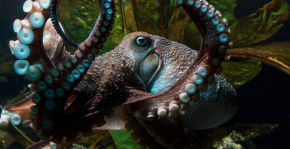
Riederer-Inky-the-Octopus-290x149-1461702146We are susceptible to stories that spotlight animal intelligence, and challenge our assumptions about the unique capacities of humans. Cleverness and intelligence can be difficult to parse, so the details of the story matters.  This one is better than most such stories for reasons we cannot quite explain:

Earlier this month, under the cover of night, an octopus named Inky hauled his basketball-sized body out of the tank he shared with a companion at the National Aquarium of New Zealand, heaved himself across the floor, and squeezed his gelatinous mantle into a narrow drain leading to the Pacific Ocean. Continue reading

Plants Attracting Pest Predators

Illustration by Dr. Otto Wilhelm Thomé via Wikimedia Commons

We’ve discussed ants living with plants in the past, actually in the context of acacia trees like Ed Yong mentions in his post. And there’s proof of plants sending pheromonal signals to wasps that will parasitize the caterpillars eating the plant’s leaves; this article in the NatGeo Phenomena blog reminds us of that:

Six years ago, Anke Steppuhn noticed that the bittersweet nightshade, when attacked by slugs and insects in a greenhouse, would bleed. Small droplets would exude from the wounds of its part-eaten leaves. At the same time, Steppuhn and her colleagues saw that the wild plants were often covered in ants.

These facts are connected. Steppuhn’s team from the Free University of Berlin, including student Tobias Lortzing, have since discovered that the droplets are a kind of sugary nectar, which the beleagured nightshade uses to summon ants. The ants, in return for their sweet meals, attack the pests that are destroying the plant. And this discovery provides important clues about the evolution of more intimate partnerships between ants and plants.

Continue reading

If You Happen To Be In Japan

27tb-fireflysquid1-superJumbo

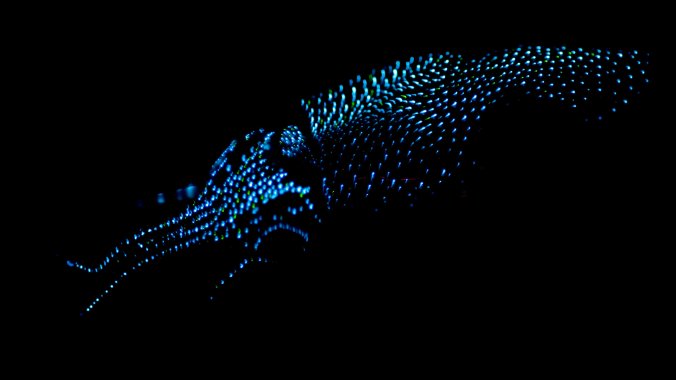
A firefly squid in Japan. The best time to see them is between March and June. Credit Michael Ready/Visuals Unlimited, Inc., via Getty Images

It is Science section day in the New York Times, and this story doubles as a travel recommendation:

Hop on a fishing boat in Toyama Bay, Japan, in the wee hours of the morning and you may feel as if you’re in a spaceship, navigating through the stars. That’s because each year, between March and June, millions of firefly squid transform the water into a galactic landscape. Lucky for you, all you need is a reservation to come aboard, your eyes and perhaps a really good camera.

The firefly squid may bring to mind a lightning bug. But the cephalopod is three inches long and flies through the sea, not the sky. And instead of a single light on its belly, it has five around each eye, three each on the tips of two of its arms and even more covering its body. Continue reading

South Australia’s Renewable Energy

Wind turbines at the Snowtown Facility.

Any story regarding the expansion and encouragement of renewables to promote sustainable development is a good story in our book, and we’re impressed by the Clean Energy Council policy manager’s statement, “If South Australia was a nation, it would be second only to Denmark [in renewables].” South Australia is a state in the middle of the southern coast of the country, about a hundred square miles larger than the US state of Texas, so it’s great to hear that such a large area relies so much on innovation. Kathy Marks reports for the Guardian:

In a state that leads the country – in fact, much of the world – in producing electricity from renewable sources, Snowtown is wind central. The first stage of a $660m, 270-megawatt farm, with 47 turbines, opened in 2008, 5km west of the town; the second, adding another 90 turbines, came on stream in 2014.

Developed by New Zealand’s Trustpower, South Australia’s biggest wind facility – and Australia’s second biggest – created hundreds of construction jobs and 21 permanent positions.

Continue reading

Good News for Manatees

Florida manatee Credit: Carol Grant/Getty Images via Scientific American

When we wrote about “sea-cows” before here it was in a post about water hyacinth. Now Scientific American is sharing some good news on the species that we weren’t aware about, with great increases in their population’s numbers. Sean Carroll reports:

Good news seems to be rare these days, and good news about the environment even rarer.

But in January this year, after fifty years on the endangered species list, the US Fish and Wildlife Service (FWS) proposed to remove the manatee as its numbers in Florida have increased 400% in the past 25 years. And just this month, the FWS proposed to delist the Greater Yellowstone grizzly population as the number of bears has increased from 136 in 1975 to about 700 today.

Continue reading