
One of Ethiopia’s many excellent national parks
This is not the post promised. It is a taste of why I must post, as promised. This canyon, this river, this view came early in our expedition and is among the strongest in my visual memory. It seemed fortunate, at the time, to catch this view at sunset but the more I think about it the more I am convinced that the place is worthy of a snapshot any time of the day. And it is worth making future visits, so next time I intend to navigate downriver (from the right in this photo), arriving at the place where I snapped this photo after hiking up the canyon. Continue reading

Aby Warburg (second from left) was the spirit behind the iconographic studies that dominated much of twentieth-century art history. CREDIT COURTESY THE WARBURG INSTITUTE
We mention and link to museums, and museum exhibits from time to time. For reasons related to our love and belief in libraries as essential institutions worthy of our civic support; but also related to our interest in entrepreneurial conservation.
Weird museum? Count us interested:
At first, the library of the Warburg Institute, in London, seems and smells like any other university library: four floors of fluorescent lights and steel shelves, with the damp, weedy aroma of aging books everywhere, and sudden apparitions of graduate students wearing that look, at once brightly keen and infinitely discouraged, eternally shared by graduate students, whether the old kind, with suède elbow patches, or the new kind, with many piercings. Continue reading
Serengiti, Tanzania
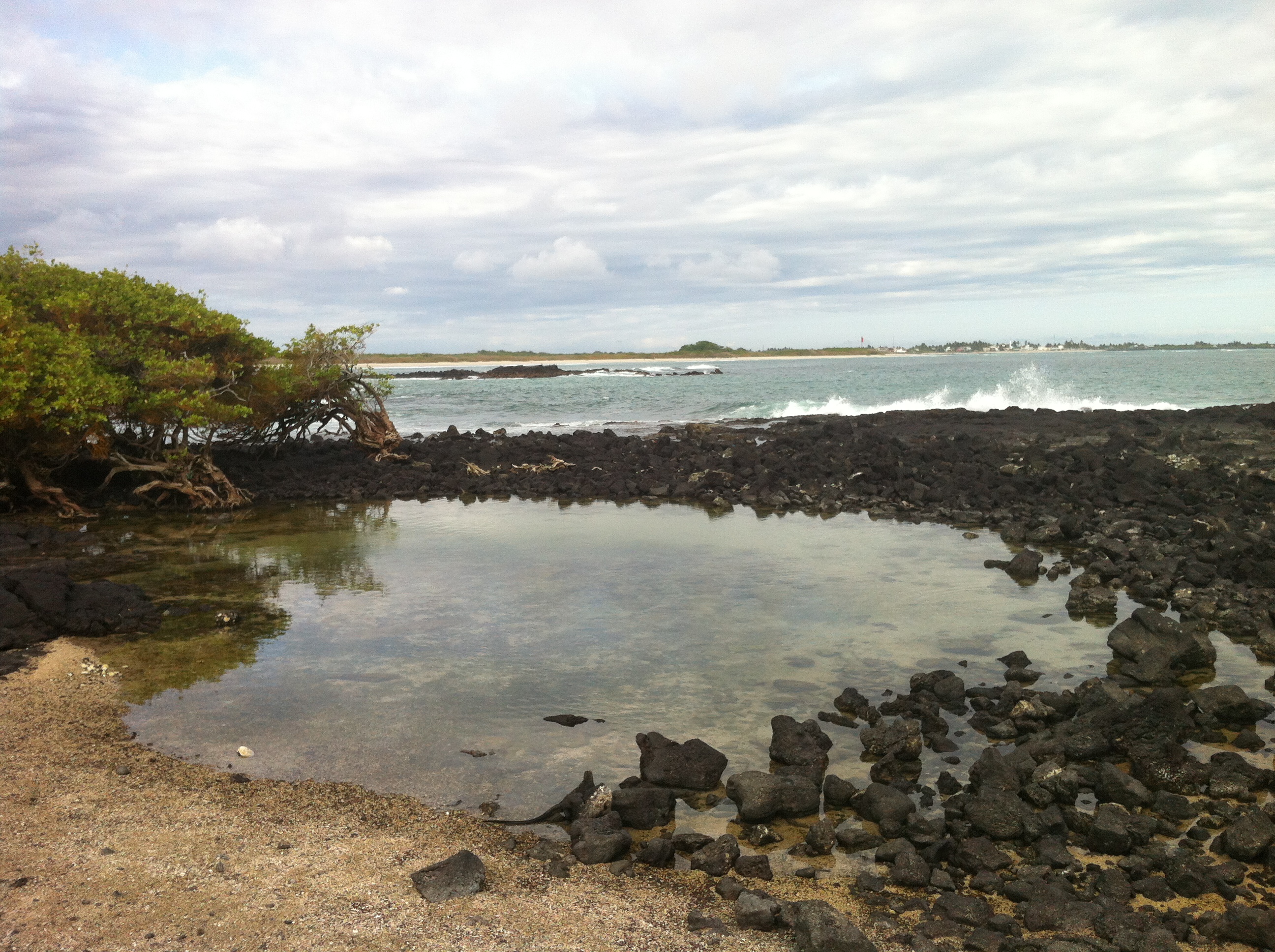
Isla Isabela: Paradise with a dark history
I am currently on study abroad in Ecuador, which has provided me with a mountain of experiences to post about when my homework will allow. I recently had the good fortune to go to the Galapagos, a dream I’ve had since I realized they existed. I am still so struck by everything I saw. In this post, I’ll just highlight one of the places on Isla Isabela that started some good conversations among my classmates about historical conservation of sites of trauma. Also, I will share a poem I wrote about the location.
Former President Ibarra of Ecuador used the island of Isabela as a penal colony (1946-1956), where prisoners were forced to do agricultural labor. They had to carry lava rocks from all over the island to construct the walls of their own prison. There are stories that they would cry as they carried the rocks. I was told that bodies are inside the walls from the rocks falling down while they were building them. The saying that accompanies the island’s history is: Los valientes lloran y los cobardes mueren, which means “The brave cry and the cowards die.” After ten years, the prisoners escaped by creating a play for the guards about prisoners escaping. They got the guards drunk, and actually escaped during the play.
Despite the story of escape, it couldn’t feel like a happy ending. My friends and I were talking about how it felt to visit this site of trauma as tourists. What is the role of historians and purpose of preserving places exactly as they were in the past? Is it to empower us with memories that in our normal lives we couldn’t have access to? Who are these memories for? For some people, this type of oppression is not of the past. They don’t need external reminders because the struggle for survival is part of their daily lives. There was conversation in the group about how preserving sites of trauma allows many of us to experience a sense of empathy before moving on to our daily, more privileged lives. This is how the set-up of touring through the site of trauma left us feeling. Continue reading
Nationwide, utilities have been wary of the expansion of residential solar (termed Distributed Generation in the energy industry), as we discussed in a previous post. The contentions between utility executives and DG providers came to head an announcement from Salt River Project.

SolarCity’s dispute with SRP claims that that new surcharges “sabotaged” customers’ ability to generate their own power.
The crux of SRP’s (a major Arizona utility) new fee is this: all customers who have solar arrays installed after December of 2014 will be assessed a $50 “demand charge,” which will apply regardless of how much or little power the customer’s array produces. Therefore, any new residential solar customer should expect to pay at least $600 per year, in addition to their variable utility costs. SunPower, the solar company for which I work, has determined that the SRP fees have made residential solar non-viable overnight. SolarCity has taken the same position and is now suing the utility for antitrust violations.

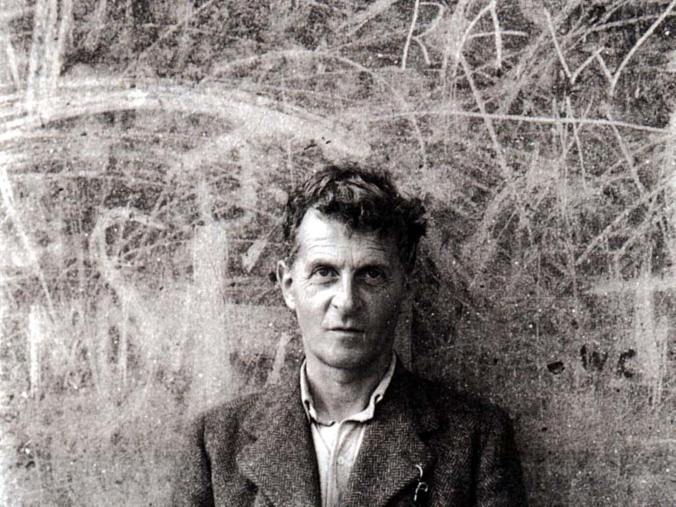
Ludwig Wittgenstein, who knew how to sully a chalkboard with the best of them.
The photo above will make sense below, I hope. Read on. Derek is with us in Kerala for one more week before he moves on to Australia. I am reflecting on his time here, while also currently in conversation with prospective interns for the second half of 2015. And I just received news of Michael, the poet prince of past interns, who is currently on a tug boat in the Atlantic ocean. His experience, since graduating from Amherst College the year after he interned with us, is not typical of anything other than that we have had a very interesting variety of interns who go on to do very diverse, interesting, meaningful things of their own choosing.
These reflections are mixing up with reflections on Ethiopia that I hope to make enough sense of to produce one relevant post, soon. The meaning of our Ethiopia expedition, I already know, will have something to do with the value of perspective, and change of scenery, and leapfrogged expectations.
The pitch for an internship with us is related to those same values and is straightforward, in one sense: practical work experience in sustainable hospitality, social enterprise, or some variation of the two. The trickier part of the pitch is being clear about the value of spark plugs blowing out in the middle of the night before you’ve reached the top of the mountain. It is not possible to predict what a particular spark plug moment is going to be like in the future, or even that a particular person will be ready for it.
But it is possible to predict that most of us, most of the time, benefit from removing ourselves from our comfort zone. We may have just one zen moment, or a whole string of them, or none at all. And any of those may be just the right thing for us. It is making the decision to put one foot forward in a particular direction, and living with it for as long as it is useful for you, that seems to be the real source of valuable life experience.
So, the photo. It is not necessary to know who this philosopher was, or even that he was a philosopher. Just knowing what follows is enough to appreciate that sometimes a change of scenery is the best way to prepare yourself for the next big thing in your life:
…He revolutionized philosophy twice, fought with shocking bravery in World War I, inspired a host of memoirs by people who knew him only glancingly—and for six years taught elementary school in the mountains of rural Austria. Biographers have tended to find this bizarre. Chapters covering the period after his teaching years, when Wittgenstein returned to philosophy, are usually called something like “Out of the Wilderness.” (That one’s from Ray Monk’s excellent Ludwig Wittgenstein: The Duty of Genius. The next chapter is called “The Second Coming.”) Continue reading

In the early years of this site we highlighted a concept of “the fourth r” – focusing on the restaurants and events planners who support a form of social entreprenuership by donating excess food to local shelters. On an annual basis huge amounts of prepared foods go to waste in all forms of venues, but the classic buffet-style cafeteria is a long-term culprit. But luckily creative solutions have gone hand-in-hand with awareness of the problem. At the time we used the term “recycled” when taking about the food programs. Kudos to the new voices who redefined at as “repurposed.”
Back in 2011 when I was a student at the University of Maryland in College Park I once noticed a massive pile of trash in front of a dining hall. A closer look revealed that it was mostly food — a half-eaten sandwich, a browning apple and what appeared to be the remains of the day’s lunch special.
The heap was gross, but intriguing. Turned out it was a stunt to get students thinking about how much food they throw out each day.
Nowadays, students are coming face to face with their food waste, and its environmental and social impact, a lot more often. They also have more opportunities do something about it. Continue reading
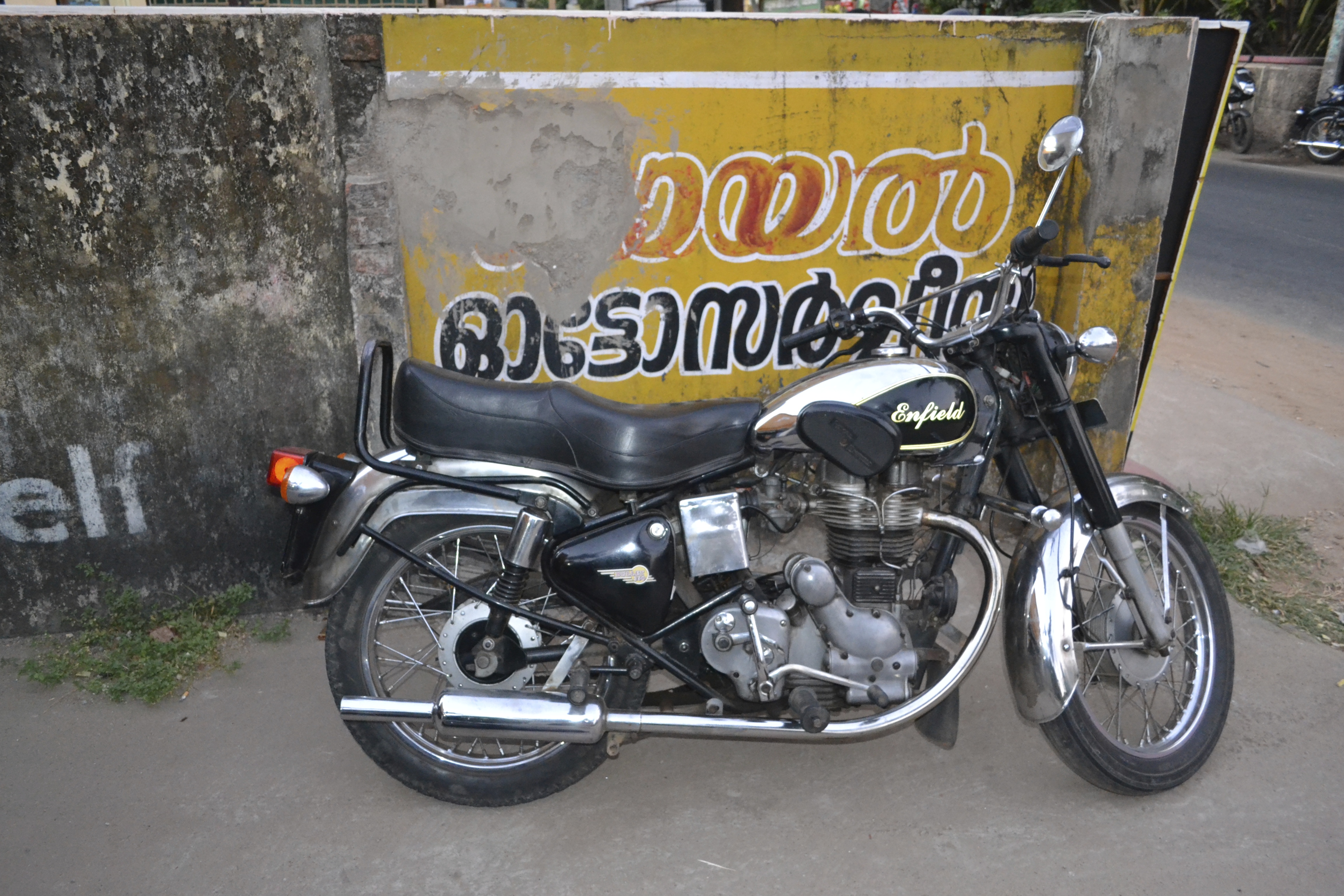
The classic 350cc Royal Enfield or “Bullet”
When I arrived in Kerala around 6 weeks ago it would never have occurred to me to drive here in India. Based on my first impression of driving I was overwhelmed just sitting in the passenger seat. But between making new friends and my thirst for experiencing more of this beautiful state, it’s amazing what a mere 45 days can do. But a journey is multi-faceted; it’s not only about where one is going, but how one gets there, and everything in between.
I arrived to Fort Kochi in the late afternoon in search of a Royal Enfield, a classic Indian-made motorcycle that I’ve had a crush on for a while now. The older models are “backwards” to the typical bike, with the gear foot-lever on the right side and the break lever on the left. I was determined to find the newer model where the arrangement is “normal”. After scouring the city and asking every bike rental and all the contacts available to me, it was apparent that there was no chance of finding what I was looking for. With that news I made the decision to go with what was available rather than what I wanted, (a perfect example of the flexibility that India demands) and I paid the Rs. 800, roughly $13 for the rental. I couldn’t believe what I’d just done: My first time driving in India and I’d rented a totally unfamiliar bike from an unfamiliar source with a 6 hour drive ahead of me, at night. My nerves were tingling at the realization!
Luckily, Dilshad, a friend from Marari Pearl who’d been planning everything for us, was with me. We started the drive through Cochin rush hour traffic. Slowly, I began to stretch my motorcycle-memory-muscles, and gradually the drive became more pleasurable. Soon enough, I was flirting with my 350cc beauty and she was smiling back.

We’re back in Jamaica and now in the second portion of our trip, where we explore the Blue Mountains and John Crow Mountains National Park looking for any signs of the Jamaican Golden Swallow. We arrived at the main visitor center for the park in Holywell yesterday, where we met with park rangers as well as representatives of the Jamaican Conservation and Development Trust, the organization that runs the park. We introduced everyone to our project using an adaptation of the standard slideshow that Justin uses to explain his masters research in Hispaniola to people, and then opened the table for a discussion of the best possible areas to hike and survey.
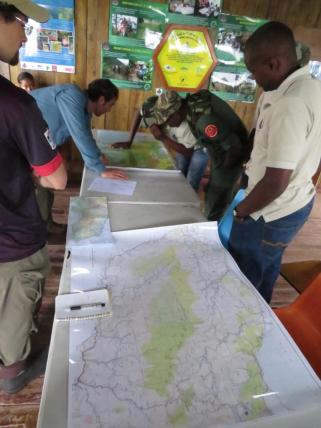
Map exploration with representatives of the Jamaican Conservation and Development Trust
The park rangers had many helpful suggestions for certain regions that they thought best matched the type of habitat and un-birded nature that we’re looking for, and thanks to their help while poring over our maps we have a much better idea of where to go from here. The national park is simply so massive that any head start we can get on the right places to survey is a great help.
Today, we enjoyed some beautiful weather – blue skies and quite refreshing temperatures comfortably between the wind-chilled -10°F of Ithaca and the muggy 90°F of Cockpit Country. From our short hikes around the park so far we all agree that it’s an amazing area with stunning views and lots of potential for the Golden Swallow.

photo credit: Stephen Crafts
J.N. Ding Darling National Wildlife Refuge, Sanibel Island, Florida
The most illuminating 75 minutes with earbuds on, in a long time or possibly ever (since my history with earbuds is only a few years old), by far, were spent listening to this. If you are a combined “words person” and “nature person”–how else would you have found your way to this blog?–then you will understand.
Ethiopia, from the perspective of our recent expedition which I have barely begun to process with words, was illuminated for me just a bit hearing this man talk about how we describe places and the impact that ecosystems have on us. Ecosystems serve as metaphors, he says. And that prepositions matter a great deal to how we communicate the impact ecoystems have on us, literally and metaphorically.
Ethiopia was an enriching experience, in these senses. I will write separately on that illumination. For now, a bit more from Robert Macfarlane, the illuminator on nature, through words. After listening to the podcast of his lecture, I had to know who this was, and it brought me here:
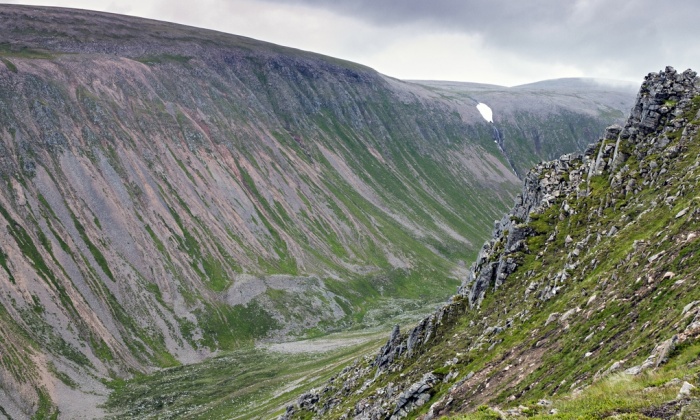
Làirig – ‘a pass in the mountains’ (Gaelic). Photograph: Rosamund Macfarlane
Eight years ago, in the coastal township of Shawbost on the Outer Hebridean island of Lewis, I was given an extraordinary document. It was entitled “Some Lewis Moorland Terms: A Peat Glossary”, and it listed Gaelic words and phrases for aspects of the tawny moorland that fills Lewis’s interior. Reading the glossary, I was amazed by the compressive elegance of its lexis, and its capacity for fine discrimination: a caochan, for instance, is “a slender moor-stream obscured by vegetation such that it is virtually hidden from sight”, while afeadan is “a small stream running from a moorland loch”, and a fèith is “a fine vein-like watercourse running through peat, often dry in the summer”. Other terms were striking for their visual poetry: rionnach maoim means “the shadows cast on the moorland by clouds moving across the sky on a bright and windy day”; èit refers to “the practice of placing quartz stones in streams so that they sparkle in moonlight and thereby attract salmon to them in the late summer and autumn”, and teine biorach is “the flame or will-o’-the-wisp that runs on top of heather when the moor burns during the summer”. Continue reading
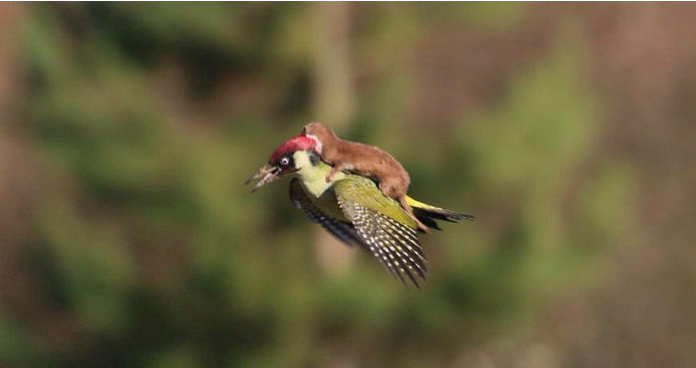
Weasel clutching on the back of a European green woodpecker; Photograph: Martin Le-May Twitter
According to Martin Le-May’s recent photograph that went viral a couple days ago, they can when they’re riding a woodpecker. I remember scrolling through Facebook and seeing the picture, but I didn’t take it seriously. There are many posts on Facebook that shouldn’t be taken seriously. We all have those friends who post everything and anything on the internet and swear it’s true. But how about National Geographic Magazine, is that credible enough? After reading the full article, and the research that went into proving it true, I am now a firm believer that it is, indeed, possible. And you?
Is the Photo Real?
As the viral video of the pig rescuing the baby goat taught us, just because something is cute doesn’t mean it’s real. But is the photo now known on Twitter as #WeaselPecker a fake? Continue reading

An ethereal plant from the ginger family from an orchid garden in Mindo
I just got back from Mindo, Ecuador, a small town with a lot to do. It’s about an hour and a half from Quito and we took a bus through winding roads in a cloud forest with beautiful sights of waterfalls along the way. Upon arriving, we promptly found a hostel and went ziplining within the first hour. After that, we did a “tarzan jump” off a 30 meter platform into the cloud forest. In the afternoon, we went tubing followed by a tour of a chocolate factory. Before dinner that day, I had a full, multi-layered sensory experience of my body in nature. It wasn’t until later, when I saw a mural on a wall, full of paintings of gringos and tourists ziplining that I realized what was missing. Continue reading
Michael Tsegaye for The New York Times. The Arthur Rimbaud Cultural Center in Harar.
For those involved in Raxa Collective’s recent scouting expedition in Ethiopia, since Harar was not on the itinerary we must consider Rimbaud’s endorsement during the next expedition:

Haunted by her father’s death, Helen Macdonald kept company with a bird of prey. CREDIT PHOTOGRAPH BY CHRISTINA MCLEISH / COURTESY GROVE ATLANTIC
Birds represent something important in our work, and it is not always clear exactly how and why, so every day we try to elaborate it for ourselves as much as for anyone.
If you did not take the moment to watch the video posted yesterday, or read the post from our boys in the Blue Mountains of Jamaica, no matter. Today those are complemented by a book review, of all things, that captures the essence of why we find birds so compelling, and helps us understand why their world has come to play such a vital role in this blog:
…Among those who know their birds of prey, the reputation of the goshawk is half Hamlet, half Lady Macbeth: mad, murderous, unpredictable, the kind of creature whose partners and intimates should brace themselves for trouble. “Spooky, pale-eyed psychopaths,”
Thevara Ferry Junction Photo credit: Diwia Thomas
 Organikos