Wilbur, Come To Kerala!

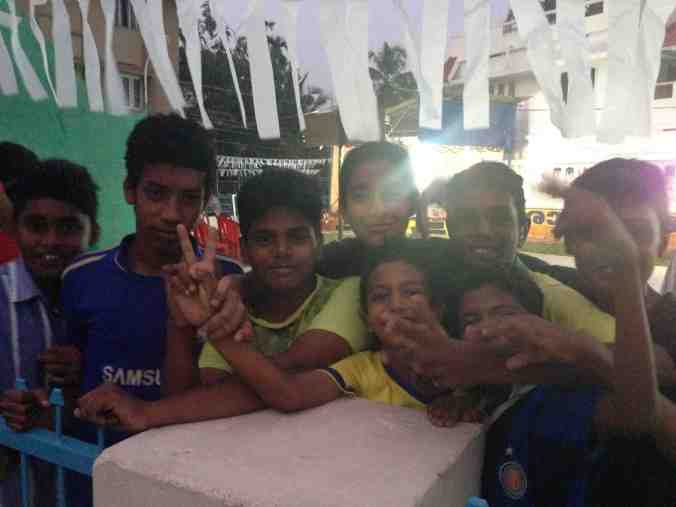
Wilbur Sargunaraj sings about life in his family's ancestral village in India. Produced by Wilbur Sargunaraj for NPR and John W. Poole/NPR.

Wilbur Sargunaraj sings about life in his family’s ancestral village in India. Produced by Wilbur Sargunaraj for NPR and John W. Poole/NPR.

Tirunelveli, as the crow flies, is not so far from the Raxa Collective office in Cochin.  Much closer than the location of the average reader of National Public Radio (USA)’s website, or the typical viewer of these videos on YouTube. They ring true with southern Indian sense of hospitality, so we hereby invite Wilbur to our neck of the woods:

Who is that man in a white shirt, black necktie and what appear to be blue plaid pajama pants? And why is he running around a village tasting and drinking all kinds of food?

That’s Wilbur Sargunaraj. He calls himself “India’s first YouTube star.” His videos about life in India have drawn more than a million views. And now he’s made some very first-class videos for NPR’s Goats and Soda blog: “Dunk-A-Chicken: The Village Way” and “The Village Way: Food.” (Well, he says they’re first-class, and who are we to argue?) Continue reading →

Humans Have DNA For Making Feathers

Siberian Turkamanian Eagle Owl by Chris Paul. Via NatGeo.

We’ve always found feathers fascinating, both from an aesthetic and a biological perspective. Recently, the Cornell Lab of Ornithology’s bird guide website AllAboutBirds uploaded an interactive page solely focused on feathers, which is quite a wonderful mine of interesting information, cool animation, and amazing videography. But now, about a month late, we’ve learned that DNA researchers working on the genetic recipe for feathers have found that the sequences responsible for most of the steps involved in creating feathers are actually much, much older than feathers themselves. This indicates that we humans should have a sizable chunk of the feather-making genetic recipe as well! Carl Zimmer reports for the Phenomena section at National Geographic’s website:

Feathers are like eyes or or hands. They’re so complex, so impressive in their adaptations, so good at getting a job done, that it can be hard at first to believe they evolved. Feathers today are only found on birds, which use them to do things like fly, control their body temperature, and show off for potential mates. The closest living relatives of birds–alligators and crocodiles–are not exactly known for their plumage. At least among living things, the glory of feathers is an all-or-nothing affair.

Continue reading →

The Second Annual Thevara Badminton Tournament

Thevara2014Badminton2

The 2014 edition of our neighborhood sporting event of the year officially kicked off this evening, with two Raxa Collective representatives sharing the stage with two politicians, a priest and the neighborhood association’s leadership (who graciously invited Raxa Collective to join in again) prior to the first match.  We look forward to announcing the champion on December 31. Continue reading →

The Oceans’ Invertebrates, Inveterately Out of This World

Clockwise from top left: a white phantom crab, a fuzzy red-spot crab, a frilled anemone Phymanthus, a red-eye Medusa Polyorchis penicillatus, a tiger cowrie Cypraea tigris and a three-lined nudibranch Flabellina trilineata. Credit Susan Middleton via NYTimes

We are no strangers to the fantastic sights of the deep sea — not only because of shallower personal experience but certainly also due to the wonders of the web. But the images captured by Susan Middleton look to be confirmation of how amazing invertebrate life can be in the oceans. Her new book, Spineless: Portraits of Marine Invertebrates, the Backbone of Life, includes around 250 photographs of these magnificent creatures, and we look forward to exploring them more in person. You can read Dana Jennings’ review of the book for the New York Times below:

As we stand on the thin crust of this watery planet, our gaze tends to roam from horizon to heavens. We often neglect the riot of life that seethes and thrives below us, especially in the still mysterious depths of our oceans.

Continue reading →

A New Break for Alaska’s Bristol Bay

Helicopter view of the area surrounding Bristol Bay, Alaska. Still image extracted from WH.gov video linked below.

We’ve hosted a good number of Alaskan “bird of the day” photos here, and we share the near-universal affinity for the charismatic Arctic mammal that is the polar bear. Two years ago, Carol Browner and John Podesta wrote an open letter on Bloomberg.com opposing any more drilling in the Arctic, and now we’re happy to announce that President Obama signed an executive order last week that bans exploration for oil and gas in Bristol Bay until another president chooses to counteract the order in the future. Read coverage by Peter Baker for the New York Times below:

Mr. Obama first put the ecologically sensitive area of the Bering Sea — home to an important population of whales, seals and sea lions — off limits to oil rigs in 2010, but that restriction was set to expire in 2017, several months after he leaves office. With the new executive memorandum that he signed in the Oval Office on Tuesday, Mr. Obama made the ban permanent unless a future president acts to reverse it and allow leasing of the waters of the bay.

“It is a beautiful natural wonder, and it’s something that’s too precious to us to just be putting out to the highest bidder,” Mr. Obama said in a one-minute video announcing his decision, which was posted on the White House website.

Continue reading →

Fruit Bats Can Echolocate With Wing-beats

Lesser short-nosed fruit bat. Photo by Anton Croos via National Geographic.

Bats represent an enormous amount of the mammal species alive today, but we still have a lot to learn about them. We have direct experience with a particularly large species of fruit bat called the Indian flying fox or Greater Indian Fruit Bat, and we’ve also learned earlier this year about insectivore bats in Thailand that can protect rice paddies from pests. Now we hear that fruit bats, contrary to prior scientific belief in much of the bat-biology community, can also use sonar echolocation to navigate the way insect-eating bats do. Whereas all insectivorous bats use vocal projections of sound to echolocate and find prey, most fructivorous bats have large eyes that they use to locate fruit or nectar. Three species of the fruit-eaters, however, have now been shown to use a very crude and relatively inaccurate form of echolocation using clicks created by their wingbeats. National Geographic writer Ed Yong reports:

Together with Sara Bumrungsri and Yossi Yovel, [Arjan Boonman] studied the cave nectar bat, as well as the lesser short-nosed fruit bat and the long-tongued fruit bat. He found that as the animals flew in a pitch-black tunnel, they all made audible clicks. The clicks aren’t accidents of flight. The team showed that the bats can adjust the rate of these sounds, and they click more furiously when flying in the dark than in dim light. Perhaps they actually use these noises to find their way around.

Continue reading →

Goats, Sheep, Dairy

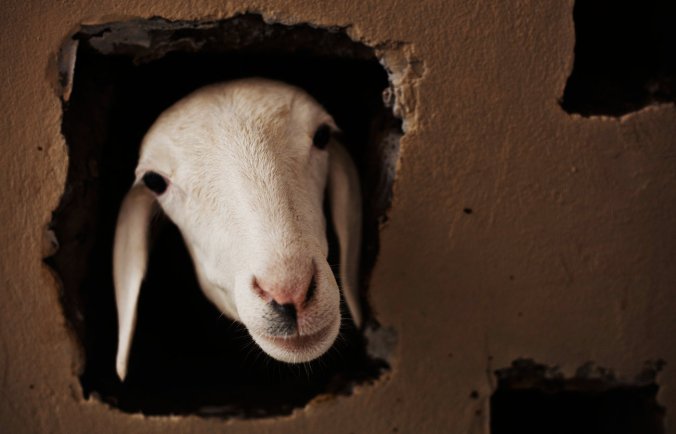
The photographer thought it was a goat. The photo editor thought it was a goat. Sure looked like a goat to the author of this post. It turns out to be a sheep, in Dakar, Senegal. Claire Harbage for NPR

The photographer thought it was a goat. The photo editor thought it was a goat. Sure looked like a goat to the author of this post. It turns out to be a sheep, in Dakar, Senegal. Claire Harbage for NPR

From a strictly culinary vantage point, those of us at Raxa Collective who are not vegetarian are at least slightly more inclined to lamb than to mutton (though this dish is a favorite); but we find ourselves in goat territory more often than in sheep territory. And in goat territory, from a productive agriculture vantage point, we are focused on dairy rather than meat. From the time we started paying close attention to goats we have also been wondering whether sheep might be adaptive to the same territory, and this post got us thinking further along those lines:

So perhaps you noticed a post I wrote last weekend about how you know if your goat is happy. Yes, scientists do study that.

The story had a cute picture of a goat at the top, taken by a photographer in Dakar, Senegal. The farmer told the photographer that the animal was his “goatie.” And to our untutored eyes, it looked like a goat.

And then NPR’s ruminant-wise Africa correspondent, Ofeibea Quist-Arcton, send me an e-mail with the subject: “MARC, THAT’S A PIC OF A SHEEP, NOT A GOAT!”… Continue reading →

Aliens vs. Ice Giants

Photo by Marko Korošec in Slovenia. Via thisiscolossal.com

This may look like a still from the trailer of a fictive blockbuster Aliens vs. Ice Giants, but it’s actually a photograph of nature on Mount Javornik in eastern Slovenia by Slovenian weather photographer Marko Korošec. Earlier this December, after periods of high winds, fog, and freezing temperatures, Korošec visited Mount Javornik and found everything covered in a deep layer of hard rime. Rime, or rime ice, is frost created on objects when water vapor freezes quickly. So in the photo above, perhaps a tree or small stone formation was being buffeted by freezing winds and fog, which accreted ice crystals on the structure that grew over time. The ice spikes, which apparently measured over three feet long in some cases, are formed by the continued winds that sculpt the rime into thin points.

Continue reading →

Horseshoe Crab, An Awesome Creature Facing Awesome Challenges, Creating Awesome Challenges

imrs

This is not the first time we have read about the various reasons to appreciate the horseshoe crab, though apparently we have only posted on small feature on them before. However, they play a critical role in the livelihood of another creature from a different part of the animal kingdom, as this story in the Washington Post describes:

“We had actually attached small devices that tracked their migrations,” explains Niles, “and they made 6 day flights without stopping to get to the Delaware Bay. So they would arrive completely bereft of energy, their weight would be sometimes far lower than their fat free weight, which meant they were burning muscle to get to the Delaware Bay. And the horseshoe crabs were laying eggs in such density that there was no work involved.” Continue reading →

Costa Rican Wildlife Saving Under-vacationed Americans

We have many connections with Costa Rica at Raxa Collective, but especially after the inclusion of Xandari in our network. So we were happy to hear that, facilitated by Costa Rica’s Tourism Institute (ICT), the country’s animals have gotten together to try to save overworked Americans by offering them natural habitat and a stress-free paradise to escape to. Or at least that’s what the Save the Americans website declares after you watch the video embedded above. Spinning off statistics like “Americans leave 500,000,000 vacation days unused,” “1 in 4 Americans get no paid vacation,” and “59% of Americans feel vacation deprived,” the initiative’s true purpose is to advertise and inform American travelers about the opportunities for different vacation experiences in Costa Rica.

Continue reading →

Electric Eels Can Paralyze Prey

Photo via National Geographic

We’ve seen eel art before, but actually don’t know much about these fish or their biology. Electric eels are even more fascinating for obvious reasons, but of course are also that much more mysterious to us. National Geographic science writer Ed Yong fills us in with the help of Vanderbilt University biologist Ken Catania below:

A fish swims in the Amazon, amid murky water and overgrown vegetation. It is concealed, but it’s not safe. Suddenly, two rapid bursts of electricity course through the water, activating the neurons that control the fish’s muscles. It twitches, giving away its position, and dooming itself. Now, it gets zapped by a continuous volley of electric pulses. All its muscles contract and its body stiffens. It can’t escape; it can’t even move. Its attacker—an electric eel—moves in for the kill.

Continue reading →

Cornell’s Nanoscale Carbon-scrubbing Sponges

© Provided/Genggeng Qi – A scanning electron microscopy image of a pristine silica support, before the amine is added.

We’ve had posts on this blog about carbon output by consumer technology, motor vehicles, and food. We’ve also posted, including quite recently, on carbon storage, often in forests. Less numerous are our posts on carbon output by power plants, probably because good news on technological advances in the field is infrequent (at least relative to the bad news). But scientists at Cornell have recently developed a nanoscale scaffold of silica that comes in the form of powder and could replace the current method of carbon capture called amine scrubbing. Anne Ju reports for the Cornell Chronicle below:

In the fight against global warming, carbon capture – chemically trapping carbon dioxide before it releases into the atmosphere – is gaining momentum, but standard methods are plagued by toxicity, corrosiveness and inefficiency. Using a bag of chemistry tricks, Cornell materials scientists have invented low-toxicity, highly effective carbon-trapping “sponges” that could lead to increased use of the technology.

Continue reading →

Librarians Fortify The Front Line

9780544535022_custom-376b39afbbf45a91478a9f43c2df0b1cc11e6e4f-s500-c85

Books we love, war not so much. The story told in this book is about books, about librarians, publishers and common folk who believe in books. And who believe that books are important for fortifying people who need heroic capacities.

In an interview with the author, we see publishers and their town square counterparts, librarians, in a light we had not been aware of, showing their contribution to community at a critical moment in history:

…Over the next few years, millions of Americans would leave home to fight in Europe and the Pacific. They had few comforts and little in the way of escape or entertainment — at least not until American publishers got involved.

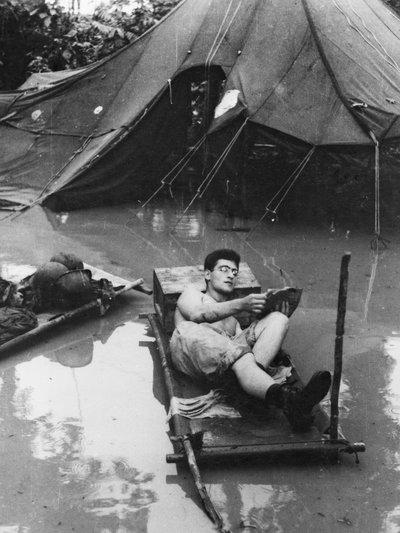
A soldier reads an Armed Services Edition in monsoon conditions during World War II. Australian War Memorial/Courtesy of Houghton Mifflin Harcourt

A soldier reads an Armed Services Edition in monsoon conditions during World War II. Australian War Memorial/Courtesy of Houghton Mifflin Harcourt

“During World War II, American publishers wanted to support the troops,” author Molly Guptill Manning tells NPR’s Renee Montagne. “And so they decided that the best they could do was print miniature paperback books that were small enough that they could fit in a pocket so the men could carry these books with them anywhere.”

Guptill Manning’s new book, When Books Went to War, is a history of these paperbacks, known as Armed Services Editions. They included all sorts of literature — from Charles Dickens and William Shakespeare to mysteries and Westerns — and were the culmination of earlier efforts on the part of American librarians to get usedbooks to servicemen with help from book drives. Well-intentioned though they were, the results of these book drives were mixed, turning up titles like How to Knit and Theology in 1870. So the focus switched to designing and printing books that soldiers actually wanted to read — no easy task since these Armed Services Editions had to be battlefield ready.

Continue reading →

Lady Mondegreen

Everyone has done it before, probably by accident or perhaps by malaprop. You’re singing along to a song you like, in the company of a friend, when suddenly they stop you and say, “Wait, what did you just say? You know that’s not the actual lyrics, right?” And you stare at them in disbelief and retort, “No, I think you’re wrong. Bob Marley clearly sings ‘three little birds sitting on my toaster.'”
“Not ‘toaster,'” your friend replies exasperatedly, “why would Bob be talking about a toaster? He says ‘doorstep.‘” And you think about it for a second and then sheepishly come to the realization that your friend must be correct. If you had been talking about Bob Dylan, there might be no guessing what the actual lyrics are without an authoritative reference, but Bob Marley is a lot more straightforward. It turns out that the misinterpretation of lyrics due to a failure to hear the words in a song correctly has a name, coined in the 1950s. One of our go-to contributors for the New Yorker, Maria Konnikova, writes this week about the phenomenon, and you can read some excerpts of her piece below. But before you do so, you might want to listen to pop/country singer/celebrity Taylor Swift, who has a song in her new album 1989 that has elicited many a case of mondegreen during one line in the chorus. It is called “Blank Space,” (you may have heard it on the radio a dozen times already) and to find the mondegreen, you simply have to be primed to hear the word “Starbucks.” Actually, the mondegreen potential is so severe that articles have been written online about it, indicating that you don’t really need to be primed at all.

Continue reading →

If You Happen to be in Kochi

http://www.huffingtonpost.in/riyas-komu/kochimuziris-biennale-aga_b_6319218.html

The second edition of the Kochi-Muziris Biennale opened with typical Indian energy, with drums and enthusiasm. Fort Kochi and Mattanchery streets were alive with painters, working solo or in teams, adding finishing touches to murals and other installations.

Riyas Komus’ words resonate well with the RAXA Collective ethos of Community, Collaboration and Conservation.

The story of Kochi-Muziris Biennale, an artist initiative which derived its confidence from artists, art lovers, cultural organisations and the people of Kochi, is the story of taking on challenges to create an alternate space, of sacrifices and solidarity to build an art ecosystem for the new emerging India. Conducting the biennale in Kerala — a state that had the world’s second democratically elected communist government — complimented by the history of the land in the context of art was an organic achievement of its legacy. Our mission is to draw energy from the rich tradition of public action and political engagement in Kerala and build a new aesthetic that integrates both the past and the present…. Continue reading →