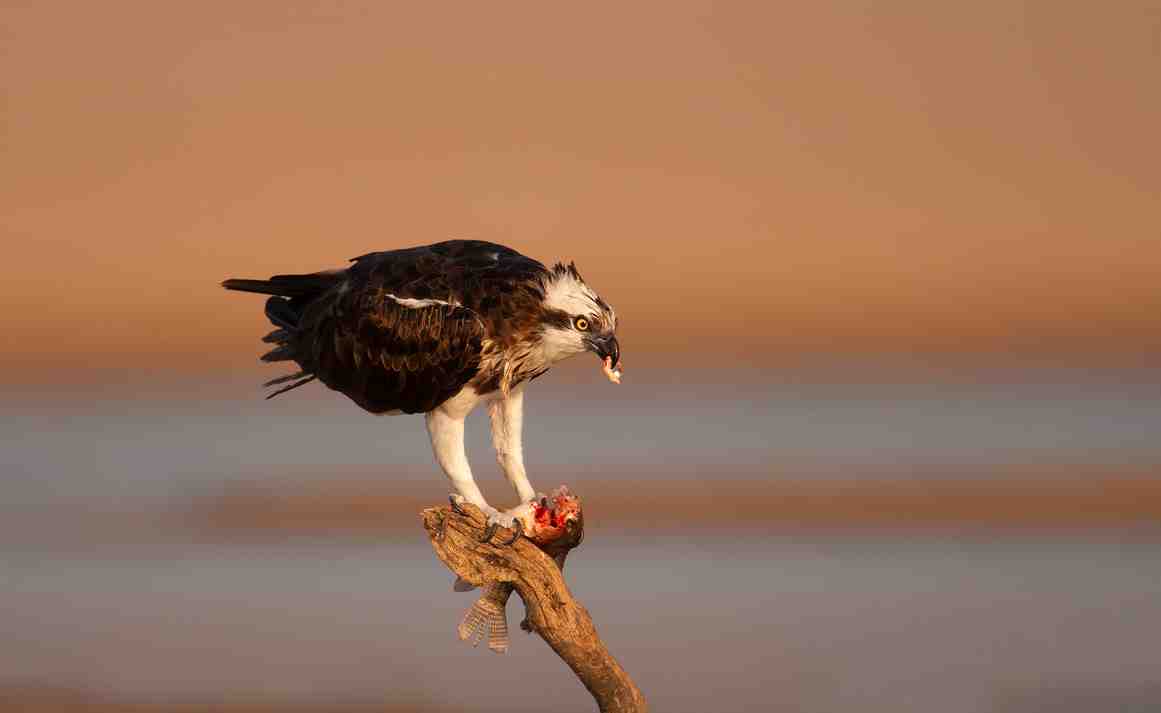
Chambal River, Uttar Pradesh
Chambal River, Uttar Pradesh
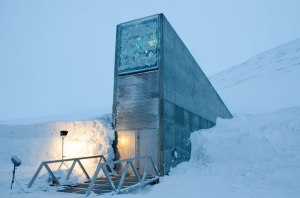
Travels to the seed vault on top of the world
In advance of a story of our own, albeit set in the tropics at our upcoming beach resort, on this same topic, we thank Conservation for the story they offered in an earlier issue of their magazine about this seed vault way way north:
…One day in Svalbard lasts four months, and the sun never sets; one night lasts four months, and the sun never rises. The other four months consist mainly of either long days with short nights or long nights with short days. Here the equinoxes—the two days annually with 12 hours each of daylight and darkness—really mean something. But what does “a day” mean here, and how many are there in a year? Continue reading
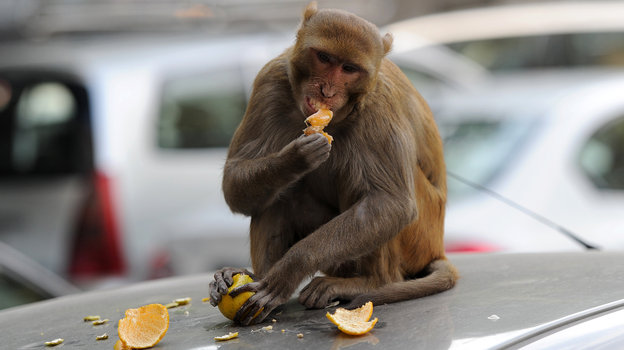
New Dehli has tried numerous schemes to control its monkey population. Photo Credit: Sajjad Hussain
We’ve had our fair share of monkey business as a garden challenge in Cardamom County. In Dehli, they’re looking for ways to monkey proof their city.
Reporting monkey raids, Sharma says, residents complain that ” ‘they’ve just taken away my clothes,’ or … ‘they have opened the fridge’ … and ‘they’ve taken out the food.’ “
The monkeys have also been known to intimidate fruit vendors and get intoxicated on stolen whiskey. Sharma says when they fail to find food, they can raise a rumpus.
You can read more in depth at the original article here. Initially, there were people who were hired to train Langurs because they were able to frighten off the smaller Rhesus monkeys. That practice was recently banned due to animal rights concerns. Now, there are 40 men hired to mimic the calls of the Langurs to scare them away. Continue reading

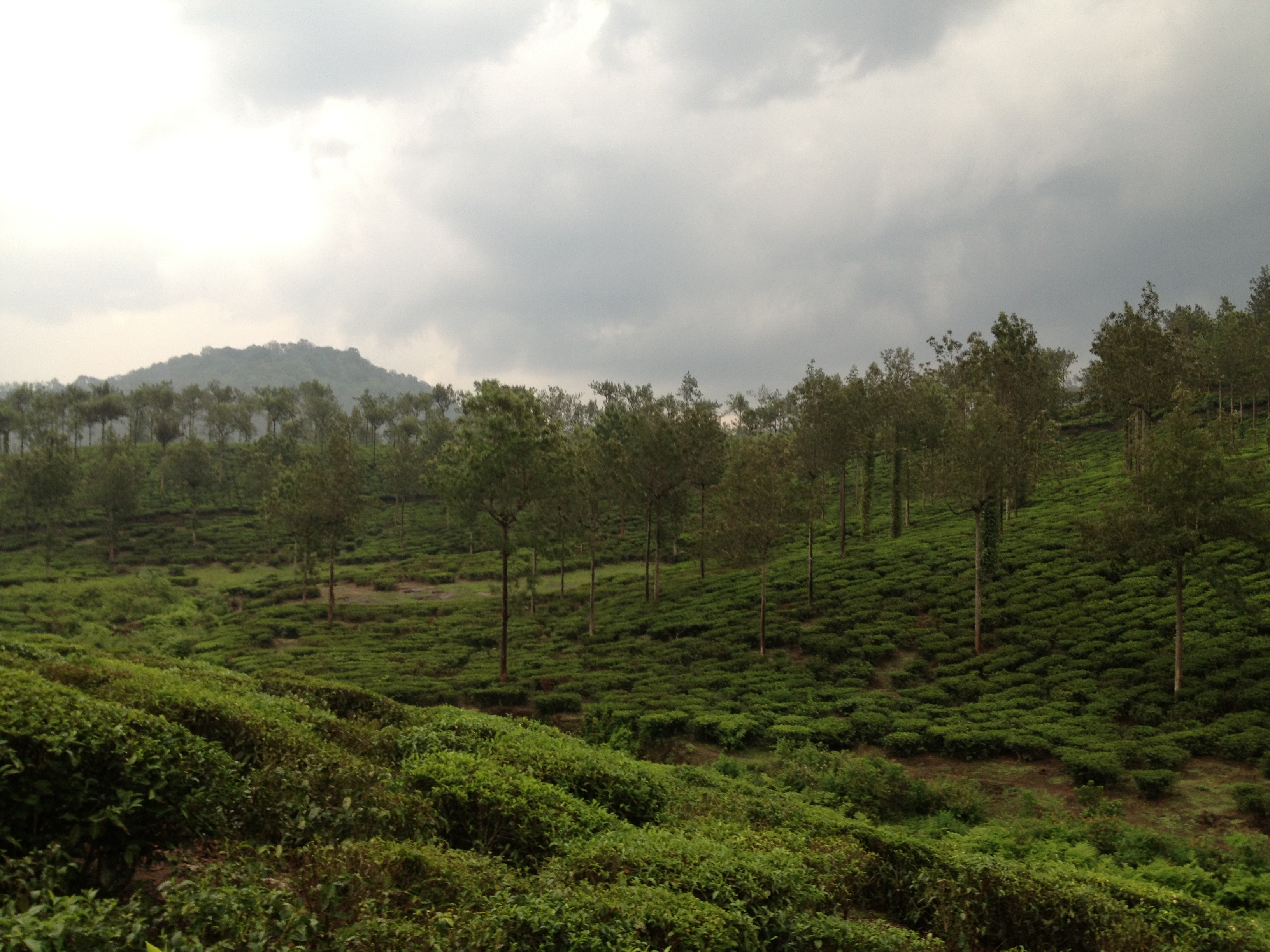
Credit: Ea Marzarte
As I wrote about in my last post, my current project is documenting the conservation story of RAXA Collective. Yesterday we were driving up to the Cardamom County property in Thekkady from Spice Harbor in Cochin. I’m used to the busy main “highway” but this time we took a different route. It was through Vagamon, which is this lush, green landscape with waterfalls and not many cars on the road. We drove through tea plantations. Driving through the tea plantations with all the greenery and fog kind of enchanted me into this quiet, contemplative space.
In order to document the conservation story, I have been asking Crist questions whenever we have time to sit down about the business model of projects they’ve worked on. While driving through the tea, we had plenty of time for this conversation.
The landscape and the conservation seemed to pull me within, pointing out the shape and feeling of an idea. I don’t know what it will end up being, but I can feel the progress and formation of something. This shape seems to be magnetizing key words and planting them like seeds. I am inspired by the idea of creating a business model that funds environmental and cultural conservation. Continue reading
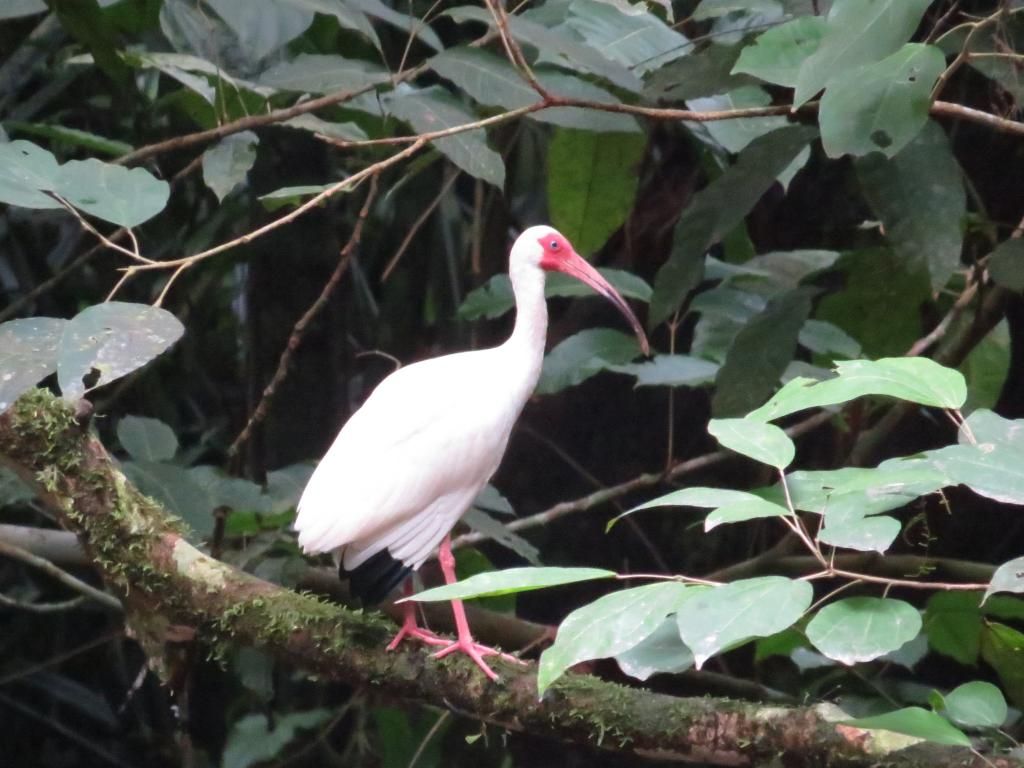
White Ibis on the banks of a river.
As I hinted in Part 1, Carara National Park is great for experiencing much of Costa Rica’s famous biodiversity. Monkeys, iguanas, poison dart frogs, and insects, together in a rich rainforest replete with all sorts of weird fungi that can look tasty and cute. Upon entering the park, James and I were greeted with the laughing calls of Black-hooded Antshrikes, birds that enjoy the columns of marching insects that commonly go by the name of “army ants.” Plenty of other birds with the word “ant” in their names made themselves known with their songs or movements in the undergrowth: male and female Dot-winged Antwrens, a Dusky Antbird, several Chestnut-backed Antbirds and Black-faced Antthrushes, and even a Streak-chested Antpitta heard from afar.
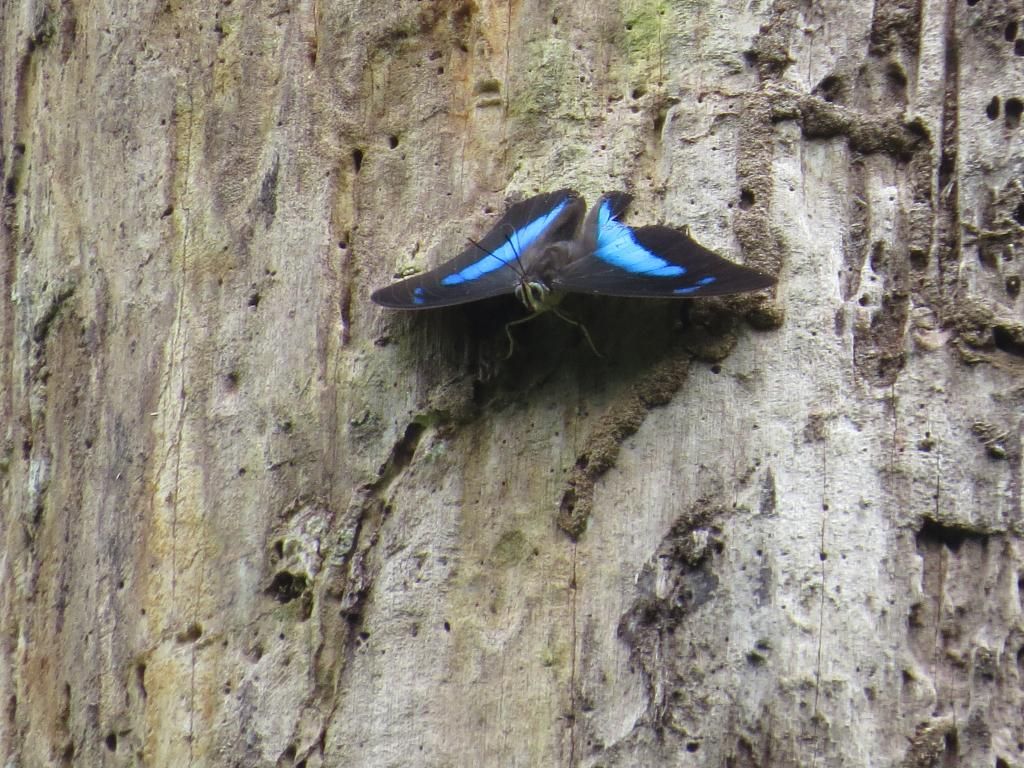 Apart from birds, we also saw several species of butterfly, including this one with the classic owl-eye pattern on its wings to startle potential predators. We also saw cicadas, but several times they had fallen prey to skillful salliers from silent perches. This female White-whiskered Puffbird, as well as this woodcreeper (Long-tailed, perhaps?), both emerged from their hidden leafy blinds to land somewhere with a juicy, shiny cicada in their beaks. There were several other woodcreepers doing their job–creeping along tree trunks–like a Streaked Woodcreeper with its powerful bill, and in general James and I struggled to Continue reading

Bharatpur Bird Sanctuary, Rajasthan
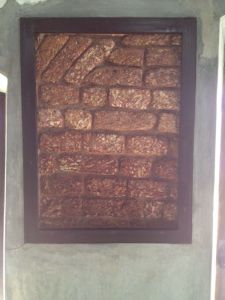
This is a wall from the Spice Harbor property. A lot of the conservation story can be told in the design. The way they built this property is an example of historical/cultural conservation. The restaurant building was a “go down”, or waterfront warehouse, that used to store spices. They didn’t knock down the old building, they actually just built around it and framed pieces of the old wall to display it as art. This design concept has been passed on by word of mouth-taught to the workers here, but it hasn’t been documented yet.
I felt that this blog could better serve its purpose if the conservation story was told in one place. The stated purpose of the RAXA Collective site is to provide a space for people to learn about entrepreneurial conversation. It seems to me that highlighting the details of the property is less meaningful without context of the concept and history behind them.
The summarized version as stated in the RAXA Collective “About section” is to have a business whose profits are invested in conservation of natural and cultural patrimony. However, as I’ve been learning, the way this model manifests itself depends on the situation. Each story is pretty radically different than the next. So, we have a very general description (About section) and very specific descriptions (every day posts), but we don’t have the overall narrative of each property to show how “it depends” shows up differently in the field of entrepreneurial conservation.
I resonate with the initially stated goal in the About section about having this site provide a space for university students to learn about alternatives to mainstream occupations and career paths. As a university student myself, that is really what I am here as an intern to learn. I have been able to offer my skills and passions for organic agriculture and gain more practice in that field as an intern here. However, that is a skill I have picked up along my studies, which are driven by the bigger goals of conservation and environmental business models.
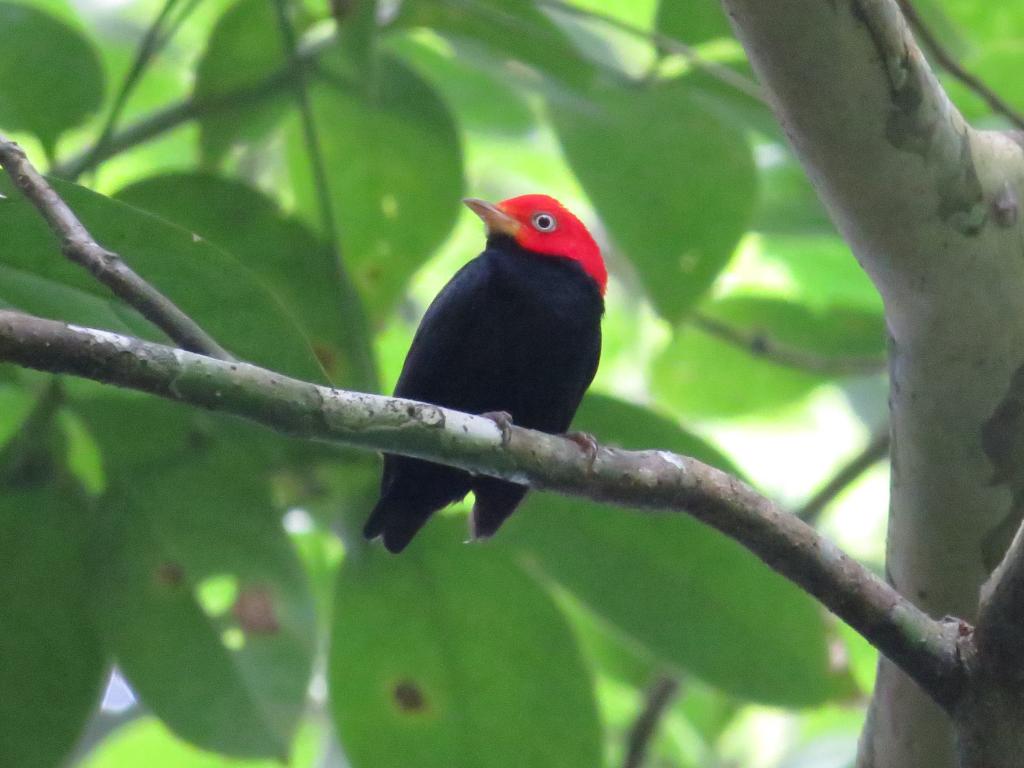
Red-capped Manakin (male). He has spiffy yellow thighs, unfortunately not visible in this picture.
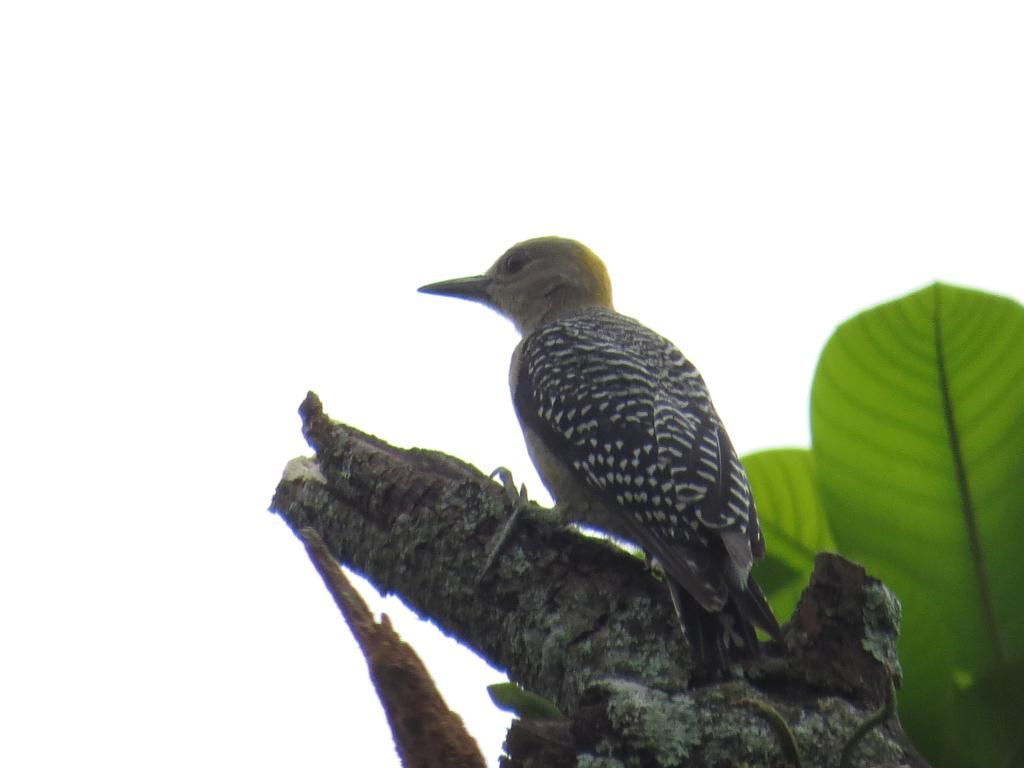
A few weekends ago, James and I spent six hours at Parque Nacional Carara, on the Pacific side of Costa Rica and just about an hour and a half from Xandari. Braving the muggy, humid coastal rainforest with the intention of spotting and/or hearing at least fifty new (for us) species, we set off on the first couple miles of trail with our field guide in hand. James uses a pair of Nikon Monarch binoculars for quick spotting and following birds as they flit around, and I sport a Canon SX50 digital camera to hopefully capture still images or video for identification purposes. Sometimes I get lucky enough to take a photo that’s worth sharing!
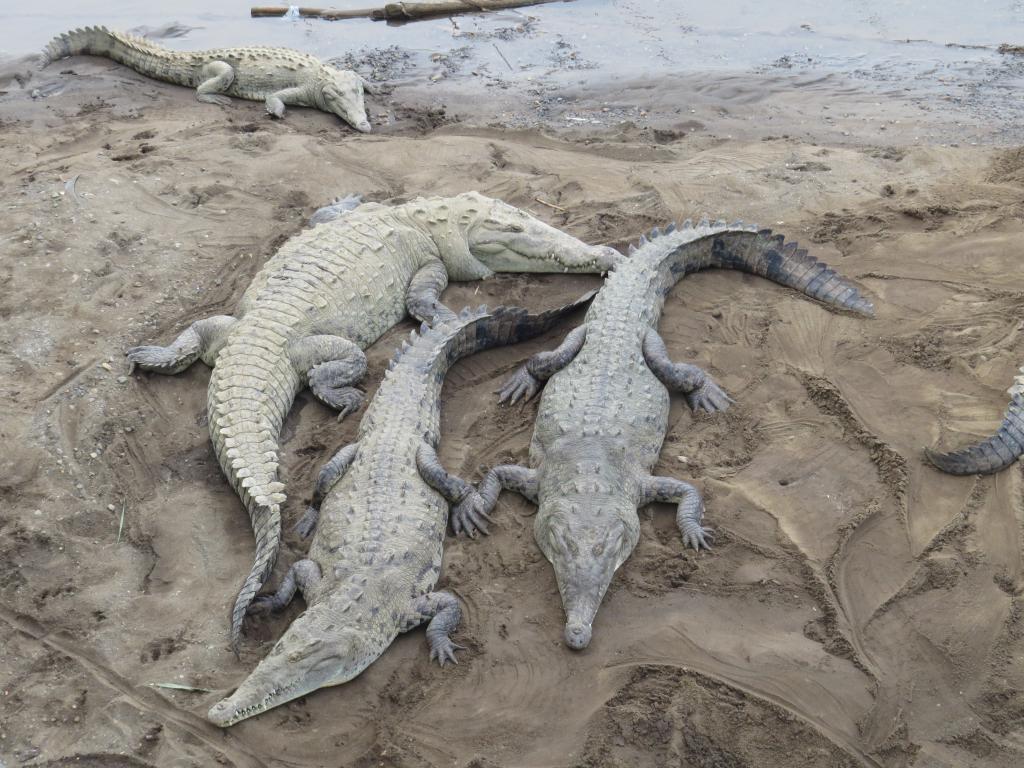 But not all the wildlife we spotted at Carara was avian. On the way to the park entrance, we crossed the famous Río Tarcoles, a river that is home to dozens of crocodiles that bask in the mud, particularly under the bridge that tourists walk over to gaze at the enormous predators hanging around. James and I saw plenty of smaller reptilian relatives skitter across the paths at the park, including iguanas and a basilisk lizard. We passed several troops of leaf-cutter ants marching Continue reading



We recently noted two days in a row that it might be good to take half an hour or so each day to reflect; hinting that there is general tendency to not allot enough daily time for reading, for important ideas, etc.. Of course, sometimes when one reads such a thought, in hindsight it can sound heavy and dull and self-important and, well, probably boring.
Cheer up. The cartoon editor of the New Yorker insists on it, and he is good at getting his way:
I just finished a fascinating blog post by Joshua Rothman called “What College Can’t Do.” There are so many insightful points in the essay that it wouldn’t make sense for me to cite just a quote or two. Continue reading

Thermal imaging on an elephant in the Dzanga clearing. Photo by Peter Wrege
Way back when, we first shared what we had read and visually devoured about this project, and the last line of our post at that time asked if “one of our Lab-based contributors will help us with an introduction to their office mates in the Elephant Listening Project?”. Not until now were we nudged to think again and do something about it. Stay tuned…
Meanwhile, thanks to the folks at Science Friday and the donor-listeners and producers of the amazingly diverse public radio networks in the USA, tune in to learn more:
Elephants have different rumbles and roars for how they greet each other, warn about danger, and even to show that they’re annoyed. Peter Wrege, director of The Elephant Listening Project, recorded an event called “mating pandemonium,” where a group of elephants roar after a pair of elephants mate. Wrege discusses the possible reasons for this pachyderm party.

Hambledon Hill, Dorset, UK, in late afternoon sunlight. Photograph: Mark Bauer/Alamy
National Trust is a private UK-based conservation organization whose nearly 4,000,000 members and more than 60,000 volunteers make great things happen. That leads to about 50,000,000 visitors to sites like this recently created protected area:
National Trust buys Hambledon Hill in Dorset
Pristine chalky outcrop is a treasure trove of plant species and a butterfly haven untouched by modern farming since Iron age

Little Rann of Kutch, Gujarat
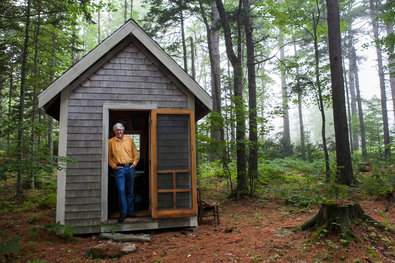
Craig Dilger for The New York Times. Douglas Preston, a best-selling author with Hachette Publishing, at his writing shack in Maine.
We started paying attention to this issue here. It relates to our longstanding belief that reading and books are essential goods. So who we trust with books matters:
Plot Thickens as 900 Writers Battle Amazon

Photo credits: Binu Kumar
Brihadeeswarar Temple was an imperial monument to Chola power and the greatest artistic accomplishments of the late Chola period. This Temple was the greatest single undertaking of the South Indian temple builders, taking almost 15 years to complete. Continue reading
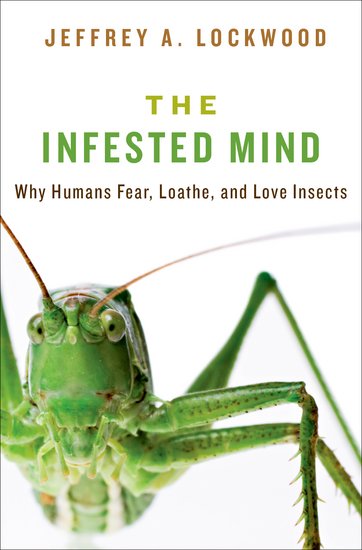 Jeffrey Lockwood, the director of the creative writing program at the University of Wyoming, has received the Pushcart Prize and a John Burroughs Award for his essays. His most recent book, to the right, was brought to our attention while reading his recent essay in one of our favorite online publications. The description of his book, provided by Oxford University Press:
The human reaction to insects is neither purely biological nor simply cultural. And no one reacts to insects with indifference. Insects frighten, disgust and fascinate us. Jeff Lockwood explores this phenomenon through evolutionary science, human history, and contemporary psychology, as well as Continue reading

Although food entrepreneur Tim West’s family legacy is in Doritos chips, he wants to shake up the food system — with sustainable, healthful food. Vignesh Ramachandran/Ozy
Thank you, National Public Radio (USA), for carrying The Salt and its occasionally deliciously ironic stories:
Tim West’s grandfather invented Doritos chips and was an executive at the global snack food giant Frito-Lay.
The younger West ate plenty of junk food growing up. But lately, he’s been much more interested in kale, quinoa and tree-ripened fruit.
And the 30-year-old Bay Area food entrepreneur now wants to completely reinvent what we eat and how it’s produced. Continue reading
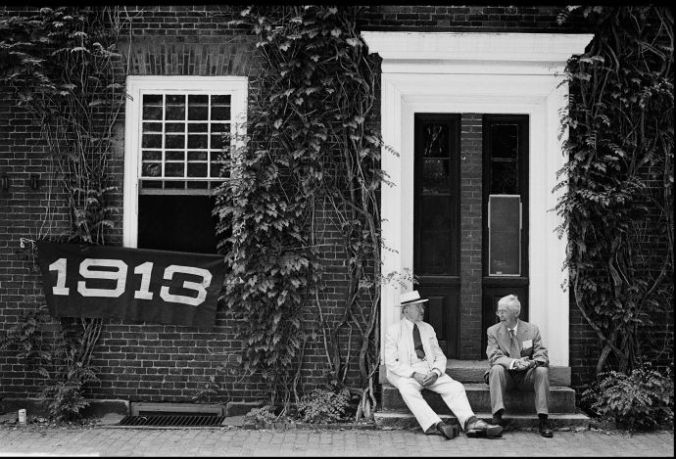
A pair of Harvard alumni on campus for commencement, in 1977. CREDIT PHOTOGRAPH BY CONSTANTINE MANOS/MAGNUM.
Just after this post had been published yesterday, starting with the acknowledgement of busy-ness and concluding that education plays a key, if mysterious role in character-building and communication capabilities, a kind of echo reverberated through the reading of this post by Joshua Rothman:
There’s a special joy in giving someone advice that’s sure not to be followed—“Wake up at the same time every morning”; “Don’t check your e-mail while on vacation”—and William Deresiewicz must have felt it when writing his recent cover story for The New Republic, “Don’t Send Your Kid to the Ivy League.” Hypercompetitive colleges, Deresiewicz wrote, Continue reading
 Organikos