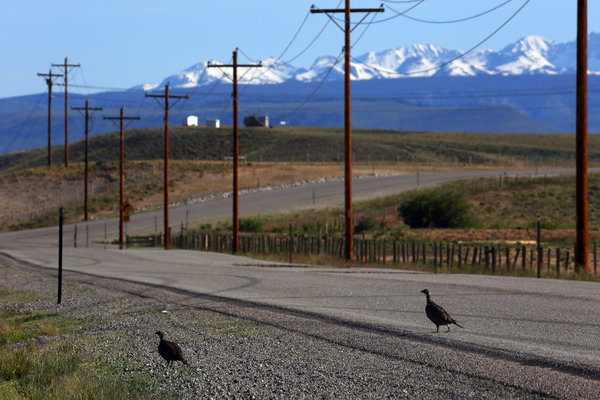
Sage grouse in a part of Wyoming where Shell has gas fields. Credit Jim Wilson/The New York Times
Conservation is a classic collective action challenge. Collaboration is a requisite for success. This New York Times report on the struggle between the energy needs of a country, and efforts to conserve a bird species illustrates how green priorities can sometimes conflict in unexpected ways, and how cooperation can prevail for the common good:
…On paper, at least, the Wyoming plan is in line with federal goals, officials say. It cordons off large areas as critical for the bird to survive, and its authors say it is the best compromise they could fashion.
Nestled in the gray-green sagebrush on the sprawling ranches or pecking their way along the dusty roads near the Pinedale Anticline gas fields, the squat, mottled-brown birds appeared unruffled. But they are persnickety creatures easily disturbed by human activities. Every year, males return to relatively open areas called leks, splaying their tail feathers and puffing up their chests as they waddle and call to attract hens. Vulnerable to predators like coyotes and eagles, the grouse depends on vast expanses of sagebrush for food and shelter. Wyoming’s plan would restrict development to levels that would not disturb the birds. For example, it would limit surface disturbance to 5 percent a square mile and ban activity within 0.6 miles of the leks. Continue reading










 Indian mangoes apparently weren’t allowed into the states for almost thirty years due to “pest concerns.” Actually, it was more like, nuclear trade concerns. India and Canada had a nuclear trade relationship in which Canadian nuclear reactors were being used to build a nuclear arsenal. In 2007 though, India signed a nuclear treaty with the United States, only under the condition that India’s mangoes be allowed back in the states. Later when President Bush flew to India to discuss the deal, he announced, “the U.S. is looking forward to eating Indian mangoes.”
  Organikos