Writer Will Walk, We Will Watch

We will link to the updates as they arrive.  For now, the plan:

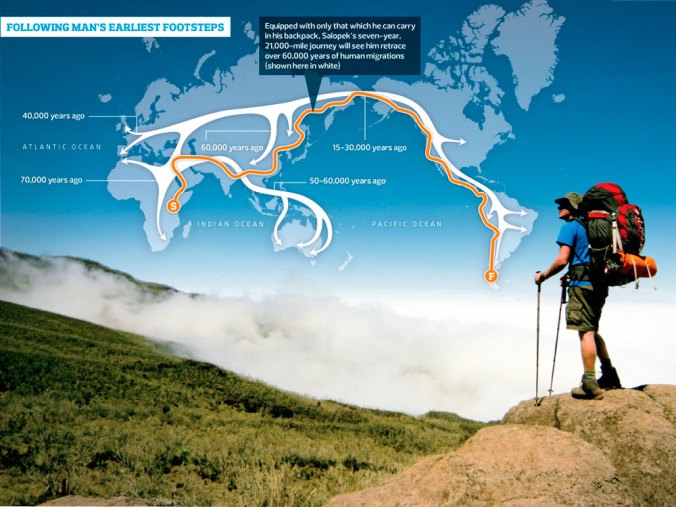
It will be a journalistic assignment like no other. Call it “the longest walk”.

In what is probably the longest, most arduous piece of reportage ever undertaken, Paul Salopek, an experienced writer for the Chicago Tribune and National Geographic, is embarking on the astonishing task of retracing the journey taken by early man tens of thousands of years ago.

Beginning in the exotic surroundings of the Great Rift Valley in Ethiopia, Salopek will take an estimated 30 million steps, reaching his destination seven years later, three continents away at the most southerly point of South America. Continue reading →

Southern Rustic Butterfly (Cupha erymanthis)

Southern Rustic Butterflies are commonly found in Periyar’s forest areas, flying up and down and resting in shadowy places. Their wings are dark  brown and yellow.  Continue reading →

Folks Fight Feral Felines For Frigatebirds

A male frigatebird with the distinctive red sac on its chest that is inflated during courtship. Photograph: Derren Fox

Thanks to the Guardian‘s coverage of scientific and environmental issues for this story of success involving collective action on the part of British folk who decided to fix a problem they had inadvertently created starting back in the day when Darwin was voyaging on the Beagle:

…In the early 19th century, Ascension Island was home to more than 20 million seabirds, mainly masked boobies, black noddies, brown noddies and Ascension frigatebirds. The frigatebird was considered to be the most important because it was unique to the island. Continue reading →

Profile Of Smithsonian American Ingenuity Award-Winner

Click the image above to go to another note of tribute, this one in the current Atlantic, for a remarkable leader in academia, this one at the beginning of her career:

Eric Lander, director of the Broad Institute, a genomics research center affiliated with MIT and Harvard, has known Sabeti since the late 1990s, when she was an undergraduate advisee at MIT. Continue reading →

Chamundi Theyyam – Ritual Dance

Theyyam are ritual filled performances of dance, music and religious worship of the people of Kerala. There are nearly 400 deities that are represented in this manner, with each Theyyam believed to be a physical manifestation of the particular god. One of the Theyyam performed in the northern regions of Kerala is Chamundi Theyyam, representing the god Durga Devi. Continue reading →

Sometimes Science Says Otherwise

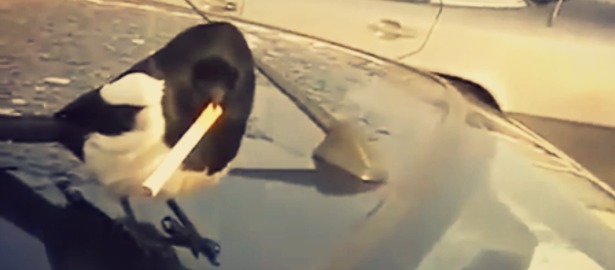
Among family, friends and colleagues everyone knows someone who has tried to kick the habit.  Many succeed. Once the habit is kicked, where does it go?  And for those who have not kicked the habit, and are still flicking the remainders about, where do those go?   Apparently, both end up in bird land, and for reasons we might find acceptable:

We never actually established why birds suddenly appear every time you are near. It might just be because you are one of the terrible, horrible people who throws cigarette butts on the ground everywhere. When a little bird waddles out and picks one up and uses it to build a nest, though, you are sort of redeemed, in that the world becomes a better place for its bird family.

Research published today in the journal Biology Letters followed urban birds and measured the amount of cellulose acetate (from cigarette filters) in their nests. The nests with more butts had fewer parasites. Continue reading →

Red Silk-Cotton Tree (Bombax ceiba)

The Red Silk Cotton is a fast growing tree growing widely in the Western Ghats forest areas. These trees can reach a height of 35-40 meters, and bear large red-orange flowers from December to March. The timber of the tree is very soft and used for making plywood and match boxes. Continue reading →

You, and 999,999 Other Email Protesters, Can Sometimes Save The World (In This Case, The One Whales Inhabit)

South Korea had planned y to conduct ‘scientific’ whale hunts similar to those carried out by Japan in the Antarctic every winter. Photograph: Momatiuk – Eastcott/Corbis

Bravo, activists of all stripes, but in this case especially the emailing type.  And thank you, Korea, for finally rejecting false justification for whale-killing and doing the right thing. Click the image above for the whole story in the Guardian (whose consistent coverage to these issues deserves credit, too):

Japan, which uses the loophole to kill hundreds of whales every year, is expected to send its whaling fleet to the southern ocean in the next few weeks.

South Korea initially said an increase in whale stocks in its coastal waters had prompted the decision to resume whaling. The fisheries ministry said rising whales numbers posed a threat to squid and fish stocks.

The ministry reportedly began to reconsider after criticism from anti-whaling nations and an online petition that attracted more than 1,000,000 protest emails in three weeks.

Et tu, Japan?

Tribute Is Due

His academic work is so far removed from what we do day to day, it would be difficult to explain why this post must be. His political activism is not the reason, though we admire his taking the side of the underdog, being friend to the friendless, giving voice to the powerless.  When someone leads as he has led, he deserves a birthday tribute.  Do yourself a favor and take 5-10 minutes to read this in its entirety, or at least these last two paragraphs:

When I was a second-year graduate student at M.I.T., Chomsky taught a class on philosophy, which I was lucky enough to sit in on. The class itself was an event, almost a circus; people came from all over Boston, not just M.I.T. Continue reading →

Pottan Theyyam

The Pottan Theyyam is one of the most popular ritualistic dances of Kerala performed by the Malayan community. It is a devotional performance with a surrealistic representation of the divine. The Pottan Theyyam leaps into the fire at the end of his performance, his costume made of fronds and leaves insulating him from burns .  Continue reading →

Friends In High Places

Not all marine creatures have equal opportunity of species survival.  As in any social milieu, some are better connected than others; some have benefactors to look out for them; others do not. Thanks to Green Blog, more on the protection of certain charismatic species (but not not others) in the wild blue yonder:

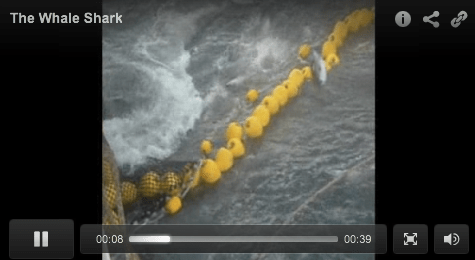
Whale sharks get some respect; the bigeye tuna, not so much.

That was the gist of the message from the Western and Central Pacific Fisheries Commission, whose member nations agreed this week at a meeting in Manila to help reduce whale shark deaths in Pacific fisheries. The commission did not act on a recommendation from scientists that the catch of bigeye tuna be sharply reduced. Continue reading →

Zombie Architecture & Rainforest Creatures

In the New York Times, the great science-explaining journalist Carl Zimmer writes about a mystery most of us would never otherwise encounter:

In the rain forests of Costa Rica lives Anelosimus octavius, a species of spider that sometimes displays a strange and ghoulish habit.

From time to time these spiders abandon their own web and build a radically different one, a home not for the spider but for a parasitic wasp that has been living inside it. Then the spider dies — a zombie architect, its brain hijacked by its parasitic invader — and out of its body crawls the wasp’s larva, which has been growing inside it all this time. Continue reading →

Guardian, Angel, Sea Shepherd

Paul Watson, founder the animal rights and environmental group, Sea Shepherd Conservation, has returned to Antarctic waters after months on the run. Photograph: Markus Schreiber/AP

We feel fortunate to have the Guardian’s coverage of our favorite angelic trouble-maker, Paul Watson, since few other publications seem willing to pay attention to his cause. From our relatively comfortable, distant perch on dry land we nod to the southern waters where he and his band of activists righteously take on the whale-killers:

From aboard a Sea Shepherd ship, Paul Watson told Associated Press on Tuesday that his job is to protect whales, and he can’t do that if he’s in custody. He said the Sea Shepherd fleet is already in the Southern Ocean.

“I want to stay in the ocean,” the 62-year-old said. “I’m not going to be able to do that from some holding cell in Japan.”

Read the whole story here.