Click the Guardian banner to go to the welcome news’ story told in the slide show pictures below it:

Click the Guardian banner to go to the welcome news’ story told in the slide show pictures below it:

Wadi Feynan was one of the first 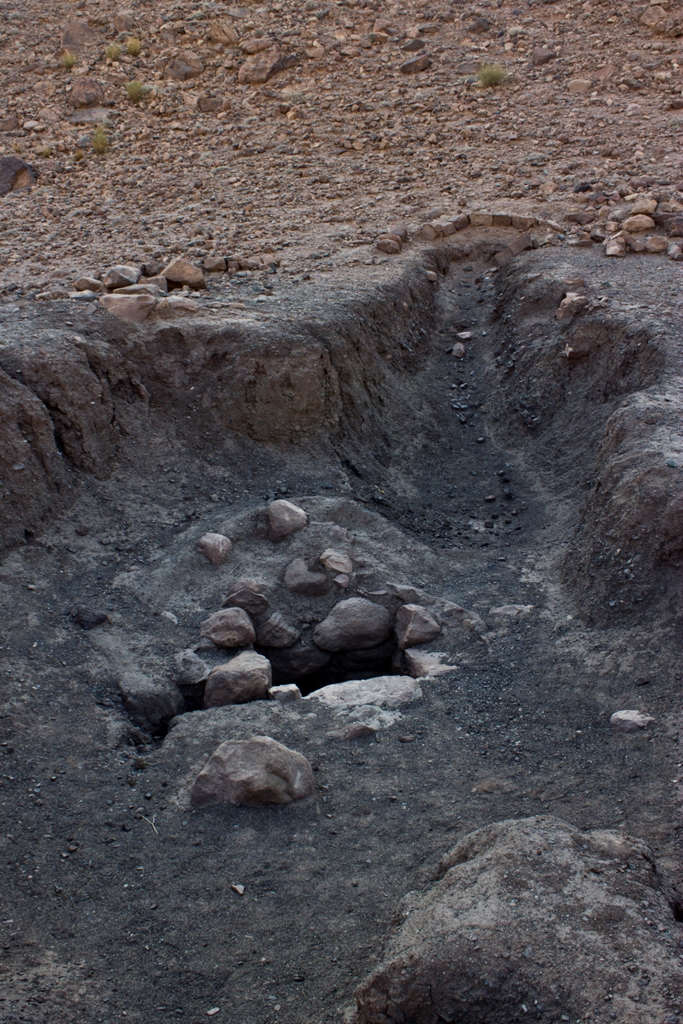 places in the world where copper was mined and smelted by humans, which when
paired with one of the first Neolithic settlements in the world, makes Feynan an extremely important area in terms of prehistoric human development. Few places in the world can boast this sort of historical wealth – and visitors to Feynan can journey into the past with or without a guide. From the first bit of ore extracted to the collapse of the Roman Empire to the 20th century, copper mining has been a major aspect of human settlement in these valleys. Innumerable shafts have been opened, collapsed, reopened, and abandoned using a wide range of methods and technologies. Today, guests at Feynan Ecolodge have the chance to venture into the past by walking or biking to these historic sites nestled in the rocky foothills of the Dana Biosphere Reserve – and learn about their historical significance. Continue reading
Community, collaboration and conservation are the categorical things–ideas, actions, examples–that we most like to talk about on this site and point to with links elsewhere. Still, perhaps half of the posts here would be hard pressed to fit into those categories in any literal sense. This little item below, for example. Two guys talking about cultural differences in mathematical expression. Go figure.

Pineapple is one of the most popular fruits worldwide and it’s widely cultivated throughout Kerala. The flesh and juice of this fruit are used in various of the state’s cuisines. During season it’s not uncommon to see them by the truckload on road sides.

Thanks to Mr. Krulwich for the investigative wonderland his sciencey (and artsy) blog is. Click the banner for a great series of photos and explanation for the wonders.

Cordillera Central, Dominican Republic
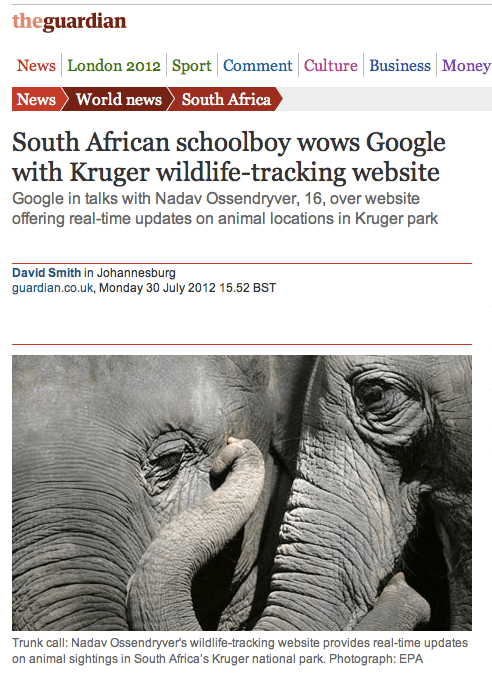
Yesterday’s Guardian had this interesting story of a young fellow’s innovation (click the image above to go to the full account):
In the decadent days when Theodore Roosevelt and British royals led African hunting expeditions, they had to rely on local trackers, patience and luck in their quest to bag “the big five”. Continue reading
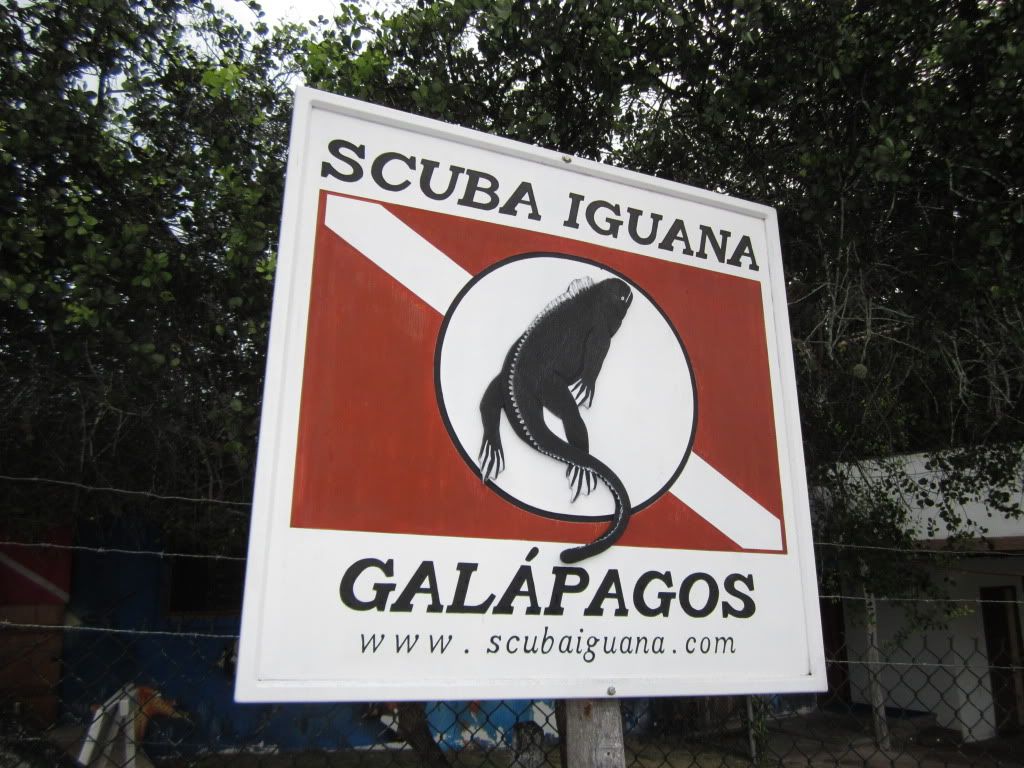
Last week, I had my first, second, third, and fourth dives since I got my CMAS diving certification in 2007 in Croatia. I saw two of the weirdest organisms I’ve ever encountered in the flesh (to be named in the next post), and was also able to fulfill one of my longtime wishes: to be underwater with any aquatic mammal!
I leave for a camping trip on the island of Isabela today, so for now my two brief and scheduled posts will be limited to a couple photos and the video that will be in each! All images and videos were taken by Quike Morán, my Scuba Iguana guide.
Yesterday, Jonathon, Siobhan, Milo, and I moved into one of the new Raxa Collective properties under development. As the four of us huddled silently under our covers, the backwaters of Kerala’s nighttime accompanied Jonathon’s ghost stories…
Instead of spooky tales, though, today I want to share with you another story Jonathon narrates, Raxa Collective presents “A Learning Laboratory.” It’s a short video, Jonathon (narrator), Sunnie (illustrator), Siobhan (director), and I (producer) put together with the help of all the staff and summer interns to highlight some of the best anecdotes of how Raxa Collective’s Cardamom County ecolodge has acted as a “learning laboratory” for its staff, international trainees, and summer interns.
Enjoy!

The telescope, wrought of tax dollars and scientific vision and that allowed this photograph to be taken, is a wonder in itself. But in the photo, to state the obvious, is evidence of wonder taken to a different order of magnitude. Click the image above to go to where we encountered this celestial beauty, in The Atlantic‘s ever more useful website:
This is a nebula we used to think was a star. Located in a neighboring galaxy called the Large Magellanic Cloud, astronomers long called this object 30 Doradus, and labeled it a star. It wasn’t until the mid-18th century that Nicholas Louis de Lacaille detected that it was, in fact, a nebula. We now sometimes call it the Tarantula Nebula.
There’s no color enhancement or significant doctoring in this image: Unlike many astronomical pictures, everything shown is in the visible light spectrum. The Hubble Space Telescope took the photograph.

The hill station Munnar lies 1600 metres above sea level, making it the perfect summer resort of the British Administration in South India before independence. Now famous for its tea plantations Munnar retains its colonial charm. With its sprawling estates, rolling hills, sparkling waterfalls, picture postcard hamlets and undulating valleys, Munnar has all the makings of an idyllic holiday destination.

Periyar Tiger Reserve, Kerala

Dhobi’s Kerchief is native to the Western Ghats, thriving in forested hilly tracts. Although the shrub flowers during mid- monsoon and early winter, the white bracts may be seen on the plant throughout the year. Its leaves and fruits are used in traditional medicines, and the shrub is the food plant for the commander butterfly.

There is nothing quite like waking up in the morning knowing that you are about to enjoy a beautiful hike through the incredible Periyar Tiger Reserve. Sign up for the Green Walk and experience not only this wonderful feeling but also the sights and sounds that make Periyar so special. A three-hour hike, the Green Walk takes you through some of the most amazing habitat the reserve has to offer. With Great Hornbills flying overhead and langurs calling from the trees, the Green Walk is certainly a hike to remember.

Click the banner above to go to this literary-intellectual online magazine edited by Russell Bennetts. Click the image after the jump to go to their reprinting of an item by a lion of letters from another era, writing about a place familiar to us, translated by Louise and Aylmer Maude. It was first published in 1885 in the short story collection What Men Live By. Thank you berfrois and thank you Leo!
The Coffee-House of Surat
by Leo Tolstoy
In the town of Surat, in India, was a coffee-house where many travellers and foreigners from all parts of the world met and conversed… Continue reading
Kerala Backwaters, India

Marigold is a tropical plant found widely throughout south India. The beautiful flowers are mainly cultivated for commercial purpose as temples offerings. It comes in different colors, yellow and orange being the most common. This flowers has a strong pungent odor that is not only used in cosmetics and herbal medicines but in gardening as a natural pest deterrent.
Every Monday and Wednesday evening, starting at 8:30PM, a group of Puerto Ayora residents gathers at Parque San Francisco to play Ultimate Frisbee together. About half of these 25- to 35-year olds are teachers at Tomás de Berlanga, and others work at the Charles Darwin Foundation or around town.
Parque San Francisco is a long and fairly narrow stretch of land between Charles Darwin Avenue and the shore, and to walk from Baltra Avenue (the main road that crosses the whole island from north to south) to the main pier one has to walk through the part of the park that skaters, Ecua-volley players, and Frisbee players use at different times of the day: youngsters anywhere between eight and eighteen years old are constantly skating on the cement space enclosed by steps lengthwise, a stage on one end, and a large cement ramp on the other. Metal rails are often laid out to practice rail-grinds or hopping over the rail while the skateboard rolls under it. Skaters dominate this part of the park (the other parts are a sandy playground and some benches shaded by trees lining the coast) for most of the day, until 4:30PM or so when the volleyballers come out to set up two courts on one of the rectangle. These Ecua-volley players (who deserve their own post) then share half the park with the skaters, with the occasional stray ball or board, until the late evening, when volleyball stops and the skating continues on.
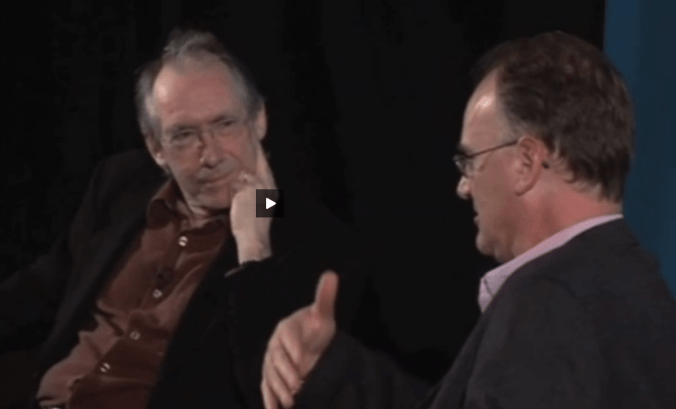
Click the image below to go to the interview, in two parts, with one of the English language’s best living writers, who with this other great writer shares a deep concern for issues facing our planet’s environment and that writer’s uncanny ability to personalize it, as he talks about
the inspiration for Michael Beard, the anti-hero in his comic novel Solar about climate change. The idea came to McEwan when he attended a gathering of 35 Nobel prizewinners, all men of a certain age, ‘big beasts’ in the scientific world who were nevertheless ‘living in their own shadow’ with their most creative years behind them.