Collaboration Without Borders

Until they mate, acorn woodpeckers devote their time to gathering food for their relatives’ young. Credit: Walter Koenig

Let me tell you why I love Tuesdays.  Tuesdays are the designated “Science” day in the New York Times.  I should also say that I love Wednesdays, too!  That would be the “Food and Wine” day.

The fact that today is Friday only goes to show that I don’t always have time to view the paper on a daily basis.

In light of the Vijaykumar Thondaman‘s Bird Of The Day posts, I was excited to see this article about the collaborative nature of this species of woodpecker.

Sindya N. Bhanoo writes:

Acorn woodpeckers are industrious, cooperative birds that live in family groups. Each family has several “helper” woodpeckers that do not breed. These birds devote their time to gathering acorns and other food for the young.

In other words, they’re the equivalent of  ornithological  “nannies”.

I hope you’ll agree that the concept is interesting…and the photo isn’t bad, either!

Ezra, Zephaniah, Amos, Edward & James

The discussion about whether or not to work under the Raxa Collective name had already been a couple hundred hours long as of early March, 2011. Emotions were at full tilt on this and that consideration when a team showed up and got us to the tipping point. Lindsay and Nicole were perfectly balanced, for these purposes, between interested and disinterested. Not to mention interesting. And sometimes very interesting.

Credit where credit is due.  The fellow who founded Cornell University, from which (by some measure) we have had the most inputs for this venture, and the fellow who is credited with the decision by which Amherst College came to exist, can take a momentary bow to the fellows who represent the namesake of the business school at Dartmouth College, the funding of that business school, and (for our purposes here) most importantly the fellow who funded the initiative that brought Lindsay and Nicole to work with us and convince us of our convictions.

It’s A Tough Job…

One of the many hats I wear within my La Paz Group responsibilities is orienting our new interns and visiting colleagues to the Kerala experience.

The usual itinerary includes a visit to some of the cultural sights at Fort Kochi, as well as Backwater excursions and of course, Thekkady and the Periyar Tiger Reserve.

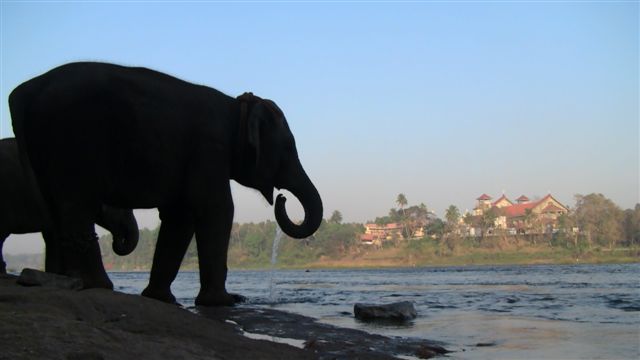
I think I can say without reservation that each intern who enters the reserve has expressed the clear desire to encounter one of India’s most charismatic fauna–the elephant– and some have been luckier than others.

An important part of Indian mythology and culture, here in Kerala elephants were once called “sons of the Sahya”, meaning “sons of the Western Ghats”–referring to the mountain range that not only forms the border with a neighboring state but represents the heart of this one. Continue reading

A Different Good

To get to a basic meaning of good using music, plenty of choices were available beyond the “folk,” “ska” and “world” categories. Bach, Handel, Mozart and Beethoven among many other classical composers had more than enough to say musically that helps us get a grip on good.  The point was more about Pete Seeger’s character, and his choice to not back down and his ability to not become embittered by the injustice; the choice The Specials made to sing to protest a hero’s unjust imprisonment, or Raghu Dixit’s choice to celebrate virtue through a young girl.

For a cinematic rendering of good, Wim Wenders film Until the End of the World comes to mind, which brings the topic back to good music.  Lou Reed does not normally evoke good the way Pete Seeger does, but his contribution to the soundtrack of this film, What’s Good, is worth a listen.  It approaches the subject by pondering inexplicable loss.  Another contributor to that soundtrack is even harder to associate with the word good, but if you listen to him in conversation, he sure sounds like he knows something about good.

Are there equations predicting good behavior other than George Price’s?  If so, please share.  Meanwhile, you might find Laurie Anderson’s Let X = X, a fine diversion.

Bags For Bombay

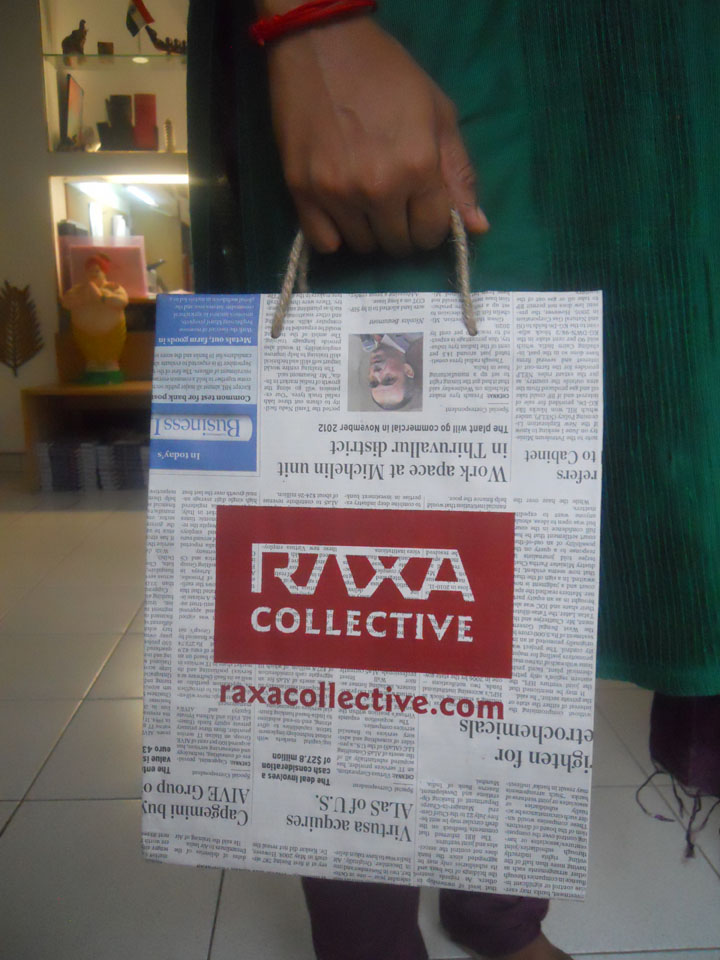
It is customary to bring fancy printed material to industry trade shows. At our next event, in Bombay during the first three days of September, instead of  bringing brochures we will bring these bags.  A new calling card, as it were.  Thank you Diwia, and the team at Thought Factory Design, for quick response to this idea to make it happen.  A special thank you to Raxa Collective team member Bruno for thinking of this initiative (he was in the middle of announcing his wedding engagement in the office when this idea came out of his mouth!) as an answer to all the paper that goes into trade shows.  Now, some of it will go into our recycled bags.

And In Other News…

One day shy of a  fourth opportunity to have a bit more fun with Michael’s mysterious invisibility, foiled.    He is back, so we do not need to make reference to other young men of letters who stopped writing and made us all wish otherwise.  And thankfully there was no resemblance to the story of Yuri Andropov after all, either.  Nor to the even less humorous, or more humorless, current event question that Amy Davidson asks in her most recent blog post.

Let’s change the subject.  Earthquake. No humor in that either.  But for a rare short-form piece by John McPhee, take a look here, to help put such events in perspective.  Amie, Milo and Adrien were all in the location McPhee describes, at the time when that piece first appeared.  The folks who manage that ever-improving site where it was first posted perform a great service of recycling archival material when news brings an old piece to new relevance.  Yesterday’s mention of Pete Seeger makes this worthy of recycling. It is, itself, a recycling of personal history along with a moving observation of the good guy’s aura:

His voice is a little shaky now (he talks the songs as much as sings them), his banjo picking is a little uncertain, and he required the help of his grandson, a powerful singer and guitarist with a perfect sixties name: Tao Rodríguez-Seeger. But he gave a lovely performance, and when he reappeared at the end, to sing “Down by the Riverside (Ain’t Gonna Study War No More)” with Ani and her band, there was nothing but love in that room.

The Meaning of Another World

I experienced monstrous difficulty getting this piece written. The difficulty was that of synthesis, which eludes one all the more deftly when one searches for it too seriously. Almost desperately, I wanted, both for my own sake and for the sake of this, our burgeoning compendium of tidbits and travel tales, to provide a perfectly comprehensive explication of my two months in Kumily. But I have to give up the ghost, and I always have to think more humbly about writing.

So after several drafts, I submit an account more prosaic than I’d hoped for, which is the price of my liberation from this imprecise living–both here and there and in neither hemisphere entirely. I have had reason and time to think about travel, specifically about travel and writing, the collection and formation of disparate experiences for the creation of something meaningful. Growing up, I tended to believe that writing just happened–that a writer, when faced with a given circumstance, simply reported what was before him, and that his metaphors and imagery arose spontaneously from the content of his impressions. I don’t believe that any longer. Writing is hard, and writing honestly is harder.  Continue reading

An Expedition Worth Tracking

Take a look at Paola Pedraza’s post today titled Discovery and Conservation of Plants.  The photos are beautiful but the concept is even better.  It makes the New York Times worth subscribing to.  Thank you Bill Keller!

If Willie Says So

The ideas are all ones we agree with: food transparency, corporate social responsibility, activism, etc.  We do not know much about this company, but if Willie lends (or even sells) his credibility to them, we are inclined to support their campaign:

Odysseus & Jobs

This news item serves as another reminder of the crafty hero and the travails of his journey.  The classical story works because we are always asking, what’s next?  We want to know.  We need to know.  We care.  And no matter what, we have hope.  But markets tell the story their way. Stock price down 5%.  The wounded hero gets no benefit of the doubt.  Will the ship sail well without him at the helm?  It is the entrepreneur’s ever-present existential question.

Big Ideas, Exclusive

There was a provocative item we noted a couple Sundays ago in the New York Times.  One response to it has appeared in The Economist’s online site.   It would seem that anyone who believes in the notion of immortal soul might not bet on their own (or anyone else’s for that matter) no matter how confident they are about a particular issue:

…I’ll bet my immortal soul that more really big ideas, whatever that means, were studied, discussed, and produced in 2010 than in 1950. The number of people with the means, opportunity, and motive to care deeply about ideas is greater than ever.

A TED talk or a book-talk spot on “The Daily Show” may not have the audience or cultural centrality of a half-hour with Dick Cavett on ABC in 1970, but more people are consuming and discussing big ideas, old and new, than ever before. The difference is that the audience and the discussion has become fragmented and decentralised.

Of course, it is a turn of phrase, effective precisely when you are confident of your own opinion but not certain of the facts.  Nonetheless, the point is well taken, not least because we are so frequently awed by TED talks.  It is good to have more ideas more available to more people.

But this misses the point.  It is one thing to be creating big ideas (the major point in the original piece, even if it dillydallied with mentions of Norman Mailer, William F. Buckley Jr. and Gore Vidal–none of whom belong in the same paragraph with Carl Sagan let alone Albert Einstein) and another to be disseminating them more effectively and more efficiently.

Kathakali

It’s said that about 70% of communication is nonverbal. However in the case of Kathakali, which has its own stylized language of dramatic movements, stories – epic classics even – can be 100% told without uttering a single word. Next door to the Kalari Centre where Sung and I witnessed the impressive show of Kalari Payattu, is the Mudra Centre for Kathakali: yet another cultural spectacle that originated in the southern Indian state of Kerala. Continue reading

Wordsmithing: Good

So sly, this one.  Let’s leave OED out of it.  Good comes to mind on enough occasions that we do not notice it; just the sound of the word is enough to lull.  Any one reference would be pointless.  Even without a point, here is a recommendation: listen to this podcast.  There is a good formula and there are plenty of stories of good people.

If you are a regular Radio Lab listener you are likely already familiar with that episode (one of their most listened to, and for good reason, so to speak), in which case find yourself a recording of The Weavers in reunion at Carnegie Hall in 1963.  Listen to Guantanamera and consider this: some years prior Pete Seeger had serious legal problems due to his political views (search it and the story will reward you with a colorful illustration of what “land of the free and home of the brave” really refers to) and yet chose, at the height of Cold War tensions with Cuba, to sing about and quote Jose Marti.  Whether you like the music or not, and regardless of your ideological perspective, listen to Seeger’s voice: no malice, nor fervor; just what sounds to be, by some aural definition, good.

Alternatively (in the ska sense), find The Specials’ original studio recording of Nelson Mandela.  Good sounds and good pleas about a good man.  And for a completely different aural rendition of good, find the original studio recording of Raghu Dixit’s Mysore Se Aayi.  YouTube has some live performance versions of both, but the original recordings are a better place to start.  And it is good to own them.

New Wheels

A friend writes from Santa Monica, California (USA) that he has taken a new job with a new company producing a new kind of electric vehicle.  It will be fun to watch the progress of all three.  If you read his column regularly, you may recall Thomas Friedman wrote about them.  So did these folks, and we are happy to know of their site.  It looks like one more source for staying apprised of technological innovations and the businesses that provide to and feed from such troughs.  And we like the word collaboration on their masthead.

Ramírez, Reading & Responsibility Update

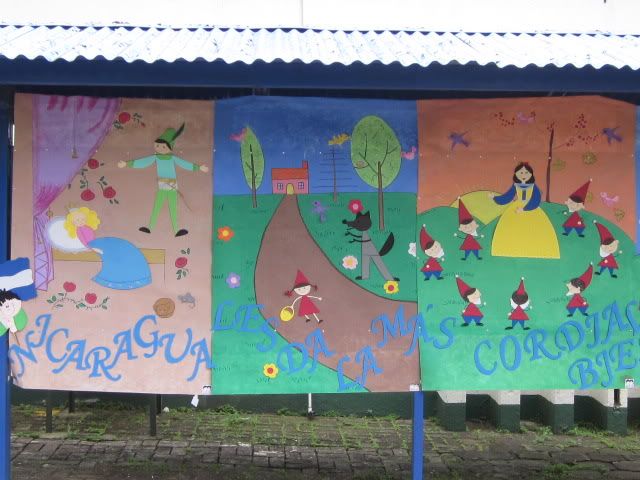
In my post about Sergio Ramírez, former vice-president of Nicaragua, I had very few pictures. I have corresponded with José Tomás, and thanks to his camera I can provide some pictures here:

A welcome poster made by children showing famous stories

Continue reading

Refresher

From the New York Times, a statistical reminder of progress to date and how far yet to go:

Over the past 25 years, the number of conservation areas set aside for the nonhuman species has grown considerably. Globally, there are now more than 100,000 protected areas, including national parks, biological reserves and marine sanctuaries. All told, they protect slightly less than 13 percent of the land on earth and slightly more than a half-percent of the oceans, though only a minute fraction are “no-take” zones that bar fishing. But can these protected areas do enough to protect biological diversity?