The Bells & Whistles Of The Forest At Daybreak

GBD2017ResultsWed.jpg

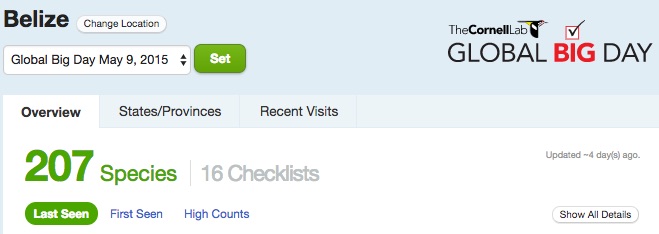
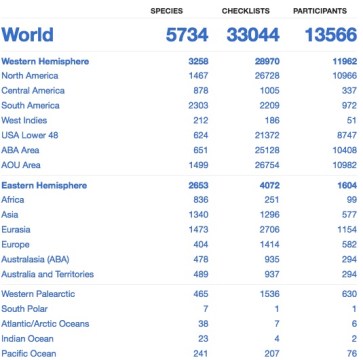
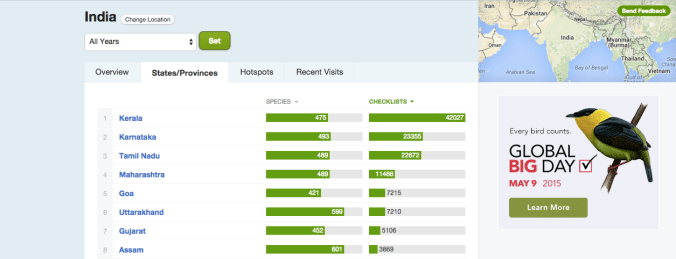
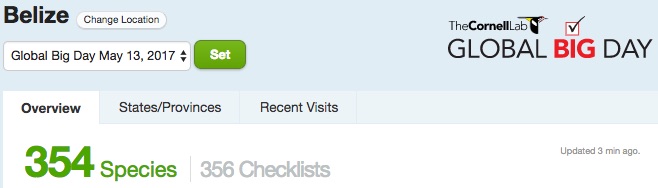
We post a few times a day, sharing information about initiatives in our own realm of work and frequently observations on news links that we find interesting. For the record, here is a bit of news worth celebrating. As I type this at 5:30a.m. Belize time, the Global Big Day page on eBird shows the latest tally of the species count as seen above. At the same time, on the eBird Facebook page I am looking now at the last post, dated May 15 midday, that says:

The #GlobalBigDay total is now 6,255, less than 100 away from a new record for a single day of birding!

Looks to me like a new record has been set. Where are all the bells and whistles? They are outside my door right now, where the wildlife is whirring, cling-clanging, whooping and shrieking as the forest lights up…
Sticking To Mission & Unintended Consequences

GBD2017Result1

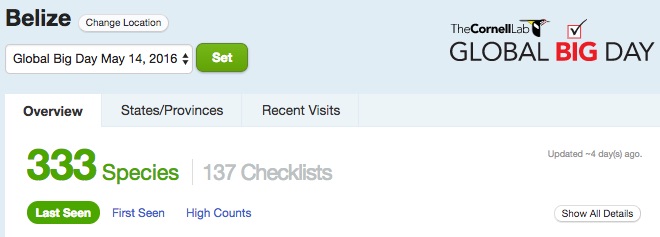
In recent months, as we prepared to host Team Sapsucker Belize at Chan Chich Lodge, our goals were focused on the citizen science mission. Using a couple simple metrics, the event was a clear success, comparing the number of species counted in Belize this year versus last year, and especially looking at the number of checklists submitted.

GBDResult16.jpg

If you look at this as the third iteration of an event that we hope to grow in future years, the progress from beginning to present is promising. As I type this there are still more than 40 hours of data entry remaining for this year’s event, so the increase in this year’s participation and species identification will likely grow larger by this time Wednesday.

GBDResult15.jpg Continue reading

Global Big Day 2017, Results

GBD2017b.jpg

When I left Team Sapsucker late last night it was pouring rain, a perfect punctuation to the day, telling them to stay under cover on Chan Chich’s deck since no bird would be out in the deluge. They were reviewing their lists, waiting to see if the rain would pass, allowing one final outing of the 24-hour period. I did not ask the final number, but I could tell they were happy with the day.GBD2017Result

As I type this at 5am the rain has long since stopped, the early birds are out in full sonic force, competing with the howler monkeys it seems, and results on eBird’s website look impressive. My eye is drawn to the Central America numbers. Partly because I moved to the region two decades ago and have worked in each country. Partly also because the region has embraced its ornithological importance, and yesterday provided one more metric for that embrace. But mainly, because I am here in Belize and the Lab team we had here was exactly as expected, not only as birders but as people.

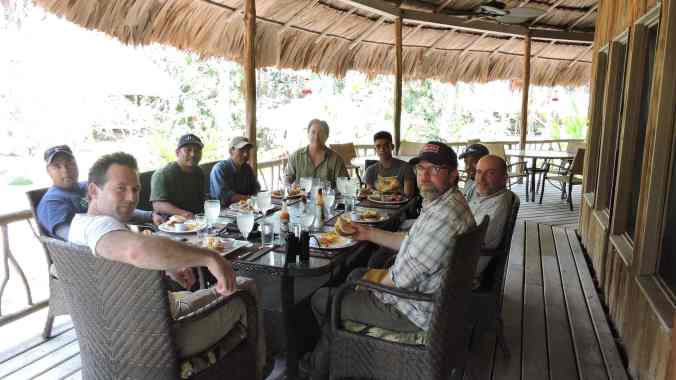
The Chan Chich guide team had an amazing day with the Team Sapsucker on Friday, and over lunch that day they all celebrated several firsts, the details of which escape me now, but they involved two new species being added to Chan Chich’s list on eBird (a big deal) and our guide Ruben adding a life list bird that day to his nearly two decades of birding accomplishments at the Lodge.

GBD@CCL.jpg

The Lab team explained the rules of the game for the following day. No assistance of any kind would be possible after midnight. Continue reading

Introducing The Team Prepping For Global Big Day At Chan Chich Lodge

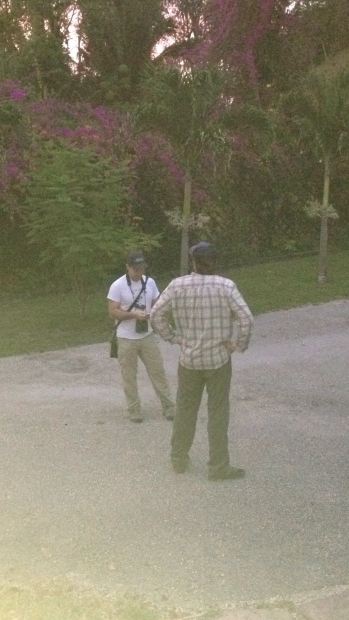
GBD1On day two in Belize with Team Sapsucker introductions are due. The photo to the left, taken at about 5am today in front of Chan Chich Lodge’s reception area, shows two of them. The best information I could find to share with you about Andrew Farnsworth is on Songbird SOS Productions, where he says:

“I like the challenge of trying to figure out how to go birding when there’s a traffic jam on first avenue. It’s cool to be able to study birds in a city… Some people have seen technology as the end of all things natural, but there’s a whole other side to it that gives us access to a world that we would otherwise not have seen.” Continue reading

Counting Down To Global Big Day

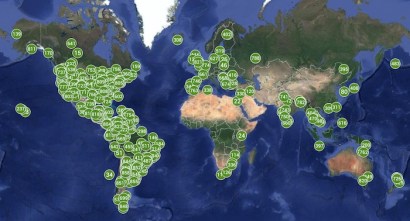
Global-Big-Day-map

A world of birders has already marked out where they’ll be on 13 May. Where’s your place? Add it today!

Thanks to eBird for the one week marker until Global Big Day, which we look forward to supporting at Chan Chich Lodge. Click the map to the left to mark your territory, so to speak. This countdown notice uses one species to illustrate a conceptual premise of the annual event, and we are happy to report that this species is frequently seen at Chan Chich Lodge on birding walks, and excursions to Gallon Jug Farm, where the barns are accommodating:

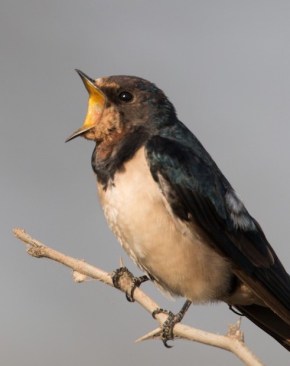
The familiar Barn Swallow (right) has been recorded in eBird from 222 countries. You can hope to spot a Barn Swallow almost anywhere on the planet, from Alaska to Argentina, Siberia to Australia, Iceland to South Africa. Barn Swallows criss-cross the equator and traverse the Eastern and Western Hemispheres. Their movements not only span an entire planet of birds, but connect a worldwide community of birders.

In the same way, Global Big Day and eBird connect all of your local birds with the rest of the world, making a real difference in the collective understanding of birds worldwide. On 13 May, every bird that you report contributes to the global team total for an unprecedented snapshot of our planet’s bird diversity. Every bird counts.

To join the Global Big Day team from more than 150 countries, all you have to do is go birding on 13 May!  Continue reading

Big Day Pledge

clo_logo_2_351px

As we have in past years, in solidarity with our friends and colleagues at the Cornell Lab of Ornithology, we are sharing the pledge drive as far and wide as we can, and look forward to doing our part more specifically in a couple weeks:

BigDay_Email-banner_032817

On May 9th, the Cornell Lab of Ornithology’s top birding team will begin the long journey to the Yucatan Peninsula for Big Day 2017. Big Day is an all out midnight-to-midnight birding event to see who can identify the most species in a 24 hour period. Team Sapsucker hopes to find the most birds yet — by identifying 300 bird species. Continue reading

Global Big Day, Coming Soon At Chan Chich Lodge

We have already extended the invitation, but we will continue reminding you just as the Lab keeps reminding us:

On May 13, 2017, the Cornell Lab of Ornithology’s birding Dream Team, the Sapsuckers, will reach for an audacious goal: finding 300 bird species in just 24 hours – and raising $475,000. Can they do it?! Continue reading

Why We Use eBird, A How-To Primer Explaining Our Motivations

Chan-Chich-Lodge-logoThis article published by Audubon (click their banner below to go there) continues to provide fresh illumination on the basics of eBird; also on why we have made eBird central to our birding activities for guests in recent years, and why Chan Chich Lodge is collaborating with the Lab of Ornithology this Global Big Day event .

AudubonLogo

Since its launch in 2002, eBird has revolutionized the way birders worldwide report and share their observations. A joint project by the Cornell Lab of Ornithology and Audubon, eBird is a free online program that allows birders to track their sightings, while other birders watch and search in real-time. Articles have been written about eBird with mind-bending titles like, “eBird Changed My Life” and “The Agony and Ecstasy of Surrendering to eBird.” In a front-page science headline in 2013, The New York Times called it “Crowdsourcing, for the Birds,” and concluded that eBird is “a revelation for scientists” and gives birders “a new sense of purpose.” Continue reading

Global Big Day 2017, Belize

BigDayDonate

You have plenty of options of where to spend the day, but we are hoping to share the entire week leading up to May 13 with lots of old friends of Chan Chich Lodge–not only dedicated birders, but especially them. And not only old friends–we welcome the opportunity to introduce new folks to birding. So think about joining us that week in particular.

In our work around the world in recent years we have tried to support the Cornell Lab of Ornithology’s mission, focused through ebird in this worthy call to action, in as many ways as possible. If you do not know about the Lab, start with what they say about themselves and if it strikes you as relevant click on the banner above to make a pledge on one key initiative:

The Cornell Lab of Ornithology is a world leader in the study, appreciation, and conservation of birds. Our hallmarks are scientific excellence and technological innovation to advance the understanding of nature and to engage people of all ages in learning about birds and protecting the planet. Continue reading

Come See, Enjoy, & Count With Us!

LeanderOcelot

We had the good fortune some weeks ago to host one of Europe’s finest birder-guide-photographers at Chan Chich Lodge. His bird photos are wow quality (see below for an example) but my favorite of all his photos is the one above of an ocelot. We are gearing up for Global Big Day at Chan Chich Lodge. Our primary goal is simple. Follow the leader, and lead by example. Our secondary goal is kind of competitive, related to the program’s own details:

Details

For the past two years, the second Saturday in May has been the biggest day of the year for birds: Global Big Day. More than 6,000 species of bird. Tens of thousands of people. 153 countries. Immeasurable fun. Continue reading

Preparing For Global Big Day On May 13, 2017

Cornell_Lab_Global_Big_Day_Map-625px

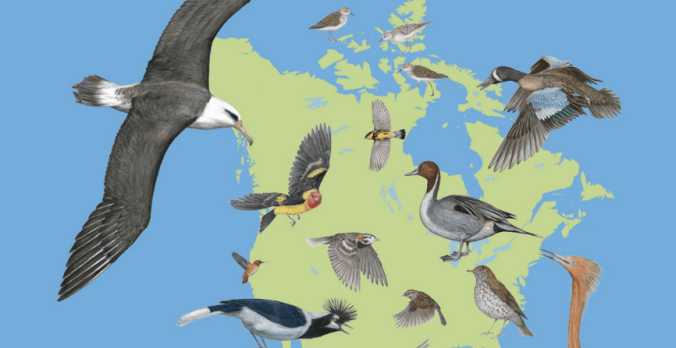
Global Big Day map painted by Luke Seitz, a Bartels Science Illustration intern and member of the Redheads student birding team.

We have about two months to prepare, and this third year of Global Big Day could be epic. When we started participating in this annual event in 2015 our work still mostly focused on the Western Ghats region of southwest India, but we were migrating back to the Mesoamerica region so our attention has been shifting. Now we are all in at Chan Chich Lodge and we want to help ensure that this year Belize is as strong a contributor as possible to the goals of this program:

In our ongoing effort to push the boundaries of a Big Day, we’re inviting everybody around the world to join together and participate in our Global Big Day to support global conservation.

How to Participate

Submit Your Data to eBird on May 13

It’s that simple. If you submit your birds to eBird they count. Learn how to take part. Don’t worry — you don’t need to be a bird expert, or to go out all day long. Even a half hour checklist from your backyard will help. Of course, you are welcome to spend the entire day in the field, but know that it is not required! Please enter your data as soon as you can, preferably by Tuesday, May 16. Continue reading

For the Birds: a Message to North American Policymakers


The State of North America’s Birds 2016

The State of North America’s Birds 2016

We continue to laud the importance of eBird on this site, gaining special importance as it becomes more and more clear that wildlife doesn’t acknowledge political borders. The data gleaned from tens of thousands of Canadian, Mexican and U.S. citizen scientists who contribute to eBird indicate that more than 350 species in North America migrate up and down Canada, the U.S.A, and Mexico over the course of a calendar year.

And according to the recently released State of North America’s Birds 2016 report, those three countries—their governments, and their societies—need to step up and do more to preserve our continent’s spectacular and shared natural heritage of birdlife. This report is the first-ever scientific conservation assessment of all 1,154 bird species in North America, and it was only possible because of the tremendous scale and big-data capabilities of citizen-science….

Among the many takeaways from eBird maps and models includes one of relevance to our property, Chan Chich Lodge, located on 30,000 acres of Belizean forest in the Yucatan peninsula.

The Yucatan Peninsula is one of North America’s most vital bird habitat regions

The Yucatan Peninsula is one of North America’s most vital bird habitat regions

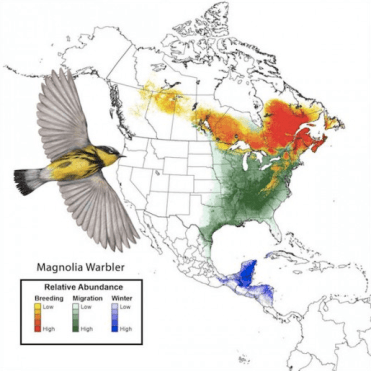
Not only is the Yucatan rich with endemic birdlife, it’s a critical wintering area for more than 120 birds species that migrate from Canada and the U.S.A. In winter, the entire population of Magnolia Warblers relies on an area of tropical forest in Mexico only 1/10 the size of its boreal forest breeding range, with the Yucatan as the bull’s-eye of their wintering range.

Continue reading

Birding from VdF: San José Estuary

IMG_2485_zpspmm923kl

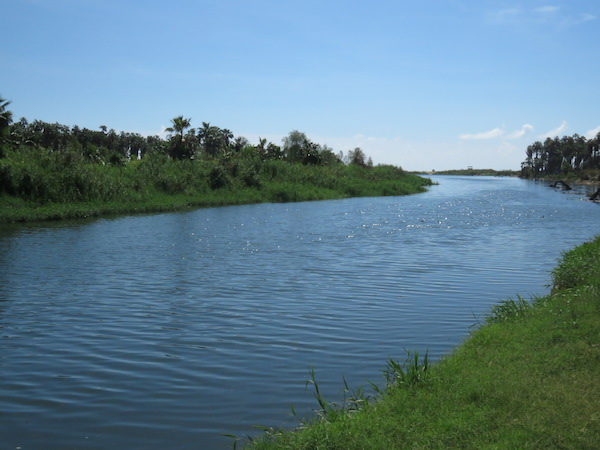
Since last week, I’ve been based back at Villa del Faro in Baja California Sur, Mexico, where I’ll be co-managing the property with Jocelyn for a good while. In addition to having the opportunity to see what kind of birds show up here in their winter migration, I’m also hoping to have time to check out the surrounding region for other birding hotspots. I’ll do this not only for my own interest, but also because we may get guests here in the future who are bird-watchers.  I’d like to be able to recommend areas based on my own experience, so they don’t have to rely solely on eBird, which helps find certain spots but can’t give you any directions that Google Maps doesn’t have.

Nevertheless, eBird is one of the best ways to quickly figure out what locations within a region are popular for birding, whether because they have lots of species or because lots of birders pass through there (or both). Continue reading

eBird Workshops in Guatemala

First of all I would like to give to you a brief introduction of myself since it’s the very first time I have the great opportunity to write a post here – by the way thanks Amie, Crist and Seth Inman for the invitation.

I am a 20 year old birder from Guatemala and I have been in touch with nature and birds since I was a little kid. I remember being carried by my dad on his back and going out to the field to go birding. He needed to take care of me but he didn’t want to just stay at home wasting valuable hawk migration time, so he took me with him no matter what. I remember I enjoyed it A LOT, not only because I liked being carried, but the memories of the field guide open in my dad’s hands and his binoculars hanging by his neck and his trying to point out the bird and later showing it to me in the book are things I will never forget. Of course I was too young to actually spot the bird and appreciate it in the field but I do remember looking at the birds carefully in the field guide. A few years later I was so excited when he gave to me my first pair of binoculars as a Christmas present! I felt like a pro ornithologist (although I didn’t know that word yet). That same year he bought his first spotting scope so when I wasn’t able to see the bird and observe it through my binoculars myself he would find it on the scope so I could enjoy the beauty, behavior, different plumages – everything of the birds. I immediately fell in love with birding and all of what biding had to offer to me. Continue reading

Big Numbers for eBird this Summer

Starting in May, eBird hit a big milestone: 11.8 million bird sightings in that month alone – the same amount of sightings the citizen science database collected in the first five years it existed. Participation in recent years had shot up enough to make that sort of number, and these sorts of maps, possible. Then, on June 17th, the 333,333,333th checklist was submitted to eBird from a participant in Illinois. A third of a billion records submitted by just over three-hundred thousand different people around the world since the Cornell Lab of Ornithology and Audubon partnered to make it possible for people to easily digitize their bird sighting checklists – that amounts to an average of a thousand-and-fifty checklists per eBirder!

At the end of last month, eBird saw another big number, with a million bird photos archived in the Cornell Lab’s Macaulay Library through the new tool allowing users to attach images to their checklists. And this week, the app Merlin got downloaded by its millionth user since it was launched for iPhones in January 2014 (and a bit later on Android phones). But eBird, Merlin, and the Macaulay Library aren’t the only ones reaching milestones this summer. Continue reading

Ornithological Climate Change Indicators

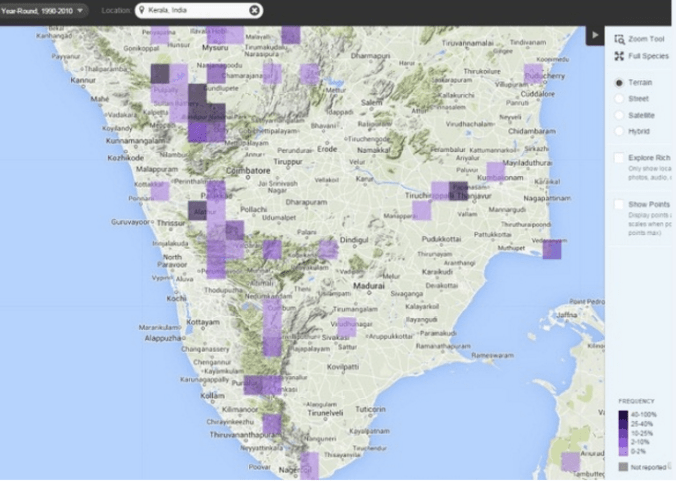
Map showing peafowl-sightings between 1990-2010 (Source: Cornell Lab of Ornithology and the National Audubon Society)

Map showing peafowl-sightings between 1990-2010 (Source: Cornell Lab of Ornithology and the National Audubon Society)

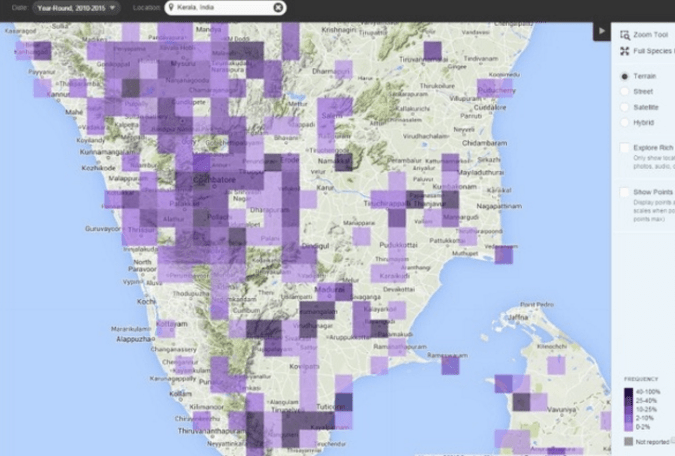
Map showing peafowl-sightings in Kerala between 2010-2015 (Source: Cornell Lab of Ornithology and the National Audubon Society)

Map showing peafowl-sightings in Kerala between 2010-2015 (Source: Cornell Lab of Ornithology and the National Audubon Society)

Few of our readers will fail to notice that eBird and Citizen Science are important elements of the RAXA Collective DNA. Stories related to Kerala and the state’s healthy birding population are equally on our radar.

The folks at India Climate Dialogue recently turned to eBird observations to document changes in climate patterns in Kerala, an important watershed state for the Indian subcontinent using peafowl population as one of the indicators. Especially during mating season, the birds find it difficult to move their trailing feathers in areas of dense foliage, so they’re attracted to drier climactic areas. The eBird data above illustrates their movement into Kerala, meaning more areas are opening up.

High heat in February-March is not unusual in Kerala, and in reality it is this heat trough that pulls the monsoon from Indian Ocean into the Indian subcontinent. The heat epicentre heralds the monsoon and runs like a pilot car through the peninsula, taking the same path that the southwest monsoon will follow a few months later. Since the southwest monsoon starts from the coast of Kerala, it is the state that has to feel the heat first, so that pre-monsoon showers start in May and the monsoon arrives in June. Continue reading

Great Backyard Bird Count at Xandari

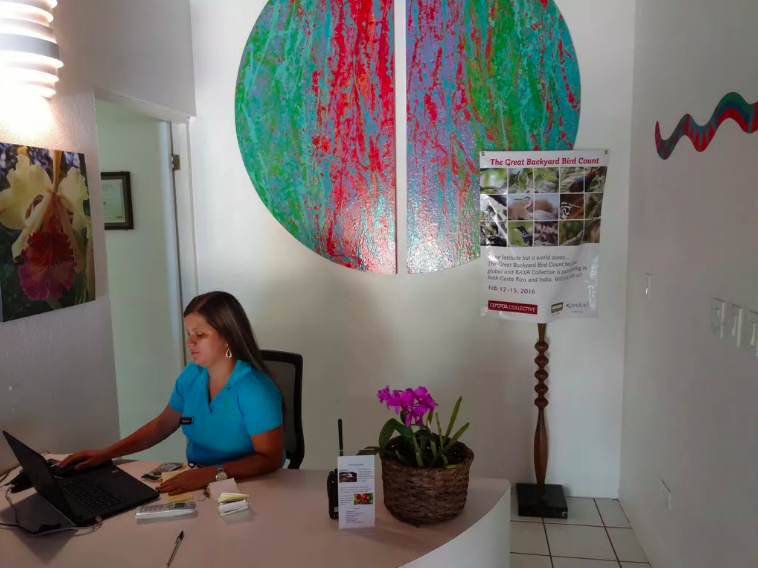
Patricia works at Reception, with the Great Backyard Bird Count sign behind her

Xandari Resort & Spa’s Great Backyard Bird Count started off with the piercing whistle of a Common Pauraque, followed by some wren vocalizations and a Great Kiskadee‘s eponymous (“great kis-ka-dee!”) call. While drinking my morning coffee before the scheduled birdwatching tour I listened to the sounds from the forest and recorded my first GBBC checklist of the day at 5:30.

Then, some guests and I watched birds from the restaurant terrace for almost half an hour before walking through the gardens as well, leading to two more checklists. The most exciting sightings this time were a small group of White-crowned Parrots and a Zone-tailed Hawk soaring alongside a Short-tailed Hawk.

Continue reading

Concurrent and Coinciding Thoughts on 5000+ Birds

img_7608_zpsgfofu0lt

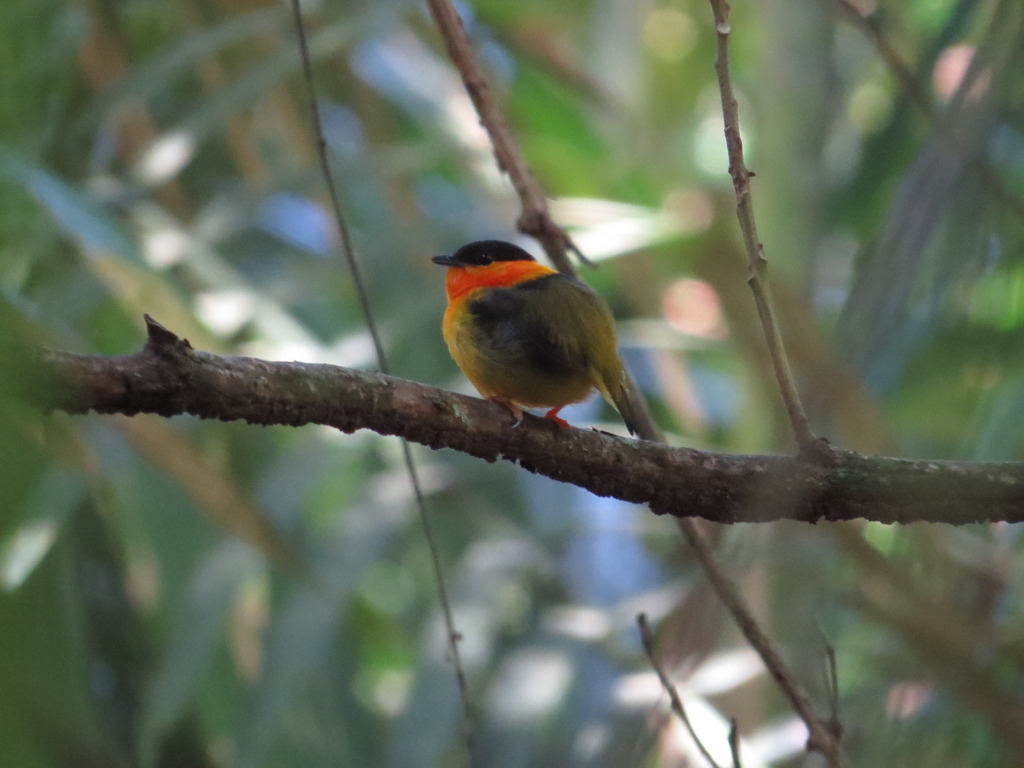
male Orange-collared Manakin seen at Carara National Park, Costa Rica

This week, two birders (one of whom we’ve featured on the blog before, and the other who we should have), Noah Strycker and Tim Boucher, wrote some thoughts on birding and life lists that had much in common, partially because I suspect Boucher’s post on The Nature Conservancy’s blog was inspired by Strycker’s summary of his 2015 Big Year, even though he made no explicit mention of the new world record (6,042 species of bird seen or heard in a calendar year).

Boucher, who saw his 5000th bird at the very end of 2015 (and those 5000 birds are ones he’s actually seen, not only heard), reflects on thirty-four years of birding to achieve his goal. Strycker, on the other hand, summarizes 365 days of straight birding to end up with the biggest big year ever recorded.

Continue reading

Clap Hands for Kerala Birders!

Between the on-going Bird of the Day series and many ornithologically focused posts, our interest in birds can’t be breaking news to any La Paz Group reader. We’re constantly hearing more about the importance of citizen science in all sorts of ecosystems, but with both birding and Kerala so close to our hearts we’re thrilled to applaud the enthusiasm of the Bird Count India community. Continue reading

October eBirding at Xandari

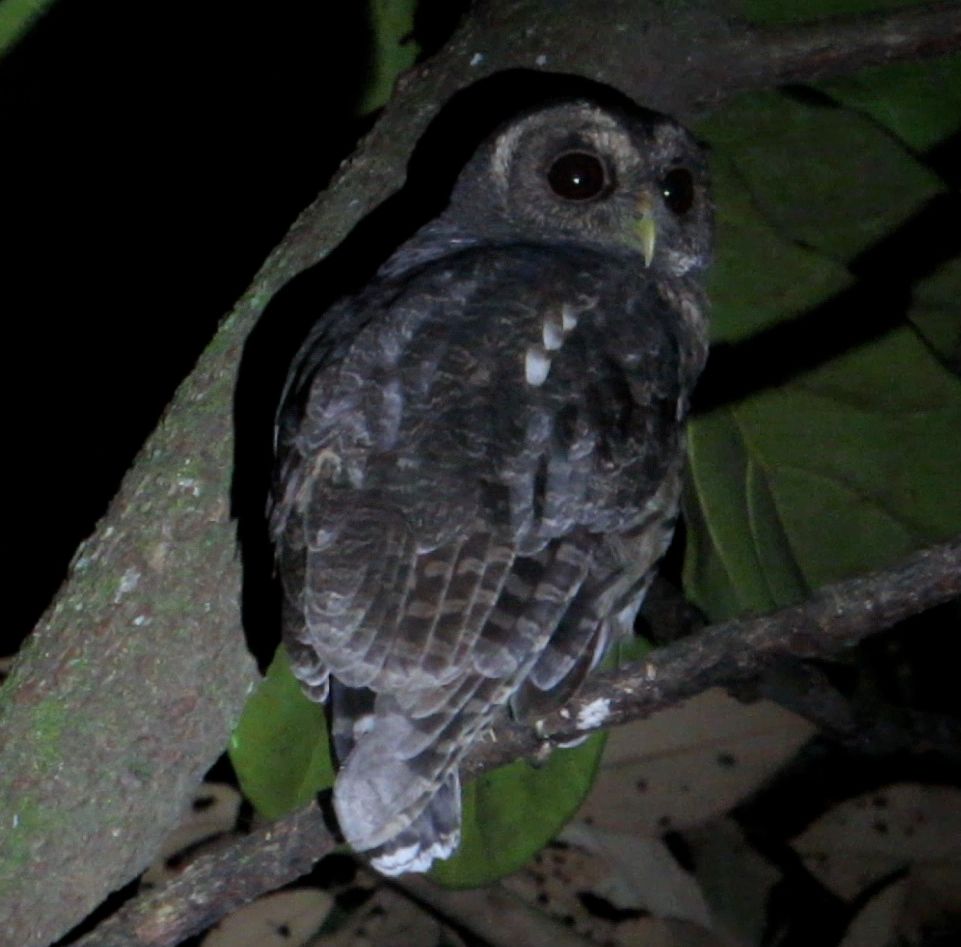
A Mottled Owl seen on Halloween, 2015

This past month at Xandari was a good one for the resort’s eBird hotspot, since it saw the beginning of the migratory bird season in earnest (some species start migrating from North America in September or even late August). Not only were 91 distinct species seen throughout the month, but 15 of these species were newly observed on property (including three new representatives each of both raptors and warblers; four new swallows; and even a new hummingbird that was probably fleeing the rain-induced cooler temperatures at its higher elevation habitat). These fresh observations have bumped the hotspot’s species count up to 137, putting Xandari in a tie for 54th place by species count within the entire province of Alajuela, which as the third-largest province of Costa Rica includes some of the stronger birding sites in the country, like Arenal and Poás volcanoes and Caño Negro National Park (not to mention all the private reserves––like Xandari’s––that get lots of bird-watchers every year).

Last night, fittingly for Halloween, Jocelyn and I saw a Mottled Owl (not the first time at Xandari, but the first time filmed that I know of):

Continue reading