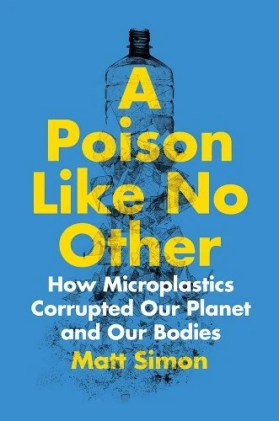
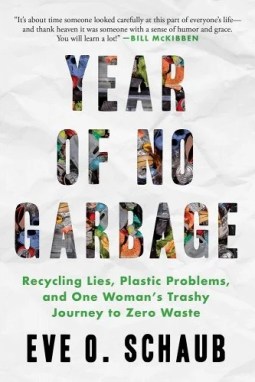
 Four books have been read and summarized, thanks to Elizabeth Kolbert (the information challenges you, of course). The covers of those books appear here with links to independent booksellers where they are or will be available, and at minimum the opening story of Kolbert’s article is a must-read if you care about plastic:
 In 1863, when much of the United States was anguishing over the Civil War, an entrepreneur named Michael Phelan was fretting about billiard balls. At the time, the balls were made of ivory, preferably obtained from elephants from Ceylon—now Sri Lanka—whose tusks were thought to possess just the right density. Phelan, who owned a billiard hall and co-owned a billiard-table-manufacturing business, also wrote books about billiards and was a champion billiards player. Owing in good part to his efforts, the game had grown so popular that tusks from Ceylon—and, indeed, elephants more generally—were becoming scarce. He and a partner offered a ten-thousand-dollar reward to anyone who could come up with an ivory substitute.
 A young printer from Albany, John Wesley Hyatt, learned about the offer and set to tinkering. In 1865, he patented a ball with a wooden core encased in ivory dust and shellac. Players were unimpressed. Next, Hyatt experimented with nitrocellulose, a material made by combining cotton or wood pulp with a mixture of nitric and sulfuric acids. He found that a certain type of nitrocellulose, when heated with camphor, yielded a shiny, tough material that could be molded into practically any shape. Hyatt’s brother and business partner dubbed the substance “celluloid.” The resulting balls were more popular with players, although, as Hyatt conceded, they, too, had their drawbacks. Nitrocellulose, also known as guncotton, is highly flammable. Two celluloid balls knocking together with sufficient force could set off a small explosion. A saloon owner in Colorado reported to Hyatt that, when this happened, “instantly every man in the room pulled a gun.”
 It’s not clear that the Hyatt brothers ever collected from Phelan, but the invention proved to be its own reward. From celluloid billiard balls, the pair branched out into celluloid dentures, combs, brush handles, piano keys, and knickknacks. They touted the new material as a substitute not just for ivory but also for tortoiseshell and jewelry-grade coral. These, too, were running out, owing to slaughter and plunder. Celluloid, one of the Hyatts’ advertising pamphlets promised, would “give the elephant, the tortoise, and the coral insect a respite in their native haunts.” Continue reading →



 Organikos