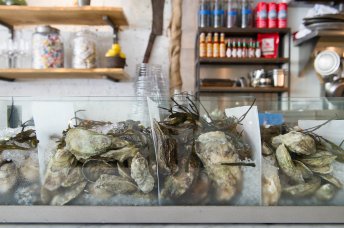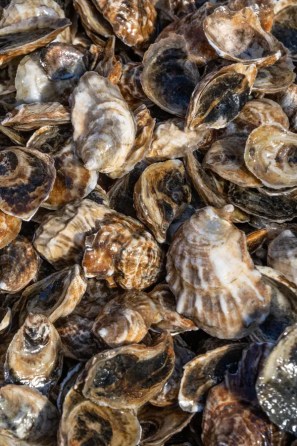
Give It Up For Oysters

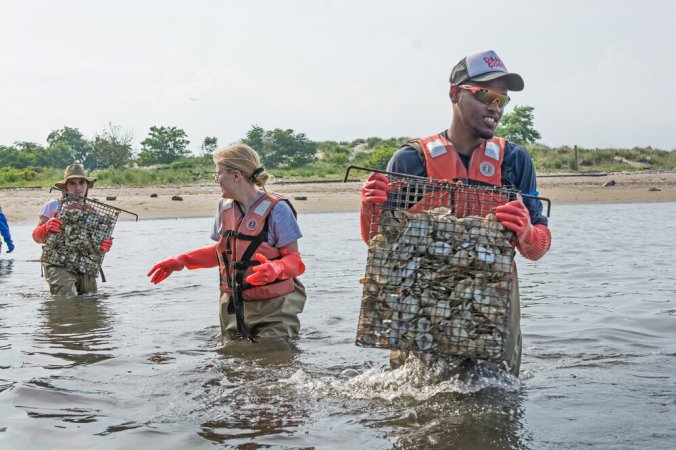
Among the ocean’s best filter feeders, one oyster cleans 50 gallons of water per day. Tony Cenicola/The New York Times

We have linked to stories about the environmental services that oysters provide, as well as the environmental activists who leverage those services; today a riff on those topics:

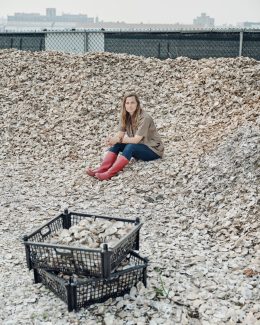
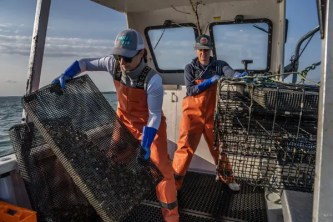
Stefanie Bassett and Elizabeth Peeples left their city lives behind to raise mollusks.

The Little Ram Oyster Co., a farm of 2 million oysters on the North Fork of Long Island, started with a Groupon.

To celebrate a friend’s birthday in the summer of 2017, Stefanie Bassett and Elizabeth Peeples joined eight other enthusiasts in Long Island City to learn how to shuck oysters at a discount. The Brooklyn couple, who knew each other from middle school in Columbia, Md., always had a love for the delicacy. But as they laughed with their friends and fumbled with their oyster knives, they also listened intently as an instructor explained the history and magic of the mollusks.

Ms. Bassett and Ms. Peeples prepare oyster cages to be put into the water. Tony Cenicola/The New York Times

“The thing that drew our attention was the positive environmental impact oysters have,” said Ms. Bassett, 42.

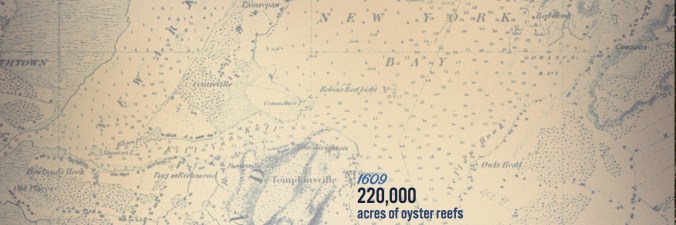
Among the ocean’s best filter feeders, one oyster cleans 50 gallons of water per day. New York was once known as “the Big Oyster,” but over-harvesting and poor water quality wiped out the population by the 21st century. The couple learned about efforts to bring them back to the harbor. Continue reading
Oysters & Rescue Plans

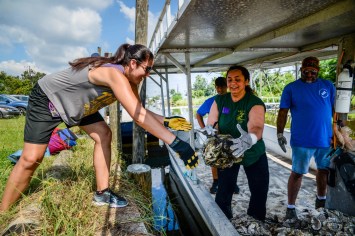
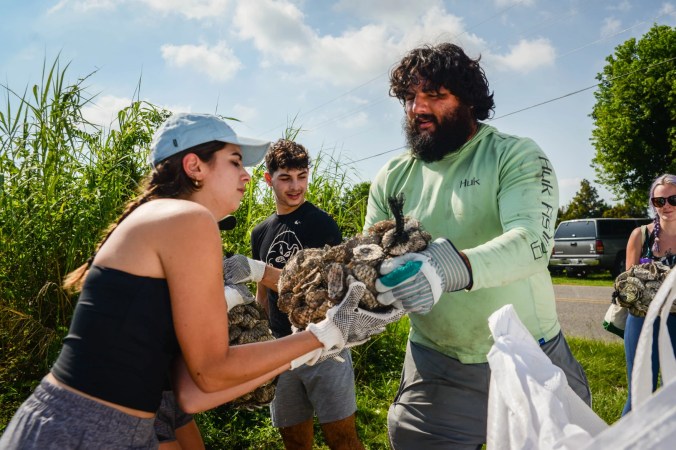
Halle Parker/WWNO. Pointe-au-Chien Indian Tribe member Pete Lebeouf works with volunteers to load bags of oyster shells onto a boat on Saturday, Sept. 24, 2022.

We have enjoyed every instance of oysters being treated with respect, beyond culinary. When indigenous knowhow is part of the story, even better. Our thanks to Halle Parker and WWNO (National Public Radio, USA) for this story:

Halle Parker/WWNO.  Pointe-au-Chien Indian Tribe citizens Patty Ferguson-Bohnee and Lori Stewart pass bags of oyster shell and pile it on a boat for transport during a volunteer event on Saturday, Sept. 24, 2022.

A Louisiana tribe is losing cultural sites to coastal erosion. Oyster reefs could help.

For the past six years, the Pointe-au-Chien Indian Tribe has battled to stop its historic earthen Indian mounds from slipping into the sea, looking to the power of oyster shells to protect them. Now, they’ve expanded that effort.

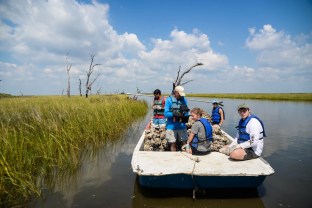
Halle Parker/WWNO. Volunteers boat down to Bernard’s Mound, one of the Pointe-au-Chien Indian Tribe’s historic mounds, to build a new oyster reef that will help slow erosion during an event on Saturday, Sept. 24, 2022.

The tribe has lived in the area for centuries, forced south as Louisiana was colonized, and the mounds that past members built have a range of uses. Some might’ve held homes, others were used for ceremonies and some were burial sites, said Lori Stewart, a member of the tribe.

“The mounds are really significant because we do have some of our ancestors that are buried there, and so we don’t want to see that washed away,” she said. “That’s sacred to us.” Continue reading

Nature, Intervention & Protection

Discovery inspires.

Participation motivates.

Discovery + Participation + Organization =

Results

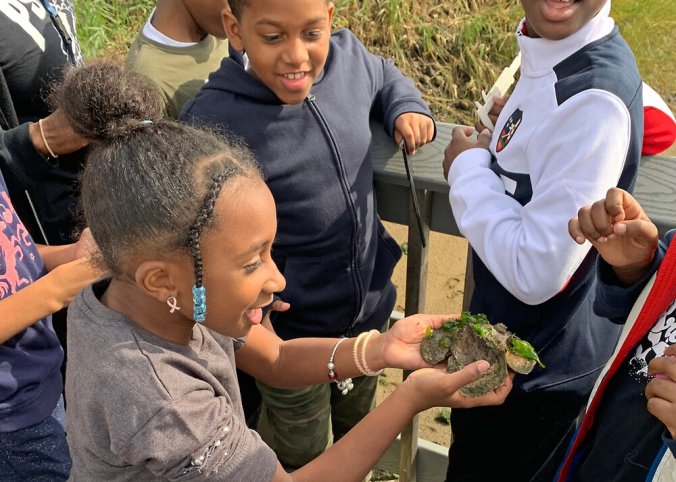
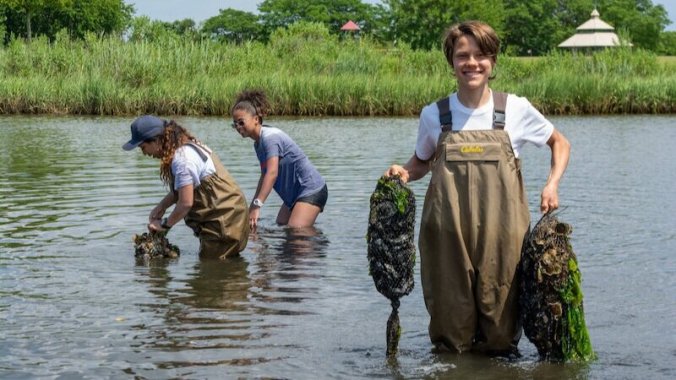
Click any of the images above to go to the website of this organization featured once before in our pages and now again in the article below. It will make more sense after reading the article. But do visit the site and consider volunteering. Take some kids along.

In New York, Kate Orff will use oyster reefs to mitigate storm surges. Photograph by Thomas Prior for The New Yorker

Eric Klinenberg‘s work on the topic of libraries provided a sense of common cause. After featuring so many stories about libraries and librarians (my more recent personal anecdote was purposely brief so did not relay how many ways my local library impacted my young life, a topic for another day), his book summed up much of why the institution matters to us. And then some. Advocating for libraries was something a talented academic could do on a larger scale than we could in these pages, especially with publications like those. Bravo. And now this.

After lots of attention to rewilding in these pages, plenty of it related to urban landscapes, the same author that further illuminated our understanding about the value of libraries has convinced me of how much more there is to learn on this topic:

The Seas Are Rising. Could Oysters Help?

How a landscape architect is enlisting nature to defend our coastal cities against climate change—and doing it on the cheap.

On a windy afternoon in April, the landscape architect Kate Orff stood on the open walkway of a container crane, some eighty feet above the Red Hook Terminal, in Brooklyn, and the Buttermilk Channel, a tidal strait on the southeast side of Governors Island. Continue reading

Billion Oysters And Counting

BillionOysters

HarborClass

Our school programming puts students at the center of the movement to restore oysters to New York City waters. Explore our Billion Oyster Classroom program, currently in 70+ New York City schools, and high school at the Harbor School.

Every week or so since we started this platform in 2011 we have had too many opportunities to highlight water-based ecological challenges and they seem to outnumber solutions. But it has been our goal to balance the highlighting, neither hiding our head in the sand nor claiming false equivalence between bad news and good.

Given all the challenges facing our oceans and waterways we are always heartened to hear of another initiative that involves collaboration between enterprise, youth and civic organizations. Click the image above or the one to the right to see what the Billion Oyster Project is doing in this regard.   Thanks to National Public Radio (USA) for bringing this initiative to our attention:

Oysters On The Half Shell Are Actually Saving New York’s Eroding Harbor

20180626-dsc_8730_custom-017620689c347e9ace4501eb1e5f40b39875a047-s1400-c85

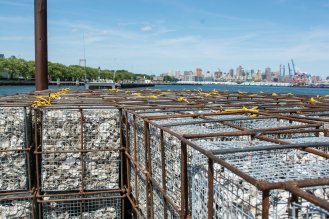
The shells are trucked over to Brooklyn’s Greenpoint neighborhood and once a month are brought en masse to Governors Island in the heart of the New York Harbor. Billion Oyster Project has collected more than 1 million pounds of oyster shells so far. Courtesy of Agata Poniatowski

Across New York City, more than 70 restaurants are tossing their oyster shells not into the trash or composting pile, but into the city’s eroded harbor. It’s all part of Billion Oyster Project’s restaurant shell-collection program.

The journey from trash to treasure begins after an oyster half shell is turned upside down and left on an icy tray. Once discarded, it joins hundreds of thousands of other half shells collected in blue bins and picked up (free of charge) from restaurants five days a week by Billion Oyster Project’s partner, The Lobster Place, a seafood supplier. The shells are trucked over to Brooklyn’s Greenpoint neighborhood and once a month are brought en masse to Governors Island in the heart of the New York Harbor, just yards away from both Brooklyn and Lower Manhattan. There, rolling shell hills sparkle in the sun while “curing” out in the elements for one year, a process that rids them of contaminants.

zadies_morganioneyeager-231_custom-8561dab3ee768ba35d5c28f16d698c2144cc7889-s1400-c85

Oysters at Zadie’s Oyster Room, one of the New York City restaurants participating in Billion Oyster Project’s shell-collection program.
Courtesy of Morgan Ione Yeager

The shells then get a final cleaning and are moved to Billion Oyster Project’s hatchery at the Urban Assembly New York Harbor School, a public high school on Governors Island that offers technical and vocational training in the marine sciences. In an aquaculture classroom’s hatchery, student-grown oysters produce larvae in an artificially induced springtime environment. In one to two weeks, each larvae grows a “foot” — a little limb covered in a kind of natural glue — and then is moved to a tank full of the “cured” restaurant shells, which serve as anchors for all of those sticky feet. This phase is critical: If larvae can’t find a place to attach, they die. One reclaimed shell can house 10 to 20 new live oysters, depending on shell size. Continue reading