John, Justin and I have been at the Windsor Research Center for a day and getting ready for our first five or six day trip through Cockpit Country. Every single Jamaican we’ve met so far has been super friendly and helpful. We won’t be able to update as much as we’d like but hopefully every week we can send out one quick post. If you don’t hear from us though, it’s likely just because there’s some wind hitting the leaves that are reflecting the signal that the antenna here picks up and plugs into the desktop they use at Windsor. Continue reading
Smithsonian Institution
A Word About Our Partners

Research trips, especially international ones, take a lot of money to organize and execute properly. There’s flights, gear, accommodations, food, and other logistical or supply costs that add up to a hefty sum, and field scientists can rarely afford to foot the bill themselves. That’s where large, well-funded organizations like the Smithsonian Institution come in. The coordination and leadership of a museum and research body like the Smithsonian, paired with additional support in the form of grants or gear from other groups, is what makes a successful research trip possible.
For our Jamaica expedition, we’re Continue reading
The Golden Swallow Expedition

From left: Justin Proctor, Seth Inman, and John Zeiger.
It’s now been several months since we last shared any news on the Smithsonian Institution’s expedition to search for the Golden Swallow (Tachycineta euchrysea) in Jamaica, where no sightings have been reported since 1989 — and even that report is a little questionable. While the Hispaniolan subspecies of the Golden Swallow is labeled as vulnerable, the Jamaican subspecies is labeled as critically endangered and possibly extinct, so this research trip is designed to lend some more finality to the issue. If our team of three positively identifies a Golden Swallow in Cockpit Country or the Blue Mountains between mid-January and late March, it will be the first confirmed sighting of the species in Jamaica in several decades, and new conservation efforts might be kick-started into action. If during our pair of one month trips to these two isolated areas of Jamaica we don’t see any signs of the Golden Swallow, the ornithological community can move a little closer to declaring the Jamaican subspecies of Tachycineta euchrysea extinct.
Golden Swallows, Jamaica Expedition
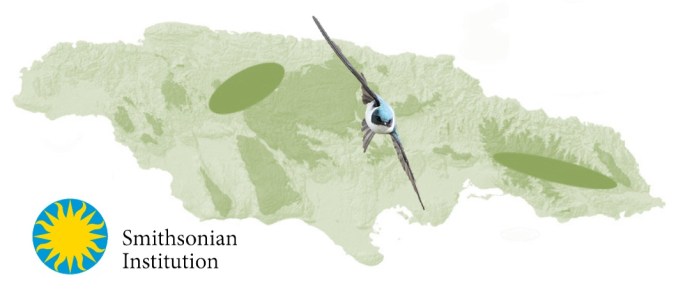 It was in 1844 that English naturalist Philip Henry Gosse arrived in Jamaica for his first time. Gosse would ultimately spend 18 months on the island, where he became fascinated in studying the local birdlife he found there. After returning back to London, he went on to publish a book entitled, “The Birds of Jamaica,” in which can be found the first formal descriptions of many birds still cruising about the Caribbean landscape today. The encounters he had with one bird in particular inspired Gosse to write the following:
This exceedingly lovely little Swallow, whose plumage reflects the radiance of the Hummingbirds, is found, as I am informed by Mr. Hill, in the higher mountains formed by the limestone range of the very centre of the island, as in Manchester, and St. Ann’s. It is not until we ascend this central chain, that we meet with this sweet bird, occasionally in the more open dells, but principally confined to the singular little glens called cockpits.
In this passage Gosse speaks of the Golden Swallow, a small passerine that has only been historically known from two islands, Hispaniola and Jamaica. And while populations of this species continue to persist in several mountain ranges of Haiti and the Dominican Republic, the beautiful bird that Gosse describes in his Jamaican travels has not been seen on that island for more than 25 years.
Science-Education-Technology Convergence
Museums and libraries are the stewards of culture in many ways. They both offer us a place to go for quiet contemplation as well as dynamic discovery. Kudos to the Smithsonian for accepting new technologies with open arms and sharing it with their researchers, curators, educators and conservators, and thereby with us.
A Bird In Hand….
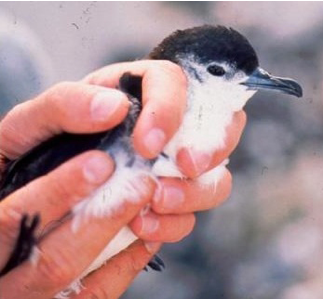
Some fields of scientific study rack up an astounding rate of new species discoveries annually; think entomology as an example. But ornithologists are currently more likely to be subtracting species than adding them.
But last year Peter Pyle, a sharp eyed scientist at the Institute of Bird Populations noticed something amiss while studying a group of pelagic bird specimens in the Smithsonian’s collection from 1963. Pyle’s theory was strong enough to merit a DNA study and it was discovered that the small bird had been misidentified as a Little Shearwater. The analysis was correct and the bird was given the name Bryan’s Shearwater, Puffinus bryani. Continue reading
Ecological Adventure Careers
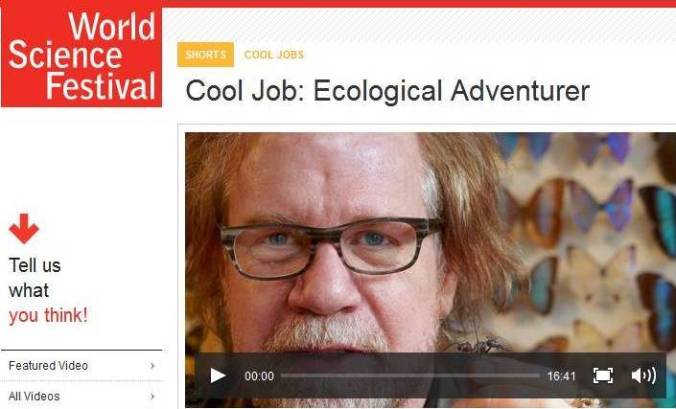
Click the image above to go to the location of this video featuring ecologist and explorer Mark Moffett who
has trekked across the globe to find his stories and capture them on film. Just like the creatures he photographs, Mark can be found crawling in the dirt or clinging to the tops of trees to get that perfect shot. Joined by a scaly friend, he shares his breathtaking work, urging all of us to go out and find stories of our own. Continue reading
 Organikos