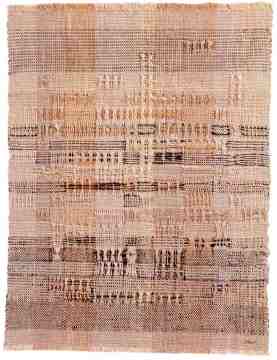
“Development in Rose I” (1952).Art work by Anni Albers / Courtesy © The Josef and Anni Albers Foundation / ARS, 2024
Weavers got more attention during our seven years in India, but we are no less interested in the tradition today. Thanks to Jackson Arn, writing in the New Yorker, for this review:
Anni Albers Transformed Weaving, Then Left It Behind
Her textiles are quiet revelations, but even her later prints show how restraint can generate ravishing beauty.
Imagine you’d been born in 1899. Imagine living through the invention of the Model T, the jet aircraft, the liquid-fuelled rocket, and the computer chip. Now imagine looking back on all this in 1965 and writing, as though with a shrug, “How slow will we appear some day?”
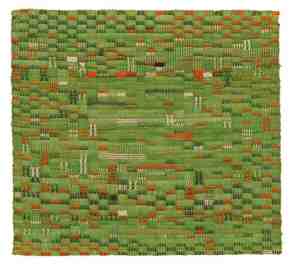
In works like “Pasture” (1958), texture and almost-patterns create an overwhelming experience.Art work by Anni Albers / Courtesy © The Josef and Anni Albers Foundation / ARS, 2024 / © Metropolitan Museum of Art; Photograph by Peter Zeray
It takes an uncommon turn of mind to survive decades this dizzying and then sum them up with perfect nonchalance—but a lot of the greatness of Anni Albers lay in her ability to stay undizzied and keep doing her thing, year after year. Not that she was afraid of innovation; her thing just happened to be weaving, an art form that, by her own calculation, had not changed in any fundamental way since the Stone Age.
Critics reach for a few key words with Albers: “crisp,” “precise,” “mathematical.” Continue reading


 Organikos