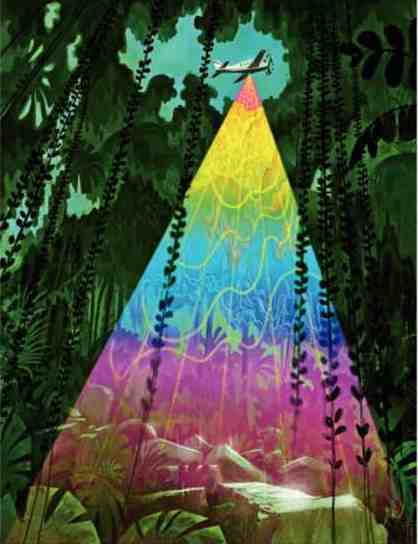
Another great article (click the image to the left to go to the source), complementing this recent one from the New Yorker, about one special location within the region several members of Raxa Collective have called home for most of the last two decades:
The rain forests of Mosquitia, which span more than thirty-two thousand square miles of Honduras and Nicaragua, are among the densest and most inhospitable in the world. “It’s mountainous,” Chris Begley, an archeologist and expert on Honduras, told me recently. “There’s white water. There are jumping vipers, coral snakes, fer-de-lance, stinging plants, and biting insects. And then there are the illnesses—malaria, dengue fever, leishmaniasis, Chagas’.” Nevertheless, for nearly a century, archeologists and adventurers have plunged into the region, in search of the ruins of an ancient city, built of white stone, called la Ciudad Blanca, the White City.
Rumors of the site’s existence date back at least to 1526, when, in a letter to the Spanish emperor Charles V, the conquistador Hernán Cortés reported hearing “reliable” information about a province in the interior of Honduras that “will exceed Mexico in riches, and equal it in the largeness of its towns and villages.” The claim was not an impossible one; the New World encountered by Europeans had wealthy cities and evidence of former splendor. In 1839, John Lloyd Stephens, an American diplomat and amateur archeologist, went in search of a group of ruins in the jungles of western Honduras—and found the stupendous remains of the Maya city of Copán, which he bought from a local landowner for fifty dollars. Stephens explored scores of other iconic ruins in Central America, which he described in a lavishly illustrated, best-selling book; serious archeology soon followed. Researchers have since determined that, beginning around 250 B.C., much of Mesoamerica south of Mexico had been dominated by the Maya civilization, which held sway until its mysterious collapse, in the tenth century.
But the grand Mesoamerican cultures, which stretched from Mexico southward, seemed to end in Honduras. The regions east and south of Copán were inhabited by peoples whom early scholars considered more “primitive” and less interesting, and the jungles were so dense, and the conditions so dangerous, that little exploration was done. Nonetheless, rumors persisted of lost cities—perhaps Maya, perhaps not—hidden in rugged Mosquitia. By the twentieth century, these legends had coalesced into a single site, la Ciudad Blanca, sometimes referred to as the Lost City of the Monkey God.
Read the entire article here (subscription required).
 Organikos
Pingback: Lost Civilization, Collaborative Discovery | Raxa Collective
Pingback: A Few Thoughts To Close The Year | Raxa Collective