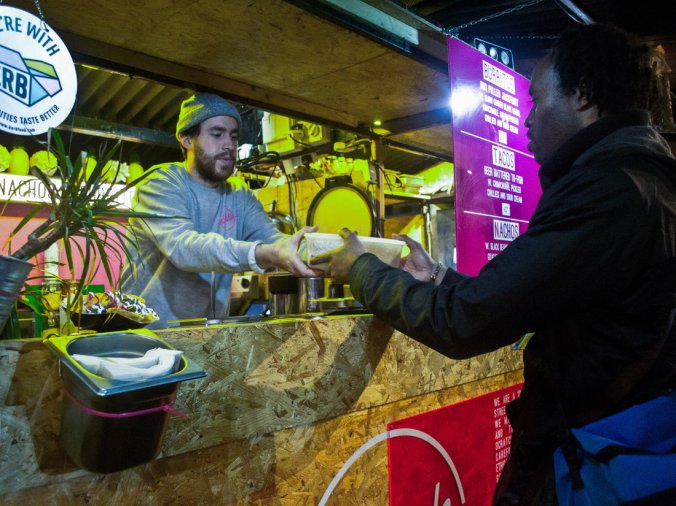
Junior Herbert, a volunteer with Olio, collects leftovers from vendors at London’s Camden Market. London has become a hub for apps and small-scale businesses that let restaurants and food vendors share leftovers with the public for free, and otherwise reduce the amount of edibles they toss. Maanvi Singh for NPR
Green entrepreneurship is alive and well in London (thanks to National Public Radio, USA, and its program the salt for this story):
Eat It, Don’t Leave It: How London Became A Leader In Anti-Food Waste
MAANVI SINGH
It’s around 6 o’clock on a Sunday evening, and Anne-Charlotte Mornington is running around the food market in London’s super-hip Camden neighborhood with a rolling suitcase and a giant tarp bag filled with empty tupperware boxes. She’s going around from stall to stall, asking for leftovers.
Mornington works for the food-sharing app Olio. “If ever you have anything that you can’t sell tomorrow but it’s still edible,” she explains to the vendors, “I’ll take it and make sure that it’s eaten.”
Olio wants to make it easy for busy food sellers to avoid wasting food. “These vendors usually don’t have enough surplus to donate to a charity or something, but they still end up having to throw away quite a lot at the end of the day,” Mornington explains. “So either I or some volunteers will come everyday to collect any scraps and put it on the app.”
In fact, anybody in London with a smartphone — be it a restaurant, grocer or just a regular Joe — can upload pictures of their leftover lunches and dinners, spare ingredients or unwanted produce onto the app. Those hankering for a free meal can then peruse the offerings, message those who’ve got food to spare and then go collect it — for free.
Olio is just one of many start-ups and small enterprises working to reduce food waste in London. When researchers at Trinity College Dublin recently launched a database identifying more than 4,000 food-sharing and waste-reducing enterprises in 100 cities around the world, they found that London — with 198 such enterprises — had more than any other city.
“We decided to focus on cities, because more than half of the world’s population now lives in cities,” explains Anna Davies, a professor of geography and environment at Trinity who led the research. City dwellers produce more than a billion tons of solid waste annually — and about half of that is food waste. But cities are also centers of innovation, Davies says. “So we were curious — what difference is technology making to the way we share food in cities?”
Quite a lot, it turns out.
Over the past three years, technology has transformed the way Londoners are approaching food waste, says Laura Hopper, the CEO of Plan Zheroes, a social network that connects charities that need food with local businesses that have a surplus. “We have so many organizations in London doing good work.”
Initially, the idea for Plan Zheroes came from Lottie Henley, a nonagenarian whose experiences as a refugee during World War II motivated her to do something about food poverty in London. Back in 2011, through a city-wide program designed to encourage green entrepreneurship, Henley got some seed money and teamed up with some techie types to design Plan Zheroes.
Now restaurants, coffee shops and small grocers that have just a little bit extra can use the platform to find nearby homeless shelters and food banks in need. The organization also recruits a small army of volunteers who help run food between the businesses and the charities.
“This isn’t a large-scale thing. It”s really about helping communities connect,” Hopper says. “Plan Zheroes fills a very specific niche.”…
Read the whole story here.
 Organikos