
Sugar kelp from Penobscot Bay, Maine. Photograph: Josie Iselin
We have featured the promise of various seaweed schemes many times, and we find it evergreen for further exploration:
Could I live and breathe seaweed – and reduce my use of plastics – for 24 hours?
Seaweed Day starts at 8am. Haunted by pervasive news that so many of our everyday habits harm our planet, I wonder how to minimize my personal use of plastics. I embark upon a day of replacing the microplastics that pollute our atmosphere, our water and even our bloodstreams.
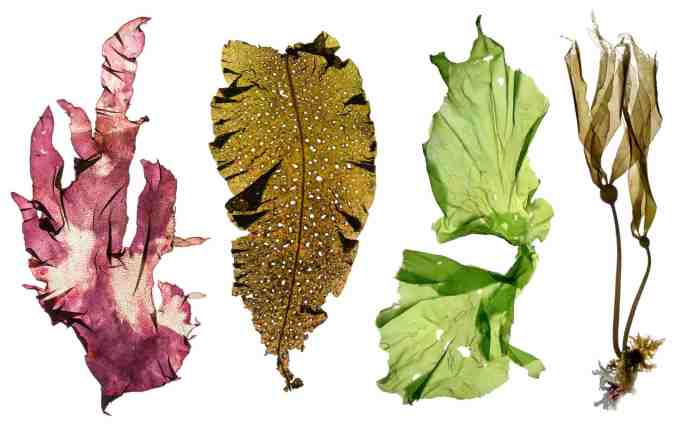
From left to right, Chondracanthus, Agarum, Ulva (sea lettuce), Nereocystis (juvenile bull kelp). Photograph: Josie Iselin
How much of my daily life can I accomplish with seaweed? Eating, washing, dressing? Armed with a budget of $500, I set out on a seaweed-based product shopping spree.
“Seaweed” refers to thousands of algae species; kelp is the largest subgroup. Scientists and entrepreneurs are exploring its seemingly limitless potential. Sometime in the future, they tell us, it will be a commonly used biofuel or supplant ubiquitous plastics, which wrap our food and weave through our clothing fibers. Seaweed cultivation has a long history in Asia, but more American and European companies are recognizing how a plant that requires little more than sunlight and seawater could change the course of many industries.
I’m all in to find out how seaweed can alter my everyday, from fashion and food to all other daily necessities.
But I’m already behind. Seaweed linens exist theoretically but not readily; they’re still in prototype stage. My search for seaweed toilet paper also proves fruitless.
It gets easier. My toothpaste uses carrageenan, a red seaweed used in processed foods and toiletries as a binding agent. Seaweed soap? Check. Seaweed shampoo? Check.
Seaweed towel to dry myself? I commit my second violation with a cotton towel…
Read the whole article here.
 Organikos